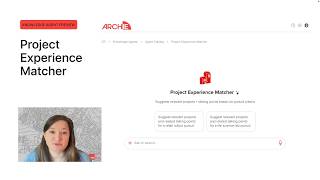
In this presentation Christopher Parsons demos a private‑beta of Synthesis Knowledge Agents, illustrating how AI‑driven agents can automate and elevate core AEC workflow tasks. He first shows a Project Experience Matcher that, given pursuit criteria (typed or from an uploaded RFP), instantly surfaces relevant past projects, complete with reasoning, eliminating the manual, multi‑step process of searching Deltek, folders, case studies, and cross‑referencing typologies. Next, he demonstrates a Scope Drafting Agent that ingests an RFP and, using a curated scope library, produces a tailored scope draft, shifting the question from “what should be included?” to “how can we make this stronger?” He then introduces a Firmwide Best‑Practice Codifier that scans Studio workspaces, identifies where practices align or diverge, and recommends standards grounded in actual usage rather than top‑down mandates. Throughout, Parsons emphasizes how these agents surface actionable reasoning, encourage data contribution, and make knowledge reusable across the firm. He wraps up with a quick view of additional agents built in a short time, expressing excitement about scaling this knowledge infrastructure to make collective expertise more accessible without replacing people.
Chapters
I am very excited to give you a special preview of Synthesis Knowledge Agents in action. The KA team has allowed me to start a private beta test of these agents and wow, do they unlock the next level for us. In this first example, I'm asking my new project experience matcher agent to match project experience to the criteria for a pursuit. In this case, I typed it in. I also could have uploaded the RFP to give it more context. So let's see how it works. Not bad. This is the kind of task that historically was incredibly manual. If you're lucky, you're simply filtering a project directory on Synthesis and extracting the information that you need. If you're like us, you are also pulling information from Deltek, searching folders and digging through case studies, asking around for more context and details, cross-referencing typologies and dates, et cetera. And it's not that any one of those steps is particularly difficult. It's just that there are a lot of them and they do add up, especially when we're talking about really specific experience types. I could tell you all of the life science labs that we've completed, but I definitely couldn't tell you every elevator that we've modernized. The other day we used this agent to find all relevant experience within a 50-mile radius of a specific site, which was a question asked in a recent pursuit. And that sounds simple, but if you've tried to do that manually, you know it's not. You would probably use AI to make a list of places within that radius and then run a report matching those locations to a field, and then you're exporting data and resorting it for your output. And here it's just answered. And it's not only answered, it's explained. And I think that is a really important distinction. You're not just getting a list, you're getting reasoning and information that you can actually work with. In a later case study, I'm also gonna talk about project data and enriching our project information database will absolutely supercharge this resource for us. In this second example, we're gonna draft a scope based on an RFP that we uploaded to the system. Historically, this is frequently a start from something and rewrite it process. You find a similar scope, you copy it over, you customize it, you adjust it, you fill in the gaps. So let's see what the agent can do. Here I'm uploading the RFP. And voilà. So what the agent is doing here is starting from a grounded base of knowledge, the scope library that we built out within our proposal language library, and then it is tailoring it to this specific pursuit. So instead of starting from a blank page or a scope from a previous project, we are you are starting from something that is informed based on that criteria. And so that's really changing the way that you spend your time. You're not asking, what should this include? You're asking, how can I make this stronger? And that is a much more high-value question. I mentioned earlier that we created Studio workspaces in part to respond to the diverse ways our teams work. That is absolutely true. But when we originally formulated the idea, we also hoped that it would help surface some areas where we could standardize firmwide. So this firmwide best practice codifier agent looks across how different studios are working with the grounding knowledge being our studio communities. And instead of forcing a top-down standard, it shows what's happening, where there's alignment and where there isn't. And then it recommends best practices based on that. And what I liked about this is that it grounds standardization in reality. It's not something that's theoretical. It's based on how people are actually working. And going back to that idea of starting from scratch versus starting from a draft, it is so much easier to get everyone on the same page when you have something like this drafted that says, hey, we took into account how each of you are doing this. How about we all do it this way? Rather than starting from a theoretical conversation that so often leads to a lot of circling around progress. This is a tool that allows teams to explore past work in a much more fluid way. And the possibilities here feel endless. You can look at really broad things like I've done here, facade strategies, or very specifically, we could dive into the minute details, something like a flooring material specification. And this is where internal marketing comes back in because when people can kind of see this kind of thing in action, when they can see how they can benefit from it day to day, it clicks. They understand why the data matters. They understand how it benefits them specifically, and so they're much more likely to contribute. As we wrap things up, here is a snapshot of some of the other knowledge agents I have created in a very short amount of time. I can't tell you how excited I felt about these things, and I have plans to build many more. I also can't wait to see how these grow and change our knowledge infrastructure. We have these tools and systems that allow us to capture knowledge in a way that is usable beyond the individual. And that is really the goal, not to replace people, but to make what we know more accessible.