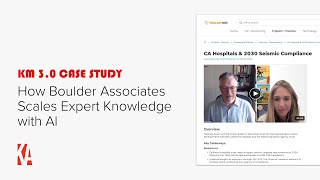
Christopher Parsons describes how Boulder Associates (a 250-person architecture and design firm in Boulder, CO) uses a KM workflow to scale expert knowledge. Todd Henderson interviews subject-matter experts (notably Darcy Hernandez on California SB 1953 and Emily Nightingale on Bluebeam), records and uploads interviews, uses AI to transcribe and summarize them, posts summaries to the firm intranet (Biscuitnet), and exposes that content to AI-enabled search so staff can retrieve both knowledge and the experts behind it.
Chapters
You we're going to talk about Boulder associates. They're a 250 person architecture, interior design and consulting firm based in Boulder, Colorado. Their intranet is called Biscuitnet for reasons I do not have time to explain today. At their core business challenge we're going to look at is this. How do you scale expert knowledge across the firm? On the left is Todd Henderson, Director of Practice Improvement at Boulder. And on the right is Darcy Hernandez, who is a principal at Boulder Associates with deep expertise in healthcare. Like many of your experts, she's super busy, highly billable, high bill rate, and she's in demand, both by her clients, but then also by colleagues at Boulder. Darcy has this critical knowledge around this California legislation called SB 1953, which is requiring seismic compliance for healthcare projects by 2030. It's a huge issue and many of the healthcare systems in California assumed the deadline would get shifted, but it hasn't and it's sticking. And so it's creating this urgency in California around getting a lot of buildings up to code really fast, which is real challenges for Boulder's clients. Right? There's financial pressure and logistical complexity and all kinds of trade offs that healthcare systems have to make. So Darcy is deep in the weeds with understanding not just what's published publicly about this bill and the compliance, but but what's going on behind the scenes to really make this happen politically, organizationally, et cetera, within these healthcare systems. So instead of asking Darcy to write something and kind of just share her knowledge, Todd on the left, who's the intranet champion and KM Champion, interviewed her on Zoom. He recorded the video, uploaded it to synthesis, which then automatically transcribed it. He then took that transcription out To Perplexity and ChatGPT, External AI tools to write key takeaways and summaries from the video, posted that back on the intranet, and now he's made that available to AI search. So it's this full AI trifecta, AI to transcribe, AI to summarize and build the page, and then AI to retrieve as part of search. So the AI part of this, I think is undeniably cool. But the part that's really interesting to me, even more interesting perhaps in the AI piece, is, is that I said before that knowledge management was about people, process technology and culture. And this process that Todd has pulled together is really, really powerful because asking someone like Darcy to sit down and write down everything she knows, it's unrealistic. Number one, she doesn't have the time. And number two, it usually doesn't work. Like it's not effective. We're trying to capture deep, tacit knowledge from Darcy. And that's why expert interviews like Todd did such a powerful technique because experts often don't know what they know. They can't imagine what it was like to be a novice. They don't know what they know is special. And so somebody that can act like Todd and be naive to the topic or pretend to be naive to the topic can really extract really deep, deeply buried kind of insights and assumptions and create really useful content. And it's also efficient for the subject matter expert. So Todd took this whole AI trifecta approach of the interview transcription summarization using AI and then making it available for retrie with Emily Nightingale, who is another expert at Boulder. She has deep expertise in Bluebeam, especially around its use in project management workflows. So Darcy, she's busy. It's hard for her to write down documentation from scratch. So Todd interviewed her, did the transcription, the whole thing. Super powerful. Okay, so what happens now? So I'll search on SB 1953 and I get a good answer that's citing the knowledge created in the interview that Todd did with Darcy. Right. And we can see that we're citation and we can point right back to that interview. It's also saying, hey, if you need further information, you may need to contact Darcy. So if you read this page but you still have a follow up or a more complicated interpretation of this, this is a good way to do that. How can we help clients comply with 1953? So not just what is it but okay, so what are we doing to help clients? And there we go. We've extracted information on that topic straight out of that expert interview that Todd did with Darcy. Or same thing with Bluebeaming. Right. So Bluebeam redlining, this is from that interview that Todd put together. Or if I want to know when should I use Bluebeam sessions versus projects again extracted out of that interview and it's comparing sessions and projects and telling you the pros and cons of each. Or I want to see who our Bluebeam experts are within the company. And there's our friend Emily Nightingale right there at the top. So again, whether I need the knowledge or to find the person behind the knowledge, this KM 3.0 AI search approach helps me do both.