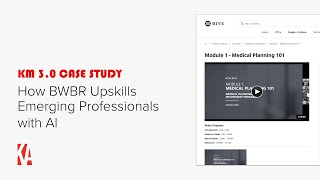
Christopher Parsons describes how BWBR, a roughly 200-person architecture firm in St. Paul, Minnesota that hired 70 new people last year, uses its intranet (Beehive) and a healthcare community of practice to onboard staff into complex healthcare projects. The firm has a Practice Hub with an 18-module upskilling series (Medical Planning 101, ED planning, imaging, etc.) that captures best practices and expert contacts (KM 1.0). Layering AI search over that content (KM 3.0) produces synthesized, cited answers (including timestamps) across documents, videos, and profiles, and also surfaces internal experts (e.g., Devin) to accelerate in-workflow learning and connections.
Chapters
So we're going to talk about BWBR first. They're an architecture firm based in St. Paul, Minnesota. They're about 200 people, multiple offices. A key challenge that they're facing is that they hired 70 new people in the last year. So many of them are working on healthcare projects, which I think many of you know are notoriously complex. Right? There's all this regulation and there's nuanced building types, there's tons of acronyms and jargon and specialized processes and equipment and room layout stuff and user types. It's a steep learning curve even for an experienced AEC professional, let alone somebody who's new to the industry and new to working inside an AEC firm at all. So the KM challenge at BWBR was how do we get 70 new people up to speed quickly in a deeply specialized knowledge area? And so I'll show you how knowledge management 1, 2 and 3 are making a big impact there. So BWBR's intranet is called Beehive. Most of our clients rename them. So you'll see in the upper left, it's Beehive. And so what we're looking at is a healthcare community of practice page on Beehive focused on healthcare. So community of practice, if you haven't heard the term, this is a knowledge management term, is a group of people who share a domain. So it could be a market, it could be a building type, it could be even a technical skill or a piece of software like Grasshopper. It's people that come together to share knowledge and learn from each other. So, so you have experts who are kind of sharing what they know and answering questions. You have novices that are trying to learn all this new material. They can ask the questions and they can also provoke a lot of change. So communities of practice are an old thing. I would wager that all of you on this call have been in a community of practice at one point or another in your life, whether you called it that or not. So this is a healthcare community of practice page. One of the things that community of practice has built is a healthcare upskilling training series. So you can see Here there are 18 modules on their intranet covering foundational topics like Medical Planning, 101. There are courses on emergency departments, clinics, surgical services, inpatient units, and so on. So this is really trying to cover that core knowledge needed to work effectively in this complex building type. This is what BWBR calls a practice hub. So it contains a ton of best practices on doing healthcare work, including this example which is a page on medical imaging, which is a highly specialized healthcare area. You can see that there's curated content and in the bottom right, an expert to contact if you've got a question. This is classic KM 1.0, capturing and organizing knowledge so other people can find it. But here's where things get exciting. We've layered AI search on top of all this content. The AI doesn't just do keyword search searching, it understands questions and it pulls the most relevant answers from across the Internet. So long form pages, videos, documents, social posts, et cetera. Instead of having to know where to look or who to ask, you just ask a question. And AI services the best pieces of knowledge across formats and time. So let's say I'm an emerging professional, right? I'm working on a healthcare project and someone mentions, or I get assigned to work on an on stage offstage layout and I have no idea what that means. So I go to synthesis, I type in the question and it searches through all the content on the Internet and generates an AI generated search summary. It's telling you exactly where it pulled that information from. You can see the citations at the end of each of these paragraphs. So in this example it's citing a video from that upscaling series that we saw before in that community of practice on ED planning concepts. It even tells you the timestamp, so it's minute 126. So, so if I were to click on that video, it would take me straight to that part of it. Or I'm an emerging professional, I'm hearing this term fgi. And if you're in healthcare, you know what FGI is. If you're not in healthcare, you probably don't. So what is this term? When do we use it? What is it? So I type in what is FGI and when do we use it? And there I've got a generated search summary from content we've seen before. An example, here's a document coming from one of those learning modules that we looked at or I'm an emerging professional. I've been asked to start working on an imaging suite, but I've never worked on one before. So I might ask what's important in an imaging suite. Synthesis generates an answer. And there are eight things here to consider. One of the things that I think is interesting here is if you look a little bit carefully at the end of each of these pull ups, each of these strategies or factors, you, you'll see that it's synthesizing knowledge from different people at different times. In different formats, all coming together to put the best answer that the firm has on that question. For example, the first citation is from one of these best practices pages on medical imaging. We saw that in the Practice Hub earlier. This one is coming from a video. It's coming from. You can see 1 hour and 14 minutes into this video on this video on hybrid operating rooms. So. So I just want to pause for a second and talk about what this means, what KM 3.0 means. And I want to take you back to the old days of search. And by that I mean like six months ago you would have done a keyword search on imaging suite layouts and probably gotten back 12 documents and 10 pages and seven videos, kind of in a grid on your page. Each of those videos is 30 minutes, 40 minutes, an hour, maybe longer than an hour, like this example. So what is an emerging professional supposed to do? Read all those pages, read all those documents, watch all those videos, like seven hours of videos to find an answer? We know that's not going to happen, right? So we've done a good job historically in knowledge management of capture and sharing, right? We've got really rich content, we've shared really rich knowledge. But where it's fallen down, and this is why I think there's such a golden era coming, is on retrieval. It's when somebody needs that piece of information in the flow of work, right? It was harder to retrieve than it should have been. But now AI search in this KM 3.0 era is changing all that. So it lets me, as an emerging professional, stay in the flow of work, get my answer and go right back to my project and start working. I mentioned before in my definition of knowledge management about connecting people to knowledge, but it's also about connecting people to people. And that's a big part of what we're trying to do in this KM 3.0 era. So thanks to those integrations I mentioned before, we have a lot of structured data about people, titles, bios, skills, licenses, certifications. But we also capture insights about expertise via that intranet content. So I was pointing out those contact blocks on those pages before where they said, this is the go to person for imaging suites, right? Or talk to this person about NICU design. Our AI search looks across both the structured content and the unstructured content to answer a question like who should I ask about NICU design? And just like that, you'll see it identifies two people in the firm who are the most likely. Go to experts, or maybe I'm asking who can help with infection Control design synthesis comes back with three experts. Right here I've got a link to Devin's profile so I can click on it. I can understand what she's worked on, get a sense of her background. From there I can reach out to her on teams, ask for help, whatever it is that I need. This is exactly what we're trying to do with AI. Not just connect people to knowledge, but connect people to people and find the right person, build a relationship, level up faster. And so when we're thinking about upskilling, especially in specialized areas like healthcare, this is a really important workflow to enable. So I just want to do another one of those flashback six months things, except thinking about connecting to experts. So what did it take to find the right person before AI search? I might send a firm wide email and hope somebody replies. Or maybe I post in teams or Slack and hope it reaches the right person. Or I walk around the office asking, hey, do you know who knows about infection control design? It's slow, it's disruptive, it's hit or miss, especially in multi office firms. You compare that to what we're looking at now is who can help me with infection control design. I just found Devin and from there I can connect with her and get going. So I'm thinking this is a golden era because this is a whole new way of working.