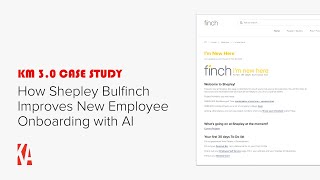
Christopher Parsons describes how Shepley Bulfinch, a ~200-person architecture and design firm with offices in Boston, Hartford, Houston and Phoenix, uses an intranet called Finch to centralize onboarding. Key Finch resources include an 'I'm New Here' page, a benefits guide, a seven-part 'Ropes Course' discussion series, a Standards Guide (file naming, PM, sustainability), staffing and project-role pages, voluntary working groups, and a learning catalog called Birdfeeder. Parsons emphasizes that while onboarding content is comprehensive, the real knowledge-management need arises when employees later search for specific policies, processes, tools, or people — for example, querying benefits coverage, work-from-home policy, expense submission, staffing procedures, membership of the Staffing Responsible Body, or who in Houston knows Affinity Photo.
Chapters
Shepley Bulfinch is a 200 person international architecture, planning and interior design firm with offices in Boston, Hartford, Houston and Phoenix. Their intranet is called Finch. And like every AEC firm, Shepley faces this universal challenge around onboarding. So the question is, how do you balance giving people enough information without overwhelming them? So during onboarding, there's a natural desire to share a wide range of information. Policies, benefits, org structure, key tools, firm history, culture. But new hires often struggle to retain it all. It can kind of feel like a fire hose of information, which you don't want to do, but on the other hand, you don't want to just throw them into the deep end and ask them to swim with no support and no context. So that's the tension we're all trying to navigate in all of our firms. Too much too early or too little too late. So Shepley has built a really strong library of onboarding resources. But the real KM opportunity, in my view, comes after someone is six weeks or three months or even a year in when they actually need that policy or that process or that person. How do they find it? So let's take a look at that. This is a page on Finch called I'm New here. And it's a page style that Shepley pioneered a few years ago. Since then, it's been shared within our KA community. And many firms on this call have adopted an I'm New here page. And the idea is that you give a new employee everything they need in one place. So orientation information, links to different groups within the office, how to get started with technology, where to find firm standards, and so on. So it's super thoughtful and practical and it's a great resource for new folks. The next page is a benefits guide, so it covers the kind of things you'd expect to see during orientation. Medical and dental insurance, 401k, employee assistance programs, wellness, and so on. This page is called the Ropes Course guide, or this is the introduction to the Ropes Course Guide. And it's a series of seven guided discussions that introduce new employees at Shepley to a broad range of topics. In architectural practice, There's a Design 101 orientation. There's a page about team roles and design phases. There's stuff about construction information and client meetings. So it's a really thoughtful way to understand how Shepley does things right and to tell people not just the what, but like the why and the how it's done at Shepley. The There's a Shepley Standards Guide this is everything from file naming conventions to project management, design standards, technical documents, sustainability, and so on. And again, it's not just the what, it's the philosophy behind the how, the why behind the how. And in each example, they've got key contacts listed. There's a page about project roles, which break down all the major roles and what's expected of people. There's a staffing overview page which explains how people get assigned to projects. The bottom of that is the staffing responsible body. So this is the group of individuals who are responsible for making staffing decisions. Working groups at Shepley are essentially voluntary committees within the firm. You can see there are working groups on a design exchange, Interiors, Revit, project management, sustainability, the technical advisory group. So each of these pages make clear what are each of these working groups, how can you get involved? Who's in each group? And finally, this is the course catalog for Shepley's learning and development program called Birdfeeder. There are recorded sessions covering topics like project management, design, technical skills, professional development, marketing, bd, et cetera. So it's a great way for new employees to get oriented on what's available, but then also start learning right away. Okay, so going back to the point I made earlier, Shepley's done, as you can see, an extraordinary job creating high quality onboarding resources. That said, we all know when someone gets four weeks or four months into their job, they start forgetting some of those onboarding details because they're human and they can only retain so much. For example, if someone wonders, do our benefits cover a gym membership with AI search, they can just ask the question and get an answer. And yes, we do, and it's cited from the medical and dental insurance page. Or maybe they started working at the firm and they were working full time in the office, but now there's been some kind of life change. And maybe they want to understand if they can work from home, or maybe hybrid or part time. They don't know. And so they can just ask, what's our work from home policy? And then get a clear summary of how it works at the firm. They didn't need to know this information when they're being onboarded, but now they want to know it. Or maybe expense policies were covered during onboarding, but they weren't on a project where they were going to submit expenses, so they didn't retain it. Why would they? But now it's six months later and for the first time they need to figure it out. So they ask, how do I submit expenses? And they get detailed instructions. Or maybe somebody joined the firm and got put on a project right away and that project's been running for a while, but now it's wrapping up, they're starting to wonder, well, how am I going to get assigned to my next project? And again, they may not remember that process works and how it went in onboarding. So they ask, how do we get assigned to projects? And they get a detailed summary that pulls together the firm's process for assignments, including working with the staffing buddy, coming from frequently asked questions, or how to maintain your baseball card, which is a Shepley tool for skills and experience and those kind of things. That was shared in a staffing update in a recent tower hall at 22 minutes in. Or maybe you might remember we talked about that Staffing Responsible Body. They just want to know who's on the staffing Responsible body. So they search for that and boom, you get an answer. And this is filtering the employee directory and returning the 12 people who are part of that Staffing Responsible Body or who knows Affinity photo in Houston. So Shepley doesn't use the Adobe suite. They use a different product called Affinity. Let's say a new employee in Houston is used to Photoshop, but now they need to figure out Affinity. They can ask who knows Affinity photo in Houston? And there we go. It returns Anna as someone with the right experience. And then I can just click on her profile, reach out on teams, walk over to her desk. Whatever it is, I can connect to the right person who can help me move forward with this new technology that I don't understand. It.