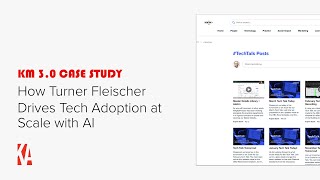
This content was created by Christopher Parsons. This content was uploaded by Christopher Parsons. This is a YouTube video titled "How Turner Fleischer Drives Tech Adoption at Scale" created on July 18, 2025. It features Christopher Parsons discussing the strategies employed by Turner Fleischer, a Toronto-based architecture firm, to drive technology adoption and knowledge management across the company. The video covers their use of design technology, microlearning, and knowledge management strategies to enhance tech literacy and innovation within the firm.
Chapters
I want to talk about Turner Fleischer and I want to talk about driving technology adoption at scale. So Turner Fleischer is a 250 person architecture firm based in Toronto, Canada. They've been very design technology focused for well over a decade. So they've pushed tools, they built tools, they built a DT design technology department. They're very tech forward, but, and I think especially the technology people, but anyone that's done change management can relate to this. It's one thing to have a design technology team building cool tools, knowing about cool tools, introducing cool tools. It's a whole nother thing to have those tools adopted and used on progress and to drive that change and that innovation across the whole firm. And so that's the business goal that we're going to explore. So from like a KM 1.0 perspective, Turner Fleischer has done a really nice job of capturing knowledge. So here's an example from their digital practice page that really gives a high level overview of the different resources that are available, whether it be about computational design or content creation or revit standards or visualization. If I drill into revit standards, I can see in the upper right, I've got key contacts to talk to about revit standards and then I've got a list of all the different resources that are available to me. If I drill in further into something specific like door family standards, you can see this page is structured around door parameters and different hardware schedules and door swing detail level. And it's just a very deep intranet with a lot of knowledge. And again, key contacts in the upper right, synthesis still includes a lot of that social intranet technology I talked about before that we added during the KM 2.0 era to support knowledge sharing. So an example from Turner Fleischer is they run a series called Tech Talks. These happen monthly, they get recorded and shared on the Internet. So this could be a new technology, they built a new technology, they're introducing to the company trends that are happening in the industry and they're recorded and shared on the Internet. So you're seeing all the posts with a hashtag TechTalks. So it's a great way to make this informal learning visible and accessible across the company. This is a video library on Newton. That's the name of their synthesis intranet called Etutor. Right. So you can see there are 374 of these little short videos, most of them around four to 10 minutes long. Each one focuses on a very specific task. So you'll see there are 10 videos here on ACC the Autodesk Construction Cloud. There's 11 on Bluebeam and so on. So these are a great example of what's called micro learning. Bite sized just in time content that helps raise tech literacy across the firm. I should point out in the KM 3.0 era, all these video transcripts are created automatically and are now searchable via AI. They also have a super robust learning and development program they call TF Academy. So what you're seeing here are the courses being offered in the current term. In addition to that microlearning on demand library we looked at, they're also running more structured in person cohort based courses too. So they're putting a ton of effort into educating the company on what it needs to know about these Design technologies from KM 1.0 to 2.0. So documentation, social sharing, microlearning in person courses. It's a wide range of approaches. They built a really solid foundation on these KM 1.0 and 2.0 strategies. So it's a great way to scale this expertise beyond just the DT team. So how has that set Turner Fleischer up for the KM 3.0 era? So imagine you're new to the company. You keep hearing this term BXP fly around, or maybe you've been at the company for a while, but this new thing gets emerged, it gets introduced bxp. So you're wondering what's a bxp? And you feel you should know, but you don't and, and you don't really want to ask anyone because it seems like they already all know. So you just look it up, right? What's a bxp? And you find out it's a BIM execution plan. And synthesis tells you not only the definition, but how we use it at Turner Fleischer. And then in addition, when we have that information available, we'll also include a note at the bottom that says go to Brent Mowdy for more information on BIM execution plans. So you not only get the definition, but a clear person to contact. Okay, so now I've been told, hey, hey, you need to go capture existing conditions on this new project that we've got. Cool. How do I do that? So I type in the question and AI search gives me a clear direct answer. If you look at the bottom, you'll see a link to the laser scan request form so I can take action right away. Or maybe I have to create a door schedule now. So I get back a bunch of different resources that help me guide me how to do it, including a video that comes from that Etutor library that we looked at before, the microlearning library. So whether I want to read or skim or watch, I've got a bunch of different resources here that are available to me. Maybe I am using Grasshopper and I've gotten going and I've gotten a little stuck and I'm looking for someone who can help me. So I can ask who's the go to person for Grasshopper? Great. Or maybe I have to use the laser cutter now for the first time with a project. And I've kind of watched the video, but I don't necessarily understand how to do it. So boom, we give you the two people that can help you with the laser cutter. I think this is an important point that I think Turner, Fleischer and a lot of firms have done a really, really great things, especially when they're doing innovative work. You've done great training, you've documented how things work, you've shared knowledge, but then it's two weeks later or two months later, or two years later, right. And they don't necessarily remember everything from the training because they're humans. Right? And that's where, just in time knowledge becomes really important. So when you go to a class, for example, it's oftentimes just in case knowledge. It's covering a lot of broad topics that help you understand context and what you might need to know one day, which is good. I think we should do that. Right? It lets people understand the art of the possible. But when someone actually needs something to apply to a project today, we also have to do just in time knowledge to make it available to them right. In the flow of work. So that's the power of km 3.0 in our view.