Kate Grimes & Chad Carpenter | Debating the Future: How Will AI Change How We Learn, Teach and Work?
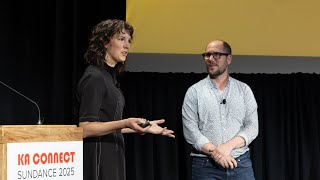
Transcript of a recorded conversation (panel/talk) between Kate Grimes (Director of Knowledge) and Chad Carpenter (Senior Project Leader, design technology) at Snohetta about integrating AI into architectural/design practice. They present contrasting positions—Kate urging a cautious, deliberate rollout and foundational training; Chad advocating active experimentation and early adoption—while agreeing on augmentation (not replacement), the need for documentation, guidelines, and targeted tooling (e.g., AI search, Claude-like chat models). They discuss concrete use-cases (idea generation/inspiration, learning scaffold, research assistant/internal AI search, computational translation/mesh generation, code augmentation) and implementation steps (publish guidelines, pilot tools, studio-wide foundational course).
Chapters
Indeed. Hi, everyone. Thanks for the introduction, Chris. I am Kate Grimes and I am the Director of Knowledge at snoheta in.
The U.S. yeah, hello. And I'm Chad Carpenter. I'm a senior project leader and design technology specialist, snoheta in the U.S. and, yeah, Kate and I have been working together at Snoheta for 13 years. I started a couple years before as a designer on the SFMOMA expansion and then recruited you to join as we were growing.
Yeah. So I joined Snoheta in 2012, and since then, our roles have evolved greatly, and Chad and I have different expertise and different backgrounds, but our roles have come to the point where we have a shared responsibility in the firm, and that is to offer direction about the role that technology plays in our processes. And specifically for this conversation today about integrating AI into our work.
Yeah, we get a lot of questions about what and how we're going to do, and so let's dive into it.
Yeah. So to that end, my role includes our information systems, our physical and digital assets, our procedures for knowledge sharing, and as it happens, I provide oversight for the IT department. I'm happy to say that Emmett, who's here with us this week, is managing it, but I still have a say in our software suite. So that is where I come in.
Right. And most of the time, I'm a project leader on projects. I spend my time designing and working with teams and figuring out things.
Go.
We often, and I'm lucky to have often been able to start on a project early on in programming or concept design and see it all the way through through construction. And that gives me a lot of interest in improving all different types of our tools. I have questions. Why are we doing it this way? How can we do it? I am an incurable early adopter.
He is. We thought it would be interesting to share our ongoing conversation with you because you've either been in our place before or you may be in our place now. And we're hoping that you can relate to our different positions in this conversation. Before we get into that, though, let's talk about Snohetta.
So briefly speaking, Snohetta is a multidisciplinary design studio. We have offices and projects around the country and around the globe. And a common thread among all of our projects is a value in process dialogue and material exploration.
Yes. And environmental and social sustainability are our highest priorities. And we design spaces that try to form connections between humans, natural habitats, and ecosystems. So I really think of us as humanists and that physical design is really pertinent to our practice. Right.
So fun fact about me and Kate, while we've worked together a long time, we've actually known each other even longer. We met in college and even then we were exploring questions about design and process, materiality and tools. So my thesis in grad school was actually a digitally fabricated pavilion, a question of craft and process and design, whereas.
I was exploring traditional handicraft and how I could use that to build conceptual sculpture.
So even still, we kind of approach things with our whole background coming to it. We are not just in our professional roles, but in our personal interests. I tend to approach things with a digital technology perspective, approaching that as a really valuable tool and a first place to start.
And I typically think that we learn with our bodies and it's important to take time to absorb everything. And so I still favor the manual processes in many cases, which may explain our different positions in this conversation today. My position is that we need to slow down. So the hype is all around us. We're hearing it every day. Every day in our inbox, at least three new tools are being announced that are AI driven. And so we're getting a lot of pressure to answer the question, how are we integrating AI immediately into our practice? And my answer is, slow down, let's be prepared. And to me, that isn't about the tools being ready, it's about us being ready for the tools.
Right.
And so I have a question for you. How many of you work for a firm that offered a foundational AI course before activating all the AI tools in your office? Interesting. Okay, well, I think that is really important. Before licensing all the tools and making them available company wide, I really want to offer a foundational AI course that helps to bring enthusiasts like Chad and skeptics, who we have on our team closer together and create a baseline of expectations. Both an expert, both the expectations that we have for our team members using AI and also our team members expectations about what AI can actually deliver or not. And I also want us to be able to engage thoughtfully in other conversations around AI, including the impact on the environment. We won't be able to answer it perfectly, but I want to be able to engage intelligently in the conversation.
Right. So my position is, let's go. I think there is a lot of value to understanding the way these systems work. They don't work the same, they are not deterministic. It is a different way of thinking about information and technology and our processes and tools. And the hype has some merit. There is a lot of value to be gained by being intentional and exploring and experimenting and finding ways where it augments and enhances our design process. So, and the other piece. Click. Is that it is happening. We live in the world where it is now becoming the way in which we engage with the information everywhere. It is in our little, little box, in Zoom, it is in Google. It is a thing that is important for us to understand and embracing it into our processes has already been something that we're experimenting with. And there's a ton of value in finding the places and where that is gaining traction and. And fits our process and priorities.
Right. And so in formulating this conversation here and as part of our roles in the studio, we've been talking about this a lot and we've been talking about where it is actually happening in our studio and trying to examine whether it's working or not. So where is it happening?
Yes, it's happening, I think in a bunch of places. Some of it's surprising to us and some of it familiar, probably to everybody in this room. To start with, I think we're looking at as an agent of inspiration. It is early in the concept process and it can help that.
Okay. And we've seen it used as a learning scaffold.
Yeah. And I think we've seen it used as a computational translator.
And perhaps most obviously, we've seen it used as a research assistant, especially for looking at our internal knowledge base.
Yeah.
So from the beginning.
Right. You know, I think at the most conceptual part of our process, where we're not really sure of it, there's a big question about how and where do you start? Where do the ideas come from? And this kind of this. It is a process of dialogue. Right. So I think that we've seen some promising traction here.
And I have questions here. This is one of the most controversial parts, I think. Are we using it for image generation? Are we using it to design?
We've tried. And in general, I think a way to understand it is that a lot of our early process really involves a kind of metaphorical thinking and dialogue and questioning. We're trying to figure out what is the ideas that's going to drive the narrative, that's going to create the spatial or emotional connections and conditions that we're pursuing. So it's maybe an image like this metaphorical take on baths and a sketch about proportion and movement. And that leads to further questioning and further testing. It's an open ended brainstorm.
Right. And as a former conceptual artist, this speaks to me because I like that it Asks more questions than it answers. Yeah.
So when we tried, it looked like this. Yes, sometimes. Which is on the surface, maybe not.
Bad, but I disagree.
Well, I think that's the thing, is that it's surface level, it really quickly hollowed out the conversation. The images are perhaps brought forward by a design team member as a provocation meant to be intended in the same metaphorical way as a precedent image.
These are no longer metaphors.
Right. They're taken literally. And they're also not something that we're really fully in control of. This is not a place where we see it gaining traction. We tried it. Everybody thought it was a natural fit. It in fact becomes hollow.
Right. So we've actually seen people back away from using it as image generation, and our concept boards continue to look more like this. None of this is AI generated, Right.
It's a process of dialogue and brainstorming, discussion, testing of ideas. It is still the same question of what if it was like this here and there? I don't necessarily know where and how this is improved by having a photoreal image that is added to this.
Right.
There's a lot. There's a wide world already.
But where is it being used as an agent of inspiration, if not there?
Right. So when we talked to some designers who were really pushing this, they kind of had a really great quote. I don't use AI for design. I use it to generate ideas.
Very fine line. Right.
So what's meant there is in fact that it's part of the brainstorming process, but. But not the proposing process. It's not doing the rendering or the sketching. It's part of the idea generation. Very similar, I think. Todd, I loved your description of, like, you go for a run and it unlocks something. Right. And so there's this dialogue that it is able to engage in that is intentional. It is something that you have to work at, but it generates a field of ideas. Right. And some of them come from a designer, and some of them come from the dialogue itself. But they generate new excitement to bring back to the team to put together a mood board or a concept narrative or a series of ideas to then build a design around.
Right. And so the conversation that we had with some of our colleagues who are using it in this way, they showed us their process of prompting and escalating and prompting and escalating. And ultimately, here's an example of something they created. Again, no AI generated images here. This is. It comes directly from the dialogue that they were having with the AI. Right.
So AI in This case is another voice in the team, not a major one. I think perhaps there's a maximalist out there that is really trying to get it centered. But in general, what we see is that it's there, it's available when you are. Right. I think the person who we were talking to was actually very clear. She was like, actually I have a really long commute. This is great for me to brainstorm or while I'm thinking about the day ahead. Right. And so ideas come at all times and this is a way to capture it and bring it forward and find something interesting to contribute to the team.
Right. But I had to ask, how did she learn to prompt AI in that way? She seemed to make it very easy. It was like second nature to her.
Yeah.
And I'm not sure that happens for everybody. How did she learn to do it?
Yeah, well, we all learn differently, but I think when we talked about it, she learned much the same way I've learned, which is by experimentation. You just dive in, you figure out how it works, you read a little bit about it, you see what works for you, the way you like to use it and what you can get out of it. Learning by doing.
All right, But Chad, that doesn't work the same for everybody. Fair. I think it is a misunderstanding that that is the way that we learn AI and that in fact, as an organization we have a responsibility to create a more consistent foundation and invite everyone to come to the table and learn from each other and invite skeptics to talk to enthusiasts like you and get some hands on experience that help everyone meet in the middle.
Yeah. And I think actually engaging in that conversation also helps everybody see potential that they might have discarded because they had a different expectation about what it was for. Maybe they thought it was going to do their renderings for them.
Not in our office.
Well, and it doesn't work.
Yes.
But it is really useful for learning in general as well. So how to learn AI, but also how it can teach us other things.
Right. Yes. And so you have an example of it being used as a learning scaffold in the course of image generation.
Yeah. And so in this case it's actually a. We had a team. We do a lot of form finding, we do a lot of kind of questioning of what sort of space, proportion or geometries might work. We had a team that was interested in this minimal surface, a little tricky, a little bit counterintuitive to understand. And the way in which AI helped here was to help figure it out.
Yeah, but I'm not sure that was necessary because as we talked about at the beginning, we designed physically. And I would have told someone to just go into the shop and start experimenting with materials, maybe talk to a colleague.
Right. And I hope that they might have tried that. But oftentimes what happens is you're pursuing something that the challenge of learning it one way actually prevents you from even exploring it. So in this case, what I think actually happened is attempts to try and model it either in the shop or manually, quickly led to maybe I don't do it at all. Or we use this tool. And this tool, I'll explain a little bit about how it works. This is a, takes a 2D image. This looks 3D, but it's just from a website, the one you just saw. And it actually analyzes the light, the shadow and the edges and makes a 3D mesh approximating that shape. It is not accurate, it is not actually what we want, but it is close. It's a way to three dimensionalize a 2D image that lets you then take that mesh that it makes and analyze it, Cut a section, look at it, spin it around, draw through, trace it and modify it. And then with that analyzation, you're in 3D space and you can then build your actual structure, your actual surface that you can then aggregate and modify and incorporate into a design process and turn into a part of your project, or at least evaluate it successfully as a team for its potential.
Okay. And I can understand this. I know that ultimately you took this and aggregated it into a model. You were repeating the module and you probably, probably couldn't have done that with a physical model. Nevertheless, I do wonder if this becomes the dominant way that our team is learning to draw and model, what will we lose?
Yeah, I think that's a really great question and one that I think we are going to have to keep asking. I think there's this quote that resonated really strong with me. Marshall McLuhan said, With every augmentation there is an amputation. And I don't know the answer to how this will lead. And I think the thing that I really wanna stress and I've heard from the teams is that the value here is in learning how to do rather than having it do it for us.
Right.
So that is a tricky thing to maintain. But that's right where we're at right now. And that's what I'd like to encourage.
And that's why I think it's important to slow down and talk about it. We need to talk about how the technology is going to intersect with our process and. And affect it. I remember recently that we had an experience where we didn't do an adequate job of that. And that was when you and others came to me years ago and asked me desperately to flip on all the switches for the real time rendering tools.
Yeah. These tools swept over the studio and the industry like wildfire. We traded knowing the Byzantine menus of V Ray for an almost as good, quick real time render. That really changed so much of our practice.
Yes. And I went along with it without much conversation because I thought, oh, wow, they're going to save time. Maybe they'll actually use some of that time for knowledge sharing.
Right.
Did that happen? No.
We make a lot of images. It's true.
Just made more images, saving no time at all.
Right.
Yes. And so this is an instance where I feel like we missed the mark and we probably should have slowed down and talked more about how we wanted the tool to work for us rather than consume us.
Right, Right. It's hard for me to imagine how this could have changed. I see it firsthand, how it changed our internal processes and changed our client expectations.
One of the things that I've noticed is in the same time period since we activated all these tools and this happened is there has been a significant reduction in the physical modeling and hand drawing around our studio. Which is really sad.
Yeah. And I think I had not made that connection until we actually started preparing for this conversation. I had seen my own work changing, but also my roles. And it's just kind of part of a blur. But then with a little bit of distance, you see a challenge that we have of identifying good processes, good quality, and how to our tools kind of either pull us closer or further from it. So how might we kind of do it now?
Yeah. I think the blur comes from moving too fast. And I think stopping and taking some time to talk about it is a key thing. It's what we didn't do enough of back then. I'm happy that Emmett, who's in our IT department managing our IT department, actually started this series a while ago called the Snoheta Process and Technology Exchange. Spate or Spate.
Yes. I love these conversations. I think they're fantastic. I think there's a lot more that we can kind of grow into them. One thing that I love about them is that they're one of the things that it's hard to do, but it's really one of the special things that we've done that is not about project delivery. It's about curiosity, experimentation, play. We've explored topics that are really kind of at the edge of what some people do or something that are kind of the core nitty gritty of what everybody has to do, like 3D texture mapping or revit. Arcane weirdness or coding.
Yes, coding has come up more recently, and that figures into the conversation because you have, in fact, had an experience relatively recently where you had a project, you were using a lot of code, and in fact, the member of the team who knew the most about that code ended up leaving the team.
Yeah. So computational design and scripts, all types are part of our process. In this case, we had kind of gone quite heavy into a pattern that basically on each piece of glass, varied for the entire building. 1800 units, all with a full frit pattern all the way from edge to edge, and each one had to be computationally generated. So as we were developing the design, we used Python scripts to modify and tweak and manage our process. But then, like you said, we had team change. And as we moved from design intent to fabrication coordination. Right. The glass fabricator wanted us to provide artwork, full res for everything. We had a challenge. So that challenge really ended up being greatly solved by the use of ChatGPT, Python and C to manage the code base, to update the script when it ran into edge cases where it didn't work, to make sure that as we worked through the entire facade, we're able to make sure the process go. And in translating from Python to C, we really improved the speed, which allowed us to get the job done faster, which helped us a lot too.
So you used AI to bridge the knowledge gap, or did you use AI to replace that team member?
No, it was purely an augmentation of the team. Right. Definitely not to replace a team member. The new team that was taking it over was familiar with coding, but not great at coding. They were perhaps something that they had used early on in their career or more at school, and this allowed them to get a handle on something that was perhaps more complex than they would have come up with on their own.
Okay, that last part does give me a pause, however, because ultimately you've created this massive code file and you just admitted that there's no one on the team who's that familiar with this. What are you doing with this now?
Right, so there is a risk of vibe coding. Right. Like you end up with this thing that is doing a lot that you don't fully understand. Right. So in this case, I think what we're really trying to do is we're building a document or a tool set that is useful for one very specific case.
Right.
And the team is kind of developing skills at managing that.
Right.
And I think the main focus of our knowledge gap is on the intent, how does it work and why does it do what it does. Right.
Okay. Well, this brings me back to my point that I think we need to slow down and place even more emphasis on documenting our knowledge and our process so that we don't lose it as we use AI to bridge these knowledge gaps. I think we need to formalize our knowledge base.
Yeah. So, I mean, I think there's been some amazing examples at the conference this week about the importance of that, some great ideas about the feedback loops that we can do. So what are some things that we can kind of incorporate?
Right. Well, as you know, I have struck a bargain with you and other enthusiastic early adopters. Each time you come asking Emmett and me to license the. The latest toy, I ask that you experiment with a small group. So we license a few people over a short period of time. And the bargain is that during that period of time, you document your experimentation, you share it with others, and you discuss with the whole team how it can fit into the process meaningfully. If it does, and if it doesn't, then we back away from that and we don't end up going forward with it. I think it's telling that I've struck that bargain six times and this is the only post I've gotten.
I do owe you some.
Indeed. So I think that it is important to share the work if we're going to do the experimentation and be thoughtful about how it is fitting into our processes.
Yeah. I think one of the things that I'm optimistic about and excited to kind of keep doing this is that I think there's a role for AI to help us with that effort. We already document a ton. Right. These are often work products at this stage. These are kind of like deliverables that we have to do and we always have to describe the end product. Right. And so using AI to help explain it to each other seems like a thing that we could maybe leverage to help ourselves.
I can see that at the conference this week. In fact, just this morning, I think we learned from Jess how there are opportunities to, to use video and the AI tools to document the process in the course of work and then in fact, to retrieve that in the course of work through the AI search. So we are using AI search in beta on our synthesis based intranet, the guide.
Yeah. So I'M part of that beta and I love AI search on this. I find it super helpful. I'm very excited for how it kind of makes cognitive leaps about what you're looking for and what you might be interested in. I think it's super, super helpful when and why. Why haven't we turned it on for everybody?
Why haven't we turned it on for everybody? Yes, it's a good question because I am actually very enthusiastic about this tool and I have seen it used very successfully as a research assistant by some of the people who are testing it with us. And I have been delighted that you are delighted to. To find things that you didn't know were on our Internet.
Yeah, I think there's a genuine surprise when you're looking for one thing and then all of a sudden it makes a connection and you find something else that someone else was doing a project you weren't even really sure was there. You think it might be there and it becomes a habit. You're like, oh, well, I don't know where on the P drive it is, but maybe I'll start here.
Right? Yes. And so there have been some discoveries, but I still haven't answered your question. Why haven't we turned it on for everybody? And that is because there is also some confusing information on there. This is just one small example. But early in the testing I asked it a simple question. When did the Far Rockaway Library open to the public? And it couldn't answer the question because in fact the answer isn't there. But it did tell me that it took 99 years to open that building.
It did take a while, but not that long.
When I invested investigated that, I found that it was in fact going to the only source of information it could find on this topic, which was an all staff meeting in which someone cracked.
A joke and it didn't get the joke.
Didn't get the joke. And so this is again one representative example. But I have a number of these issues that I need to fix, that we need to fix together. And every bit of new content that we add requires us to add, add context and detail to make the AI search work well. And more importantly, we need to prepare our team to encounter this tool and to be thoughtful in receiving these results.
Right. And I can really see how internal resources are perceived as more authoritative than the Internet. And the confidence that a large language model builds into its statements makes it very hard for a perhaps new user or a young person, an emerging professional, to know the difference between fluff and.
Indeed and not to make excuses. But like many of you out there, we're a small team and I haven't had the opportunity yet to launch this foundational AI learning opportunity. So when we do that, I'll be ready to launch the AI search. In the meantime, as I said, I am thrilled that you are ready to dig into our files. Yeah.
I mean, the project teams are already deeply spend a ton of time diving through reference drawing sets and deep nested folder structures, trying to build on knowledge and decisions made prior. Right. This is already data that we have that is structured, it is contextualized. It's ready for kind of this type of interrogation. And I think we're gonna find a ton of value in content we already have as soon as we can figure out the right context to put it in.
Yeah, exactly. It may be contextualized, but I doubt it's contextualized enough for the AI search. So we'll have more work than the upload that made it look very easy. We're going to get there. But we do have more work to do. Yeah. So I think it may be clear that Chad and I don't settle on. Agree to disagree. In the 25 years that we've known each other, I don't know that we've ever agreed to disagree. Disagree.
It's more like these. A common thing that we didn't know was there that we find.
Yes. And that's what's happened over the course of putting this conversation together is we did actually start much further apart. Yeah. But now we have agreed on several things. Right.
I think we agree on the importance of everybody kind of having a reasonable expectation of how to use a tool and what it's for.
Right. And how we get there is by teaching everyone.
I think we also agree on the real opportunity to improve our practice, to improve people's understanding of what we all know and what work we've done before in the past.
And we agree that it is about augmentation, not replacement.
Absolutely.
And that it is about quality over efficiency. Yeah.
We're not trying to bring this tool into. You know, it's not a silver bullet that gets it done faster. It is a augmentation that improves things that were already processes that we're already in the midst of.
Exactly. When we first pitched this conversation, I really intended to take the hard skeptic stance. And I was going to be way over there.
Yeah. And I personally thought that it was much more capable than it was. I thought that as soon as I started really diving deep into all the tools that I'd be basically finding high value applications at every stage of the design process that we just hadn't really adopted yet.
But over the course of this process, I've discovered that I am more of an AI enthusiast than I realized I would be.
Right. And as for me, I've found that it actually, for our practice and our projects and our teams, its use is very high value in very specific ways and it's evolving, but it's not generally going to change everything that we do everywhere.
Exactly. We have put together an implementation plan of sorts and it begins with publishing our guidelines. And I think that that's an important place to begin always. We have developed guidelines about how we want our team members to use it and how we see it fitting into our practice. And so I want to publish those guidelines first and foremost.
Absolutely.
Yeah.
I think there's. We haven't really touched on it here, but there's really important topics around intellectual property, authorship and understanding how and when to draw the line and how and when it's encouraging people to ask questions of their teammates and be transparent.
Right. And those as well as some consideration for the environmental impact are all part of our guidelines.
Yeah, yeah.
The second thing that we plan to do is we've developed a short list of tools that we think are proven and seem to be successful at adding something to our process. So we're going to start licensing those tools.
Yeah. So I think there's really a place for encouraging a base level understanding and access to a chat model, a large language chat model. I think we're leaning towards a tool like Claude that has really clear accountability standards, very good writing standards, very clear structure and very intentionally doesn't mix what it's for. It's not an image generating large language model, it is for dialogue.
Right, right. And are we going to seek out an image generating model?
I think we need to really speed up our experimentation, but I think keeping that still as a wet and wear in the spate. Spate realm of curiosity as opposed to. Well, I mean, for example, one of the more popular image generators, midjourney really creates problems for us.
It violates our guidelines.
Right. It's just kind of baked into their approach of intellectual property that just isn't going to work for us. So we need to find ways to encourage experimentation and find out how and when, if that comes in, but not so much adopt it right now.
Right. That is the one that hasn't been proven to be that useful. But I think the lowest hanging fruit perhaps is activating the AI search across the studio on synthesis. And we're going to do that as soon as we design a foundational learning experience for the entire studio to get on the same page about our expectations for AI. Great.
I can't wait.
Amazing. We are Kate and Chad.
Please come find us afterwards. We'd love to talk to you if.
You'D like to break the ice. Talk to us about my dog or my cat. Indeed.
More from Christopher

Human in the Loop? Testing Our Assumptions About Where People Add Value in Learning | Todd Henderson

Redesigning Work for the AI Era: How Greenprint Turns Implicit Knowledge into Shared Intelligence

Designing Learning Like a Product: Branding, Culture, and the Unseen Work of Building an LMS

Scaling Design Excellence: How Diamond Schmitt Amplifies Knowledge Through Learning and AI

From Tame to Wicked Problems: Rethinking Learning and Development in a VUCA World | Ellen Bensky

Learning at the Speed of Change: Adapting L&D to Your New AEC Workforce | Kristina Williams

Designing Modern Learning Organizations: Rethinking AEC Learning Development in the Age of AI

The Link Between Learning, Motivation, and Career Fulfillment for AEC Professionals


Why Communication Skills Are Foundational to Teaching, Leading, and Adapting in AEC F

A Framework for Collaboration and Quality: SMMA’s ISO 9001 Journey | Ryan Farias & Jessica Smith