Knowledge Infrastructure is Never Complete in AEC
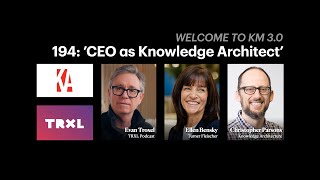
Podcast episode (Welcome to KM 3.0 series) featuring Evan Troxell with guests Ellen Bensky (CEO, Turner Fleischer Architects) and Christopher Parsons (CEO, Knowledge Architecture). The conversation traces Turner Fleischer’s KM journey: starting Newton (their intranet) around 2017 when the firm grew from ~60 to 250+ people, maturing KM into a strategic, culturally embedded practice (TF Academy, community managers, KM team, project coordinators) and integrating technology (ERP, OpenAsset, Power BI) and AI (ChatGPT) to simplify and maintain knowledge. Key themes: treating knowledge as evolving infrastructure/digital twin, prioritizing the "why" in documentation, embedding KM responsibilities into roles, managing pace of change and adoption, and linking KM investments to retention, client service, quality, and optionality for future innovation.
Chapters
Welcome to the Troxell Podcast. I'm Evan Troxell and in this episode I welcome back Ellen Benske, CEO of Turner Fleischer Architects, along with Christopher Parsons, CEO of Knowledge architecture, for the second installment in our welcome to KM 3.0 series. If you missed the first episode with Chris, that's episode 190. You can check the show notes for a direct link. While Ellen is officially the CEO of Turner Fleischer, I like to think of her as the Chief Empowerment Officer, especially after this conversation. Her role and that title immediately signals that this is not your average leadership conversation. Ellen has helped shape a culture that's grounded in trust, professional autonomy and long term investment in people, all while methodically evolving the firm's operations to meet the future head on. Turner Fleischer has been one of the true pioneers in knowledge management in the AEC industry. Not just investing in systems and technology, but building a living, breathing culture of learning, teaching and sharing. I became aware of this back in 2016 at an inspiring session led by Ellen at AU Autodesk University. Turner Fleischer was a much smaller team back then, and since 2017 their firm has grown from about 60 people to over 250. And throughout that growth, knowledge management has evolved from an informal practice into a fully fledged strategic priority deeply woven into the way they operate, innovate and grow. Under Ellen's leadership, Turner Fleischer has built an extraordinary knowledge management program, a dedicated KM team, a thriving internal university called TF Academy, structured mentorship and site visit programs, a vibrant intranet called Newton and and an open commitment to sharing knowledge across their teams and within the broader AEC community. In this episode, we get into what it means to intentionally work on the firm, not just in it. The three of us talk about how to operationalize innovation in a service based business, how Turner Fleischer protects time for internal research, and why Ellen believes that curiosity and empowerment are the real foundations of changes. We talk about what knowledge management at Turner Fleischer looks like today. The teams, the tools, the priorities. We explore how they got here, why KM became a strategic priority, what challenges they faced as they scaled, and how learning and teaching became part of their firm's DNA. From there, we talk about how AI is reshaping knowledge management and what opportunities Alan sees on the horizon. Along the way, we'll unpack some of Turner Fleischer's most creative programs and and we'll reflect on the powerful role knowledge management plays not just inside the firm, but across the entire AEC community. Ellen has been a Longtime leader, a generous mentor, and a passionate advocate for advancing how our industry captures, shares, and grows its collective knowledge. I'm so excited to share this conversation with you. So without further ado, I bring you my conversation with Ellen Benske and Christopher Parsons. All right, we're continuing our series on knowledge management. And in the first episode of this series, we talked about knowledge management 1, 2, and 3. And now we're going to go through some case studies. And our first guest is Ellen Bensky from Turner Fleischer Architects. Both of you, welcome back to the show. Great to have you.
Thank you. Great to be here.
Thanks, Ellen.
So, Chris, introduce our guest. Ellen's been on the show before, but many people may not go back four years to listen to that episode. It's been a while. But Chris, give us an intro and let's kick this off.
Yeah, I mean, we've, we've been really blessed to, to work with Ellen and her team for working, getting close to a decade now. And one of the reasons I wanted to bring Ellen on is to get the CEO perspective on knowledge management, but also a kind of a longitudinal study, you know, in terms of how much Turner Fleischer has changed over the last 10 years in terms of growth, in terms of kind of complexity of the business, but their investment in knowledge management. And I'm not, I'm not claiming that the investment in knowledge management is causal to the growth, but I think maybe Ellen would agree that knowledge was kind of a challenge and kind of a growing pain for you. It was kind of getting in your way, knowledge and sharing and communication. And your investment in knowledge management just helped ease some of that growth. Right. And the evolution of the company. And, and I would, I find it, and people in our community always find it really interesting that, that KM is being championed at the CEO level at Turner Fleischer. And maybe we can just start with why, like, how did you get into knowledge management? Why was it a really important thing for Turner Fleischer to invest in? And then why you personally leading knowledge management for the, at least for the first multiple years of Turner Fleischer's knowledge management journey?
Absolutely. I'm happy to tell the story because it's one I'm super proud of. And if I dial back to about 2017, we were maybe 60 people and we had a very, very strong culture. We were all in a, in a relatively small place. And when you needed something, you just yelled across, you know, hey. And you had a question. It was like, hey, Russell, can you answer that? Hey, John, what's the and that's how we worked. When we started to hit towards 70, 75 people, you, you couldn't just do that. And as we were adding more people and we were growing, we realized we actually did not have any of our knowledge written down. And so it was just folklore. And it got us to where we were. And I knew I needed an intranet and I started to try and have one developed by an external consultant. It didn't work anyway. Long story, search for an Internet. And I found knowledge Architecture and synthesis at Autodesk University. And I knew immediately that that was the solution that was going to allow us to start writing down some of this knowledge in these stories and help us grow beyond where we were. Little did I know when I got the platform, I was also getting an introduction into knowledge management because I didn't actually know at the time that there was a thing called knowledge management. We were just experiencing the lack of this thing. And so once we created our first round, first iteration of Newton, which is our intranet, we created hundreds, 400, 500, I'm not sure if I remember the exact number of wiki pages. We were just on a roll and in like a nine month period we got this thing up and we were like, yeah, this is good. And that was when I sort of started realizing the connection between knowledge growth, retention, everything. And so I started to dive deeper into knowledge management. Definitely facilitated by attending conferences and meetings and learning from other people that were in the knowledge architecture community and transitioned a person into what I decided was going to be a knowledge management department. My philosophy of growth in operations is always start with one, get it going and then add as you need. And we, we, we kept that knowledge growth as we grew as a studio. So we fast forward from 70 people with an intranet platform and we grew till 2020. In the pandemic, we went in at 125 and we came out at 250. So suddenly we had a whole different knowledge opportunity. And at that point I had a department of two or three people and we were keeping up our knowledge base as we were growing. But what I've learned is and is as you're growing, you have to continually re look at how you think about knowledge. And I think I definitely, Chris, to your point, because I'm the CEO, with my role and my lens, I'm able to really take the problems that I'm trying to solve as a CEO and I know absolutely the importance of connecting all operations in an AEC firm, but specifically knowledge. And so because I came to this in the beginning, it was easier for me to share the importance to my leadership team and then throughout my studio. And so the adoption of knowledge management as an integral part of our studio was definitely an easier mindset shift than I've heard and spoken with so many people who are trying to embed knowledge management into a company.
I think that's awesome. I mean, you said one thing I'd love for you. Actually, two things I'd love for you to kind of dig into. One would be you kind of understood that knowledge management was more than just an intranet or more than just technology. And I say all the time that, you know, kind of an intranet is to knowledge management what a website is to marketing in that, you know, yes, maybe, maybe the website is Grand Central station for marketing and an intranet is Grand Central Station for knowledge management. But there's a lot more, you know, kind of happening. And so I wonder if you can help us round out the picture beyond just an intranet for knowledge management at Turner Fleischer. And maybe this is at the same time, or a separate question. What are some of those challenges? Like you said, as a CEO, I understand what the core business challenges trying to solve are. What are some of those challenges you pursued by investing in knowledge management?
Absolutely. Two great questions I'll go through. The first one, it's been an interesting sort of dance between what is most important about the intranet in terms of culture and knowledge, and where do those two things overlap. And that was something that I learned specifically in the pandemic, because all at once, right overnight, we were all at home. And because by that point in time, our intranet was three, four years old. It was solid. And so we had a lot of knowledge in there, but we also had this cultural connection communication tool, so that was keeping us together, posting and talking and sharing. And never did I realize that we were going to grow to the size that we did. But then I realized that facilitating that cultural sharing during that moment in time was knowledge management because we had to add to our knowledge as we were adding to our people, especially in a remote way. Because as I was saying initially, Even though we're 250, we still have an open studio and we still do say, hey, can I know this? And hey, can I know that? Those moments when you're in person, we didn't have those moments. So we had to really dive into and we started to restructure our knowledge. What worked for us before in terms of our knowledge communities shifted the, the, the level of Detail we were going into in terms of guides and processes and workflows intensified because we had so many new people coming in.
So what's, what are some examples, Ellen, of like knowledge that you needed at 250 that you didn't have to have at 125 as an example.
I can talk about people in culture. Okay, so we bring in new people. How are they onboarded? How do they know how to be a member of our studio? We have a lot going on, so how do we share what is, for example, what is knowledge management? What is our digital practice? What are those workflows? How do you do a timesheet? Like, everything that you needed to know about the uniqueness of our studio became really important. And as, as, as we grew, those touch points to everything become naturally farther apart. So what does marketing do? Well, it might be obvious, but guess what, if, if I'm especially at home and I'm working with my project team and I'm not interacting with them at all, I need to be able to go to marketing on our intranet and understand these are the people in marketing and these are the types of things that they do. And so it really, then as we continued, I'll, I'll stay on marketing for a minute as we continue to develop our social media strategy. For example, how do, what is the intentionality of our social posts? How do people know then? How are they going to request a post? All of these things are found in our knowledge base on our intranet. And so it really is fascinating how it just goes hand in hand and we're at the point in terms of content that it's just a given. You create a new workflow, you create a new wiki page, a new piece of knowledge. You don't create anything without creating the knowledge. It's just a part of who we are and how we function as a studio.
So it's almost like a digital twin of the business, kind of. Right. So as you make a change in the analog real business, you have to keep the digital, like exact reflection of it up to date.
I love that, I love that analogy. And my CTO Brent, my partner, is going to love that analogy. We were just talking about it today, but about the digital twin and data and everything. And it is, it's a digital twin of our knowledge and it's, it's, it's ever evolving.
Yep.
And I think for me, that's the other thing that I know for sure and I've realized over this journey is that you think in a moment, in Time. You've got it right, Right? This is great. This. The way we designed our wiki pages, the way we've organized our knowledge. It's awesome. Now we can just like, stop thinking and move on to the next, you know, bright, shiny thing. But your needs evolve and the needs of the knowledge and the way the knowledge is shared evolves. And that's been a really important thing as we segued from post pandemic to now 2025. And we just looked at all of our knowledge and we just realized it's not doing it. It's not written, it's not displayed, it's not stated in the way that is going to resonate with our studio members who are living in 2025. And so we are now re looking at our entire knowledge base, which is like, overwhelming because you can imagine it's pretty well developed and we're redoing all of it piece by piece.
Quick question about this kind of evolution. And this something Chris said in the last time that we talked was like, knowledge is infrastructure. And then that, that to me, kind of, if you elaborate on that, it's like, okay, well, infrastructure needs to be constantly maintained. Right? And this is kind of what you're talking about. It's like we have to keep looking at it, we have to keep going back and we have to be critical. And something. Another topic that kind of came up, I guess, or a tangent to that is just this idea of expiration dates with certain things. I mean, it could be a lot of things, right? It's like processes, workflows, technology, tools, all that stuff. And so I'm just curious, how do you keep your finger on the pulse? Because like you said, it's so well developed, it seems kind of overwhelming. So it's overwhelming when you don't have the information, and then it's overwhelming when you have all of the information in there and then there's all the in between. Right. And so, like, obviously the incentive to me, if I, if I just had to guess is like the value that people get out of this. That's. That's how you. How people keep updating and keep going and like how it actually becomes this digital twin is through this kind of. I keep getting value out of it, and I will only get value out of it if I put effort into it. And how do you just step back and get the perspective of like, okay, we need to resurvey this. We need to make sure that this is serving everybody here now and, and for what's coming.
Yeah, that's a great question. And it's something that, you know, I'm extraordinarily passionate about in our industry, you know, rethinking the value of operations teams. And so typically, operations teams are seen as overhead that will crush your business, and so you should keep them as lean as you possibly can. And to me, my operations teams actually form the foundation of my business to allow my designers to focus on design, because I've got a very deep people and culture. Marketing, knowledge, management, learning and development, digital practice. And we work together, right? So trends that my HR team are seeing in our employee survey are letting us know where we're missing the mark in some of our communications and some of our knowledge. Our digital team is constantly coming up with new ways that we can enhance our workflows. Every time a workflow goes from one thing to another, you have to update your knowledge to stay, you know, recent with that, our marketing strategy, like, it's all connected. And because I've got leaders in every one of those areas who are talking and sharing and thinking, and they're doing all of that with, together with me. That's how we know when the time to look at it is. So one of the things, you know, I've talked to Chris about this, you know, a lot is in 2025, what, what, what's the new need? Right? The new need that we put together based on all of that information that we've received from our studio members and our work is people need simple, clear, intentional knowledge, and they don't have time, right? It's like they got to get it. They got to get out, they got to get in. And as soon as we all realize, like, that needs to be the focus, we started looking at our knowledge at our wiki pages, and we were like, whoa, there's too many words like, like we might be telling them what this thing is. Like, for example, like our social media page has a definition of what is social media? Well, everybody, if they don't know what social media is like, that's ridiculous. But what they don't know is what is social media to Turner Fleischer. And so putting the why into our wiki pages. So it's not just the what. And the what was good. The what served its purpose, but now our studio needs the why. And once they get the why, they need to clearly and easily know the how.
So you're kind of getting at people are what I'm inferring, and correct me if I'm wrong, is that people are busy and the attention spans might be shorter than they were five years ago, 10 years ago. So that's the kind of simplicity and clarity piece. What's the, what's the why piece like? Why are you. Why are you thinking that the why is so important in 2025 in a way that you didn't when you wrote the first version of your knowledge base?
From the feedback that our studio members are giving us, people are disconnected. No matter how amazing I think we're doing in communicating our why, it's not resonating and it's really interesting dichotomy because people love to work here because of the culture and yet we're missing the mark on the intention of a lot of what we do. And because we have so many different unique workflows to our studio, people are now seeing it as an added burden instead of a benefit that is going to enhance their own work because it.
Hasn'T been explained why it exists and how it helps them. And Turner Fleischer.
Exactly, Exactly. And something as simple as we talk about Power bi, for example, everything we do has an associated Power BI Dashboard. Those of us who work with Power BI and understand that it is an incredible visual tool to allow you to access knowledge and data easier. Our studio members gave us feedback that this was an added burden that we were now asking them to do. So then we looked through our knowledge database and we actually didn't have anything that told people what Power BI actually was for us. And so we're rewriting all of our wiki pages. The Power BI Dashboard is at the bottom. There's a Power BI wiki page now that we're creating. It's the why. Why do we use Power BI at Turner Fleischer? What is this getting you? So that it's not seen as an added burden, but it's seen as a. I want everybody to open those wiki pages and go right to that Power BI Dashboard because they know the why. So that's just one example. I could spend hours talking about a lot of those examples. And the interesting thing is, to us who have been working in KM for so long, we don't see it because it made sense to us. What we need to understand is it's like anything, anybody that's an expert in anything, it's hard to take your a step back and look at it through the lens of I'm someone that knows nothing.
You have, you have what we call the curse of knowledge in knowledge management.
Right?
Like you can't unsee, you can't unlearn what you know and it's hard to see it like a beginner again.
We have this. And, and honestly, like, with this project is so big and it's such a passion of mine. I'm like, I'm right in it and, and I'm a lot of the keeper of the writing and the brand voice and I love it. And I was just in a meeting today where my software developers created a wiki page on a new software that they developed, obviously. And I, I started reading it and I was like, I, I know that it made sense to them, but I know that it will never make sense to somebody who's trying to actually use it.
And you know, Evan, you and I talked about this in our conversation and Ellen, I think you know where I'm going to go. So I'm going to throw AI in for the first time in the conversation. I think we made it 25 minutes without saying AI. So, you know, kudos, good job. Kudos to, Kudos to all of us. You know who else likes context and doesn't know how? Turner Fleischer already runs AI doesn't know it. And so when you kind of take the time to write that the way that you're talking about, Ellen, and be simple, be clear, write it with a user in mind that isn't an expert, but a novice. Right. And then include context, like you're also helping AI to understand your content too.
Can I throw something in? There is. Because I see this a lot with AI tools is users are frustrated with it because it doesn't give them the right answers. And people are constantly testing AI to see if it will give them the right answers to learn if they can trust it or not. And guess what? Like, it's wrong sometimes when it doesn't have context. And it's like you have to approach it a little bit differently than the way that you're used to or the way you think that this tool should work. Right. And this is kind of the same thing, right. It's like, okay, maybe I come from a different firm into Turner Fleischer and I'm going to bring habits that I've developed from outside of Turner Fleischer into Turner Fleischer, and I'm just going to expect everything to work the same. Right? Well, that does happen a lot. Right. And from Turner Fleischer standpoint, like, you might have a lot of bad habits. You might have some great additions too. But you know, go back to your point about like, why does it matter and why does Turner Fleischer do it this way? That stuff has to be right at the top. Otherwise I go in with an expectation and I don't get back out of it. What I might think of as valuable and I don't trust it. And so like it all plays in together, this whole AI plus knowledge management.
And all these things.
But, but it's about context.
It's about. It's so interesting that you said like at the top because literally the design of our new wiki pages, the top of the wiki page is the why. And every single wiki page is going to have the why. And your point about coming into the company, it's so true. So a simple thing like, I don't know, accounts receivable. I'm doing a lot of work with writing out processes for my project managers. So project manager will come in and they will have done it this way at their other company, or maybe they didn't do it at all. And why am I making that them work with accounts receivable? Shouldn't that just be like an accounting team member doing that? Well, at Turner Fleischer, it's not. It's the project manager. And I figured that out 35 years ago. No client wants to listen to me in accounting ask why they haven't paid their bill, because we typically have very good clients and the reason they're not paying their bill has to do with something that happened on the project. And so I was forever saying, you know, hey, Peter, what happened on the project? Because I'm trying to explain it to this guy over here. And I was like, wait a minute, you talk to them directly. And so the new accounts receivable page is, why do PMs have to do accounts receivable at Turner Fleischer? And then you get into the contents of the page and then it shows you how. Right? Whereas if you don't have that context, you're thinking like, oh my God, I took this job and now I have to do this, this, this and this. And that's where the whole perception can come. There's too much structure, too many workflows, too bureaucratic, too right. But if you understand the why might, you know, you realize what we've put in place again to support people in doing their jobs and doing them more efficiently.
It's so interesting because, like, I think the parallel. I kind of can come back to this again. I think most people assume AI is like some kind of Oracle wizardy, super expert thing. And my view is you should write for AI like it's actually a very junior employee and it doesn't come with intern. You could, you should imagine it's an intern and you give it the context you give an intern and the same kind of thing. You're talking about the level at which we should be writing. Alan. But that the interesting point is like most people that write a knowledge management or they teach learning and development courses or whatever internal comms, like it's usually the experts or at least kind of more senior people or the person that knows the most about the thing writing it, but they're so far away from where that intern or that novice or the AI is that you almost need like someone to come back and user be like a tester, you know, to like see if they can comprehend it. Like you need like a junior level person to like read this and like, do I understand what this page even says?
You know, but this is exactly what we're doing and this is how we're creating the workflow to create all of these new wiki pages. Right. So AI is not writing these wiki pages from scratch. People are still writing the content. They're still putting their expert thoughts down in what it needs to be. AI is helping me bring it down to the level that anybody can understand it. AI is helping me to simplify the language. So I'm training AI to understand the level of simplicity and clarity that we want consistently across all of our knowledge. So people say, oh, AI is taking jobs away. It's not taking jobs away from me. It's going to allow us to get through this massive database of rewriting these wiki pages way more efficiently. But I still need the experts to review the process because AI does not know what the process is at Turner Fleischer. But if I needed to have everybody write the processes down, then I needed somebody else to literally write it and rewrite it for clarity and simplicity. Then I needed to have those people, the experts, review it and then I need to have a beta group see if they understand it. What I'm doing now is I'm compressing that iterative process of getting to simple and clear. But all of the other steps are still really important.
So you're letting an expert come in at 301 level or whatever it is, and you're using AI to be like a translator to just simplify it down.
Yep.
That is so cool.
Nice.
I love this. That's such a good use of. What tools are you using to do this? I'm just curious.
ChatGPT right now.
Yeah.
Yep. And it's amazing to do this and it. And it's really making this whole project, which we're just starting, we've been. We're like, we're just putting together the framework. We're taking a couple of our knowledge communities, our people and culture and our marketing to really dive in. First, we're empowering our community managers. So this is another thing. So for all of our knowledge communities, we have a community manager and they are responsible for ensuring that the knowledge that's shared within their community is current and relevant. And now we're adding simple and clear and we're empowering them with the tools to be doing some of this iterative process themselves. Because I would need like a dozen people in KM if I was going to take on a project like this to move through a database as quickly as I feel we need to move it, at least to hit the high priority. So, for instance, my people and culture team now, they're going through all of their knowledge pages, all the wiki pages, and they're marking high priority. And then they're going to say, okay, we're going to work through four and it's going to take us two weeks. And then they're going to start creating new wiki pages right in synthesis, in the sandbox, and that's going to help, again, speed the process up. So we're giving somebody the tools and the knowledge. And my community manager of people and culture said, him, he said, this is going to sound weird. In the intro meeting to this yesterday, he said, are you going to create a wiki page on how to create wiki pages? And I said, 100%. We've already got it in the works. Right? So that paragraph, what is the intention of that paragraph of the why other people can start trying to write it right now they're giving me bullet points of it and I'm putting it together. They can. I can empower them to do it for themselves. So then we'll have people embedded. It's embedded in their role. They're embedded in the teams. The teams are now empowered to own their own knowledge, and the teams are empowered to understand how their knowledge is being reformatted and represented to better impact our studio members.
So let's say Evan is in the design technology team and he creates some new tool that helps with shadow studies or something like that. And they want. And you want to get it added to your knowledge base. What's the new process? Do you interview Evan to get it out and then kind of dumb it down? Does Evan write a draft? I shouldn't say dumb it down. Simplify it Evan, you're so brilliant.
My explanation was way too smart, way too smart.
Let's kind of, for normal humans. So like, does Evan write first and then you guys review it? Do you interview and pull out of it? Like, how do you imagine that knowledge creation will work in this new paradigm?
Right. So right now I'll give you two like perfect examples. So my, my software developers just created a fee calculation platform module, whatever, they developed it. And so instead of our clunky Excel spreadsheet for us to create our fee proposals, they've literally created our own software to do it. So they wanted to beta test this out with project managers and project coordinators to, you know, get proof of concept and before we do a massive roll up to the whole studio. So they wanted to write a page to teach this beta group how to get in, how to create a project, how to add the time, like everything. And because that team hasn't been taught how to literally go into the sandbox and create wiki pages and they don't really have the same understanding of what we're trying to do. My KM team, somebody sat with them, interviewed them, got the intention, put together, the draft went back to them, they worked on it back and forth together. And then right now it was coming to me to do the sort of simplification process with my people and culture team because they've had more experience. And my community manager there, Jose, has had a lot of experience working in the sandbox, creating wiki pages. And he understands the intentionality because we worked through a few brand new guides. We did a role framework guide and we did a performance management guide. So they're a step ahead. So now they are actually doing the first step, which we've called discovery. So instead of having a discovery meeting with one of our KM specialists, they're doing their own discovery in their own department. They're going to create their draft guide, wiki page, whatever it is they're working on, and then they're going to meet with the KM team and review it at that point. So that's, you know, my, my end ultimate goal is that all of my teams will be able to do a lot of that discovery and draft layout work on their own. So then my KM team and my writing team and everybody else can really stay in their lane. And that's how we're going to tackle a project as big as this.
How do you get across to these people on these teams? How, how do they make the time to do this stuff? Because they're already totally slammed, right? Everybody Knows what it's like to work in an. Everybody listening to this podcast knows what it's like to work in an architecture office. And this sounds like a heavy lift informationally. Like, I have to put time into figuring this out, writing it down, breaking it down, revising it, doing all the. And that sounds like a lot. And, and I know that, like, there's an investment kind of angle to this for sure, which I would love to zoom out later, maybe about that from your CEO position. But. And Chris, yours too, right? Like this idea because you're looking across multiple, you know, lots and lots of firms across the industry. But how do you sell that value and, like, make it okay? I'm using my podcast air quotes right now. Like that it's worth. We need you to spend the time to do this. So how do you enable them to make the time to do this?
So, like I always say, and I've said it on many podcasts and as many conferences that I've spoken at, I have a very special superpower. And it's not because I'm amazing. It's just because of my two roles. So I'm the CEO and I'm the cfo. So I can have a great idea and I can ask myself if I can have the budget.
What does your other self always say, Ellen, when it's a great idea?
Some types of questions. Sometimes the questions. Yeah. And then I have the added layer that, you know, I'm an owner of the company. So it's like, okay, you take those three things and I've got to really, really believe in the value ROI of doing this. And. And because if we go back to what I was talking about, about operations, teams and overhead, we don't talk about utilization here. So these teams in ops that are doing this work, they don't have billable targets. So this is just their job. So my people and culture, generalists, it's written in his role that this is literally what he does is being the community manager on Newton.
Can you just say that sentence again? That had the word utilization in it? Just so I.
Just for the people in the back.
Just for the people in the back.
We do not track utilization. If you were to ask anybody in my studio what utilization means at Turner Fleischer, they would not know. And that's how we can do what we do. That's how come I have three software developers in my digital practice department who are making incredible workflow technology improvements to make us be more efficient again so we can pay more attention to the practice of Architecture and interior design and experiential graphic design. But you have to have that belief. And it's. And it's really hard because it's really hard to measure. Right? It's really hard to measure roi. I get this from people after I talk all the time. I get like, you know, a lineup of people that did what you did, Evan, and go, what? No utilization? Can you talk to my CEO, like, what are you doing? How do you deal with that? And I have to prove monetarily, dollars and cents, how many dollars this thing is going to save. It's really hard to monetize efficiency change.
Absolutely.
To that level.
But I'm imagining when CEO Ellen talks to CFO Ellen and pitches her on this massive project, you have a hypothesis of what is going to be different about Turner Fleischer when it's finished in the end of 25 or 26. And my guess is it goes something like, we're going to be more profitable, like we're just going to be more efficient at doing work. People are spending less time researching or hunting for things or not knowing how to do things, or making up some new version of a way to do things. That's my guess on kind of what your hypothesis is. It will translate to just efficiency and maybe employee engagement.
I just want to throw in like, I hope it's not just that. I hope it's not just efficiency, right? Because like, we're doing architecture and like going back to the whole purpose of Turner Fleischer at the bottom level and like, why do we do what we do? Like, I'm hoping it's more than just doing it faster, better, cheaper. Right? It's like, well, maybe the better part, maybe the better. But it's like, what? Yeah, I'm hoping that there's something in here because to me, like, that it really has to serve that greater purpose, which is like we, we really need to produce even better architecture than we've been producing. And I'm hoping these, this all help us get there.
Absolutely. And that's a big part of it. So yes, it's efficiency and everything, but it's a big part of it in 2025 is retention. Every time you lose a studio member, you lose a large investment in them. But it's. And, but, but it's also client relationship, right? Continuity and retention directly impacts client service. We're in a client service industry, right. That we're creating architecture and Absolutely quality. And so a lot, I mean, I haven't even talked about redoing our practice community We've got a team of leadership just figuring out how we're going to change the structure of the community. We're not even touching yet the actual content. It's how are we thinking about the architecture? Like the practice related knowledge. Right. We've been talking about people in culture and marketing, but the practice related knowledge is like really to your point, Evan, it gets back to why we're here and what we do. So we've already had six or seven meetings with a group of leadership going, okay, I think standards should be here. I think this like, or even the intention of our pages when we originally put them up around practice. If you looked at our like shop drawing review page, it literally taught you how to review a shop drawing. Well, I'm going to assume if you come here at any level, you have a basic idea and what we need to do. Again, if we get back to the why, how do we do shop drawing review at Turner Fleischer? Not how do you do, because I can lead you out to Canadian Handbook of Practice and all of these things. So that's a big focus. Because again, the ROI of all of this, to your point, Evan, for sure has to be the quality of our work and the success of our client relationships.
Yep.
And if we have members of our studio that understand what we're doing and how we do it and are happy to be here and stay, that all flows into the work that we do for the clients that we have.
Yeah. I mean, I think, I think it's fair to say, like when you're rewriting a wiki page on shop drawings, like, yes, it's true there is that you are putting a page on your intranet that shop drawings. But it sounds to me like what you're actually really doing is trying to get aligned on how we do shop drawings at Turner Fleischer.
Yes.
Because it's probably different in people's heads. Right. And so that's what this project actually is, you know, is getting aligned and on the same page.
Yes. And what the beautiful thing is is we have created such a culture of feedback and surveying that again, I got all this knowledge to make my decisions based on what our studio members told us. We're in our second year of an incredible employee engagement survey and the what we are learning is invaluable. And so there is a part of this whole process where we're going to survey people and we're going to say, hey, how'd you find these new pages? How do you find that, that, that, you know, the instructions for Our new the Calc app give us feedback and, and we can do Pulse surveys. We do Pulse surveys all the time. And so we're not just going to guess, did it work? Because we think it's going to work. We're going to ask people, is this better? And if it's not, how could it be better?
It's a really, really, I think treating. You're basically talking about treating your knowledge like a product. Yeah, in a way.
Because it is.
Right. And it is. Yeah, it is.
Yeah.
Your company's a product. Actually, you know, that's what we're talking about.
And I talked earlier about this kind of idea of this iteration. Right. But this feedback loop, like that whole maintenance process, like not everybody maintains the Internet. Right. Like there might be contributions and comments and threads and all those kinds of things. But like this feedback loop that you're talking about, I mean to be, to have it at that high level of like constantly getting that feedback so that you can iterate and improve. I think that's another critical piece that a lot of companies miss. Right. There's a lot of like throwing stuff out there and then hoping it sticks or hoping it gets adopted. And we all know like adoption, especially with new technology, because we're constantly bombarded with it, is incredibly difficult in firms, again, with people super busy all the time with the tools they already are using. Right. So that whole idea, I just want to put an underline on the importance of that. Continual polling for feedback and then taking that feedback and having a team that can take that and improve upon what they're putting out there. Super important.
Each community will be responsible for getting the feedback for the pages that they're creating. And again I go back to. Because it's in somebody's role, that's what they need to do. They take the job. It's part of their role. So we're not leaving it to chance. I mean, we used to. We didn't. We didn't. Well, we didn't even write roles until two years ago. So we were definitely one of those companies, like, oh, you should just know what you should do. I don't have a role. How am I supposed to know what I should do? So that was a whole year long project of writing a role for every single member of our studio. And so we baked it in. And so an interesting thing about how we're leveraging. So you might ask, okay, Ellen, that makes a lot of sense. People in culture, you've got somebody whose role it is that makes sense. Marketing. Well, what are you doing about practice? Whose role in architecture is it to do this? And so we used to have practice area leaders. Well, guess what, they're super busy people. And to your point, Evan, they are way more useful in a client meeting or pursuing new business than they are sitting here and crafting wiki pages. So we knew we had a need there. We created a role four year, five years ago of project coordinator. So I knew my project managers were too bogged down with administrative work. They're taking minutes in the meetings they're leading. There is something inherently wrong with that. And so multitasking works.
What are you talking. Everybody can do it.
And I still have some project managers that are like, I'm good. I'd rather do it myself. But I'm proud to say I have 25 project coordinators now, and they are absolutely impacting the project managers and the team's ability to focus on the architecture and not on the administration. And they're giving better client service because there's, you know, PMs are hard to find. Right. Client wants to get someone on the phone, they've got now a point of contact. Right. But we needed to create another role. When you have everybody in a role, well, they want to know what's next. So we just developed a senior project coordinator role and the senior project coordinator. The difference between the two is their viewpoint now is less projects and team, and they're starting to look across the studio. And so we baked the practice community into their role because they're in projects, they have at that point, once they become a senior, even though they're not architects. And this was a big stumbling block in this role. We did not hire architects as coordinators. We hired smart administrative professionals. By the time they get to the senior role, they know enough about architecture, they're going to be able to gather the information that's needed for these wiki pages, work with the experts, do the interviews, create the drafts, and get that process going.
I mean, it might even be a benefit. They're not architects, Ellen, because they can. If it's the shop drawing page we talked about before, if they've never done one, then they can ask questions like a beginner would ask.
Right.
In terms of how we're doing it and why.
Exactly, exactly.
That naivete is, is a, is actually a benefit when it comes to that kind of thing. Yeah. Going through that discovery that you talked.
About, I love how we're now keeping track. We're whatever number 50 minutes in, 45 minutes in, and we have talked about, I talk about knowledge management being people, process, technology and culture all the time. And we've talked about technology for like 5% of it. Right. Like we're right in the people, process, culture side. Because this is really the lift when it comes to doing knowledge management.
It is, because the technology, I mean, like I said, I've got 13 people in digital. Like, we're doing technology, like, but you know, we're where it relates to KM and where it relates to knowledge is now we're doing really cool things in connecting knowledge areas through technology. So taking our disparate systems and we've created a single source of truth for our data entry point and then connecting that back out to where we need it. So an example would be, you know, we're creating CVs for everybody constantly. For marketing, for business development. We do it through open asset. We're creating project sheets on all of our projects to put in RFPs and submissions. We're doing those in open asset. But everybody that's listening to this podcast at some point has either had a marketing person or somebody who's doing it 20% of their time running around behind people saying, how many square feet is that building? How many floors? What's the unit count?
I just turned her Fleischer. Ellen.
That's nobody else.
Yeah, it is. Oh, darn. So we're special. Okay.
I've never lived through that. Yeah, never.
So now we have, we have, you know, data entry points and user defined fields within our ERP system and project coordinators written in their role. It's their responsibility to make sure that those UDFs are current and updated.
What's a UDF?
User defined field.
Okay. Like a custom field in the erp.
Yeah. So you can make a custom field within our projects.
Yep.
And once we, once we realized that, it was like, oh my God, what can we make a custom field for? What kind of knowledge do we need to pull? And we've got like, every day somebody's thinking about another. I'll give you a great example because I'm super proud of this. So we're finally putting together a sustainability action plan. Right? Like we talk about sustainability, everybody talks about it. What do you do? I don't know. We're putting a plan together and we're actually making it happen. So how do we track success? So if we say we want 80% of our industrial projects to have this embodied carbon metric, let's just say, how do we track that? Well, guess what? We're going to make a udf. And so one of our embodied Car like, you know, window wall ratio. Okay, so now we have a, we're going to have a udf. Did this project hit the window wall ratio target? Yes. No. Now we can pull that data out and we can look at it in power bi and we can ensure we're hitting our targets. And that's just because we already knew we had these user defined fields and we were pulling this information. So all of that annoying marketing statistics from all of these projects are now in one place. They're going into synthesis, they're feeding our project data in synthesis, they're going into Open Asset and they're going to go directly into our new website. So that's the cool intersection of technology and knowledge that we are now. Absolutely. It's so exciting what this has unlocked. Aside from we talk about efficiency, duplicate data entry, bad data, how are you trying to find you spell something slightly wrong in one or two? We could talk about Excel spreadsheets, right? That's knowledge. We have all this project knowledge that all of our different teams are keeping in different spreadsheets. Your due dates or this or that. I don't know what the client likes for dinner. It's all in a, in a spreadsheet. And now we've linked Excel into, into Unanet. You put in the project number and you just tell Excel which fields to pull and boom, your spreadsheet is entered with all of those fields. Mind blowing. Yeah, like literally we just started doing this about six weeks ago. The difference already you ask Evan, how do you know? How do I know the difference in my project coordinators who had all these expo, their minds were just blown. They were like, what do you mean? I spend like hours entering the project number, the project name, the project manager, the client. Everything is now pulled. So Chris, that's your technology like super power here. And again, I can do it because I have software developers in my digital team, but I also, my knowledge management team is a big part of it. So they're brokering those connections, they're making sure that the connections. Right. So Marco was working directly with Open Asset to make sure that the coding was working so that we could pull information from uninet into Open Asset. So my director of finance is working from a financial perspective in our ERP to make sure we can access the information that we need to be able to access. So that's your technology knowledge.
Km But I have to imagine, you know, as I'm listening to this, like obviously the efficiency is compelling. Well first of all, just cool. Like I think most people listening to this podcast, like love Connecting, like the perfect system and everything flows in its magic. Like that's just like a really inspiring thing. But I'm thinking as like either an employee of Turner Fleischer or a potential employee of Turner Fleischer, like from an engagement or job satisfaction perspective to just not spend my time entering data in multiple systems or chasing data or hoping it's in here and it's not, or it's wrong. But instead it's like I have this really solid foundation of good data and systems underneath me. So I can just do what it is that I came here to do in the first place. Right. And I have to imagine that if you're in the company and you've worked somewhere else, you know that this is special and you can't imagine going back to when you had to work the old way. And I'm imagining you could start recruiting people based on like, look, look at how efficient and like empowering our. It's like a Iron man suit. Right? It's like, like if you come work here, like this is the kind of infrastructure that you have to work on top of.
Exactly. But I can take that right back to why are we changing our knowledge? And the way that we're presenting it is because there's a lot of people that don't understand the why. So we didn't have a great UDF user defined field wiki page that said why. So some people thought this was an added burden.
Right.
So yeah, you have to be telling them why? Why do I need to do this why? And sometimes, and it's. Sometimes we think the why is so obvious and yet you have to say it, you have to over and over people, over and over, and you can't get frustrated, you can't get. You just have to understand that again, coming into a studio like this, that has all of this, you know, it's incredible. I know it's incredible. A lot of your listeners will know it's incredible, but it can feel burdensome. It's like, hey, the last place I worked, all I had to do is show up. I didn't even have to do a timesheet, let alone a four level timesheet with detailed comments.
Right?
Right. So you have to tell them the why. So it isn't a burden and it becomes the superpower that it is. Right. Because it all sounds great. And you know, I'm not here to say it's all perfect either. Right. We still are definitely, you know, trying to ensure that all UDFs are kept current. It's a process. And then you don't just snap your fingers and say it's there. And every single project is going to be current all the time. Right, Right. So. And the, and the, the danger of connecting all of this is if you're believing your data is good and you've got it automatically going out to your website.
Yeah.
It has to be good. Right. So there's.
You raise the stakes. Right. Like. Yeah, like you've, you've changed the return, the calculation or the return on knowledge. Like, that single field now has a much higher return, but it's also. You've changed the risk profile of that field as well.
Exactly, exactly. Which is why people have to take it seriously and people have to understand it. And it's. It's kind of funny that we're, you know, talking about this, but we're doing a presentation at the AIA next week and we're telling this story, this single source of truth story and our ops and the whole thing. And I decided, you know, for an added. Why we're doing this presentation first for our entire ops teams. So Brent and I are doing it for the aaa. We're coming back and we're literally doing the presentation to our own internal ops teams first. And then we'll move through project teams and we'll do the presentation for them. Because we realized it's another great way to drive home that why if they hear us tell our story that we're telling externally, internally.
One thing that always ran up against was like, how people get information. Right. It's not the same for everybody. So you can't just post it on the Internet. You got to send out the email blast. You have to talk about it at a town hall meeting. There's so many different ways. Can you just talk about maybe the ways you get these kind of messages out to your team in this kind of repetitive but not redundant, you know?
Yeah. And this, this gets back to some of the programming that we have in place in our studio. So we do not. And I know, you know, there's a lot of different views on this from, from people who use synthesis, but we do not do email blasts. We've got rid of it. The minute we got synthesis, we got rid of email notifications. So if you don't see it on Newton, it's your responsibility. But we also back that up with town halls. We also back that up with. We have a thing called tech talks. So once a month, on a Tuesday, we have a tech talk. And so digital team gets up and talks about what's new and they'll pull up where it is on the intranet. So that's another way that it's. It's retold. We have our internal TF Academy, our internal learning program that is constantly teaching about how we do things, why we do things, the way we do things, and referring back out to where all of this is stored. We also have in those community managers in their roles is also a consistent stream of posting about pieces of content within their community. So they don't just go up on Newton and never get talked about again. There's reminders. Hey, remember, take a look at this work from abroad policy. It's summertime. We have a lot of people working from all over the world. Don't forget this page because it tells you everything you need to know before, during and after you go. So there's a lot of mechanisms in place. We've got. When we do a new guide, sometimes our like our people in culture, they just did this role framework guide. They went into team meetings and presented the guide in team meetings because every team has a weekly team meeting. So we'll, we'll use time during a team meeting to do it. We'll use time during a manager meeting to teach our managers about something new. That's big because it all comes down, everything comes down to communication. So you can have all the knowledge you want, you can have all of the places, everything. But if you're not communicating about anything, even about the practice of archetype, if you're not communicating, you're not doing anything well.
And that cadence of, I hate to say repetition, but like, not everybody's receiving the same thing at the same time. They're not open to it, they're busy. They weren't there. There's so many reasons why. And like that communication from the communication giver perspective could feel repetitive and redundant and all those things, but literally you could have been saying it for three weeks and somebody heard it for the first time three weeks after you started doing it. And I just wanted to say all that out loud because I think a lot of people get discouraged or they magically think that one time or two times is enough and it just isn't right.
There's no question. But there's also a fine balance. If you say it too much, then it becomes overwhelming. Then it feels like you're like, you know, shoving it down people's throats. So you have to be really thinking about that balance. Right?
Yeah, Great point.
One kind of like mental model. I've been Forming during this conversation is Turner Fleischer is a very ambitious firm in terms of lots of new ideas. Lots of new. I mean, it's an architecture firm, I guess, but you're wanting to do a bunch of new stuff. By wanting to do a bunch of new stuff, you're increasing more knowledge debt as you go. Right. So if we're talking about that digital twin idea, if this thing's changing more rapidly, like it needs more reflection in the actual thing. So do you. Do you think about the pace of change a lot? Like, and do you. Do you lend. Like. And when you do think about it, do you. Because people's ability. Because there's the doing the new thing and then there's adoption of the new thing, which is a whole nother kettle of fish. So I'm curious how you think about rate of change in adoption and turning the dial up or down, that kind of thing.
We think about it a lot because over the last few years we've had a lot of change. So it may seem weird, but it's my, like, you know, confession that before the pandemic, I didn't have any ops teams, so I was doing most of it. I had my finance team members doing some of it. I didn't have HR. I didn't have HR until 2019.
Finance was doing HR. Yeah, yeah.
And I was doing a lot of it. We just. Because we were a little company that grew. Right. 125 people and we had no HR.
Yeah.
So because we had. We. We had, you know, no learning and development. We had four people in digital, not 13. So there's been a lot of change when you put those systems in place. There's a lot of new workflows. There's a lot like, so we know our pace of change has been fast. And so really what we're trying to do. And we talk about it all the time. And again, this is where I'm grateful that I've got my leaders in ops to work with me to talk about things like pace of change and how much can people handle. And that's why I've been telling the team, even in the overhaul of our Newton pages. Right. And I just said it in a meeting today, once you see something, you can't unsee it. And so if you open a page and you're like, oh, my God, what were we thinking? We have to change it now. You can't do that. And so. And sometimes I'm like, don't open it. Don't look over there, because you know that you're going to need. And so this is what I said.
There's an inconvenient truth. And then you don't want to. You don't want to be.
Just pick the most important, start there and make a change. And when we roll these out, we talk about the change. But if people are going to open up other ones and say, well, why is this like this? It's because we're doing it at a pace that we know we can succeed at.
Yeah.
And one of the things that we've been doing a lot of talking about with, with my. My Director of People and Culture is the pace of change and that we need to just. And that's hard for me because I'm like a thinker, I'm a dreamer. And I'm just like, but, you know, we can do that. And then I'm waiting, okay, what do we. What are we doing? What are we doing? Well, and so, you know, having people around me that help keep me in check has been good.
Does CFO Ellen help keep CEO Ellen in check, or does that require external people? I'm just curious how this works.
Well, I can tell you, CEO CFO Ellen definitely does. And especially right now. We're living in a really weird world right now, Right. The economy. There's a lot of external pressures on the economy. And so I've had to look and say, okay, wait a minute, we were doing this, we were doing this, we were doing this. We gotta pare back some of this, this and this. And that's hard because I know the benefit of all of these things, but we have to kind of really be a little bit more cognizant of where we're spending our money than we had to, I'm going to say, even seven, eight months ago.
Please.
I have a quick question regarding this. You mentioned a second ago about the pace of change, and Chris was asking you about that. And I'm curious, just from a leadership perspective in the AEC field, if you could give me what is the appetite of the current pace and overwhelm potential that there is. Right. Like everybody's, like I said earlier, bombarded with apps and tools and social media and media in general and all of these things. And I'm curious just from, like, are people burnt out on it? Are they. Are they seeing the benefits of the investment into this, that's giving them more time. And I guess if I were to step back and frame this all from a perspective of, like, architecture is a creative field and creativity takes deep thinking. And so how do you get to the point of deep thinking when there's all this noise. And so then, then it starts to burn out on the noise more, I think.
Right.
So I'm curious from your, from your perspective as CEO of this company, but also maybe at the industry in large, like, what do you think, what do you think the sentiment is right now? Or how are you feeling?
I think what I'm hearing in the industry, people are burnt out from change. There's no question. And I think that when you have. Our industry is, is not known to be the quickest. Not. We don't have the quickest pace of change, like in good time. Like, we're like pace and appetite mindset. There's a huge disconnect in this industry. I always try and explain that to, you know, new ops people that come in and project coordinators that come in, because it is different. Not not making an excuse for it, but it's different. So you have to work harder. And I'm going to, I'm going to go back to the same thought. When I see companies that I talk to that are having a real disconnect, it's because leadership isn't bought in and it's not trickling down. And that's where there becomes a huge disconnect between pace of change, what are we doing, what's going on? I want to understand. People now want to understand. If they can't get that understanding, they're checking out, they're checking out. And, you know, everybody's having higher turnover rates. And then now the talk is, you know, the quiet stay. Right, Right. So it's too much. I can't stand it. But I'm not really going to quit my job because I don't want to be out there in the market.
So I'm just uncertain time out.
And I'm just going to quietly stay. But I'm not bought in to what you're doing. And I think it's. I think it's, it's. And it's not just this industry. I think it's a general sentiment that, you know, that aligns with a lot of uncertainty in the world at large. And so my philosophy for my studio is we all live, you know, in the world. We don't live at Turner Fleischer at 67 Les Mill. We live in the world. And the world is crazy. And when you come into our studio every day, we have to be a safe space. So we have to do whatever we can do within our world to slow the pace, to minimize the anxiety, to get People the support and the knowledge that they need.
We danced around a word, but we haven't said it really. We haven't said prioritization. And I feel like one thing I say all the time is you can't manage all the knowledge in your firm. Like, there's too much like it's not going to happen. And so you have to prioritize. And I think, Ellen, you kind of got at that. It's like we need to figure out what the most you have to ignore. Ignore a bunch of stuff. Like that's kind of what leading with a good pace looks like is just being really clear about what's important, what's not, and really being able to like, tune out the stuff that's not important. And I wonder how related that might be to when people are feeling overwhelmed. It's partly the volume of things, but it's also the kind of lack of clarity on the strategy and how this leads to that, leads to that. And like, that things are prioritized in a way that makes sense. Does that make sense to you?
Yeah. Yeah. But that gets back to the why, correct?
Yes.
Why are we focusing on this and not doing that? Why are we not focusing on that? Why are my software developers spending more time creating a fee calculation app? Now they're moving on to creating a project planning app. They're not. Like, we do have people that are working on innovation in architecture and in our projects, but I've got the focus of my developers right now in these big ticket workflow efficiency projects.
Yeah.
Because the stress of the way that we were doing it was too much and we were, you know, Excel. You can only push Excel so far.
Yeah.
Right.
You're kind of focused on things that are organizational health related. It kind of sounds like.
Yeah.
What?
What you mean you can't have 38 priorities, Chris.
Oh, my God. You know what's so funny about priorities is actually it's grammatically incorrect to have more than one priority plural. Yeah, it's actually supposed to be. We, like broke the language rules and we just. We've all accepted priorities. I'm curious, Alan. Like, we're in 2025. You and I have been working together for almost a decade. Your knowledge management journey's taken the company from 60 to 250. You didn't have all these departments, you didn't have digital practice, you didn't have a director of knowledge management. Like none of these things when we first met. So if I'm in firm that's coming new to this, doesn't use the word knowledge management in my firm, whatever it is. Like, what have you learned that you could kind of tell 2017 Ellen, and.
If you could just do it, you know.
Yeah. And if you could just compress it down, make it simple, make it clear. Start with the why.
Yeah, I. I totally can because I talk about it all the time and you. You. It can be overwhelming. All of this can be overwhelming. And what. What, you know, what I did. Right. Is what I would. Is what I'm proud of in terms of starting with one. Just like start with one. If you want to start, you know, getting into cam. Get one person. Don't get 20% of five people. Get one person. Take that chance. Make the case to your leadership that 20% of five people isn't going to give you the result that you need. Right. I started with one person in digital. What I would absolutely tell 2017 Ellen and 2018 Ellen and 2019 Ellen is build ops teams earlier. Right. Don't. And this. Like, we were such a close, awesome small studio. We just thought. I thought I could do everything. We could do everything and we could just keep doing it. We should have started putting more of this in place earlier.
How did you know when it was time to do it? Like, what broke?
Oh, when we. When we just. There was too many people. There was just too many people. You could not get anything out to all of those people. Like, without hr. Right. Problems started, you know, mounting. Thank goodness. I thought about it just before the pandemic, but even with technology, without a cto, it was just pieces. Right. At that point, I was ready to have somebody pull it together and grateful that I did it when I did it, because I talked to a lot of companies now who haven't gone down this path, and they're overwhelmed. How do I even start? And what I find fascinating, I was doing it out of one location. I have a few people in Halifax. But when you have multiple locations with people, it's even that much more important to get this foundation in, because at the end of the day, I still can also walk over there and ask somebody a question, but if I'm in a different state or country, I can't do that. So 2017, I want to start earlier and start small.
So it's kind of the, you know, you don't build your foundation on sand, build it on rock.
Right.
So whether it's a data foundation or a knowledge foundation or a operational team foundation, you would have tried to focus on making sure the building was on a good footing.
You know, 100% and because for people that don't have the ability to have both roles and people that have to present a case to a financial leader, like figure out the case and make it real and ask for the opportunity to try. Right.
I've got one more question.
And then work hard and prove yourself.
Yes, that's it. Yeah. Evan, I've got one more question. Do you have anything.
I don't mind wrapping up with? Just kind of my general thoughts about what I'm seeing here with the way that Ellen leads.
Okay, I'll ask my question then. You should maybe go there.
Okay, sure.
What's next, Ellen? Like, if we're talking in 2027, what hopes and dreams are kind of nascent that have been like a not yet thing because you're not trying to overwhelm your team, but like, where do you want to take Turner Fleischer? Knowledge management, operational teams? Like, what are you dreaming about?
I'm dreaming about the day that. And maybe this day doesn't exist because of the pace of change in the world that we live in, but I'm dreaming about the day where, you know, it's functionally working at a level that then we can really put our focus in dreaming about what do we want to be doing in our service areas? Architecture, interior design, egd, growing the practice, dreaming about different types of work, different sectors, different. But I don't believe you can do that without a strong foundation. And if you try, I'm not confident that we would succeed without still working on our foundation. And so dreaming about the possibilities of where we can go as a design studio is really, really exciting to me.
So, you know, whatever, whichever path that's going to take you, you need to re. Platform the business to be. To just give you options. Right. It's optionality. It's the, it's the. It's confidence that you're standing on solid ground to go do these.
100%.
Yeah.
100%.
Nice. I just wanted to wrap up with an observation. You know, we talked several years ago. I first saw you, I mentioned earlier at. I think it was AU 2016, 2017. It was, it was a while ago. And that talk was super inspiring. I think, I think the main part of it was TF Academy, your internal kind of training.
Yeah, yeah.
And that I used to teach at the university and so I kind of brought that plus digital practice together. We created this layer in the firm, but that was really a spark to do that. And I come away from this conversation kind of in the same way that I Did the last two times that I've interacted with you, which is just this impression, Impressive impression that your leadership is really such a huge investment into the development of other people. And to me, like, that's the real definition of leadership. It's not standing at the top and pointing the word. You know, everybody's seen that graphic, right? The person at the front pointing, and everybody's kind of pushing them forward. No, it's like we're investing in everybody and doing. And I just see, like, such a diligence every time. I'm like, have these touch points with you. It's just like, wow, there's so much energy going into this intentional development of your people as professionals and to get the things out of their way so that they can focus on doing the right things that. That really add value to the world and bring that back to the why of architecture and thinking at it at these multiple levels. I just wanted to say thank you. Like, that, to me is. That, to me is an incredible. Like, you're just a role model, I think. And I hope people come away from hearing this podcast and maybe they'll go back and listen to the last one that, like, we need more people like that running architecture firms all over the place. Because, like, we do have the power to change the world if there's people who remove roadblocks so that people can do their best work. And that's really what I keep seeing you just modeling out there. So I want to say thanks.
Thank you so much for saying that. That's the foundation for everything I do is about people. And the irony in my whole story is I have a degree in psychology. I don't have a degree in business.
It doesn't sound ironic to me, Alan.
It's all about people. Because if we empower people to be able to do their best work collaboratively together, we're going to build something awesome.
Yeah. Something that. Yeah. It's incredible to know that. That what we can do together is way more than what we can do alone.
Right.
And in order to enable that to happen, it takes a lot of work and a lot of effort and a lot of investment, especially when you get to the size that you're at and beyond and coordination and all of those things that it's just. It is kind of a grind, but at the same time, it's probably incredibly rewarding to see it unfold.
Well, I tell people that all the time because they say 35 years. I just celebrated my 35th anniversary. Like, seriously, how are you still doing the same thing for 35 years. And I say still, I'm sure there are some days that are harder than others. But I still am excited to walk in here every day because there's possibilities, and I'm not done with possibilities.
I want to just tag on my kind of flower basket for you. Of compliments. Mine is, of course, what Evan said, but I think it's and you and I have talked about this before. You're in the business of design, but you're very focused on designing the business. And I admire that kind of taking the same collaborative design skill set and applying it to business that most folks only apply to projects or many, many firms only apply to projects. And I think that's it shows, like, what that kind of, like, level of kind of ambition and integrity can do. So I love watching it.
Thank you.
More from Christopher

Human in the Loop? Testing Our Assumptions About Where People Add Value in Learning | Todd Henderson

Redesigning Work for the AI Era: How Greenprint Turns Implicit Knowledge into Shared Intelligence

Designing Learning Like a Product: Branding, Culture, and the Unseen Work of Building an LMS

Scaling Design Excellence: How Diamond Schmitt Amplifies Knowledge Through Learning and AI

From Tame to Wicked Problems: Rethinking Learning and Development in a VUCA World | Ellen Bensky

Learning at the Speed of Change: Adapting L&D to Your New AEC Workforce | Kristina Williams

Designing Modern Learning Organizations: Rethinking AEC Learning Development in the Age of AI

The Link Between Learning, Motivation, and Career Fulfillment for AEC Professionals


Why Communication Skills Are Foundational to Teaching, Leading, and Adapting in AEC F

A Framework for Collaboration and Quality: SMMA’s ISO 9001 Journey | Ryan Farias & Jessica Smith