Making the Leap – From Architecture Firms to Knowledge Management Company Founder
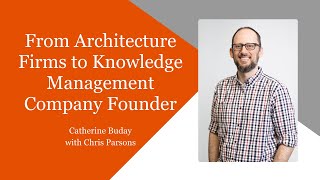
Interview with Christopher Parsons about his career transition from technology consulting and architecture firm IT leadership into founding Knowledge Architecture. He describes motivations (desire for ownership, interest in knowledge management), risk-management strategies (gradual part-time transition, deferred compensation, client contracts), early team hires, and milestones such as reaching profitability and surviving external shocks (recessions, pandemic).
Chapters
Tell me about what you did before you had knowledge architecture and what made you think that you, what made you realize you needed to run your own show?
Yeah, so I was a history major and graduated during the dot com boom. And so that might be, I don't know your audience, but like, maybe that's before some people's time, but it was a really heady time where, you know, technology was really exploding. All of these old brick and mortar businesses were converting to BE dot com. And so I started as a technology consultant in that environment and did that for two years. I was kind of based in la, but working in San Francisco. Moved to San Francisco and then the dot com boom crashed and then 911 happened. And so those two things together in the city of San Francisco like just put a huge cooling effect on our economy and especially on tech. And so after I kind of had decided that I wanted to stay in the city and the only people hiring were like lawyers and architects. And so I took a job in an architecture firm just being their IT person to ride out that recession and hopefully get right back into software. I ended up falling in love with architecture. I thought it was so interesting as a business. It's a combination of technology and law and design and science. It's just all these things are happening, it's constantly changing. So I stayed there for five years, moved to a larger firm, became their chief information officer, did that for about three years and so had done about eight years in architecture and technology. And along the way I discovered knowledge management as a field that had kind of started around 1995 kind of formally, but had never really reached our industry, architecture industry, which we call aec, which stands for architecture, engineering, construction. Knowledge management hadn't hit us in a formal way. And so I decided this is what I want to do with my career. I want to do knowledge management full time. And I kind of had two choices. One was to go into a much larger firm, like 2,000 people, 2,500 person firm, and just be their chief knowledge officer or director of knowledge management, whatever that was, or start a business and work with more mid sized firms, you know, 100, 300, 500 people, the kind of firm I grew up in, and help them with knowledge management. And so this was again another recession. This was the beginning of the housing Crisis. This is 2008, 2009. I mean, I think a lot happens in moments like that where it kind of clarifies your priorities and decide to take a leap. For me there's kind of this security of a paycheck thing that people talk about leaving a full time job, but you know, depending on your point of view, I think sometimes it's riskier to be in a full time job than to have your own thing. I had a very formative experience when I was doing technology consulting, like six months out of college. We got brought in to do like an IT assessment for this very large manufacturing company outside Chicago. And oftentimes when those things are done, and this was one of those, it was basically, we want to restructure the IT department and we need an outside firm to come in and point out everything they're doing wrong to get the justification to lay people off. Which was like, you don't want to hear that as an idealistic 22 year old. That's how the world works. But even worse, the guys knew it that worked there. And I ended up sitting in a room with somebody who was about 60 crying because he was going to lose his job and he knew how hard it was going to be for to find another job. In that moment. I'm like, man, I feel for this guy. But I never want to be in that position where arbitrarily the thing I love doing my work can be taken away from me because it restructures, because you get a new vp, whatever the thing is. And so it's true there's risk in entrepreneurship, but there's also risk in staying put and working for somebody else.
So you have that realization and you kind of carried it inside you for a while. You continue to work in a corporate environment when you realized that you wanted to have your own show. I mean, I'm sure you did some thinking before you actually quit your job. Can you tell me about that process?
There's this characterization around people who aren't entrepreneurs. I think I hear a lot that entrepreneurs are risk taking and they're aggressive and they jump off the cliff without looking and build the wings on the way down. Like all the cliches. And I have found that to be the exact opposite of what good entrepreneurs are. I think good entrepreneurs are highly attuned to risk. They're willing to take risks, but they very much look into de risking whenever possible. So maybe I'm jumping off a cliff, but I'm going to check the wind first, check it twice, make sure I have wings. I'm going to have a parachute, a backup parachute, make sure the parachute works. And so when I took the leap again, the timing of the recession, the housing recession, I went down to part time and we wanted to do this but by going part time, I could save a job for somebody on my team, but also manage my risk a little bit. We had kept our expenses incredibly low, my wife and I, and so we, I could afford to take a pay cut which let me work Monday through Wednesday at my full time job and weekends, nights. I could get start working on getting this thing up.
You were able to test the waters?
Yeah, I tested the water for about 10 months until I got enough clarity and conviction that this thing was going to work. You still have to jump off a cliff at some point. You basically say like this is better work. But I had done a lot of work trying to make sure that it felt like it actually was, was real.
So it was a gradual withdrawal from full time work. First you went part time while you tested the water with your potential, with your company.
And even more so I got a contract with that past company that ran for about two years into the new company to still provide some of our old services to get some revenue going. So I became a consultant to them. So the company I left, they liked me, I liked them, they wanted me to be successful, you know, and so we found a way for me to still provide services. We're building a software company. But like as many bootstrap software companies do, you oftentimes have to do services to keep money coming in while you build the product and then you have to make it transition to doing full products. So that's another kind of part of the story. Again, de risking by making sure the revenue was taken care of, you know, but also still having the vision of what I really wanted to build.
Well, that answers one of my questions. How did you go about getting your first clients? Yeah, one big one was your former company.
That's right, that, that was one big one. I did a lot of, a lot of things, you know, and I think being a person who I wasn't raised in a family of entrepreneurs, I was a history major, I never really thought I'd run a business. And so it was so much autodidact, self teaching, it was just reading a ton, but going out and trying things. And so we tried a bunch of new services to see like, is this what we're going to be, is that we're going to be. And people at least at that time were very receptive. They liked the idea that something new is going to happen. Like our industry, AEC has gotten much more innovative lately, but I think has always lagged a little bit behind some other industries. And so the idea that somebody's coming from within the industry to try and change things and make something new. It was easy to get meetings because people were excited that something was going to happen. We partnered a lot with larger companies. Without going into the details, we provided integrations between larger software products in the industry. So that solved a pain point for them. They didn't have to build that integration, but it also got us in the door. And when we were in the door, they said, okay, it's cool you built this little integration, but what else can you do? Then we could talk about our vision for the bigger thing, which is our intranet platform called Synthesis, which is now our flagship. That's now all we do is the kind of the big software platform, but by using partners, building things that matter to them, they would make introductions, and it started getting us into companies.
Now, at some point, you probably realized you needed help, you needed other people to help you with this. Yeah, when did that happen? How far into your new business did that happen and how did you go.
About doing it immediately? So for me to get to the place that I thought we could actually have a shot, I knew I needed like four people to kind of split up the work. I hired friends and family, starting with a guy named Brian Campbell, who was our first employee. I'd worked with Brian at two previous companies, and he just was the guy I trusted to build stuff. And so Brian, all of us came in on much reduced salaries for the first few years and kind of took deferred compensation. And, you know, everyone in our company now has equity in the company that has been here for longer than two years. So it was very much a look, we all want to do this cool thing together. I was open book about our financials from the beginning. It's like, you see how much money there is, you know, let's figure out how we can stay alive long enough to get this thing and make us all money down. Down the long run. So I hired Brian. I hired a guy named Paul, who joined me from a past company, and I hired my brother to be our director of operations. The four of us together got the thing started. And then the fifth piece was Susan, who was our. Now our chief client officer, and she joined us about a year in. So the five of us kind of got it, got it going, and then, you know, we've grown since then.
Was this a big change for you? Because all of a sudden, you know, before you just provided the skill at your old job, your salary job, now all of a sudden, you have to manage prospecting for clients. You have to you have people depending on you for at least, you know, it might be a reduced income, but they're still depending on you for some of their security you probably had to deal with. What legal entity is my new business under? Was that a tough change for you?
Yes and no. That's a very interesting question. Just reflecting back, I think I have a lot of skills and just habits and preferences that made me well suited. I love to read. Exhaustive. Partly going back to the history major perhaps.
I'm a big reader too.
Yeah. And I think if you're going to take on something, there's nothing that can prepare you for the fire hose of the new things. You have to learn to be an entrepreneur. I had never done anything around contracts or HR or benefits. I read somewhere and I wish I could remember it. It's like there's a brick wall that's, I don't know, six stories high. You have to get over, you have to climb it, you know, brick by brick and get up over the wall. But the, the good news is is you look around the world, other people have made it over that wall. It can be done. It's just a matter of. I'm also a long distance runner, right. So it's putting one foot in front of the other, trying to stay emotionally stable as much as you can. But it's, it's a whirlwind. The first two or three years was very, very hard physically, mentally. I was working all the time, stressed out. Like we didn't make, we didn't really become profitable till four years in. We had to hire a couple more people and then we had to make investments in marketing. And so every dollar that was coming in there was kind of accounted for. And so just being on the knife edge for a while, but I had, I had the confidence that it was going to click.
Was it scary for you? The financial uncertainty some months where maybe there wasn't a lot of money coming in and you still had bills to pay somet times.
I mean, I think I mentioned before, like we kept our expenses down. We'd always done that as a couple. We still do that. We live well below our means. That helped. I was 32 and the way I looked at it is if this thing fails, like worst case scenario, this thing fails, I'll be someone in debt because I did some credit card debt. I borrowed against my 401k. I did some of that stuff. Worst comes to worse, I owe whatever it is, a hundred thousand dollars to a variety of people and I have to start Over. But I had this experience of trying to build something which I think if I wanted to do either another company or go work for somebody, that was really valuable life experience. So on one hand it's like, I don't want this thing to die. But in the macro sense, it didn't feel that risky. And I know that comes from a privileged position of feeling like I have a backstop. You know, if the worst, worst, worst came, I do have parents that are responsible adults that I could fall back on. So there's probably some degree of safety in the back of my mind that other people might not have. But the mindset was the worst that can happen isn't really that bad. So it let me feel less stressed out. That makes sense. But yeah, when a contract was supposed to come in in October, they say, you know, we got this other thing we're going to do. How about March? When you're living on the knife edge like that, six months matters. Sure. So those weren't fun. Anything that happened like that was tough.
So when did you realize, was there a point after you started Knowledge Architecture where you realized, okay, this thing's gotten traction, we're really going now, the risk is receding.
There's an old Zen prophecy and it goes something along the lines of first you see the mountain, then you don't see the mountain, then you see the mountain again. And I feel like it's a lot like that. You get glimpses that this thing's working and then you get some information that makes you think maybe it's not working so very much like back and forth, like it wasn't a binary switch that flipped. And like, yep, we're good, no worries. And I mean, even since then, you know, there's been a pandemic. We had to replatform our product over, which is a multi year, very high risk, high reward type thing. Like there've been new things. AI is now here, which is very disruptive. So even when you think you've kind of got it, there are still existential risks that are going to and threats that are going to come up. But I mean, I think there was definitely getting profitable was a huge milestone in two ways. My wife and I would talk and say, like, what's all this for? Like, I'm working insanely hard and we're not even profitable. Is this actually working? So we put a deliberate effort in year five on getting profitable. And so that happened. That felt really good. But what also happened, and this is weird, and I've talked to a few other Entrepreneurs who've experienced this, the thing we were chasing was getting profitable. So it's like, now we're profitable, now what? Now what are we chasing? And so it was, it was a really interesting moment to figure out. Once you get past, like kind of in a Maslow's hierarchy of needs way, once you get past survival, what's self actualization now that you're kind of like alive, what do you really want to do with this thing? That took me several months to really reflect and write and kind of figure out, you know, what the, what the course was.
What advice would you give people who are in the position where they're in a job, it's comfortable, but maybe it's stifling. They have begin to do something else. They're thinking, starting their own business. What would you tell them?
I'd say a few things. I mean, number one, I think trying to pilot it in your free time is a real smart idea. You know, I'm not advising anyone to like break any moonlighting contract or anything that they have there. But usually especially if it's significantly different and you're not talking about building a competing company to what you do, like, there's probably some room to just find out if you actually really want to do this work before taking that jump. If there's a way to step down your hours to give yourself a little more flexibility to do that, I think that's great. So that's kind of like mechanically some things. But I think the most important thing, because I talked to people who are either thinking about doing this or have recently started. And they ask me kind of like, they either ask me the question or I sense that they need to have a. They haven't had a deep reflection on why they're doing it. And I really mean the kind of deep, spiritual, like, imagine your life 50 years from now or 30 years from now. Imagine the day to day of working in this business. Imagine like how it makes you feel and why are you doing it? Are you doing it to impress other people? Are you doing it to make money? Are you doing it because you found a problem that you really love and it doesn't even feel like work, it feels like an adventure. And so it's that I think a lot of times people do things because of external influences and they don't know that they're even being motivated by external. You want to start a business because, like, entrepreneurship is the thing. And there's this assumption that if you start a business, you have to go raise venture capital. And we did not. And there are a lot of other businesses I respect who did not, who bootstrapped and stayed independent. And so I talked to them about that, too, because a lot of them are on the precipice of assuming they have to go raise money. I'm not saying you shouldn't, but I'm saying don't just do it because you assume you have to. Like, the more you can get clear on what you really want and why you really want it, and why you're doing things that will serve you, whether it's why you're quitting, why you're raising money, all these steps. It's like getting really clear on why and taking the time to understand that, you know, always. That's my biggest lesson, I think.
More from Christopher

Human in the Loop? Testing Our Assumptions About Where People Add Value in Learning | Todd Henderson

Redesigning Work for the AI Era: How Greenprint Turns Implicit Knowledge into Shared Intelligence

Designing Learning Like a Product: Branding, Culture, and the Unseen Work of Building an LMS

Scaling Design Excellence: How Diamond Schmitt Amplifies Knowledge Through Learning and AI

From Tame to Wicked Problems: Rethinking Learning and Development in a VUCA World | Ellen Bensky

Learning at the Speed of Change: Adapting L&D to Your New AEC Workforce | Kristina Williams

Designing Modern Learning Organizations: Rethinking AEC Learning Development in the Age of AI

The Link Between Learning, Motivation, and Career Fulfillment for AEC Professionals


Why Communication Skills Are Foundational to Teaching, Leading, and Adapting in AEC F

A Framework for Collaboration and Quality: SMMA’s ISO 9001 Journey | Ryan Farias & Jessica Smith