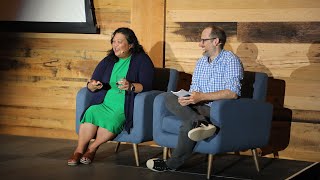
This is a transcript of a live Q&A (YouTube) between Christopher Parsons and Marlene Chen (Olson Kundig) about balancing design quality with organizational change. Key themes: decision-making frameworks (Jeff Bezos' one-way vs two-way doors; 'progress over perfection'), communicating change phases, keeping options open during organizational experiments, fostering neurodiversity and affinity groups (employee-elected, ~9 months active), building and iterating job descriptions (V1, paired with a leadership capability model), lessons learned from moving into new project types (e.g., Project Nike), meeting cadence decisions (global vs local crits), and using canonical projects ("Chicken Point") to teach design practice. The tone is reflective, operational, and practice-oriented.
Chapters
One of the things you and I talked a lot about was Jeff Bezos quotes.
Yes. Oh, yes.
And one of the ones that we both love is one way and two way doors. And when you were talking about I wrote down perfection over progress, that made me progress over perfection. Yes, that's exactly what I meant.
Yes.
Well, you're making my point, actually. So progress over perfection, how does that square with kind of designing really beautiful built work and on one hand saying on some of these internal things, we just want to make progress? Like I was thinking of one way and two way doors.
Yes.
So maybe you can explain that and how you think about it to the group.
Well, when we talk about, you know, this is an area that both Sarah and I reflect on. We sit next to each other and we frequently have way too many long conversations about this. But are we communicating this? Do people understand where we're going to? A lot of people think there's an aspect of an ideal state. How we used to do it and how we're doing it now. And how we're doing it now is a long time. People can get tricked into thinking, is this how it's always going to be? Is it always going to be this kind of band aid slapped together kind of thing where it's unclear. I think our point is really to explain that our intention is to get here, but we have to communicate where we are along that path. So are we at phase one? Are we at phase two? Are we at the final stage? This is what it's going to be. But the one and the two way doors is something that we, for a firm that likes to ski the trees, we don't like to be kind of. We are only going in this direction because that leads. You can see the diversity of work that. That's where it kind of didn't necessarily. We're pretty open to a lot of things. And so that's where having a one way door always feels a little bit like limiting. But there are certain, like if we.
Go down this path, we can't come back.
Yes. Yeah, yeah. Right.
So you're just trying to keep options open.
Yeah. And so in terms of the two way doors, I think if we can communicate, this is something we're trying. It may not stick around, but it's something that we're trying for the purpose of this because we know that this is a problem, then that's what we want to communicate.
Got it. Makes sense. Do we have questions in the audience?
Hi.
You talked about neurodiversity as among your one of your ergs. Can you bring that to life a little bit in terms of focus areas for the group, self selection, etc. Just how does it come to life in a meaningful way in the organization?
Sure. Yes. I think some of it is what we've found and sometimes you find it through employee reviews or a manager has highlighted something. Where is there additional support that we can provide. But also how do we make it so that it's not something that others them. It can be something that is not. It's not visible. My ethnicity is visible. I can't change what I look like. But somebody who is neurodiverse, you might not know what we've found is. Because that can. Sometimes our practice is so relationship based and so sometimes that can come through in terms of what comes across perhaps as shyness or standoffishness or things like that. But they are tremendous architects, really, really good architects. And so how do we recognize that, recognize that they have a place here and then also if they need some more support, if they wanted to have speaker training or something else, or if they need workplace accommodations or things like the groups that were created, the affinity groups were all created. They were elected by the employees. It was not dictated or mandated by the firm. And that was the one that came forward which was really wonderful. I sense that we will hear more from them. But right now, we're about nine months into it right now. I think for right now, they're still just finding each other and just finding space in terms of them being able to come forward and meet with the representative to say these are things we would like to ask about or see change. And so those are some of the areas that we're seeing it come forward. We had other folks where they have perhaps a hearing disability. And so for all of us who could just put our earphones on, that wasn't possible for them. So they would always have to go and find a conference room and log in from there and be able to speak in that capacity. So there's all sorts of different ways that it's appearing.
Hi.
Hi.
I'm just. Great presentation.
Loved it. Thank you.
I'm just curious about the reaction to the job descriptions. I know that's a huge lift and I actually really liked the side by side that you put up. My challenge is that sometimes people see those as a checklist and don't know kind of what's, you know, the other pieces of what might make somebody ready or not ready to move into a new role. So just you could talk about that.
That thanks for that question. Those job descriptions feel like those are the V1 versions. And we're kind of at the time, like it was a lift to get people to write what this job is. So it's a matter of, you know, is our HR team pulling from aia, pulling from other practices, and then people, leaders in the firm saying, well, but here we also expect this, and here we also expect this. And so we have that version, and I think we need to look at it again through new lenses as well. So it's, it's one of those moments where, similar to that visualization example that I gave, where it's one thing to just have the job description on there, but if there's no context or there's no person who's explaining it, that's the important part, which is that mentorship, which is understanding. Like, yeah, making relations with your consultants and your client group. Those are things in which we also see possibility. Or the way you engage in community or through networking events. Those are other areas that don't show up in the job description of the technical things you have to do. I think what I didn't show is we have what we call a leadership capability model, which encompasses business development, project delivery, organization, operational operational strategy, and leadership leadership skills. And then I forgot what the culture. That's a different evaluation form. But the first thing we write at the top is, this is not a checklist. If I was all of those things, I'd probably be a different person. But it shows the collective group of leadership that that's what composes our leadership. We have people who are really strong in business development, people who are really strong at Project delivery, people who are really strong cult bringers. And so how do we, how do we bring this forward? But it's only through conversation because we, we've, we've written it down and we've said, you know, this is how these are evaluated and promoted. But people will still take their own interpretation. So sometimes it, it comes with a lot of conversation.
Got it, Brian. Okay.
A lot of times when you ski the trees, it's, it's not the safest route. You gave a lot of really good examples about how it worked out. Well, you guys have other times where you ski the trees and take the unbeaten path, and it hasn't worked out as well.
Yes. You know, really, that transition out of the single family residential realm, right where we were all of a sudden working on that Project Nike, you know, it's, it's a little bit. It's a little bit like childbirth you forget all the difficult parts, but you now you're, you have this beautiful project and that project, we refer to it a lot. But I remember HR meetings about the team not getting along, you know, a lot of people needing support because the contractor relationship was difficult or the client relationship was difficult. The finance team and the legal team working through a lot of the additional services requests. So there was a lot of learning. And so I think we, I'd say that in any new sector that we tend to go into, those are areas that we, we have some, some, some lessons that we're still learning on that. So that, that skiing of the trees is a little bit more about how we approach both things internally, operationally and then also how we look at our opportunities in terms of kinds of projects that we take on. So.
And when you guys say that, is that partly to set the expectation, like if we're going to go do something we've never done before, it's probably going to be hard, things are going to go wrong.
Yes. Yeah. But also that optimistic of just being like if we only focus on this, which of course goes to indicate, like if we only focus on this, we will probably achieve it. But when we're a little bit more open ended with, you know, with five majority owners and then a new group coming in, there's a lot of diverse interests. So as an organization that wants to kind of be open to a lot of things, we have to kind of remain open. And I'll say that that's one area that our business office struggles with. Right. Because they would love to have 80% of it be standard form. You know, here's the standard contract go, you know, so that we can deal with the 20% of those clients that they're going to go back and forth and back and forth with sun. So a lot of it is how we can, how the business office can be a foundation to support to what we were hearing from Ellen yesterday about being the support for the design to be able to do their work. But certainly there have been other lessons learned in terms of we tried some particular overhang in a snow country that maybe didn't work out so well. So those are areas that we try to bring those forward and those lessons learned. There's things like right now, I think most recently there was one on hurricane. Practicing in hurricane country. We're from the northwest, so we're a bit more seismically oriented and less so in terms of hurricane. Those are areas that we are sharing a lot of lessons learned there. Hi, you talked a little Bit about having all staff meetings versus local meetings. Can you talk a little bit about.
How you make those decisions? Do you have set criteria of we'll have these types of meetings open to the whole firm or this is better, more regionally?
Yes. So we have directors in both of those offices and I speak to them fairly frequently, usually every other week. And so a little bit more like, what's the temperature? And so at some point, our New York office was feeling a little bit like crit is really starting to drag on us because either we have to stay late or we have to join from home and we want to participate and we want to be part of this design culture and our voices to be heard as well. That's where we said, well, if it's a project crit, maybe we'll do it locally there. But if it's a big project or explain those elements. We have tended to move most of our. If there's something that the entire office needs to hear, we'll try to put it to that Monday meeting or like we'll usually do every half year. Kind of a state is not a state of a state of the state or some version of that relates to kind of how we're doing. And so we'll tend to now reschedule those. Those used to just happen kind of at the end of the day, but now they need to happen kind of like 11, 10 o' clock so that more people can join. So it usually goes through a filter either myself or Sarah might flag and say, this isn't going to work. And our communications team and marketing team will also. They weigh on that as well because they're sensitive to those as well. But our directors will raise their hands if they sort of feel like this needs to be. I think we need a little bit more autonomy here. And so we just have a conversation.
Around that I'm curious about. Okay, Classics.
Yes.
If that goes really well, what's the purpose of it? It sounds fun, but what are you hoping happens in those?
Well, there's so many times when on a project, a principal will say, well, just go, go look at Chicken Point. Right. And somebody who's new may be like, I don't know what Chicken Point is. And so they don't know what number to look for. They don't know there might have been a different. It might have been filed under the client's name. And so we call it Chicken Point, but they don't know how to find it. And so some of it is, well, okay, so I found the drawing. Now what am I supposed to be looking at? And so those talks can sometimes unveil a little bit of what they were thinking while they were designing it.
So kind of like seminal milestone projects.
Yeah.
Got it. Cool. All right. I think we're good.
Yeah. Thank you so much. Thank you so much for your interest. It's a real honor to be here. I love this conference, so I'm happy to share. And I used to. I was telling Chris before I was like, oh, when I moved into this operational role, I was like, I'm not going to do any kind of public speaking kind of thing. I was just focused on the internal. And. And then Chris called, so.