Q+A with Jim Chambers & Jim Martin | Designing a Successful Hybrid Practice at Shepley Bulfinch
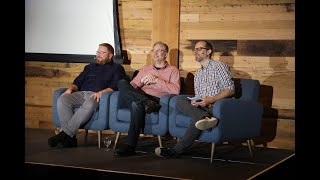
This is a recorded Q&A (moderated by Christopher Parsons) with Jim Chambers and Jim Martin from Shepley Bulfinch on designing a successful hybrid practice. The discussion addresses practical steps for sustaining communication norms (onboarding and re-running social-norm conversations), persistent artifacts such as a Miro board template, measuring wellbeing via a Quality-of-Life dashboard (Power BI), data and infrastructure considerations (virtualizing data, Deltek backend), cross-training/new-hire onboarding constraints, and remaining challenges for hybrid work—especially hybrid meetings (AV problems) and mentoring in a dispersed environment).
Chapters
Jim Chambers, when Jim Martin asked you to work on the burnout metric, did he give the appropriate information you needed to get started on the task?
Of course. And he came with what success indicators would look like and how we were.
Going to measure it.
Excellent, excellent. I think we'll just start with the audience. Let's see if anybody has a question up there. I see a hand on the back.
Oh.
And one in the front. Okay, we'll get them both.
That was a great talk. Thank you. My question is about communication. You talked about people communicating their desired communication modes and times. That's great to do it once, but how do you make it apparent all the time you have new people coming in, people leaving. Is there a way that you have that as like a permanent on your email signature, or how do you know? How do you make that more prevalent?
Yeah, I would say. I mean, I think it's part of the general firm onboarding, stressing that as a sort of a cultural preference for ourselves. But I'm sorry if I gave the impression that the social norms is something that you do once at the beginning of the project, and then people that join later down the road don't have that opportunity. But we do ask people to rerun through that more, probably more quickly, since they've had a lot of the depth of the conversation. But when they onboard a team member to their project midstream to have that conversation with them too. So, yeah, they have the same benefit.
It's a mirror board, and it's intended to be used as a template. So anytime a project manager wants to use it, they just grab a copy of it and then they edit it based on what their team kind of decides. And, you know, we love. We would love to provide the opportunity for everyone to get everything that they want all the time, but that's not how reality works. So it's always a conversation, and it's like, okay, well, it's a negotiation. It's like, this is what the team has decided. Does this work for you? Is this okay? Is there. Are there any things that don't work for you? And it's an opportunity to have that conversation that you wouldn't have otherwise. And it makes it explicitly okay to have that conversation, rather than people just assuming that whatever they got dumped into is what they've got to deal with.
What else? The Miro board is a nice. Jim uses this term all the time, a nice artifact of the conversation. So it's a persistent point of reference that people can go back to maybe if they forget or if they experience.
A foul, it's like, oh, that's not what we decided we were going to do. Has something changed?
Yep.
Yeah.
I'm curious, with your Quality of Life dashboard.
I don't know.
You didn't mention, like, who's measuring that right now and how those conversations are happening. But what I'm curious is if it's led anybody to be able to identify for themselves when they might be having a problem, if they are able to see those things or if those conversations are happening, or maybe even better, if they're able to flag where a problem might be imminent for them coming down the road.
It's a great idea that we're definitely going to steal.
We've already decided right now to start planning on how we might do that.
So the first part of the question about who monitors that? So, I mean, I look at it pretty regularly, depending on the individual and the circumstances. It might be me that is having that conversation with either them or their leadership. But also the staffing, we call them the staffing responsible body. They will look at it, too, and they have points of contact with all the people in the organization. And so they'll have some of those conversations as well.
Yeah. The thing about data is that if you can, you can get out of your own way and start collecting it. And there's so much stuff you can do with it that you didn't think about. And so you just kind of go down a path and figure out, all right, well, how can this provide value? And then as soon as you do that, you can think of 15 other ways that it can potentially provide value. And it's just a matter of figuring out what you should do and then what you can do. And then did it do what you thought it was going to do?
I had this terrible analogy that came into my mind last night about Mexican food. So it's cheese, beans, and rice, but in different combinations. And a lot of the dashboards we have are those three sort of primary buckets of information just sliced and diced and looked at different ways. So that was not bad.
I've had worse.
You've had worse.
Attracts.
I appreciate your approval.
Our question here.
Okay, you guys covered a lot of great topics there. So one of them was about cross training and having the architects, when they first start, go through the IT group. And that's always a great idea. I know everybody wants to do more cross training. Do you guys have every single architect that starts that's out of school? Okay?
Oh, God, no.
How do you.
How do you figure out who makes sense to go do that.
And then. Well, it's really interesting because we have a finely crafted project job description and it may or may not surprise anyone in this room that we don't get. We don't get enough applicants to support a 200 person firm, but we get the couple of episodes that we get. They're usually predisposed to being pretty good at this stuff, which is great. But I think I want to say we've. I didn't count the numbers, the people that were on that slide. It was incredibly gratifying to put that slide together because I'd never actually put all their faces together in the same place before because we're usually working on doing the thing, not looking at what we've done. But they've gone on to do some amazing things. Some at Shepley, some at Not. But they're, they're unicorns. But I'm a unicorn wrangler, so I try and find them and I help them succeed and I give them some skills that I think are going to be helpful for them. And I, I am hopefully creating unique people that can create unique value in our business. And I wish that I could scale it up to do it for everyone because I personally as a technologist, truly think that it would be an amazing place. But I have not figured out a way to get it to scale to that level. There are other people in our community who have done something similar who have scaled it better than we have and I think that that's amazing, but it just wasn't. It hasn't been in the cards for us yet. And I haven't figured that out.
I saw a hand on the front. Susan.
Susan allowed to ask a question?
Apparently, yes. You spoke about Power BI and the Google dashboards, which you didn't see. We heard Ellen talk about Power bi. I think we'll hear more about it. I know not everyone here uses Power BI or even knows where to get started. So I was wondering maybe this question more for Jim Chambers, but like how you got started in it for people who are not there yet.
I'm probably not a good example of how I got started. It took like two years of Jess Purcell, Jim's colleague, of trying to convince me to not use Excel because not everybody loves Excel to start using this other thing. But she kind of like, she encouraged me to do it and then gave me the opportunity to work with it. And I just like dove in and would pester her with questions as I went along. Eventually I stopped asking her questions and Started giving her information, but I don't know. So again, it's not really a great example because it's sort of like throw somebody in the deep end and hopefully they swim. But I mean, I think it's a pretty. It looks kind of terrifying, but I think with a lot of the data management that is coming down the pike with fabric and some of the concepts there of being able to have smaller numbers of individuals do the data manipulation, so do all the calculations in the back end. And then training people with the actual visualization component of Power bi, it's a little bit more like what do you want to compare? Pick your visual, just drag the two fields in there and go. So I think that will be an easier on ramp to a lot of people to get used to the visualizations, but then also start to ask like, okay, well I want to slice it this way. And then we can have conversations about doing that and either give them the opportunity to actually develop that, that prompt or the calculation or whatever, or do it ourselves, depending on kind of what it is and what sort of consistency we want to have across the organization.
Yeah, I would say if you want, if you want to, if you want to get something out of Deltec, the answer is probably Power bi. Really understanding what you're trying to get out of it is important. I don't know, we're probably three or four years down our data journey. We virtualized our server hardware and our infrastructure and now we're working on virtualizing all of our data. It is a pain in the ass at the beginning because Deltec is a pretty rough backend for that sort of stuff. And you've got data and other systems that you want to tie into it as well. I would talk to your IT people, sorry, IT people, but they're probably most qualified to kind of help if you're interested in getting started. But what you can do is have very specific needs, like, very specific, like I need to understand how this works in this context with this way. Because understanding the underlying data and where the data gets pulled from is the best thing that you can do to get successful fast. Rather than pulling a bunch of stuff in, realizing that it's the wrong stuff. Arguing about semantics of how one thing is another, realizing that Deltec has five different places for profit to live in the product, blah, blah, blah, blah, blah. These are all. There's a journey there, but it's worth it because once you get it done once right, you can generally rely on it moving forward. One of the things that Jim does on his dashboards, which I love is he actually has a confidence level. So as he's building out new dashboards, he's still showing them to people, but he just has like a red indicator on it. Like this is sketch, but it's getting there. And that gives people the ability to have opinion on it and help him improve it without necessarily falling into the trap of assuming that because the number is there, the number is right. Which you need to put a lot of time and energy into that review in order to make sure that what you think it's saying is what it actually is saying.
We have time for one more question and I'm going to ask it. What do you think is like, of the kind of challenges as you've gone on your hybrid journey? You've knocked out a lot of them or made progress. What are some big ones that are out there that you're still like, we got to crack this. To really feel like we're flying.
Meetings.
Meetings.
Hybrid meetings suck so bad.
But what sucks, can you describe the suck?
What sucks is av, specifically av. I mean, this is an amazing hybrid event. It's being recorded, but it's not being live streamed. But it probably could be, presumably. But the amount of effort that goes into putting in a meeting that doesn't suck for the people in person or the people remote at the same time is an incredibly difficult and I, I hate it so much.
What's on your list? Your kill list?
I guess non technology related, non technology.
Yeah, sure.
Mentorship. It's a challenge and I think it was a challenge pre pandemic. It always will be. Because of the nature of the profession. It's so circumstantial that you have to kind of like train in the moment. But I mean, I think that piece of just getting people more comfortable with having that type of conversation with each other in a virtual setting. I think we reiterate a lot that with our comfort level with hybrid, it's also an opportunity to get more exposure to more people throughout the organization. You're not just subject to the two people that you're sitting next to. So getting people to kind of appreciate that, but then also identifying who is a resource for what.
I would also just, I would say that, you know, we look at the history of our firm and in the last 30 years, the way that we've practiced architecture changed so much more dramatically than it did in the prior hundred 120. And we are two, three years into our kind of hybrid journey. And I don't personally have any expectation that we're going to get substantially good at it next week. There's always going to be things where like, okay, well, that process is rooted in everyone being in person. It doesn't make any sense anymore. What do we need to do instead of that? Or noticing things in the business that are not working the way that we kind of want or think that they should, which is why I'm always into the measurement. I want to know what everyone's experience is, what's actually happening without having to bug people and ask them about it. So we're going all in on trying to figure out what all that stuff looks like so we can have conversations with people and figure out what are they actually experiencing and is that good or bad? Is it contributing to the ability to do their job or is it interfering?
Amazing. Jim and Jim, thank you.
Yeah, thank you very much.
Appreciate you guys. Awesome.
More from Christopher

Human in the Loop? Testing Our Assumptions About Where People Add Value in Learning | Todd Henderson

Redesigning Work for the AI Era: How Greenprint Turns Implicit Knowledge into Shared Intelligence

Designing Learning Like a Product: Branding, Culture, and the Unseen Work of Building an LMS

Scaling Design Excellence: How Diamond Schmitt Amplifies Knowledge Through Learning and AI

From Tame to Wicked Problems: Rethinking Learning and Development in a VUCA World | Ellen Bensky

Learning at the Speed of Change: Adapting L&D to Your New AEC Workforce | Kristina Williams

Designing Modern Learning Organizations: Rethinking AEC Learning Development in the Age of AI

The Link Between Learning, Motivation, and Career Fulfillment for AEC Professionals


Why Communication Skills Are Foundational to Teaching, Leading, and Adapting in AEC F

A Framework for Collaboration and Quality: SMMA’s ISO 9001 Journey | Ryan Farias & Jessica Smith