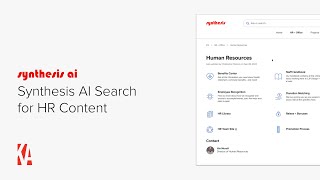
Christopher Parsons (Knowledge Architecture) demos Synthesis AI search on the company intranet’s HR & Office community. He shows how the feature searches the intranet, generates AI-written search summaries that cite sources, and lists top result links. Live examples include how to request PTO (via BambooHR), how much PTO ("four weeks / 20 days"), company holidays, family leave (12 weeks) — citing a May 2024 town hall video — and guidance on raises, ESOP vesting, profit sharing, job-level differences (principals vs associate principals), job captain responsibilities, and an overview of the One CJP initiative. The demo emphasizes that summaries are composite answers drawing from pages, videos, and posts and that users can click source links to verify details.
Questions this video answers
Four weeks (20 days).
12 weeks.
A town hall video from May 2024.
Chapters
Hi, it's Chris from Knowledge Architecture and I'm going to introduce you to our new AI search feature for synthesis. I'm on the HR and Office page on our Synthesis intranet and you can see on this community that if I scroll down, there's a variety of HR posts about different initiatives or announcements or new platforms, updates and ways for you to get involved in the company. And in addition, in the HR section of our HR and Office community, you can see that we've got information about benefits and a staff handbook, information about raises and bonuses and promotions, et cetera. So what I want to show you is how Synthesis AI search makes it really easy for your employees to ask questions about all of your content on the Internet, but specifically HR content for today and get answers to those questions. So for example, I want to find out how to request PTO synthesis is going to search the entire intranet and use AI to generate a search summary. It will also list the top results on the right hand side for that query or that question, as we'll see. So what I see in this search summary is to request paid time off, I use bamboohr, which is our HRIS system. It gives me a link to that system. It tells me kind of how to log in and what my email address and what my password situation is. And you can see down at the bottom that it's citing two sources for where it got the information to write that search summary. And if I want to, I can click in and go verify that information for myself. That's pretty neat. What if I want to know how much PTO do I get? And right now I'm asking a follow up question and you can see that we get four weeks or 20 days of PTO which can be used for vacations, personal days and sick days. And again we're citing our sources of where we got that information. Cool, let's try some more searches. So I'm going to try holidays searching the Internet and boom, there we have it, a list of the company holidays that we observe throughout the year. And again it's given me information here, supplemental to tell me where to enter that on my timesheet. And then of course I can reach out to HR and there's the email address and this again citing its source, which is the company holidays page. Okay, let's try family leave. And now we get an update on our family leave policy. Tells me about, you know, we have 12 weeks of leave and some different information I need to know. And in this case it's citing a video from A town hall that we did in May of 2024. And as the source for this information. And I can of course click through and go watch that section of the video if that'd be helpful. How about a good question? How do I get a raise? All right, so synthesis has told me, here's some tips. So performance reviews and so like when raises are typically discussed. And that comes from the performance review page. It's talked about our schedule for annual raises and when we do them. And that comes from the raises and bonuses page. We can see that there are merit based raises. And that talks comes from the promotion process page. It also talks about the promotion process, which comes from the promotion promotion process page. And then it talks about feedback. So I've kind of stitched together information about how to get a rage from a variety of different sources on the Internet to answer this person's question. And that's one of the powers of synthesis. AI. AI search is creating these kind of composite answers that draws on, you know, pages or videos or posts written by different people over time and puts them into a nice little search summary with sources. So I went ahead and did a couple more that we can step through. So I asked about ESOP vesting and I got some information kind of coming from our ESOP guide about that. I asked about profit sharing and I got some information coming from the raises and bonuses page on how we do profit sharing. I asked what's the difference between principals and associate principals? And it used some of those job descriptions to be able to do that. And so it kind of delineates some of the differences here. I asked what does a job captain do? And you can see it used the job captain job description as a way to kind of summarize what a job captain does. And then I asked to please write a summary of the one CJP initiative, which is a company initiative that we have that's helping, you know, connect different offices, different service lines, different market sectors to work as one firm. And it kind of breaks out an overview of the initiative. And this all comes from a video that was in that town hall that we did in May of 2024 and distills it down into a really consumable chunk. But then I can always click on this and go back and watch that section of the video if I have additional questions. And of course I could ask additional follow ups about one CJP here. So that's it. I just wanted to give a high level overview about how AI search works in general, but then how it can specifically connect folks to your HR content and let them interact with it in new ways. So hope you like it. Feel free to reach out if you've got questions or if you'd like to learn more. Thanks.