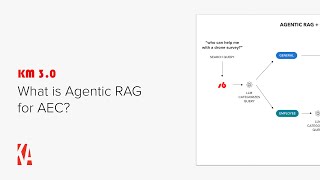
Christopher Parsons (speaker) explains the technology behind Retrieval-Augmented Generation (RAG) and the next evolution called Agentic RAG (search agents). He contrasts classic RAG (search then summarize) with Agentic RAG, where an LLM classifies a query, traverses a query-tree to select specialized search tools (employee name/role/expertise filters, project filters), and iteratively calls tools until it finds an answer. Parsons describes current and near-term use cases in the AEC industry: Employee search (rolling out to 120+ firms in an AI search beta) and Advanced Project Search (filters across project type, state, square footage, LEED level, awards), with data sourced from systems such as Deltek, Uninet, AEC360 and OpenAsset. He notes Project Search is in development and will enter beta; no release date was provided.
Chapters
I want to talk just for a second about how the technology works, because I think it's a really important thing to know. When we went to public beta in the end of last year, we were using this process called retrieval, augmented generation, which we're still using. But what this means, it's called RAG for short, is that we're not training a model on the firm's knowledge and then asking it questions. We do a search first to get the best possible information, and then we pass that knowledge to a model to then summarize and generate the answer. So that's rag, we do retrieval and we use that to augment generation. And so the next evolution of that, and this is where things get really exciting, is something called Agentic rag, or building search agents. So here's how it works. A query comes in, say, who can help me with a drone survey? What we do is we send it to AI, right, an LLM, a large language model, and we say, what is this question about what kind of search is this? Is this a general knowledge search? And if the answer is yes, it follows that top branch on the top of your screen. If the answer is it's more like an employee search, well, then we've categorized it and we follow a separate branch. We call this our query tree. So then if it's an employee search, we say, great, you've got these tools at your disposal. You've got tools for searching by employee name or role or title or expertise, or filtering your directory. Which tool do you think you need? Okay, if it's who can help me with a drone survey? That's an expertise query. So it then will analyze the content on the Internet, it'll search the employee directory, both of them. If it finds what it needs, it'll return the answer. If it doesn't, it'll go back a level, try a different tool, loop through the different tools it has available to it to generate knowledge. So this is why this is called agentic rag, or this is why people are calling it search agents. It's an agent that's acting on your behalf and you give it a tools. We give it knowledge and we give it a goal. And we basically say, go navigate and find us the right answer. So this is what's next for synthesis. Agentic RAG for employee search is going out to all of those 120+ firms in the AI search beta next week. And then projects is the next major capability for AI search in agentic rag. And so we're adding a branch to the query tree for projects that looks very similar to what I just showed you for employees. And here are some screenshots from the lab of what we're calling Advanced Project Search. So I searched on what higher ed projects have we built in California, searched the Synthesis Project directory and this data is sourced from systems like Deltec, Uninet, AEC360 and Open Asset. Or maybe just to show off a little bit more, what higher ed projects have we built in Massachusetts which were over 200,000 square feet? You can see in the search summary at the last sentence, these following two projects match the filter. Project type equals Higher education contains the state Massachusetts and square footage is over 200,000 square feet. Neat. Please list our LEED Silver or Hire projects and you'll see in the search summary that we figured out to include silver, gold and Platinum projects. Or finally, what projects have won AIA awards. So this is pretty cool. It's in development now, it's going to be heading into beta once it's ready. And no, I don't have a release date yet, but we'll keep you guys posted as we move forward.