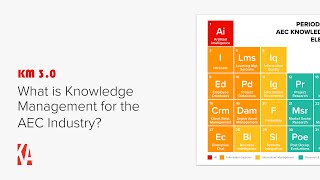
Christopher Parsons (speaker) defines knowledge management (KM) for AEC firms as the practice of using people, process, technology, and culture to enable firms to make the best use of their knowledge. He emphasizes delivering knowledge and connecting people in the "flow of work" so practitioners can find standards, templates, or experts without leaving their task. Parsons outlines a historical progression: KM 1.0 (circa 1995) focused on digitization and knowledge capture; KM 2.0 (circa 2007) emphasized internal social-sharing tools and social intranets; and KM 3.0 (beginning 2023–2025) is framed as an AI-powered era introducing AI search, transcription, and agents, requiring cultural and process shifts.
Chapters
What is knowledge management? So there are lots of definitions on the web for knowledge management. We have actually changed our definition of knowledge management over time as we've learned more about it and it's changed. But here's how I would describe knowledge management today. It's the practice of using people, process technology and culture to help your firm make the best use of its knowledge. All AEC firms are knowledge based firms. There is a wide range of intentionality and, and how strategic firms are about using that knowledge to grow better, to do better design, to engage employees. There's a wide variety of ways that you can use knowledge. And so it's really about the process of being intentional. So I look at the core about connecting people to the right knowledge around connecting people to the right people and doing both of those in the flow of work. And so what do I mean by flow of work? Let's imagine you're in the middle of a project and you need to find a standard or a template or an expert. You shouldn't need to stop what you're doing and launch a big research project. You shouldn't need to spend two hours or four hours or eight hours trying to find the thing you're looking for. Oftentimes people will do that or they'll just give up and then go out to YouTube or the Internet, find something and just reinvent something from scratch. And so KM in the flow of work means you take advantage of all that organizational knowledge you have and you deliver it to somebody at the point of need so, so that they can keep working on their project and not get totally disrupted. So what I think is that we're entering a golden era of knowledge management. Aec, this ability to keep people and deliver knowledge and expertise in the flow of work I think is completely transformed because of AI. And when people ask me how work is going these days, I tell them I'm having the most fun I've ever had in my career because I've been working in AEC, in knowledge management for 25 years. As I mentioned, there have been a lot of ups and downs, like knowledge management's been hard. We've made a lot of progress as a company, as a community in terms of managing knowledge. But I think that this AI unlocks capabilities that we in knowledge management and AEC have been dreaming about for decades. All right, so let's talk about the three areas of KM Technology and aec. And I'll start by just saying knowledge management is older than 30 years. But when you think about where this term started and how long people have been talking about it, we look at the mid-90s. That's when you start seeing it show up in things like Harvard Business Review. That's where you see organizations like APQC get started in talking about knowledge management. That's when it really entered the ethos. Obviously, as a species, we've been managing knowledge for a lot longer than 30 years, starting with oral storytelling traditions, to cave paintings, to tablets. Not the new ones, but the old ones, the stone ones. We talked about educational institutions, we talk about companies, you talk about libraries, moving into technology and the kind of things we have now. So we, we've always evolved and grown and changed the way that we do knowledge management based on technology. And I think over the last 30 years, we've seen three kind of key shifts. So number one was circa 1995, when the Internet exploded and the web exploded. So it transformed the way that we accessed information outside the firm, but also inside the firm. And I think what happened is AEC firms started pushing towards digitization. They moved from things like binders and file cabinets and stack static documents into intranets and file servers and searchable databases. This era was all about getting knowledge online. For the first time, it was making it easier to store, organize and retrieve knowledge. So this focus, KM 1.0, was on knowledge capture and it laid the digital foundation for everything that came afterwards. KM 2.0, in my view, was around knowledge sharing. And this started around 2007 when social media exploded. So Twitter, Facebook, LinkedIn and I was still in practice at my second architecture firm at this time as the chief Information officer. And I was looking at what was happening with Twitter and Facebook and LinkedIn and thought, what happens if we brought those tools inside the company for knowledge sharing? Like, what could we do? We were a multi office firm, so how could we use this to connect the office? How could I get answers to questions across the company? We started building very rudimentary internally things like activity streams and hashtags and comments. And we were essentially building. When we launched Knowledge Architecture In 2009, we were building a social intranet. And that's how we presented and marketed synthesis. When we started the company in 2009 as a social intranet, this was the. Of course we were going to do the KM 1.0 stuff, the knowledge capture piece, and have information about standards and policies and procedures. But this thing that was new was making it so that anybody in the firm could ask a question and get an answer or share what they knew, which was awesome. But with every technology change there's also cultural change that needs to happen. And there was a lot of cultural resistance to this idea of social knowledge and using social media tools inside a company. People would ask questions like, well, what happens if somebody posts the wrong thing or says the wrong thing? What happens if they say something inaccurate? What happens if they say something inappropriate? This means that anybody can post without approval. And so many firms were hesitant. They wanted us to put controls on comment moderation and posting controls, but. But if you Flash forward to 2025, almost 20 years later, with teams and Slack and products like Synthesis, it's hard to imagine running a firm without knowledge sharing tools like this. But at the time, it was a big leap and I think that's where we are now. Right as we enter KM3.0, what I would say is the AI powered knowledge management era. For us, that means AI search, that means video transcription. We're building a search agent. And if you don't know what agents are, don't worry. That's probably a lot of people now. But my point is we're just at the beginning of this transition into the KM 3.0 era. It's the first inning, right? ChatGPT exploded in 2023, and we've all been looking at how can we take advantage of this technology and use it inside the company. So similar to the KM 2.0 era that I talked about, there's a cultural shift for km 3.0 that's going to be required, a process shift, and not just in tools, but how we work.