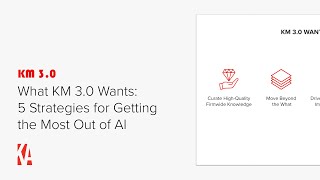
Christopher Parsons concludes a talk on ‘KM 3.0’ with five culture/process priorities for organizations adopting AI-driven knowledge management: (1) curate high-quality, firm-wide knowledge continuously (capture new, update existing, archive outdated), (2) move beyond documenting only the “what” to include why, how, and who (context helps newcomers and AI), (3) create a virtuous feedback loop using AI search ratings and written feedback so knowledge managers act on feedback, (4) prioritize capture strategically around clear business goals because you cannot capture everything, and (5) ‘play like an orchestra’—orchestrate many people into maintaining and evolving knowledge rather than relying on a single owner. The speaker emphasizes operational changes (continuous review, acting on feedback) and gives concrete examples (window-wall ratio range; Synthesis AI search ratings/feedback).
Questions this video answers
30 to 50%.
1–5 stars.
Chapters
I want to wrap up with a couple thoughts on culture and process change and talk about what's next. So as you might remember, at the very beginning we talked about knowledge management being people, process, technology and culture. And I've touched on process and culture a little bit here, but I've mostly focused on technology. So I want to talk a little bit more about people, process and culture and what has to change in in order to take advantage of these new benefits that the KM 3.0 ERA is making available. So I've got five things. One of them is curating high quality, firm wide knowledge. That's number one for me. And this has always been true in knowledge management. I want to say that by high quality I mean acquiring new knowledge that's important to capture, keeping it up to date and removing outdated or inaccurate information. And that's always mattered. But we with what I've just shown you over the last 40 minutes or so with AI you can understand how the ROI of this information has gone up, but also the importance of keeping it up to date and getting coverage on important topics is really, really mattering now. So it's a operational change to not just do one and done uploading of information. It's a process change to constantly be reviewing your knowledge to make sure that you've got the new stuff, that you're updating what's currently there and then you're archiving things that are out of date. The second thing I want to mention is what I'm calling moving beyond the what. When we're talking about emerging professionals like at BWBR or folks trying to understand design, technology or healthcare or sustainability, or how we staff projects. At Shepley, it's important that people understand more than just what, but the why, the how, the who really providing context. So context is really important for people, especially if you're new. When knowledge gets written at an expert level, they tend to write an expert level and they suffer from the curse of knowledge. They don't remember what it was like to be new. And so going beyond just what. So for example, let's say that we wrote something that says our standard for window wall ratio on projects is 30 to 50%. Cool. When should it be 30%? When should it be 50%? That's a pretty wide range. Like how do I know this? So providing that context and explaining more about why the standard or why the best practice is what it is, what some alternatives are some more context and obviously providing context of who is important. So that context is all really, really useful for people. But it turns out it's also really useful for AI, so it allows it to answer some of these more complex and difficult questions. One of the features I didn't show you of synthesis AI search, that's a killer feature for us, is search, rating and feedback. So whenever somebody does a search on synthesis and they get one of those AI generated summaries, they can rate it from one to five stars, which is good. But the more important thing is they can provide written feedback that goes to both the knowledge managers and also to us at Knowledge Architecture. So in the past when people had a hard time finding stuff with search, with synthesis and other platforms, the feedback to the knowledge management team would usually be like, search doesn't work, or I can't find what I'm looking for. But now firms are getting really rich, specific feedback. This page is outdated, or I'm looking for something on twinmotion and I didn't find it. Can you please add it? Or this result was misleading because it only told part of the story. So you're getting such rich feedback. The important part of that is that knowledge managers take action. And so this virtuous feedback cycle can happen where feedback comes in, content gets improved, search gets better. More search, more feedback, more improvement. It's a beautiful flywheel, but it only works if you actually take action on that feedback and improve the content. I mean, that's the only reason the content gets better, is because you do something. But it also keeps the feedback coming. In my experience in work, if you ask for feedback, whether it's a survey or it's on a platform or whatever it is, and people take the time to give you feedback and you don't take action on it, the feedback will stop coming in because they're like, what's the point? Nothing ever changes. So the cultural change, the process change for knowledge managers is to take action on that feedback and drive continuous improvement on the content. The fourth point is about prioritizing strategically. And the reason I say this is that there's more knowledge in your organization than you can ever capture. This has always been true in knowledge management, but it's especially true now. Knowledge is moving so fast, the half life of knowledge is shorter than it's ever been. There are too many tools, too many materials, and too many topics. Like, you can't capture it all. So you have to prioritize your efforts. This is why I walked you through those five examples. Each one of those was tied to a clear business goal at the company. That's where you want to start. You want to focus knowledge capture on the areas that will deliver real business value. So if your biggest opportunity is in upskilling healthcare teams start there, get that into a good place and then move on to the next most important thing. Don't try and boil the ocean and capture everything at once just move systematically through strategic priorities. And last I call this play like an orchestra. So you've all probably worked at places where there was like one person tasked with maintaining all the Internet content or all the knowledge. This wasn't a good idea in 2005 it wasn't a good idea in 2015. It's definitely not a good idea now. There's just too much knowledge in the organization so it really involves orchestrating and bringing people into the flow. It doesn't mean every expert has to write. We saw the example of Todd interviewing expertise and shaping and sharing the knowledge but what you have to do is engage as many people as you can in maintaining and evolving and growing your knowledge base. It.