How Portless Is Revolutionizing DTC Logistics and Changing eCommerce Forever
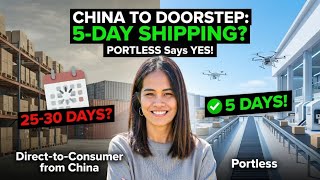
Podcast interview (Move Supply Chain) with Easy Rosenzweig, CEO of Portless, about Portless's direct-from-factory-to-consumer logistics model. Easy explains his background as a DTC founder, the problems of long lead times and cash tied in inventory, and how Portless receives product at factories (e.g., Shenzhen), fulfills orders locally to customers (USPS labels, air cargo), and delivers internationally (50 countries) with priority shipments as fast as ~5–6 days and standard ~8 days. Benefits include reduced lead times, improved cash flow, faster product launches, inventory agility (buy smaller batches, restock fast), and plans to expand operations across manufacturing hubs (Vietnam, India, Bangladesh, Mexico).
Foreign.
Welcome everyone to Move Supply chain podcast where we dive deep into the world of direct to consumer brands and the strategies that drive their success. I'm your host, Lara Guevara and today we are, we have a very special guest joining us. We are thrilled to have Easy Rosenzweig, the CEO of Portlis with us. Easy has an impressive background in DTC and has been at the forefront of revolutionizing how DTC brands manage their logistics and supply chain operations. Portless is known for its innovative and efficient solutions tailored specifically for DTC companies, helping them overcome common challenges and thrive in a competitive market. Today we'll be discussing Easy's journey, the uniques of services of Portless offers and how they support DTC brands in achieving their goals. Welcome to the show Easy. We're excited to have you here.
Laura, thank you so much for having me. Very excited to be here.
All right, let's dive right in. If you can tell us a bit more about your background and how you started in logistics and DTC industry.
Absolutely. I always say the whole thing was a mistake. I originally started getting into the DTC business in 2012 in the early days. I'm from Canada, Toronto, Canada. I'm like, oh, e commerce market's a little less competitive in the, in the Canadian E commerce market. So I started selling products in Canada and then, and I was doing it through the typical supply chain that people have been doing for years, which is I would buy products in different parts of the world, trying to be the main hub. I'll put on containers, I would have to wait. And as I was selling in Toronto, in Canada, I expanded to the States because we're right next to each other. So it was relatively crazy. And, and as the business was growing, the more sales we had, the more orders we had. The supply chain got a lot more complex. In the early days, it's not so complex. Right. When you're selling the early days here, your cash flow is okay, you're out of stock is like not, you know, it's a good thing to be out of stock. Oh, I'm doing something right. But eventually as you grow that business, all of a sudden being out of stock is very costly. And then when you are reordering, you have most of your profit, most of your capital stuck in that inventory. But that's what I did. And I got started into that business and then, and then got, I got, A couple years later, I got very lucky, met some XL Bob executives, became early advisors company. We start doing the direct logistics model. And when we did that our revenue just grew like crazy the next eight years. Pretty much 100% year over year. Ran very capital efficient and a very great cash flow efficient business. And we ship millions and millions of products over the next bunch of years.
As a consumer business and based that business is still active at this point?
No, we actually ran that business. That business is no longer active. So I'm sorry, I got to give the second piece of that context. So we ran that for many years, but then what happened was after like pretty much 10 years, 8 to 10 years of running this consumer business in the direct shipping model. Direct shipping from your factories. We became experts in logistics and then eventually we had a lot of demand for us to help other brands leverage this model. And then we went full into that business, which is called Portless. And now we're essentially a logistics business. We help brands leverage direct from factory shipping to consumer model. And that's what we do full time now.
All right. Okay. Can you give us an overview of Portless and the services you offer?
Absolutely. So as as like I was talking about when I was running a brand and this exists to pretty much most businesses that run e commerce businesses. Supply chain is very bumpy and it's very difficult. Like you buy 10,000 units of A, of a sweater, let's say you're buying it probably months in advance. You have to lay out a ton of money up front. You're putting on a boat, you're waiting 69 days to get it, then you sell it. And what happens is your best color sell it immediately on stock. And your worst colors stay forever. Meaning you have excess inventory and under inventory and it's just a very hard business to manage. Then like what do you do with that excess inventory? And the out of stock bucket is like that's revenue every day you could be getting and you're simply not. Yes. So what Portlis does is we do the logistics. Instead of putting on a boat, you send it to us in your factory. So in China, we're in Shenzhen, so you can have product by us within a day or two from your factory. And once we get it, we have it ready to shift out to your customers within 24 hours. So let's just say July 1st you were done production. Typical supply chain, you'd have to wait to mid September really to start doing business in our model by July 3rd, you're actually selling it to your customers. And what we'll do is we'll get the order, we'll put in an envelope, we'll put a USPS label on it and we will put on cargo planes and pass it over to USPS near your customer. We could deliver packages to customers as fast as under six days on our priority lines. Our standard lines is like eight days. Eight days and change. But it's a fully local experience for the consumer. So the consumer makes a transaction. If we ship it on a priority lines, you'll get it five days later. USB driver, USPS label, total local experience. But now the brand you know has all the benefits, right. Instead of months of bad cash flow, you're getting money out of your inventory. Days post production. You don't need sweaters. You can now buy 3,000 sweaters and ramp up the colors that do well and not have excess inventory and the colors that don't do well. Very agile with your stock, there's a promotion, doing well, lean into it, sell it. Because you could restock really quickly. So portless really. It really changes the way our, the merchants we do business with run their business. Agile inventory, fast restock and we can help you ship to many countries around the world.
Yeah. In first view, hearing your, your business or your service, easy, I thought, wow, it, it will cut the whole lead dime in half or more than half. But at the same time, if you dig deeper, there's a lot of other advantages. Like you can protect your cash flow by ordering lesser quantity than your usual order to so that you're doing it. Yeah, like you're doing more like you've mentioned you're doing or you're ordering a lot of different Skus colors designs because you want to make use of the time or take advantage of that lead time. But with this opportunity, not only we can reduce the lead time in more than half, but also it can really protect your cash flow. And one thing that I'm seeing a very huge advantage is the a shorter time to launch new products which is very, very important for a lot of brands right now. The competition is too high. The way, the number, the frequency of you launching new products is very important. That's why this is going to be helpful. Do you, we also have listeners and clients outside US and Canada. Do you, can you deliver outside US and Canada?
Absolutely. We deliver to 50 countries. Europe is huge for us. We could deliver it to the UK in under 5 days and it's even cheaper. Starts at $4.66 pound. Many countries in Europe deliver depending what country. You know, Eastern Europe has a bit of a longer delivery time, but you're looking like seven days. Australia, New Zealand, all the major Singapore literally We help brands go global and it's not like you need extra inventory. No, same inventory. You're just selling it to more places and we're just putting different labels and making sure it gets to the destination.
Gotcha. And can you share some examples or success stories of TTC brands or even the best type of product that is fitting for portless?
I'll answer both. So the best type of product is in general lighter products. So like think up apparel businesses, electronics businesses, accessory businesses. We're not good for bulky items. So like furniture, bulky products, not a great fit for us. Lighter items are better and apparels is probably one of the biggest categories for us. Then regards to. I'm like what was the other question, Han?
Any success stories of BTC brands that you've helped?
I think the biggest line item that nobody sees on a PNL is being out of stock. It is so underrated. So we have a summer apparel business that we service. They increased their revenue by 50% this year simply by not being out of stock. They said this is their best year of revenue and the most gross margin, the best cash flow they've ever had in the history of the business. 12 year old business. And that's something, if you would look at someone's piano you would have no idea that's missing revenue. But finally when you could simply keep things in stock on the items that count, you will increase your revenue, you will be more profitable, you'll be more capital efficient. And this is just feedback we got like last week because and we're, we're just getting started in the summer because historically you, you can't go back into production July for some somewhat business. So historically they used to be sold out their best selling stuff by end of June because it's hard to predict they were just restocking, selling and selling and selling. Excuse me. So that has been honestly one of the. I had this meeting a week ago with that brand. It was like this is the best feedback I've ever heard. Like this is exactly a great example of how this model changes businesses. And way better economics, better cash flow, better margins, better sales.
I wonder how huge is the surprise of the business owners when they, they don't have idea that they can do such growth since starting a new service because they don't know what they don't know in the beginning for many years that they're operating. That has been the process wherein they're waiting 30, 45 days of shipment and so they're ordering more and lead times high. And so do you have any client that started right away with Portless like a new brand?
Great question. We don't really take on brand new clients and we and I'll explain why we find businesses. First thing you need to do is find a great product, right? Work with your team. Great product, Understand the supply chain, that product. Then two is learn how to sell it. If you're a brand new business and you don't know how to sell like you haven't done marketing yet, you shouldn't be optimizing supply chain because the first six months of your business you just have to know how to sell your product. Product. And that's not where cash flow hurts. Not the first six months. When you start growing your business, you're north of a million bucks and now you have like money being turned over or even if it's a few hundred grand. You got to have an existing business before you start getting too technical on the back end. First find a product. You know, work with Lara, find a great product, then learn how to sell it. Then we could add magic of the supply chain. But what we have seen is a brand in Europe that used to sell one country they were always out of stock. Great brand, great marketing, great product. They were always out of stock. We five extra revenue within four months simply because they were no longer out of stock. And now they ship not only to to that one country but all over Europe, all over Asia and all over the U.S. jimmy, that's a great example of like they weren't huge. They weren't doing a million a month when they started with us. But they quickly got to once they joined us.
And I'm very curious about your background. You've mentioned about starting a business. Do you have also a hu marketing experience before on top of supply chain?
So I learned everything the hard way. Tons of mistakes and then feedback loops. When I ran the consumer business in the first year, you know, I don't know, we maybe did 20 grand of sales. Didn't know anything about marketing. I'm like I think we did Reddit and I would like go on Reddit like hey everyone check out this product. It was like to my site those the before like Reddit would like block you but eventually, right? You just keep learning. And at some point I was doing a ton of ad spend on meta on Facebook back then. So we were literally millions and one year is probably north of 2010 to 20 million. Just tons of revenue. As long as, as long as we got paid back. Like we just keep spending so good efficient marketing and especially in in this world. I was doing market all over the world. Right. Because CPMs and cost per clicks and convert and and is cheaper outside very competitive markets.
Yeah.
So I learned that over time and that was more consumer facing marketing really just in here.
And the reason why I'm asking is because I know that a lot of solutions in making marketing improvement and growth higher is when there's a proper supply chain process in place. And then sometimes a supply chain efficiency process in logistics is should be applied from in the beginning and then or if there are challenges in marketing during any time of the day then you can also solve it with other supply chain solutions. So I think that your experience in doing learning marketing had the experience of actually growing a brand before doing this is a huge, huge help for improving. And speaking of improvement, do you have any innovative solutions or technologies in port as implementing to stay ahead in the DDC logistics?
Yes, stuff that we're working on again and as you said I learned this through the pain of going through it like I was a brand, I understood that the pain points. So for us the one of the tech that's working on is helping our brands understand inventory levels and when to because historically and like you guys, you would know better than most to understand when you need to order something at what point from the factory. It is just so complex. But that's when you had an eight day lead time. If you shorten that to a two day lead time. How do you look at inventory now? So we're looking at tech to like okay, help our brands. We're here to make you run a really efficient business. So now you have, you know, your lead time went down to two days. We also want to reduce your inventory. We want to make sure that your capital is, is, is being used as efficiently as possible. And to do that is okay, how much demand in your inventory? Well it depends on your factory. What are the raw materials being used? What is the production time? And we're so we're looking to dive into all that and really help our brands run even more efficient businesses.
I'm very happy for the E Commerce DTC brand owners that has a lightweight type of product because now they have the option. And then I, I was like I, I would like to give you a little bit of more challenge like how can we help those who have heavier items, bigger items. Do you have any future plans?
It's very difficult I would say to do something like this. You would have to manufacture closer to your market because you can't avoid heavy. Heavy is just like Takes a volumetric space. It's very heavy. So I would say like if you're in the us you might want to look at Mexico. Does Mexico have any good solutions? Lead times out of Mexico, then you could be a little more agile from that side. The problem is a lot of these types of products, the efficiency, the raw materials, the expertise, live in different countries. And you'll have Vietnam clothing and China of course, clothing and electronics and all the other things. But if you do have the ability to manufacture closer to market, that would really be the answer for heavy stuff, lighter stuff. Well, fortunate we have our model heavy stuff. I don't have a good solution yet. I'll keep you posted if it comes up.
Okay. I know that you have a huge warehouse in Guangzhou. Do you have any expansion project coming up?
We're in Vietnam already. We've been running in Vietnam for a while. But what we do is we have, we have a lot of expansion plan. We plan to be in every major manufacturing hub. So India, Thailand, Bangladesh, India, Vietnam, Mexico. So right now we're in Vietnam. We should be adding customers in Q3, but before we expand customers into it, we test things for quite a bit of time. Yeah, every market has its own dynamics, its own customs rules, its own everything. So I would say Q3, we should be able to announce a Vietnam star onboarding customers easy.
I have goosebumps in that news. I just found out it's because Vietnam, India, Bangladesh, Pakistan, those countries, it's harder even to ship products from there. You in China for example, even though it's long, long lead time, you know 100% that you can send your products to anywhere, you'll just have to bear the long lead time. But for, for other countries, you have to make sure that you have a great freight forwarder partners because if not, it's, it's an issue even to how can you send that product to. To us or to other countries. So having, having this project is, is a huge, huge help for a lot of. I know that Vietnam is good. It's really good in apparel and, and other clothing industries. So definitely a huge help for DTC brands.
That's our mission. Our mission is looking at supply chain like how do we just make this easier and easier through the model that didn't exist yesterday. And because of this model, a lot of pain points can now be solved with software, with tack and with operations. And that's all we do.
All right. I have one question coming from someone who doesn't own a brand yet, but I know that the lead Time might be a little bit longer than overnight or 48 hour shipment as compared to using portless. What is your suggestion or advice for owners who wanted to transition to portless but doesn't want to change the way that they're treating their customers in terms of lead time?
Great question. The best brands that we've worked, when we work some very large brands always give optionality. Not always. If they do it, it's optionality. It's not like no one's Amazon. If you're, if you're going to be Amazon, then be on Amazon fba. It's impossible to compete with Amazon, but Amazon's good with commodities. When you're a brand, you're telling a story. You have a unique product and buyers are buying that story, buying that unique product. So for products like that, I would say 98 of our, 95 of our businesses offer 4 to 7 day window and that's the core business and customers are happy. However, there are certain brands that do want optionality. So if you have optionality but we tell brands is okay, let's look at your data. So we look at their historical data. Almost always it's under 10%. I've seen a 5% take express shipping and as high as 8% say okay, well send you pallets, bring less amounts locally to fulfill those express orders. So that's what we help brands do. We have to look at the data, understand how much they locally and then make it a revenue driver. So you say hey, your standard rate is X and that's what we versus your express rate might be another five, ten bucks. And, and so the headache of breaking locally, you get money out of that for that investment.
Gotcha. And do you have any other advice that we'd like to give to new entrepreneurs entering the DTC space?
Yeah, I would. I think advice that I have seen for me worked is honestly just patience. Like learning a new business simply takes time. Like learning golf or any new thing, it takes time. So if you do a couple swings and your shoulder's hurting and it's like oh man, this is harder than I thought. It is harder than you thought. Absolutely. It's gonna be harder than you thought. But give yourself patience. Be okay to make a lot of failures, learn from those failures and then optimize your business, it's gonna take time. Nothing happens overnight. So patience I think would be my one advice there.
We've been, as you know, in the move supply chain. We're offering fractional support to DTC brands and a lot of our clients in the discovery calls mentioning that they are an existing client of Portless and very happy with the service or they are opting to use the service in the near future. So from the time that we connected early this year and a lot of brands have been onboarded, I believe I'm hoping that we might not have solutions yet for very, very huge and big items. But I know that you have covered a lot of support for other DTC brands. Best way to reach out to know more about your service Easy.
Absolutely. The best way is portless.com so you'll learn about the business. You can see a video tour of our facility and then you could submit a ticket and we'll get back to you within 24 hours to learn more about the business or feel free to follow me on X, Twitter, LinkedIn. I'm pretty active in both those platforms. Feel free to send me a DM there. We're always happy to talk to brands that want to learn more about what we do.
Gotcha. Thank you so much. Again, Easy. Thank you for your time. I know that our listeners have learned a lot and hopefully they book a call, book a discovery call and start saving, start optimizing their logistics supply chain with Portless.
Thank you so much.
Thank you so much.
Thanks so much.
More from Lara

Your Best Seller Sells Out on Day One of BFCM. What’s the Plan? #bfcm #inventorysystems #ecommerce



Your Best Seller Sells Out on Day One of BFCM. Then What? #bfcm #inventorytracking

Don't Know Where Your Raw Materials Come From? Start Here #sourcingagent #supplychainplanning




Moved Production Out of China? Documentation Is the Real Fix #sourcingchina #supplychainsolutions

Sourcing From China, Vietnam or India? The Fix Isn't a Fourth Country #sourcingchina #supplychain

Moving Production Out of China Didn't Fix Your Tariff Exposure #sourcingtips #supplychainmanagement