Logistics Under Pressure: Factory to Fulfillment Before BFCM Hits
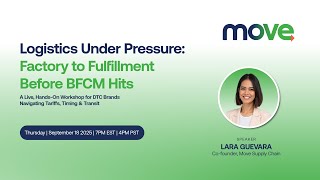
Lara Guevara (founder, MOVE Supply Chain) leads a workshop helping founders and supply-chain teams prepare logistics for Black Friday/Cyber Monday (BFCM) and impending tariff changes. The session focuses on the gap between factory and warehouse — routes, transit-time vs cost tradeoffs (sea, air, hybrid), port choices and congestion, split-container and split-warehouse strategies, bonded/FTZ options, and concrete planning tools (vendor→warehouse template, landed-cost calculator, checklist). Practical forwarder-level tactics (vessel schedules, CY cutoffs, GRI/PSS timing, free days/demurrage, shadow bookings, inspection risks, carrier alliances) and action items (confirm backup ports/forwarders, run landed-cost scenarios, lock rates) are emphasized to protect margins and avoid missing BFCM.
Questions this video answers
13–15 days (sailing only); full lead time often 30–40 days when counting scheduling and port/land legs).
28–35 days (sailing only).
16–20 days (can add 2–5 days extra handling risk).
3–6 days.
FCL: US $3,200 for ~28 days lead time; LCL: US $4,000 for ~35 days; Air: US $8,500 for ~6 days.
Foreign A brief intro I'm Lara Guevara, founder of MOVE Supply Chain and I'm so glad to be helping you with this workshop today. I'm so excited to share that this work for this workshop with you. Because this is something that is not commonly discussed within Supply chain and within founders. We usually rely on our logistics partner or our freight forwarder. And there's nothing wrong with that. They are our partners and we should maximize their support to us and this is their work. But what's not right is when we don't have any idea of what's happening. Like if they say there's delay here and there, we just accept it. And if they say that there are disruptions in our logistics and shipment, we don't know what to ask. So my goal for today is after this session, when you leave tonight, you'll have the information to discuss with your team and your freight forwarders and come up with concrete logistics plan that can save you thousands of dollars and hours of stress before bfcm. So in one word, what's your biggest logistics headache right now? And there can be different answers to this. It can be delays, which is the usual logistics problem that is commonly discussed. And then there's another one which is tariff that we're experiencing right now because that's another layer that we are actually discussing today a little bit because of its impact to our logistics. And then there are also issues on lead times, split shipments, port congestions, warehouse issues. Yeah, and those scheduling, those are some of the logistics headache right now. And if you have anything that you would like to share, you can definitely chat in the our chat box and we can also discuss that. And if you have any questions, feel free to write it down and I will try to answer it right away. Okay, so that's exactly the issues that I've shared earlier is exactly what we'll tackle today. This year is a little bit more different because not only we do have the usual BFCM madness, but November tariff announcements are also looming. And that's why we're here to prepare before any chaos hits. So there's the usual BFCM issue, the November tariff and then your freight and margin is at risk. So let's talk about the stretch most founders overlook. And this is what happens between your factory and your warehouse. Everyone obsesses about the last mile or the production with the vendors, or the end to end, but they if you get this wrong, this gap, you don't even make it to the last mile. And as an example, a brand that delayed booking Ocean Freight and ended up paying 2x for air freight. I'll tell you later on. Why do you miss any schedule? I'll share with you that. And then example number two, another brand picked the wrong port and sat in congestion for three weeks and they missed Black Friday entirely. So those are some really real life examples that we've experienced during BFCM and those are the examples that we're trying to avoid. So this line that you're seeing in your screen right now is the hidden zone where profit vanish or multiply from factory to port, which is the actual freight, the warehouse and the last mile. Okay, time to get hands on. I will be sharing in the chat box the link to our template today. We'll be using a lot of this in this session. I'll be also sharing screen in this template. This is a vendor to warehouse simulation template. The steps are to list down your top two vendors and then add your current freight path. If you know this, if you don't know this yet, this is the activity that you need to do with your logistics team later on or with your freight forwarder. You should ask this which requires port of origin, shipping method and destination warehouse. Now mark your backup options. Do you have a secondary port or another 3 PL or if you're relying to one path then we need to discuss if there are still time to discuss your options with your freight forwarders. And in your screen right now you'll be seeing different routes plants that is common from Asia to us. So our first primary option is always the primary is West Coast, LA or Long Beach. And this is the primary because this is also the lowest cost. So the Transit time is 13 to 15 days. When I say transit time, this is only the sailing time right there are the full lead time of your shipment. That's why it's longer. It's because you need to wait for a schedule. Sometimes they stop in different ports and I'll explain that later on as well. And sometimes there are most of the time there are port congestions. So 13 to 15 days plus all of those other activities it takes 30 quickly to 30, 35, 40 days. The advantage of the primary west coast. This is the fastest frequent sailings established. And the disadvantage is that there's a congestion risk because of this frequent sailings, a lot of strikes and chassis shortages. Then there's an alternative instead of la, Long beach or LA and LB instead of that we deliver to Port of Oakland, Seattle and Tacoma. So it's a little bit more days, 14 to 18 days and a little bit more expensive than the primary this avoids the LA congestion and good for Midwest. But there's a limited capacity because of the fewer sailings. And then there's the third option, the all water east coast, the Panama canal which is 28 to 35 days, a lot more expensive, extensive. This is direct to east coast and avoids the US trail. So if the delivery warehouse is in east coast, this avoids the land, the land travel because it will go directly to the east coast port. Longer lead time. Of course the sailing only the sailing alone is 28 to 35 days and there are so many canal restrictions. Then there's also trans shipment via Asian hubs like Hong Kong, Kaohsiung and busan. This is 16 to 20 days. This is flexible sailings back up. If direct sales, this is. This can add 2 to 5 days extra handling risk. And then there's also a hybrid ocean and air which we usually do air. We will ship some in the air for three to six, six days and we will ship ocean for 13 to 35 days. And the cost is of course high because there's a air shipment or a courier shipment. Then what's the advantage is that we can identify the quantity that you need to be sending to your warehouse urgently and that's going to be sent via air and then the remaining via sea or via ocean. Of course very expensive and only for small volumes. So now I'm sharing the template that you can use with your group. Later on I'll explain this. So vendor name, country of origin as an example and then port of origin. You can definitely ask your vendor about this or your freight forwarder. They should be able to answer you the port of origin because they usually choose the nearest. There are situations that they choose other port because the nearest port that they have is very congested. So when you talk to them, it's going to be helpful if you ask what will be the port of origin when we ship this via sea and then what's the name of your forwarder? Port of entry which is either la, lb, Savannah, if air lax bonded warehouse. Is it east coast coast or Oakland port And then destination warehouse. Please write your warehouse where the trans. Where the goods will be delivered and then the transit time, the cost, the duty rate and add any risk notes. This template is a good check in for all of your team to understand whether you have a, whether you have a big risk or you have a good route for this BFCM shipments and not only for bfcm. Actually. If you are of course in tight lead time and you cannot afford any delays, this is exactly the template that you should be filling out, your team should be filling out or your vendor and freight forwarder should be informed or giving you the data so that you have options or you can understand what are the risks options for you. And then on the second tab, this is the same table that I shared in the slide earlier. And as a guide you can also get this one going back again with your sheets that I shared. These your top two vendors add your current free path, port of origin, shipping method, destination, warehouse and mark your backup options. After filling this out, you'll notice the gaps right away. Most brands depend on a single route and that's risky. So you have to discuss the result of your template or the template with your partners. Okay, so just discussing more about your options. So earlier I shared with you the different routes but this is more in detail and again I'm sharing you this not for you to obsess on each side stocks of the ports, but I'm sharing you this right now so that you have the idea on how to discuss this with your freight forwarders. You don't have to do it alone but if you have the information and you have the right questions to ask your freight forwarders and partners then it's definitely a lot helpful than just them than just relying it to them. So here you go, option number one. Usually this is the Shenzhen port. They start with the Shenzhen port which is the Yantian terminal. This is where container is loaded and then the vessel departs Pearl river delta and then you use Taiwan Strait. Vessels typically pass east of Taiwan and then Pacific Ocean crossing. This is the mainland. This is the longest one at 10 to 14 days. Some carriers make a quick call at Kaohsiung, Taiwan or Hong Kong before heading east. Occasionally vessels stop at Busan, South Korea or Yokohama, Japan depending on the service loop. So why do you need to know this sometimes when you book like a fast sea and a slow sea because there are different types of via sea shipment. When you book the slow sea this is where they have many stops like this. And when you book the faster C that's why it's faster because from the container is loaded it goes straight to the US which is 10 to 14 days. That's why you can, you can, you can hear from your freight forwarder that if you book this fast sea then you can get your that you can get your products earlier. And of course it's more expensive than the slow sea. So arrival at US west coast it's either in Port of LA or Port of Long beach which is basically the most congested ports in the west. Alternative option is west. In the west coast ports instead of LA and lb, you ship to port of Oakland, less congested, good for west coast distribution, Port of Seattle or Tacoma, faster rails to the Midwest and Port of Portland, but limited service. But you can avoid LA congestion. Of course you can avoid port congestion. Why do you want to avoid this? Because port congestions alone is quickly 14 days lead time. But there are fewer sailings higher inland transport costs. If your main market is east coast then there's option number three, all water route to US east coast. So instead of stopping in west and then doing the land route, you're going straight to the east coast which is from Shenzhen to Pacific, crossing Panama Canal and east coast ports like Savannah, New York, Houston. So transit time alone is 28 to 35 days versus 13 to 15 days to LA. But there's a huge port congestion that is 14 to 20 days. You already saved days for this all water route to east coast. So again direct to east coast customers avoids west coast rail bottlenecks and the port congestion. And the cons is longer transit, higher cost and Panama Canal drought restrictions can delay. Okay, your map, I just simulated this. So you have an idea why it's longer, why it's shorter. And from the port of origin to your destination you can see why stopping in some of the Kaohsiung and other like Busan can add two to three days to your lead time. And what's the difference between Long Beach LA to Oakland and the all water to New York and Savannah. And you will be getting this presentation. So just you have a visual interpretation of the route that I've shared earlier. Okay, now let's go to the cost versus time scenarios. Let's talk about money and time and every decision whether it's full container load or FCL or lcl, loose container load or airfreight, it changes your landed cost and your timeline. So I'll be sharing in your screen the air and C calculator. Okay, I just shared the link in the chat box. So there are, there's the instruction in the first tab and you have to input your product details and your freight cost and then from, from this information that you're giving me. So giving the table for example you were able to add the total units of this shipment of the weight per unit, your unit cost, then air freight cost, ocean freight cost that is coming from your freight forwarders of course and then transit time, tariff insurance and warehousing. You will see in the summary the freight cost per unit, air versus ocean based on the information that you've added in the input part and the decision guide for founders is usually if it's high margin, urgent launch, we consider air. If it's low margin, no urgency, we use ocean. But if it's a moderate margin and timeline pressure, split is the best option. So if you want to play around split option, this tab can be useful for you. So all you have to do is to try changing the custom area. So with the scenarios it's already fixed wherein the conservative is 20% air, 80% ocean. For balance it's 3070 for aggressive 4060. And you will already see the impact on your margin and the weighted landed per unit. So this is very, very help. You can easily decide if you're planning to split via air and via sea. I can say at this point that I can do aggressive if I need it badly because 15.7 for example is acceptable for me. And so if you want to make it custom like it's not included in our scenario, then you can try 5050 or maybe 60% air and then it will automatically compute that ocean is 40 and you'll see that the weighted landed cost is 16.5. So this is very helpful in simulating your shipment if you prefer to split air and sea. Okay, very important that you complete this input tab first because this will determine all of the information that you need to see in the summary tab. So in the example that I'm sharing it is recommending air. So if you change your data in the input, it can recommend C or it can recommend split. So let's try an example of changing the unit cost. Changing the unit cost and the weight per unit. Okay, so after changing the information so for example you have 500 units and it's heavyweight product at 3kg. Then your your air freight suddenly spiked up to 75 because of the weight of the product and your ocean is your recommendations split. So play this, play around this template that I've shared with you. Make a copy please and you will see you will have more idea how to decide whether you're going for air, going for sea, going for split. Okay, so I hope that helps. Scenario that I'm sharing in this slide is some information from the tariff landed cost trade off calculator. FCL from China to LA is usually 3200 for 28 days lead time. Scenario number two is LCL. If you cannot complete a full container load, it's at 4,000 for 35 days. And then air freight is usually 8,500 for six days. So these are just to show you the difference on their costs. So run the numbers for one of your SKUs in the calculator I've given. If you don't have the information right now, you can use, you can ask your team to do it for you or your freight forwarders to do it for you. So sometimes paying more upfront saves you more in lost sales. So that's why a lot of founders decide doing air freight or split shipment and sometimes it's the opposite. That's why scenario planning matters. So how resilient are you in this BFCM shipment that you have that is upcoming? So we have a checklist that is also part of the sheet that I shared earlier. The checklist includes how many multiple warehouses? How many warehouses do you have? Do you have a bandit or duty deferred storage? Do you have backup for waters and ports? Do you know your lead time and buffer? So drop your total score. This is the tab that I'm talking about. You can if it's no, it's 1, if it's yes, it's 5. And then you can check your score and decide. This is just to show you quickly how risky is your planning this PFCM in terms of logistics. Of course, after seeing your score, whether it's risky, low risk, medium years or high risk, it is very important that you know the routes and the options that you have. And I'll be sharing more information about this in the next slide. So again, for checklists, multiple warehouses we have that. Do we have bonded warehouse, we have backup forwarders or and do we have any lead time buffers? Most of the time the lead time buffer is gone after having delays in production, quality check or scheduling. So we can't afford any more delays after that. Okay, so here's where winners separate from the rest. This is the flexible warehousing. So examples that east versus west coast shipments, this reduced transit times. So split shipment is not only via sea versus via air, it is also east versus west. So if you have 100 units of those products that you're going to sell, what is the split that you should be sending to east and that you should be sending to west. So it's possible because if you're LCL anyway, you can ask your freight forwarder to split the shipment. 50% go to east to save on cost and 50% go directly. Sorry, go to west to save on cost and 50% goes to east directly to reduce transit time to avoid congestion. And for the warehouse in east coast to Receive your products as early as possible. And that's an example for bonded warehouse is delayed duties until order ship. And that is going to help you so much in your cash flow, especially if tariff is holding you back at this point. Bonded warehouse, there are different options. You can find options in China, you can find options in the US and that can help you delay the junctees. And then there's also FBA prep hubs then act as backup storage. So flexibility isn't just survival for us, especially this season. This will also help your margin. This will protect your margin. Okay, so placing inventory in east plus west coast warehouses allows faster delivery and cheaper domestic shipping. So if your brand is still small, maybe you're asking, I have a very small quantity, how can I split it? It's still possible if you find small warehouses too. So there are family owned small warehouses that you can tap if your quantity is not big enough for the bigger players, the three PLs in the east and west. But it will not, it should, should not be a showstopper for you if you wanted to split. Especially if you have a lot of customers in the east and a lot of customers in the west or it's somehow 50 50. You'll see that in her Shopify reports. That's what we do. That's what we did with another client that we have. We identified where are the customers coming from and if it's close like 4555 or 5050 or then you should consider having two warehouses and there are so many platforms. Again your question is, will it be super hard to track this in our, in our system? No. There are so many systems that can help support tracking two or more warehouses. So a brand serving both NYC and LA customers cuts two to three days from average delivery time. If you have east and west coast warehouses then for the 3PL network flexibility, having two or more 3PLs reduces dependency risk. If one TPL gets congested before BFCM, you can reroute containers to other and the next is the bonded warehouse or bonded versus FTZ or foreign trade zone. So expand unbonded warehouses where duties are deferred until goods leave. While FTCs in the US allow relabeling and repacking before duties apply. So this is great for brands facing tariff uncertainty this November. So know your options between bonded versus FTZ or foreign trade zones and then forward positioning for DTC plus B2B. Some brands separate DTC inventory like Amazon FBA prep centers and B2B inventory for wholesale orders at Regional 3PL. So this prevents one channel from starving the other. And this is very important discussion also with your team. If you have retail, if you have a shop shopify, if you have FBA and then you have wholesale clients then the omnichannel advantage using warehouse close to retail partners or Amazon hubs and your own E comm channels creates optionality. So during the FCM this flexibility is faster order cycle plus fewer step outs. So it will help you definitely increase your sales and get more at the same time. Micro fulfillment and overflowing warehouses so smaller satellite warehouse near major cities can act as overflow during BFCM surges. Even short term 30 to 60 days spaces rentals or space rentals can save thousands in penalties for missed orders. And then there's a freight cost optimization. Splitting imports between east and west coast can lower inland transport cost. Example sending midwest bound freight directly to Savannah instead of LA plus trail. So flexibility protects both your speed and your margin. And warehousing is not just a storage, it's a strategic lever in your supply chain. So make sure to discuss these options. Okay so in this scenario, in this activity you need to list two concrete actions you take tomorrow or after this workshop. For example you shift skua to bonded warehouse or reroute container to Savannah or delay clearance. These are the topics that you should be discussing with your logistics team and freight forwarders. So yeah, together with that you have to be scheduling your activities the next seven days after this workshop. Confirm warehouse flexibility lock back up forwarder run landed cost scenarios when we look for freight forwarders we usually choose the cheapest or depending on our goal we used to, we can choose the fastest. But it's all there are so many freight forwarders that you can choose two to three. So you have your first one, your option one and then you have backup one and backup two. So total three options of forwarders and run landed cost scenarios. So even if you have a higher quotation from that freight forwarder, you know the impact in your margin. Okay so the tools you will get actually in after this presentation after this workshop is the pert based logistics tracker, landed cost calculator, the tariff proof routing playbook and the simulation template I shared earlier. So okay, I would love to share with you some forwarders, freight forwarder secrets and logistics secrets that mostly founders don't know. And this information is sometimes even limited to freight forwarders. So I'm sharing this with you so you have an idea. So what's your single best logistics hack for bfcm? It can be a lot of hacks from everything that we've shared today but also there are main hacks that you can be focusing on especially if you're at risk this bfcm. So first and foremost I wanted to share with you the carrier alliances and sailing schedules. So not all sailings are equal. So even from the same port. So even if you're coming from the same port, forwarders know which carrier alliances are running the lanes. So for example the Alliance, Ocean alliance and 2M those are example alliances. And as an example two vessels leaving Yanti an on the same day or Shenzhen port, one hits La in 13 days and the other in 20 days because of the stopovers. So always ask your forwarder for the vessel's schedule, not just the etd. Sometimes, most of the time or all the time, you're just asking what's the ETD and what's the eta? A same day sailing can mean a week of difference in eta. So ETD ETA and then ask the vessel schedule then cut off dates and CY closing the closing time for containers at origin port or CY closing cut off is usually two to three days before the vessel depart. So I told you earlier some of the most problem that are are that DTC encounters is when they thought they made it on time. But actually when your goods are ready you have to wait a little bit more because you missed the cut off for that specific vessel. So many brands think ETD or estimated time of departure is the real deadline. No it's not. It's few days before that. And if you're missing CY cut off by even 12 hours your cargo rolls to the next vessel. So which in peak season can mean if it rolls to the next vessel it can mean additional 7 to 10 days delay. Next is the GRI general rate increases or the PSS the peak season surcharges. A lot of you don't ask this because you either you don't know or you don't care because it's urgent and it's required by hook or by group to be sending your products to the us. But it's helpful to know what are GRI and pss. So GRI carrier announces the GRIS and surcharges at the start of every month. So forwarders see this coming. But brands often get blindsided. So when it's the beginning of the month they issue that cost whether there are increases, decreases or peak charges. So if you're booking before BFCM lock your freight rates before the 1st or the 15th of the month. That's when carriers usually apply increases. So before okay make sure that you work with your freight forwarder to book you the rates before. Because even if your products are not rent ready, for example, it's in the packaging process or it's in the QC process, the last part of the production process, and it's almost ready, you can already lock in your freight, which is again before the 1st or the 15th is the best time. It's just like booking an air freight, right when you're trying to book a flight to your vacation. For vacation work, you usually have specific timings when to book, so it's cheaper. It's same thing with these vessels and couriers. Then free days and demurrage detention. The real cost trap isn't actually the ocean freight, it's the fees at the warehouse or port. Okay, so forwarders know how many free days you get for your container, usually three to seven days. Every extra day in the container it will charge you 150 to 250 in demarrage. So make sure that you know the number of free days that you have. Confirm it with your freight forwarders so you know when to act or how to ensure that it will go out of that container before it starts charging you the demarrage. So before you ship, confirm your free days at destination. That's where brands bleed margin without realizing it. Then another one is the port congestion and chassis shortages. So forwarders get real time congestion updates that never make it to public trackers like us, the brand owners and supply chain experts. Example, LA might have vessels waiting seven days while Oakland is wide open. And why will they not share this information? Because sometimes rerouting takes a lot of work, takes a lot of effort. And so if they know that you will ask for a rerouting, then it's more work for them. So make sure that your partner, your freight forwarder is really a partner. If they care about you, if they care about the relationship and your margins and your lead times, they will help you find a port that is less congested. We experienced this before two years ago in our BFCM for an apparel brand. So the LALB beach is the port, the LALB port is too congested and it's the worst congestion that we've experienced. And our freight forwarder was so proactive, we've been using them for I think more than five years now. And they even before it hits the port, they reroute it to another port nearby. And that saved us so much, so many days and of course savings in our margin. So ask your forwarder weekly or even ask your forwarder to update you weekly so you don't have to ask quickly which US ports have delays. Rerouting to a quieter port can save you a week and thousands in fees. So if again if you're freight forwarder discouraged doing this or rejected you for that request of updating you, then that's a red flag. Trans shipment risks so some direct services actually stop at Busan or Kaohsiung for trans shipment, adding two to five days. So I'll always ask if your sailing is a direct call or if it's a trans shipment. It looks the same on your booking sheet but adds hidden delays. If two to three days is not something that is critical for your shipment, then you can let this go because trans shipment is actually something that is not. Avoid cargo is overloaded or the cargo is underutilized. 7. Warehouse receiving hours and appointment systems so US warehouses often require appointments to unload containers. Sometimes books out three to five days. So after our savings in our production saving in lead time in our shipment, then it gets to wait in our warehouse because we did not schedule it. So again, if your forwarder doesn't pre book the warehouse appointments or if this is your responsibility, the brand's responsibility to pre book the warehouse receiving your container might still sit at the port racking up demarage. So because your warehouse will not accept the delivery, it will wait for how many days in the port. So make sure this step is considered and prepared for Next is the split container strategy. We've been discussing split container strategy for a very long time. Forwarders sometimes recommend splitting one SKU into multiple containers or mixing SKUs differently. This reduce the risk of single container getting delayed or inspected. So inspection is random and if it's randomly selected for inspection, especially this tariff season, sometimes it's not random anymore because of the tariff and because of the random inspection. Your risk is too high if all of your BFCM shipment is in one container. So again even if it's the same route to LA or lb, split the container if your lead time is very critical, if your lead time is essential that even one delay can make or break your BFCM sales, you should consider this so that if one container decides to do trans shipment, or one container had an issue, or one container got randomly chosen for a inspection in the port, then another container is available for delivery. Never put your entire bestseller in one container, especially in this season if it's not at risk. Like if you have a lot of lead time and like you were good in freight, you were good in forecasting and there's no production Delay, then don't do this. But if you are in a very tight timeline and BFCM is coming, never put your entire best seller in one container. Spread the risk. One inspection can paralyze your BSEM, customs exams and X ray holds. So U.S. customs randomly selects containers for X ray or full inspection. This is what I've mentioned earlier. Forwarders know which HTS codes or ports are hot for inspections that month. So if your forwarder did not share you this, it's possibly because they don't want to do the rerouting. So ask your forwarder about inspection risk on your category. A single hold can delay you five to 10 days. And sometimes you cannot control the other client's products. Right? If you're an lcl, maybe they have products in the same container with you that is prone to inspection. What you need to do in this case is to ask your freight forwarder if they know if there are ports that are hot in the list. If yes, you need to reroute. And if not, you can just split your shipment. So if one get old put on hold, then you have one more that will be released on time. Then there's a backup booking trick. This is one of my favorite because my freight forwarder who is very closely working with us is has shared this. Smart forwarders book two vessels, the same shipment with the same shipment, then cancel one the last moment once the container makes the cut off. So it's the strategy of your freight forwarders to ensure that you're not going to miss any schedule. Because during peak season you can ask your freight forwarder if they can make a shadow booking. It costs nothing extra but can save you from a rollover. So for example, if you you have a production ending that is about to be finished by September 20th, let's say September 25th, but the cut off is actually September 27th. So it's too tight. You have only two days. And when your vendor is having some delays in packing or qa, you might miss the cut off. You might roll over to the next one. So what happens is your freight Forwarder will book two will book twice with a different container and then one with September 27th cut off. Maybe one September 28th cut off. So just one day delay, but one day difference. But you will be avoiding the rollover. Okay? So don't forget this. Those are what your forwarders know, but you probably don't. So if you understand this, you stop being at the mercy of freight. So I'll be sharing those 10 secrets with you as well. It's part of this presentation and when you know and when you have more knowledge, your freight forwarder cannot simply be the decision maker on your products. And it's very important that you know how to work with them because without their working relationship, without a good working relationship, they might just shortcut everything for you. So ensure that you are having a good relationship with your freight forwarders as well. They can save you a lot of times in margin, in your margin and also the lead time. Just a very few more information that I'd like to share before we end our training, our workshop. I've mentioned some of this earlier, but I wanted to just share with you Secrets after Sailing what really happens on the water? So not all direct routes are direct. I've mentioned this. Some service have hidden transshipment stops at Busan and Yokohama. This adds two to seven days and then speed versus slow steam. This is the what they call the fast versus slow Ocean carriers sometimes slow down ships or slow steaming to save fuel cost. So a 15 day crossing can quietly become 18 days. So tip for forwarders, know which alliances slow steam. So ask for the first. Ask for the fast service loop names like PSW2 or PPX. They know exactly what that means. So you should just know what questions to ask. And then Blank sailings and vessel rollover carrier cancel sailings or blank sailings to control capacity. So even after sailing, a container may get rolled at transshipment port if capacity is overbooked. Ask if your vessel is part of blank sailing program. Congestion at US ports ETA to LA might be 14 days, but if the vessel waits 7 days outside port, your transit is effectively 21 days. Rail bottlenecks so we've been discussing a lot of biase information, but rail bottlenecks is real. If your freight is going Inland, Chicago, Dallas, New York, New Jersey, the rail leg can add five to 10 days. So you can ask what's the estimated rail dwell time? And then next is customs exams at transshipment hub. So we thought that customs exams are just in the destination, but it's not. It's not just in the US Containers can be flagged for inspection in Busan or Kaohsiung. So if you know this, if you're the freight forwarder knows this, it can prevent delays. All right. So again your freight is controlled by one carrier. It's controlled by an alliance. If you know how alliances work, you can predict delays, avoid rollovers and negotiate smarter with your forwarder. It's similar alliances to the air freight community. If you know the sky alliances and in These alliances, they have groups because they share codes, they share flights if you experience like flying United Manila to us but actually a code share with Philippine Airlines because they are alliances. So this is happening also with the shipments for your goods. So alliances are quite like information that your freight forwarder should know but not going to hurt. If you know this as well, you might say it's too much information for me. Then you don't have to memorize it, just print it and post it somewhere in your office or just share this document to your team members just so they have an idea. Because alliance is like airline code share and major carriers share vessels, space and schedules to cover the global roads and it's unavoidable. So for example your booking might say Costco but your containers is actually on CMA CGM ship. So that's happening. And why do they exist? This is to control or to reduce cost and control capacity. Shipping is capital intensive so they need this and carriers cannot run every route profitably. So they pull their resources and how to use this knowledge. If you know this as a brand owner you can ask the right questions like which alliance this sailing on? What's their on time reliability right now? Like you know that when you're booking a cheaper airline versus the flagship carrier. If your budget, if you don't have budget for this, you, you're choosing the budget friendly. But you're like you're. You have already accepted even before you fly that your flight might be delayed because they already have that image of being delayed. So same thing with alliance. Some alliances are known for their reliability, some are known for their delays. Don't just ask for ETD or eta, ask for service loop code and compare. And then if you're, if all of your containers are all in one alliance, you're at risk. So you can split across two and then watch the news. Alliance reshuffle so pricing and reliability shifts plan buffer inventory when alliance negotiates. So you're now more prepared than 90% of brands having or heading to BFCM. Again, just because brands did not spend time or does not spend time working or learning about logistics. And I know that a lot of this has been overwhelming information new terms for you. But I highly suggest that you take in the information one day at a time. Like you will be receiving the recording, you will be receiving the template, the presentation. If you don't have the time to do this then at least share it to your COO or your supply chain manager or logistics expert. At least one from your company know about this right? And don't forget to follow Supply Chain Join us in our Slack supply chain lounge Paul if you can share our link 3 in the chat there are all our socials are there and then subscribe to our newsletter unboxed weekly. So if you like this kind of workshops and webinars there are so many other sources that you can that's the link. If you like this workshop you'll enjoy our YouTube. Our Slack channel lounge is for free. Founders are there. You can ask free questions to our experts for free. You can join different conversations about logistics. Also there are inventory planning, part sourcing, new product development and our socials as well is providing awareness and education on supply chain for DTC brands. Thank you so much everyone for joining. I hope not only if this is overwhelming but it helps you prepare for bfcm. Again the last effort for BFCM is our logistics. Thank you everyone and you'll be receiving copy of this presentation and templates and also the recording.
More from Lara

Your Best Seller Sells Out on Day One of BFCM. What’s the Plan? #bfcm #inventorysystems #ecommerce



Your Best Seller Sells Out on Day One of BFCM. Then What? #bfcm #inventorytracking

Don't Know Where Your Raw Materials Come From? Start Here #sourcingagent #supplychainplanning




Moved Production Out of China? Documentation Is the Real Fix #sourcingchina #supplychainsolutions

Sourcing From China, Vietnam or India? The Fix Isn't a Fourth Country #sourcingchina #supplychain

Moving Production Out of China Didn't Fix Your Tariff Exposure #sourcingtips #supplychainmanagement