The $120K Mistake That Cost Luna $800K in Lost Margins
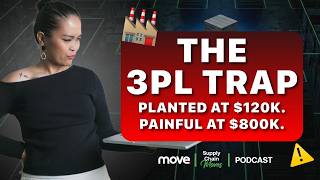
Lara Guevara warns DTC founders that hiring a 3PL too early is the costliest supply chain mistake. A skincare brand called Luna hired one at $120K revenue and lost $800K in margins due to hidden fees and inflexible contracts. She outlines when a 3PL makes sense: 1,000+ orders monthly, stable products, and fees below 50% of gross margin.
Chapters
Get a 3PL. That's advice, right? You're doing $500K, $100K, $200K in revenue, you're packing boxes in your garage or your spare bedroom, and everyone tells you, you need to scale, get a 3PL. And here's the truth, that advice is going to cost you. I've watched founders sign 3PL contracts at $150K in revenue and get trapped in minimums they couldn't meet, locked into processes that didn't fit their business, bleeding cash on a scalable solution before they had anything worth scaling. This is mistake number 1 of 12 supply chain mistakes that founders start in pre-revenue. Mistakes that seem smart, that Everyone tells you to make that plant the seeds of problems you won't feel until you're 10x bigger. Planted at $30K, painful at $3 million. Welcome to season 1. Let's talk about why you don't need a 3PL yet. You're listening to Supply Chain Moves, the podcast where I tell DTC founders what they actually need to hear about operations, not what sounds good. I'm Lara. I've spent 17 years in supply chain, from enterprise operations to helping hundreds of DTC brands figure out what actually works at your stage. This is Season 1, 12 Supply Chain Mistakes You Start in Pre-Revenue. Episode 1, You Don't Need a 3PL Yet. Planted at $30K, painful at $3M. Let's go. Before we dive in into mistake number 1, let me tell you what this season is about, because this isn't a random collection of tips. This is a system. So if you're here, probably doing somewhere between $0 and $500K in revenue, maybe pre-launch, maybe you just hit your first $10K month, maybe you're grinding toward $100K. And if you're like most founders at this stage, you are drowning in advice. Get a 3PL, build a forecasting model, negotiate your MOQs, optimize your landed cost. Everyone has opinions. Especially if you're following so many DTC experts in social media. Here's what I want you to know: most of that advice is wrong for you. Not wrong in general, wrong for your stage. See, most supply chain advice comes from people who work with 10 million, 20 million, 50 million brands. Great advice for those brands, but when you're at 100K trying to apply 10 million playbooks, you don't get efficient operations. You get expensive mistakes that compound over time. Over the next 12 weeks, I'm covering 12 of these mistakes, one per episode. And today we're starting with the biggest one, the one I see more than any other: signing up a 3PL before you're ready. So let me paint the picture. You're a founder, you're doing $100K, $150K, maybe $200K in revenue. Things are working, orders are coming in, and you're packing every single box yourself. Or you and your partner, or you and the one overworked assistant. It's exhausting. You're spending hours a day on fulfillment instead of growing the business. You're drowning in packaging tape and shipping labels. And every successful brand you know on Twitter, they have a 3PL. They've outsourced fulfillment. They talk about focusing on what matters. So you think, I need to scale. I need to get it at 3 PM. That's what real brands do. And honestly, that logic makes sense. Outsourcing fulfillment so you can focus on growth sounds smart. It sounds mature. It sounds like what you're supposed to do. But here's the problem. A 3PL at your stage isn't scaling. It's a trap. And let me explain why. Trap number 1: minimums. Most 3PLs have minimum order requirements or minimum monthly fees. Could be 500 orders a month, could be $2,000 per month regardless of volume. And when you're doing 200 orders a month, you're paying for capacity you're not using. That's cash, your most precious resource at this stage, going out the door for nothing. Trap number 2, lock-in. 3PL typically have terms, 6 months, a year, sometimes longer. And here's what nobody tells you. At your stage, your business is going to change a lot. And your product mix will change, your packaging will change, maybe your whole business model will pivot, and you'll be locked into processes and systems that don't fit anymore. Trap number 3, loss of learning. This is the sneaky one. When you're packing your own orders, you learn things. You see which products get returned, you notice packaging issues, you understand your fulfillment cost down to the penny. When you hand that off to a 3PL at $150K, you lose that learning at exactly the stage when you need it most. Trap number 4: the wrong kind of scale. Here's the thing, a 3PL optimizes for efficiency at volume. That's their whole business model. But you don't have volume yet. You have variability, you have experiments, you have weeks where you do 50 orders and weeks where you do 300. A 3PL system are not built for that. They built for consistency, consistency that you don't have yet. I've watched founders get trapped by all 4, sometimes all at once. Now let me show you how this compounds. Let's say you sign with a 3PL at $150K in revenue. You're doing maybe 300 orders a month. The 3PL has 500 order minimum, so you're paying for 200 orders you're not using. That's maybe $400 to $600 per month in waste. Annoying but manageable, right? But here's what happens over time. Month 3, you want to test new packaging, but changing packaging with a 3PL means new SKUs, new onboarding, new fees. So you don't test it. You stick with the packaging that's fine instead of great. Then month 5, you realize your hero product has a quality issue. Customers are complaining about damaged items, but you're not seeing the products anymore, the 3PLs, and they're not incentivized to tell you about a problem that's within acceptable damage rates. Then month 8, you want to launch a new product line, but the 3PLs onboarding process takes 4 to 6 weeks and costs $500 per SKU. So you delay the launch, or you launch with fewer variants. Either way, you're making business decisions based on your 3PLs' limitations, not your market opportunity. Then comes month 12. Your contract is up for renewal. You've grown to $400K. The 3PL wants a rate increase. Their cost went up, but you're locked in. You don't have the infrastructure to bring fulfillment back in-house, and switching 3PLs is a nightmare. So you sign again at higher rates. You see the pattern? The decision to get a 3PL at $150K didn't just cost you money that month. It shaped every operation's decisions for the next year. It slowed down your experiments, it hid problems from you, it limited your agility. Blunted at $150K, painful at $500K, and by the time you hit $1 million, $2 million, $3 million, you've built your entire operations around constraints that should have been there in the first place. Now let me tell you a brand I've worked with, we'll call them Luna. It's a skincare brand. Luna started like a lot of brands do. Founder had a great product, built a following on Instagram, started getting orders. By month 6, she was doing about $120K in revenue, growing fast, packing boxes every night after her day job. She was exhausted, and everyone told her, you need a 3PL, you can't scale like this. So she found one, a mid-sized 3PL that specialized in beauty brands. They seemed perfect. They had experience with her product type, their rates looked reasonable, and they had a nice dashboard. She signed a 12-month contract. So here's what happened. Month 1, onboarding took 3 weeks longer than promised. She had to pause marketing during the transition, lost momentum. Month 2, she realized that the 3PL's pick and pack Fee didn't include the custom tissue paper and stickers she'd been using. Adding those was an extra $1.50 per order. Her margin just got thinner. Month 4, she wanted to test a bundle, her 2 best sellers together at a slight discount. The 3PL said it would take 2 to 3 weeks to set up as a new SKU and cost $350 in setup fees. For a test. She didn't run a test. Month 6, customer complaints about damaged product went up 40%. When she invested, she found out that the 3PL had changed how they packed her glass bottle to save time. They didn't tell her. And month 9, she went out, but the contract had a termination fee equal to 6 months of minimums, and she'd have to figure out how to transition inventory and fulfillment while still shipping orders. She couldn't afford the disruption. In month 12, she renewed, not because she was happy, because she was stuck. When I met Luna's founder, she was at $800K in revenue and miserable. She'd grown the business, but she felt like she'd lost control of it. Every operation's decisions went through the 3PL. She couldn't experiment. She couldn't move fast. She was paying premium rates for scale she'd outgrown. We eventually helped her transition to a different setup, one that actually fit her stage, but it took months and cost money, all because of a decision she made at $120K that seemed smart at that time. Planted at $120K, painful at $800K. Okay, so if you shouldn't get a 3PL at this stage, what should you do? Let me give you a framework I use with founders. First, know when you actually need a 3PL. Here's the real signals, not the fake ones. You need a 3PL when fulfillment is genuinely blocking growth, not when it's annoying, not when it's tiring, not when it's actually preventing you from capturing demand. That usually means you're doing 1,000+ orders a month consistently, not as a spike. You need a 3PL when product and packaging are stable. If you are still iterating on your core product, changing packaging, testing bundles, keep it in-house. You need the flexibility. You need a 3PL when you have the margin to absorb the cost. A good rule: if 3PL fees would be more than 50% of your product's gross margin, you're not ready. For most brands, that means you don't actually need a 3PL until you're doing $500K to $1 million in revenue. Some brands don't need one until $2 million. Second, build a gold deluxe fulfillment setup. Between I pack everything myself and full 3PL, there's a middle ground. Here's what I can recommend for 100K to 500K brands. Option A, hire a part-time fulfillment person, someone who comes 2 to 3 days a week and handles packaging. This costs way less than a 3PL, keeps you in control, and gives you flexibility. You can find people on Indeed, or through local staffing agencies for $15 to $20 per hour. Option B, use a flex warehouse space. If your home isn't working, rent a small warehouse unit or shared space. You're still doing fulfillment in a house, but you've got more room and not taking over your life. Look for month-to-month terms, no long contracts. Option C, the mom-and-pop 3PL. They are tiny fulfillment operations sometimes literally someone with a warehouse who fulfills 3 to 5 brands. No minimums, flexible terms, usually cheaper. The trade-off is less polish, but at your stage, you don't need polish, you need flexibility and cost control. Third, systematize before you outsource. Here's the secret: the founders who have the best 3PL experiences, they didn't outsource chaos. They outsource a system. Before you ever talk to a 3PL, you should have a documented packing process, step by step. What goes in the box, in what order, and how it's wrapped. Clear quality standards. What's an acceptable pack? What's not? Shipping rules. When do you use which carrier? What's the threshold for expedited? Actual data on your fulfillment cost, not estimates. Actuals, cost per order, by product, by shipping method. When you have all that, you can evaluate 3PLs properly, you can negotiate from knowledge, and you can catch problems early because you know what good looks like. Fourth, when you do go 3PL, go slow. When you're finally ready, when you're doing consistent volume, when your products are stable, when you have the margin, Don't rush. Start with trial period. Any good 3PL would offer 30 to 60 days before you sign a long-term contract. If they don't, that's a red flag. Keep a backup. Don't fully shut down your in-house capability for at least 90 days. You want to be able to pull back if it doesn't work. Watch the numbers. Track the true fulfillment cost per order with the 3PL, including all the fees nobody mentioned upfront. Compare it to your in-house cost. If it's more than 30% higher, something's wrong. The brands that have the best 3PL relationship, they treat it like partnership, not a handoff. They went in with clear expectations, good data, and the leverage to walk away if it didn't work. Now here's what I really want you to hear. If you're doing $100K, $200K, and even $300K, you're still packing boxes yourself. That's not a failure. That's not not scaling, that's being smart. I know it doesn't feel the way. I know Instagram is full of founders talking about their 3PL and their ops team and their fulfillment partner. I know it feels like you're behind. You're not. The founders who are patient about this decision, who keep fulfillment close until they're actually ready, they build better businesses. They understand their operations, they keep their margins, and they stay flexible when Flexibility matters most. So if you've been feeling pressure to graduate to a 3PL, let me give you the permission to ignore that pressure. You're not ready until you're ready, and you'll know when you're ready because fulfillment will be genuinely blocking growth, not just annoying you. That's the difference. That's mistake number 1: getting a 3PL before you're ready. Over the next 11 weeks, we're covering 11 more mistakes, and they're all like this one. Decisions that seem smart, that everyone tells you to make, that plant problems you won't feel until later. Next week, mistake number 2: stop forecasting. Yes, you heard that right. I'm going to tell you why at your stage trying to forecast demand is actually making your inventory decisions worse, not better. It's one of the most counterintuitive things I tell founders, and it changes everything. Here's a quick preview of where we're going this season. Mistake number 3: over-negotiating MOQs when you have no leverage. Mistake number 4: obsessing over landed cost precision. Mistake number 5: buying software you don't need yet. Mistake number 6: over-ordering your first production run. And 6 more that are going to challenge everything you think you know about building operations at your stage. Now, if you want to go deeper between episodes, join the community. It's free. It's where founders at your stage actually share real numbers and real problems, and I'm there answering questions. Link in the show notes. Also, if you're making more than 3 of these mistakes and you want help fixing all 12, check out the accelerator program. It walks you through each one step by step with templates and frameworks, free videos on YouTube, or join the full program in Circle. Links also in the show notes. All right, that's episode 1 of season 1, You Don't Need a 3PL Yet. Trust me, planted at $30K, painful at $30M. See you next week. Supply Chain Moves is produced by Move Supply Chain. For show notes, community access, and resources mentioned in today's episode, check the description. If this episode helped you, share it with a founder who needs to hear it.
More from Lara

Your Best Seller Sells Out on Day One of BFCM. What’s the Plan? #bfcm #inventorysystems #ecommerce



Your Best Seller Sells Out on Day One of BFCM. Then What? #bfcm #inventorytracking

Don't Know Where Your Raw Materials Come From? Start Here #sourcingagent #supplychainplanning




Moved Production Out of China? Documentation Is the Real Fix #sourcingchina #supplychainsolutions

Sourcing From China, Vietnam or India? The Fix Isn't a Fourth Country #sourcingchina #supplychain

Moving Production Out of China Didn't Fix Your Tariff Exposure #sourcingtips #supplychainmanagement