The One With the NPD Mistake That Doesn't Show Up Until Batch Three
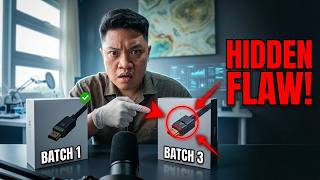
Omar explains the golden sample trap: factories use their best craftsmen for initial samples, then cut corners in batches 2-4 by swapping cheaper materials and relaxing tolerances. One DTC brand lost $120k when a supplier saved 11 cents per unit on a component, tanking reviews. He walks through six steps to catch drift early, from written specs to batch inspections.
Chapters
The sample was perfect. Like, perfect, perfect. The stitching, the finish, the packaging. You showed it to everyone, your friends, your partners, strangers probably. You held it up and went, "This is it. This is the one." So you placed the order. And then your first batch lands pretty good. Second batch, fine, mostly. Third batch, you open the box and genuinely wonder if it came from the same factory because the thing in your hand looks nothing like that beautiful sample sitting on your desk. And that's the golden sample trap. Why the sample is the best version of your product you will ever receive unless you actually do something about it. So welcome back. Today we are talking about new product development. And launching something new, whether it's your very first product or you're adding to your line. And specifically, we are talking about the moment that fools almost every founder that we've worked with, the sample. And here's how it goes. You're sourcing, you find a vendor, maybe on Alibaba, maybe through a referral, or maybe at a trade show. You go back and forth, you pay the sample fee. And a couple weeks later, this little box comes up at your door and yeah, it's gorgeous. And in that moment, your brain does this thing. It goes, this vendor makes products like this. This is their quality. This is what I'm gonna be getting. So you sign it up, you wire the deposit, and you move on to the fun stuff, the launch, the photos, the marketing. And this is the mistake. And it seems smart because what else are you supposed to judge? A vendor on. The sample is the evidence, right? You did your homework, you compared samples from 3 vendors, you picked the best one, and yeah, that feels like diligence. But here's the thing nobody tells you. The sample is not a preview of your production run. That sample is an audition. That sample was probably made by the factory's best people. Hand-finished, of course quality checked 5 times, maybe not even made in the same building as your future production run. Some factories literally have a sample room, a separate little workshop where skilled technicians make beautiful one-offs all day, specifically to win contracts. So what you're holding onto is not what this factory makes, it is what this factory can make. Once when they're trying to impress you. Those are two very different things. Okay, so why does it get expensive? Let me walk you through how it actually plays out because it's never a one dramatic moment. It's a slow slide. Batch 1 arrives and it's usually pretty close to the sample. Why? Because the vendor knows you're paying attention. New customer, first order, you're, you're going to inspect this one. They definitely know that, so they put their best people on it. And then of course, batch 2, small slips. The stitching's a little looser. The color is slightly off on a few units and nothing you'd reject from the, the whole shipment, the whole shipment over. You might not even notice honestly, because by now you're not opening every box. You're busy running your business. Batch 3, batch 4. Now this is the real one. Materials get swapped for something cheaper. Tolerances drift and the packaging feels a little bit flimsier. Somewhere along the way, the factory shifted your order from the A-team to whoever's available, subbed in a cheaper component supplier, and started treating your spec sheet as more of a suggestion. And here's the brutal part about when you find that out. You don't find out at the factory, you find out from customers because the quality drop ships straight to them. So the first signal you, you get isn't a QC report, it's your return rate creeping up. It's a couple of 1-star reviews saying not what I ordered last time. It's your repeat purchase rate that, that's quietly sagging. And reviews don't unhappen. That 1-star review about quality is going to sit on your product page telling every future customer not to buy for years. Long after you fix the problem, that's going to be there to linger. Now stack the timing on top of that. By the time you notice the slide through returns and reviews, you've usually already paid for, even already received the next batch. So you're sitting on an inventory you don't really even trust and your cash is gonna be locked up in it. So yeah, episode 10, that's, that's what we talked this and, and a decision nobody wants to make is gonna be, do I sell product I know is worse or do I eat the loss? And here's why this compounds worse than almost anything else. Quality drift attacks the one thing you can't buy back— trust. You can recover from a stockout. You can recover from a margin squeeze. But a customer who got burned on quality doesn't come back, and they tell people. So a few hundred bucks the factory saved on cheaper materials can quietly cost you your brand. And one more layer, the longer you let it slide, the harder it is to fix. Because every batch that goes out unrejected teaches the factory where your real standards are. Not the spec sheet, the unrejected batches, those are your actual standards now. You've been negotiating this whole time and you didn't know it. So let me tell you about a brand that's lived this one. There's been a lot. We've had multiple calls with really similar pain points as this. So this is a, let's say a DTC brand. They've got applicator tools, accessories, that kind of thing. And the founder spent 4 months developing a new hero product. So new vendor found it through a sourcing agency and the sampling phase, dreamy. 3 rounds of samples. Every revision came back better than the last. And the final golden sample was honestly nicer than the competitor product she was benchmarking against. And the vendor was definitely really responsive, really friendly, fast. So the very first production order, 3,000 units, they arrived. She spot-checked a couple of boxes. It looked great. Then she launched it. But the product took off. Reviews were glowing. Specifically, and this matters, the reviews kept mentioning how premium it felt. That was the brand. That was the whole positioning. Then a couple of months later, this time 5,000 units because it was selling, right? It came in fine. She checked a few units. Good enough. Ship it. Third order, 8,000 units, time for a Q4 push. And this is where it unravels. The unit lands, they go straight to 3PL. She never even touches them because by now, why would she? 3 weeks into Q4 and the messages start coming in. Mine feels different from the one I bought in March. Did you change the material? Or, um, some other messages were like, uh, this came apart after a week. The return rate had been sitting around 2% and then it's suddenly climbing past 9%. And the reviews, the exact same product page that said feels so premium now had a string of recent ones saying it felt cheap. And so definitely we, so we got involved and did the forensics, pulled out the units from the, from each batch, lined them up side by side next to the golden sample. And, and you could see the slide, batch 1, basically the sample, batch 2, the metal components was a little lighter, finish was slightly duller, batch 3, different material entirely on one part. And the factory had swapped on a component supplier to save. We figured out later about 11 cents a unit. 11 cents on a product retailing for $34. And then she confronted the vendor, total politeness. This is within normal production variance. And that was the line because here's what she discovered. There was nothing in writing that said otherwise. No spec sheet with a component defined, no agreed quality standard, no inspection clause. The spec was the sample, a physical object sitting in her desk in another country with no legal connection to anything. The damage is she pulled what was left of batch 3, about 5,000 units she couldn't sell at full price. The Q4 came, the quarter that was supposed to fund the whole next year, gutted, and the product page never really fully recovered. A year later, those quality reviews were still the first thing sorted under most recent. Total cost? She stopped counting somewhere north of $120 grand to save the factory 11 cents a unit. Okay. Deep breath, because this one is generally preventable and the fix is not complicated. It's just unsexy. So here we go. Number 1, turn your golden sample into a written spec. That's the big one. The sample on your desk is legally and practically meaningless until it's translated into words and numbers. Material specified. Dimension specified with tolerances, weight, color codes, components, and where they come from. It doesn't need to be a 50-page engineering document. Even one good page changes everything because now different from the sample, different from the sample isn't your opinion. It's a measurable deviation from a document you both signed. Number 2, get the spec into the purchase order. Every order, the spec attached Referenced, agreed, plus one magic line. Any changes to materials, components, or subsuppliers requires your written approval before production. That sentence is free and it's the difference between normal production variance and a breach you can push back on. Number 3, keep a golden sample on both sides. One sealed at your place, one signed and sealed at the factory. When there's a dispute, you're not arguing memories, you're holding the actual object. So number 4, inspect every batch, not just the first one, especially not, not the second one, not just the second one, because the first one is the one they actually know you'll check. At this stage, you don't need anything fancy. Third-party inspection services will send someone to the factory to check a batch before it ships for around $300, $300 against the $120 grand from our story. And here's the quiet superpower of inspections. It's not really about catching defects. It's about the factory knowing someone is looking every single time. Watch batches, don't drift. And then of course, number 5, open your own boxes. Even with inspections, when stock lands, pull a handful of units from different cartons, not just the top one, and put them physically next to your golden sample. 5 minutes per batch. That's the early warning system the founder in our story didn't have. Number 6, when you do catch drift, React immediately and in writing. The very first slip, uh, even a small one, not angry, just clear. Badge 3 deviates from the spec on this component. Here's the photo. Please confirm correction before the next run. Remember what I said earlier, the factory learns your standards from what you accept. So teach them early while the lesson is still cheap. So now the permission, because I can already feel some of you spiraling into full paranoia mode. So let's just pull that back. You don't need 100% inspection every unit. Sampling a batch, which is fine. Statistically speaking, a few dozen units tells you almost everything you need to know. Leave the full inspection stuff to the experts and to medical devices. You don't need expensive lab testing for most products unless you're in a regulated category. Kids' products, things that touch food, skincare formulas. A visual and a functional check against your spec covers the vast majority of What's going wrong? You don't need to assume your vendor is a villain. Honestly, most of the time it's just— this isn't a scam, it's a drift. It's a factory under margin pressure making 100 tiny substitutions across all their customers, and the customers who don't push back absorb them. It's not personal, which is exactly why the fix is systems, not suspicions. You can have a warm, friendly relationship with your vendor and inspect every batch. Those two things are not in conflict. The best supplier relationships have Both. You also don't need a perfect spec on day one. Your first spec sheet will be complete. That's fine. And every time something drifts, you add a line. The spec is a living document that gets smarter with every single batch. Version 1 just has to exist, and you don't need to slow your launch down by months over this. One page of a spec, one magic sentence on a PO, $100 or $300 inspections, and that's the whole starter kit. You can set it all up in a week. So, quick gut check, go look at your last purchase order right now. And is there a spec sheet attached? And is there anything, anything at all that defines what acceptable quality means in writing? If the answer is no, you're running on the golden sample. And now you know how that movie ends. If you want help setting this up, the spec sheet, the inspection cadence, the PO language, it's exactly the kind of thing we do with founders every single week. Of course, we have a few videos up here on YouTube, or you can come join us in Circle. And next time we're staying in this same neighborhood because everything we talked about today gets 10 times easier when the vendor actually cares about your account. And whether they care isn't luck, it's something you build. So that's pretty much it for me today. Thank you so much for taking the time to learn and get to know how to deal with your samples better. So this is Omar signing off. Thank you so much and have a good one.
More from Lara

Your Best Seller Sells Out on Day One of BFCM. What’s the Plan? #bfcm #inventorysystems #ecommerce



Your Best Seller Sells Out on Day One of BFCM. Then What? #bfcm #inventorytracking

Don't Know Where Your Raw Materials Come From? Start Here #sourcingagent #supplychainplanning




Moved Production Out of China? Documentation Is the Real Fix #sourcingchina #supplychainsolutions

Sourcing From China, Vietnam or India? The Fix Isn't a Fourth Country #sourcingchina #supplychain

Moving Production Out of China Didn't Fix Your Tariff Exposure #sourcingtips #supplychainmanagement