Episode #718 - Learning Tough Lessons As An Entrepreneur with Samantha Kozuch of Maniscripting
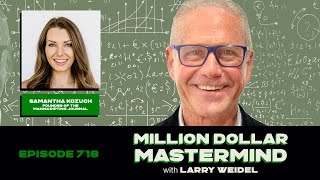
Samantha Kozuch went from fitness influencer to founding Maniscripting, a physical journal company that hit multiple millions in revenue in three years. She walks through early mistakes in inventory and fulfillment, why she chose paper over an app, and what she learned scaling fast.
Welcome to this edition of the Million Dollar Mastermind podcast. This is where we pick the brains of high achievers from all walks of life and get their hard earned real world insights on ready. I'm your host, Larry Wydell. Yeah, everything's going to take work, everything's going to be a drag at some point or another and there's going to be reversals. But the thing is, are you getting any enjoyment, any satisfaction? And the reason you pivot is when you, if you don't believe that there's something greater out there for you and you have a, you know, a high purpose in your life, you're not going to be as open to pursuing that because you're going to say, I better settle for this. I'm lucky to have this. There's a limit to how far I can go. And when. Elon Musk. And by the way, I'm not an E CAR person. But anyway, when he started Tesla, their inscription on their main headquarters is where he talked about open sourcing. And he believed he wasn't going to keep this information quiet. He wanted all kind of companies to get into that industry. And his, you know, it's the abundance mentality, you know, that there's, it's not, you know, there's room at the top, you know, it's crowded at the bottom, but there is room at the top. There's a lot of exciting opportunities at the top. And there's no advantage in not going for bigger, better, you know, faster, taller and quicker. And you know that that's where the excitement in life is now as you, you know, when you're doing that, you become a certain magnetism to yourself. And it's obvious that you have been able to carry, create and carry your magnetism through all your different activities because of people, you know, following you and interested in what you have to say. And so on the other hand, you could look at your track record and say, this woman just cannot be still. I mean, she doesn't have a clue of what she wants to do. You know, she goes here, she goes there. And you feel like you found, you know, something that can, can last a while, I would imagine. Now, so talk about what you, what led you to do what you're doing right now. And I'll let you describe it and tell everybody.
Yeah. So as coming off of being this fitness influencer and in this space. Right. So I went from being the fitness stuff, people asking me how to work out, then it turned into, hey, Sam, how did you grow your social media? How are you getting these sponsorship deals. How did you create the workbook for that you sell? And then it was like, okay, entrepreneurial bug again. Of like, well, I keep getting these questions. I could totally teach people how to do this. So then it turned into being a social media coach. Then from there, people that weren't influencers and not interested in being an influencer, they wanted to grow their accounts for their business or learn how to start a business, like I did. Okay. Then I pivoted once again to being an online business coach because I knew how to do all that stuff. I'd been doing it at this point for, like, six years. So I did that. And then up until when the pandemic hit is when I saw my community panic, right? Because I'm here teaching people how to make money online, basically, how to set up their. They're panicking or they had side hustles and they're now losing. People are losing their jobs, their income. They're stressing out. They're like, you know, we all were, right? It was a traumatic thing that happened to the world. So I just started sharing my morning routine, and that's journaling, just staying focused, meditation, how I created vision boards, how I really set up myself every single day to keep my eyes on the prize, like, keep on going, just like I did my entire life, whether it was, you know, competing in sports or, you know, wanting to be in the fitness magazines. Like, that was all, like, ingrained in me for so long of, like, stay on track, stay focused, no matter what's going on, people doubting you, all these sorts of things, right? So I just started talking about that on social media, on Instagram stories, and then people asking me, hey, Sam, like, where. Where can I download these journal prompts? And I'm like, I don't have a download for this. Like. Like, I'm just sharing my personal thing. And then once again, it was that intuitional gut feeling. It was like, you have something here, you have something here, and you need to share it with the world, because what you have done throughout your entire life, people don't do that on a daily basis. People don't think about their goals every single day. People definitely don't reflect on their days or what they want to accomplish or get super clear on what it is that they actually want and also deal with the things that maybe that were traumatic experiences or limiting beliefs, stuff like that, that is holding them back from their trust potential. So immediately I felt that again, that. Oh, gosh, here is that gut feeling. It's that Pivot feeling. And I was making really good money as an online business coach and I'm like, here I am. This needs to be a physical product. I don't know anything about E commerce. I've never done anything, anything remotely close to manufacturing, shipping, inventory, any of that stuff. Right. But I'm like, I'm going to figure it out because this needs to be birthed into the world. So immediately I just dove straight head first into that, creating a, you know, a kind of a sample journal. I got like 20, 30 girls into a little group that were interested. I was like, okay, you guys need to test this. Like, it works for me. Will it work for you? Sure enough, every single woman in that cohort had exceptional results in 30 days. I'm like, that's it, we're going to manufacture. And I just literally YouTube listen to podcasts on E commerce. I just infused myself into that space, learned it all, had first couple thousand journals manufactured within I think three months, started selling them and I never looked back. And here we are almost three years later and now I'm at a point in my life where I am fully in alignment with what I'm doing. I'm obsessed with this company, I'm obsessed with the like, what it's doing. For right now we just have a journal for women. A men's journal is coming early next year. But I'm just so in love with what I am doing. And I know that every single thing that I had done throughout my career, from being the influencer, learning how to manage social media, learning how to build an online business, you could never connect the dots forward to where I am today. But looking back, nothing was a waste of time. Everything that I did has equipped me to be the founder of an E commerce business today that is just impacting the world in such a positive way.
Now, now how many of you. So how did the sales go? Because you again, you hadn't done this before.
Yeah, the first sales were great. I think within the first year it was like, okay, we did not hit six figures in revenue our first year, I'll tell you that. But here's the difference. If this was me in a different space, like in a, as an online business coach or in social media, stuff like that, that would have looked like a failure to me. But what was really cool was to hear the feedback on this journal that women were having. And for that like my driving factor was like, it's not, it wasn't even at the money about that at that point. It was that this is a concept that's proven. I know what it takes when you're first, like starting a new company or a brand or anything like that. It's going to take time to build. I had things to learn as a founder. I'm actually grateful that we didn't even break six figures in our first year because I had so many lessons that I needed to learn before we could blow up and go really big. So that's kind of how it all went.
Yeah, that's. That perspective probably came from early experiences you had. But when you're starting business, you're always, you know, out of time, out of money and wishing you had all the venture capitalists just pouring the money at you. But the deal is you don't always recognize how stupid you really are in your first year or two and how likely you are to make stupid decisions based off lack of information and experience. You know what I'm saying? You don't always have the best advisors with you. That will come around later. You know, you'll find, you'll be able to find. That's part of growing in the business to find what do other people do, you know, who advises in this work, know what are smart business practices? And it's easy to get caught up in the tyranny of the moment and running around there and spending money here.
Yeah, yeah, yeah.
And you know, it's just like software. If you ever hear a software company, they just blow through so much money because they're trying to figure it out as they go, you know, and they can have a great idea, get it all built out and say, oh, that didn't work. But then, you know, as hundreds of thousands or millions of dollars later, they say, okay, now we're going to go this way and they're going to pivot, but that money is burned. And if you're a venture capitalist, you'd like for them to be a little bit more judicious in making those decisions and find out a little quicker. Now you did that. What would you. Let me ask you this, what, what can you think of is a dumb thing you might have done that would have been costly early on had you had more success and had more money. Can you think about that? Something you learned not to do, but it was like your second year or after you were down the road a little further?
Yeah, I think if our first year, if we had more money because we're still self funded, bootstrapped company and our first year, if I had more money to put into it, I probably would have bought way more Inventory than I needed out of that first manufacturing thing.
Right.
Let me tell you, it's interesting getting that first shipment of journals. Even, like, I thought it was like the greatest thing on earth. Right? And so did everybody else. But seeing what the journal is today, like, it's evolved. It's like gotten better. It gets better and better with each production run. But there are mistakes in that journal, even though it had multiple people read it. So we had lots of, like, different little mini misprints throughout it. So that would have been a big thing with just like over purchasing journals that just were not 100%. That would have been bad. We probably would have poured a lot into advertising, which at that time, like, again, I, as a founder, didn't yet have the space and the capacity to hold space for this many customers. Right. It was just me. I was packing and shipping the packages every single day for, I think, a year and a half. Like, I just didn't have. We didn't have the space, we didn't have the setups. We didn't have the systems in place, like, nothing. So I think we would have just. I would have just blown through that cash so quickly without understanding and learning parts of the business that needed to be understood in order to scale and make it, you know, the quote, unquote success that it is today.
Well, allow you to staff up for one thing. And, you know, if it's any encouragement. Jeff Bezos talks about when he got started, they were sh. They were shipping things out of his garage. And it was him and one other guy. And he said one day he had the great idea, a light bulb lightning. You know, it's like unbelievable. You know, the angels. Clouds parted, the angels sang. He had this new revolutionary idea. And he turned to his second in command. He said, I've got it. You know, I figured it out. You know, how we can improve our shipping. He said, knee pads. He said, rather than be on the concrete on our knees, we can get knee pads. And the guy looked at him and said, I've got a better idea. How about tables? But he tells that story on himself, you know, like out of humble beginnings, breakthroughs like that, you know, if he could have bought knee pads for everybody. And then someone said, well, how about tables? Then you throw the knee pads in the trash. And so it's just those kind of basic type things you don't even think of until you get in the flow. And the longer you postpone getting in the flow and jumping in, you delay those kind of revelations. But now, as you have Moved forward. So how has sales gone now?
Fantastic. We are, you know, three years later and now we're doing multiple million revenue per year. So that's.
Yeah. In three years to multiple million in revenue from this book you created to journal. So this is a book you're selling, a little journal, hard copy, but nobody uses hard. Are you writing an app?
No, no. It is more. No, no.
Tell me why you're not doing an app. Why, why you're doing. Why the journal is more important than the app.
Yeah. So for one thing, we are so connected to these things, right? We are on our phones 24 7, we're on a laptop, we're in. We're in everything, right. And then what happens there? You pick up your phone, you, you get a notification, you open up Instagram, you open up your email, you open up your text messages. Within two seconds you're gone. Right? You're gone. So the reason for doing a physical product is the morning routine should be disconnected, you should be unplugged. It's the first thing you should be doing when you wake up. Open up your journal. Let's tap into this first. And when it comes with chasing your dreams or creating your new life or whatever that is, right. The last thing you want to do is open up your cell phone first thing or computer, and start being impacted by everything else that's flooding in, Right. Like you want to get your mind right first. So having this journal, and it's a beautiful, beautiful journal. It's spiral bound. It's either it's got gold accents or holographic silver accents on it. It feels so luxurious. So just to even start with that, just opening it up and you have different prompts every single day. It takes about five, 10 minutes a day, depending how long you want to write in it. But just by going there and the first thing it kicks off is like, you know, that gratitude, the affirmations, your, your daily habits, the three things that you're going to take action on that day in order to get you closer to your goals. And then just like journaling out all of those things that are going well or that you desire. And all of those things, it's putting that into your mind first. Because that way your mindset, if it's in that place starting the day, you're going to take action on that. You're going to use that to make decisions whether you feel like doing things or not. It's like, wait a minute, this morning I wrote, I'm going to do X, Y and Z. Like I'M going to stay committed to that. So having this beautiful morning process of just like taking that, you know, 5, 10, 15 minutes for yourself to just get your mind right is so, so powerful. And then just writing it down when your, your mind, your eyes, your brain see you writing things down like you're going to be more likely to go after that and accomplish those goals too.
Thanks for listening to the Million Dollar Mastermind. If you felt there were any valuable takeaways from this episode, please take a minute and leave us a five star review. Your feedback is important and really helps us get the word out to a wider audience. Remember, we have a valuable webinar that is absolutely free. Register for it right now@whiteallonwinning.com thanks for listening.
More from Larry







Rick Jordan on Self-Engineered Proximity, Cyber Security Moats, and Truth-Based Leadership

Fire Fast or Fail Slow: Kevin Brittingham Reveals the One Rule That Built a $100M Empire


