Episode #781 - How Cameron Herold Built $100 Million Empires By 35
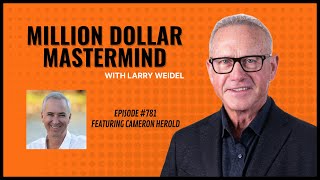
Cameron Herold built two $100 million companies by 35, starting with a coat-hanger recycling business at 7. He credits his success to hiring and culture, learned early through College Pro Painters where he coached 120 franchisees, and now travels 45 countries in 2.5 years after selling his possessions.
Foreign.
Welcome to this edition of the Million Dollar Mastermind podcast. This is where we pick the brains of high achievers from all walks of life and get their hard earned real world insights on winning. I'm your host, Larry Wydell. We're here, we're talking with Cameron Herold and we're going to have some fun today.
Sounds great, Joe. Thank you. Looking forward to it.
Thanks so much, Cameron. And reading from your background, it's mind blowing. You know, the journey you've had as an entrepreneur and then how you compounded that out, took advantage of those successes to go on to bigger and better things and to the point where at 35, you built $200 million companies and age 21, you had 14 employees. But by 35, you, you're up to two $100 million companies and 42, you had a 1,800-got junk spectacular growth. Up to 2 million. From 2 million to 106 million and 3,100 employees, you know, and you don't look any worse for wear, you know.
Cameron, I feel it at times. I feel worse for wear at times.
And now you're founder and of the COO alliance and second in command podcast and known around the world as the CEO Whisperer. So we're going to have some fun getting into that today. And right now, though, tell everybody where you are, Cameron.
I'm up in a small area called Henningsvar, which is in northern Norway. I'm at about 70 degrees latitude, so we're above the Arctic Circle, very far north. And actually the sun will not rise here for another full week. It's been about two months, three months since the sun has even risen. So it's literally like a period for about three hours a day where there's light, you know, light enough like dusk would be after the sun sets and you still can see for a couple of hours or for about an hour. That's kind of what it's like here for about three hours a day. But it's pretty magnificent country surrounded by mountains and ocean and the northern lights.
Not everybody's listening to us on audio. Some are on YouTube. How about showing that picture? You just show me for sure. IPhone photo. Look at that.
That was my wife and I just a bunch of days ago. Yeah, it was crazy, unbelievable, spectacular. About 30 minutes of the brightest vivid wizard of Oz green that you've ever seen throughout the sky. And it was shifting and moving and then the light was dancing. It was extraordinary. It was like God was putting on a light show. It was unbelievably. Magical.
And I think that's exactly what was happening. But what, what would you. Why, how did you end up there?
My wife and I sold everything. About two and a half years ago, my wife and I sold everything and we decided to chase down all of our bucket list experiences. So, sold our home in Arizona, got rid of the home in Canada, sold all of our cars, furniture, all of our assets are gone. We travel with a backpack and a suitcase each. And we've been to 45 countries in the last two and a half years. And Northern Lights was her number one bucket list. So we've been waiting for a good period where we could come up in, you know, the cold winter to chase down the bucket list item for. And we're off in. In a week, we head over to Japan to go skiing with 12 friends and chase down one of my bucket list items, which has been to ski powder in Japan. I wanted to do that my whole life.
Wow. As we were talking earlier, you chose well because they, they said at the lodge where you're staying, this is the best light show they've seen in 11 years.
Yeah, I think it was. I think they said it was the third best light show they've seen in 11 years. It was the best one they've seen this season. And, yeah, yeah, we got very, very lucky. It was been extraordinary.
And so talk about another thing we'll get into. You've turned into a speaker. You've paid. You've been paid to speak in 21 different countries.
28 now. 28 countries. And I just got booked to speak in May in Ireland. And I know your producer Joe is from Ireland. I'll be doing two speaking events, one on May 15, one on May 16 in Ireland. So that'll be country 29. And I've actually been paid to speak on every single continent. Two years ago, I was in Antarctica and a group of CEOs had booked me to speak to a group of CEOs on a boat in Antarctica. So I've now been technically paid to speak on every single continent.
Well, congratulations on that. And you're amazingly young looking. I don't know how old you are, but you're amazingly young, fit, in shape, and so you survived the wars very, very well.
I'm 58, so. So I'm trying to stay young for sure.
Yeah. Well, congratulations. And how did you. You know, you talk about being an entrepreneur from day one. What was day one, really?
From birth, My grandfather was the CEO of a big pharmaceutical company, and then my other grandparents were Entrepreneurs and had a very famous lodge in Northern Ontario, a hunting and fishing resort. And then my dad was an entrepreneur, and my brother and sister and I have all been building our own companies and running our own companies, really for the last 25 years. All of us ran companies when we were 20. So the whole time in growing up, I was always taught that a job was a bad idea, that a job was trading time for money. I remember one time vividly, my dad took me to the golf course one day when I was 15. We were sitting out on the balcony at lunch before we were going out to play golf, and he was showing me all the people coming into the golf club. And he said, that guy owns a car dealership, he owns an accounting firm, she owns a clothing store, he owns a barber shop. And he's showing me all these people. And then we went out and played 18 holes and we came back in and we're sitting on the balcony and I'm eating my fries and gravy and drinking my Cherry Coke. And he's pointing to all the people coming into the golf course at 4:30 to play golf. And he said, he's a teacher, he works for a car dealership, he works for an auto body shop, he works for the mines. And he said, did you notice the difference between who's coming in to play golf now and who's coming in to play golf in the middle of the day? And I said, yeah, in the middle of the day, it's all entrepreneurs. My dad said, the number one reason you want to be an entrepreneur is so you can do what you want, when you want, wherever you want, without having to report to someone else. Being an entrepreneur is not about money, it's about time. And that lesson at 15 really stuck with me because while I was building my first company, even my first business, in my early 20s, I was 20 years old, I had 12 employees. I was actually being kind of groomed by my dad to play a lot of golf and go windsurfing and spending time out in the lake while my employees were running my house painting business. And he was teaching me to delegate and empower people and not be such a workaholic at a very young age. And those lessons were very formative for me.
What possible company ideas did you start with early on? And then you sound settled in on the painting.
So I did a talk that was on the main TED homepage, the ted, you know, for TED talks. Eleven years ago, I did a talk about raising kids to be entrepreneurs. And I think I had about 15 different entrepreneurial ventures by the time I was 15 years old. So the first one that I remember doing, I was seven years old, and I went to a dry cleaning shop with my mom in Winnipeg, Canada. And I remembered seeing up on the wall that it said 2.2cents per dry or per coat hanger recycling. And I asked the man what that was, and he said, we pay you 2 cents for every coat hanger. I'm like, that's ridiculous. I can buy three gum for two cents. If I bring you one coat hanger, I can get three gum. And he said, yeah. I'm like, okay, I got this. So anyway, I left. And about a week later, my mom came into my bedroom, and I had the telephone cord stretched 30ft into my room, and I was lying on the floor with the yellow pages open, and I was phoning all the dry cleaners in Winnipeg. And I remember as clear as day, like, I can picture myself doing it, I can still remember doing it, that I was writing how many cents each dry cleaner would pay me per coat hanger. And I had one guy that I was telling him I wanted 4 cents a coat hanger. He only wanted to pay 3 cents a coat hanger. I said, how about 3 and a half? And he said, how old are you? And I said, I'm seven. I'm seven. How about three and a half? He said, okay, three and a half cents. So I said, okay, I'll be coming in. So my mom was standing there and she looked at me and she said, where are you going to get the coat hangers? And I kind of broke down in tears. And I opened up my closet and it was filled with coat hangers. And for the last seven days, I'd been going door to door in the neighborhood, asking all of the neighbors if I could have their old coat hangers. And when they asked me why, I said, I'm running a business. I recycle coat hangers. That business only lasted a couple of weeks because I ran out of neighborhoods that were safe for me to call, I guess, but that was my first one. And then I, you know, I did comic book arbitrage. And then I. I made pin cushions and I sold license plate protectors door to door. And while all my friends were caddying on the golf course, I found a big hill on the golf course. And I sat at the bottom of the hill in a lawn chair and I ran two bags at once up the golf course hill. And I charged a buck for each. They were getting $20 to go catting for five hours I was making 20 bucks every hour, you know, and then I hired a kid to do my newspaper route for me. It turned out to be my brother that I hired. I got in trouble for that. But then I told my dad, that's an employee. So I. He kind of was like, that story didn't go over very well. But he laughed anyway. Lots of, lots of them by the time I was 15. And here's something that's really different. Like you and I are similar age in this. When, when we were growing up, being an entrepreneur was not cool. We were kind of, we were the vilified, greedy little profit, you know, capitalist kids who were ostracized by not only the school and our neighbors and our friends, but even family members thought it was, was weird that I was doing this. Nowadays everybody wants their kids to be an entrepreneur, but that's only been cool since the rise of the first.com era in the late 90s, early 2000s. Being an entrepreneur wasn't cool when I was a kid.
How did you evolve up to and learn how to keep up with 10, 12, 14 employees at an early age? You know, how what were things you had to learn there and tough lessons maybe what, you know, like, I've got to get organized on this. What did I, you know, you couldn't have done everything right.
No, I didn't do everything right. I got very lucky though. So 1985, I was 20 years old. I was walking through the university building, the kind of central, I don't know what's called the university commons building. And there was a flyer on the floor and I picked it up to throw it in the garbage. I was in a fraternity and I was like, I don't know, I was responsible. And I went to throw this flyer out and on the front of the flyer it said, Earn $10,000 and run your own business. I'm like, that's a lot of money. In 1985, 10 grand tuition was only 2 grand. So I mean, I could make five times my tuition in one year. What's this business all about? And it was a student franchise company called College Pro Painters. And so I went to a meeting and learned about the idea and ended up about a month later getting awarded a franchise. And I was then trained how to run this house painting business. And I went out and registered my business and got my bank account and got my business cards and hired people and did marketing and sales. But I also got all of the training of how to run a business.
Who was doing this training it was.
Called College Pro Painters. And College Pro went on to become the largest house painting company on the planet. Every year they would have 800 franchisees and then they would hire 8,000 painters. And between May 1 and August 31, we did $64 million worth of house painting. So I did very well as a franchisee. I was a franchisee for three summers. Then I went and worked for the head office for four years. And this was from 1989 to 1993. I was then recruiting, hiring, training and coaching franchisees. So I coached 120 entrepreneurs by 1993, even before coaching. Business coaching really didn't start until 1993 when CoachU and the International Federation of Coaches started. I'd already coached 120 entrepreneurs by that point. One of them was Kimbal Musk, Elon's brother.
Is that right?
Yeah. I hired. I was Kimball Musk's last boss. I was also his cousin, Peter Reeve, who went on to build SolarCity. They both. I hired both of them and trained both of them to be entrepreneurs in 1993.
Wow. And so that the. You found a franchise you basically got with a good group, meaning this is a company on the way up. And so if people are looking for. There's a thread here that I want to copy. And I'm early in the game where I've got years to get educated. At least don't just get a franchise, get one that's hot and climbing, would you say?
The big lesson I got from this was very similar to the golf club member was really successful people hang out with really successful people. So at the golf club I was filled with all of these successful people who are a member of this private club. And then at College Pro Painters, I was surrounded by all these other 20 year olds who were entrepreneurial, high in goal orientation, really strong in precision, good leadership skills, running businesses and they were doing some cool, whereas everybody else at school was just drinking beer and smoking pot and I don't know, going to school. So I was in this mastermind community at a very early age and I recognized that that was similar to my fraternity. It was similar to a church youth group. It was similar to being in Cubs. And I saw the value of being in these communities at a very young age. And that's what got me into the entrepreneurs organization years later. And then years and years of now doing lots and lots of investing in myself and being in communities. I go to probably three to four groups of entrepreneur events every year that I'm a participant. I sit in the room with all these other successful people to keep raising my game every year.
And what would those groups be?
I've gone to the main five day TED conference for ten years in a row. I've gone to five baby Bathwater events. I was a member of Strategic Coach for seven years. I was in the Genius Network for seven or eight years. I just went to their annual event, a few War Room events, five Mastermind Talks events. I'm going to my fourth Wayfinders event in Laos, in Cambodia. Just booked another one actually, for April in Papua New Guinea. But I do events with entrepreneurs all over the world where I can immerse myself in these communities of really good thinkers. And, you know, it's that saying that you're the average of the five people you spend the most time with, Right. So your ideas level up, your fitness level levels up, your health levels up. So we do those. My wife chases them down as well. We're doing a big biohacking event this year.
And when you come away from those things, what do you usually find is the biggest thing? The new. The networking things, the friends you made, or are you still getting new ideas?
Oh, yeah, always new ideas. I mean, it's that saying that if you're the smartest person in the room, you're in the wrong room. So I can walk into a room and just synthesize. I call it ideas having sex. You know, I'll take an idea from Larry, an idea from Abby, an idea from Joe, and those three ideas have a little idea, baby. And it's exactly what I'm looking for. So I might learn from you about, you know, rigor and growth and determination and fitness, and I might pull something else from somebody else and those spawn. Or I might watch someone in the way they're operating from a stage, or I might be listening to a great speaker who inspires me, or I might get exposed to, you know, a concept I haven't thought about before. And it tends to be because I'm in the room with these very successful people who are investing in themselves, they're also investing in their health. They're investing in themselves, they're investing in ideas. So, yeah, I spend time with cool people. My network expands when we travel globally. I get to hang out with, you know, super fun people because I get to know them from around the world and because they're all doing cool stuff. We're not just sitting about talking about, you know, how the Bears played last weekend. You know, we're talking about something that matters.
Yeah. And let's go Back to particularly help building two $100 million companies.
Sure.
By the age of 35, I guess so.
Well, the first was called Boyd Auto Body and in the United States it's called Gerber Auto Collision. So I was a partner in the franchising group for Gerber and for Boyd Auto Body. We built that company from when I joined seven locations. We took them to about 65 locations in four years, took the company public, and right as we took the company public, I exited. And then I was hired as the president of a private currency company. We built out that private currency company, took that company public and sold it two years later to a much bigger public company right at the height of the Internet boom. We ended up with about 900 employees in the larger parent company. And we were doing kind of what bitcoin is doing today. We had 30,000 businesses buying and selling using our digital currency instead of the US dollar. So we had Starwood Hotels and Avis Rent a Car and Budget and Bose Stereo, all using our digital currency. And I was a president of that.
How did the knowledge from your first one translate into the knowledge you needed to do the second one?
College Pro taught me everything I needed to know. It was a real world mba. When I was able to recruit and hire and coach entrepreneurs, and I coached 120 entrepreneurs, I really understood business. At least I understood small business. Right. I understood, you know, entrepreneurial side. When we then did that again in the auto body sector, I was now teaching franchising to adults. We were doing conversions, we were doing acquisitions positions, we were doing greenfield locations and I was now taking the practices and deploying them with adults. And I realized, wow, at 35 years old, I've got these 60 year olds listening to me about how to run companies. Maybe I know what I'm doing after all. So I gained a confidence boost. And then from there, I'd now done it twice. That's why this company hired me to be the president of the private currency. And we scaled that and grew that.
Really quickly because the people things and the expansion, all that was totally separate from the technical side of actually what you're doing. Is that right?
I don't know anything about how to fix an auto like a car. In auto body, it was all the people side. I'm operationally world class at the recruiting, interviewing, selection, onboarding, and the leadership development of people. You know, you consider that every year at College Pro, we had to go out in four months, hire 800 franchisees and in one month we had to train them how to hire 8,000 people. There's not a lot of companies on the planet that hire 8,800 people every year in a four month period. So. And I was in the top 30 people in that company. So my skill set around operations and culture and you know, the people side and execution and time management, project management, marketing became operationally very, very strong.
Thanks for listening to the Million Dollar Mastermind. If you felt there were any valuable takeaways from this episode, please take a minute and leave us a five star review. Your feedback is important and really helps us get the word out to a wider audience. Remember, we have a valuable webinar that is absolutely free. Register for it right now@whiteallonwinning.com thanks for listening.
More from Larry







Rick Jordan on Self-Engineered Proximity, Cyber Security Moats, and Truth-Based Leadership

Fire Fast or Fail Slow: Kevin Brittingham Reveals the One Rule That Built a $100M Empire


