[Greatest Hits] Making The Right Choices with Jennifer Kem
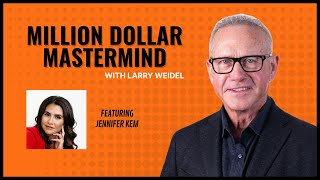
Jennifer Kem talks about pivoting from law to business, turning down Boston University for a full scholarship in California, and building a framework around vision, voids, and violations to guide decisions. Her grandmother shaped her early ambition to become general counsel at Coca-Cola International.
Welcome to this edition of the Million Dollar Mastermind podcast. This is where we pick the brains of high achievers from all walks of life and get their hard earned real world insights on winning. I'm your host, Larry Wydell.
We're here with Jennifer Kim.
Hello, Jennifer.
Hey, Larry. Nice to be here.
Nice to have you here. And where are you today?
I'm actually in the San Francisco Bay area here in California.
San Francisco Bay. And so you got three hours on me, three hours more daylight today. So three hours more shopping for Christmas.
I am done. Thank God. I can say that I'm done. I'm not done wrapping, though, which is really annoying. That's kind of the harder part is putting it all together.
How many people do you buy for?
I've done some editing over the years, but just the core family. And obviously we give something to our clients and whatnot, but just to the core family. So I have three kids, a husband, I've got three dogs. So they get gifts too, and then the parents.
So, yeah, well, great. And yeah, the wrapping becomes as much of a. That's a great thing to offload if you can, but unfortunately there's so many lines, you know, with other people trying to get their packages.
It's totally true. I usually delegate it. And this year, because I was so November and December, early December were really busy for me and I didn't schedule to get it done by my assistant and she's on vacation and I, you know, so I got stuck with it myself. So, you know, quote unquote, successful people ruin their own lives by not delegating earlier. You know, that's, that's really true.
There's always something left. The penalty for getting a little bit behind the eight ball, which it's rarely our fault that we get behind. It's usually dealing with surprises. But then cleaning up on the end of the project, you find loose ends like this you got to do. But anyway, congratulations on getting it all done. And so let's focus on the success you've had. Now, correct me, it's hard to find correct information, but supposedly you started early in your career, you worked in the corporate world. Is that right? And how did you get into the corporate world? And was that in San Francisco?
It was actually in San Francisco in Silicon Valley as well as in Honolulu, Hawaii. So I lived there part of my career and then here part of my career. Now I'm back in the Bay Area. But it's a long, winding thread, Larry, but I'll try to keep it succinct. I originally never thought I was going to get into the field I'm currently in, which is building brands and strategy and, you know, getting people to grow businesses. And I originally thought I was going to be a lawyer. I thought I was going to be the. I had a goal when I was in second grade and I told my teacher that I was going to be the general counsel for Coca Cola International. And where did you get these ideas? I know. Well, you know, when I was a little kid, my grandmother, who is an immigrant, and she didn't. She had a second grade education. And she said to me, you know, I don't understand this section of the newspaper, which was the business section, but I think that you will. And so while she would have tea and toast for breakfast, I would sit next to her and read the business section. And so the business section one day had an article about Coca Cola being the biggest brand in the world. And at the time, you know, way back when, in the 70s, when I was reading this, they were the most powerful business in the world too. And so I read this article and it was featuring the general counsel of Coca Cola International. And he was traveling to Asia to expand their operations there. And I thought, wow, that's a cool job. Like, you know, he's. I didn't even know that meant that he was a lawyer. I just thought general counsel was a title. Like, I didn't even have an idea. So I thought, okay, I want to be powerful. Literally, as I want to help, I want to like, create.
Change.
When I say powerful, like impact. I want to be able to travel while I do that. And I wanna work for a company that is renowned. It was kind of like I didn't have those words in second grade, but that's basically what my mind was saying. So, yeah, I went to a Catholic school and my teacher was a nun. And she was really mad at me when I got up and said that in front of the whole class. Cause she said all the girls wanted to be teachers and nurses and mothers and all the boys wanted to be firefighters and policemen and doct. And here I get up in my class and say, I want to be general counsel of Coca Cola International. So that's kind of the context now. You kind of know what kind of kid I was, which answers why I got into the corporate world.
Well, it's an interesting thing how your grandmother cast that vision casually. You know, I hadn't really thought about it in that specific way, but how you can catch, you know, you can cast these visions out for kids and it just might grab them, you know, and.
Yeah.
Isn't that amazing that she. It came to her to say that to you? And. And the other thing is that I don't understand this, but I think you will.
You know, that's not.
That's got to have a positive impact on a young child.
Absolutely. I think the more I miss the days, all of us have stuff that's happened to us in our life. That's life. Right. And also I think we need to be doing more of that. And it really. I credit my grandmother. Her name is Generosa, and her mother named her the right name because my grandmother was the most generous person. If she didn't understand it, she would give to somebody she thought could understand it.
Right.
And I really credit her with giving me that permission. I didn't know it was permission at the time, but that permission to be me.
That's a great point. That when they do that, they give you permission to see yourself or to think of yourself in those terms. That's a great point.
Yeah. And even in a different way that I might have never thought of, because I grew up in a tiny little town. There was only 4,000 people in my little town, and I grew up in the north shore of Hawaii, and our backyard and front yard were sugarcane, and that's what my grandparents came over to do to work the plantation and the sugar cane. And so I grew up in a town that I felt like a complete alien in, in terms of, like, my curiosity. And, you know, I loved the library, and my grandmother just noticed those things about me, and then she just kind of, you know, said, look, I don't understand all this stuff, but maybe you might, you know, and that was also her way was, you might like it, you might not. Here, try it on. You know, So I think that idea of also permission to try things and read things you don't understand. And so that was. And I credit her a lot. In fact, if you follow my journey for the past 40 years, I've definitely, like, she's the. I think she's the. She's a catalyst for my curiosity and my ability to be successful in life.
Well, these things get you going in a direction, you know, things like that can get you going in a direction. And again, if you have permission to. To think about the biggest and best type things and seeing yourself other than just a survival type life or survival type choice, you know, in other words, when it comes to choosing a college, you know, depending on where you're coming from, you'll think okay, you know, start at the community college and this, that and the other, and, you know, just get some kind of degree from some kind of place or you're thinking about going to the big name schools and, you know, the. The bigger ticket places where you can meet influential people and make the contacts. And. And so how did that. How do you think, you know, what choices did you make? Or how do you think that influenced you in your choices of schooling and your first jobs?
Oh, my gosh, it directly influenced it. Because the moment. Here's the type of person I am. And it was always like this. My mom said that I came out of the shoot this way. I'm decisive and I'm okay with making mistakes. And I think I am definitely different than most people. And by the way, it doesn't mean that my parents were happy that I was willing to do that and fail. So I had a lot of that pressure of just be perfect. Right? But I. I knew that if I was going to go to. If I was going to be the general counsel of Coca Cola International, I needed to go to the best law school in the world. And so I had a plan. I was like, look, I'm in second grade. Once I figured out they were lawyers, I made a path to go to Boston University and then to Harvard Law. That was my plan. I was like, I need to live in Boston around successful lawyers. And again, I'm kind of an alien because second to fourth grade, I was obsessed with, at the library, figuring out, how do these successful lawyers become successful lawyers? And frankly, most of them were men. And I was like, oh, I'm going to be this force of nature. And so I went through high school. I had one goal, and that was to get into Boston University. That's it. Because I didn't want to go to Harvard in my undergrad. I wanted to elevate myself into that. And frankly, I studied successful people, and that's their path. A lot of them went to BU and then went to Harvard, or, you know, they went to, like, the Yales and whatever. But I had a very clear thing. And also Boston U. What I liked about it was it was in the city of Boston. And I went there for my junior. My junior trip. My mom made a deal with me. She said, if you get straight A's, I'll bring you to anywhere you want in the world. And I said, I want to go to Boston. And she was like, okay, you're probably going to go to college there, so why do you want to go there? I said, I Want to be immersed for two weeks in Boston. I want to see if I like it because I was living in Hawaii. It's a very different culture. Very. You're on the East Coast, I assume. So it's a different climate, all the things. Right. And anyway, I went there, I fell in love with it and I decided, I was like, this is it, I'm going to do it. Now. What's interesting is that's not what actually happened to me.
For those of you who are still sick and tired of fooling around and are dead serious about wanting to move up fast, I've got something especially for you. I've combined the best insights from over 40 years in business and making $70 million in income and compressed them into a free webinar. That's right, it's a free resource. If you want to find out exactly what the concepts are that I use in coaching million dollar earners, Register now@widelowinning.com you'll discover the five part framework used by so many to reach their financial, personal and professional goals. You can find that link in this episode's show Notes.
I got into Boston U and I thought I was going to Boston U. But I ended up going to school in California. And the reason for that is because I got a full ride scholarship because of my academics. But the problem was, Larry, is that I.
How smart you have to be to get a Fulbright scholarship? How smart?
I mean, I mean I was an academic. I didn't have much. I would say I'm not very talented in like music. I love music, I love art, I love sports. You're a huge sports fan here. But I'm not good at any of those things, so. So I had to lean on my brain. And so I was a straight A student pretty much throughout my whole life because I liked it. I also didn't feel pressured from my parents to be a straight A student, but they definitely rewarded me for great grades. I got money, they would pay me. If I had a A, they'd give me $10 an A. And so I started to figure out, wow, like, you know, if you put the work in, you can get rewarded. And so it was also that that got me into school. But I ended up going to school in California because of that. And to be honest with you, it actually was a huge turning point for me. I felt lost. I didn't want to go to school in California because I was so clear I was going to Boston. So my lesson from that time is that I should have just applied to Boston. Or Boston schools and bet on me only. But I allowed myself to think about the secondary. I allowed myself to. I didn't want to go to school on the west coast at all. I was like, I think the best way for me to learn is to go someplace where I will unlearn some of the things that I've culturally. Not because of a negative, not because. Not negatively, but more like I needed to learn how these people thought over here, so I needed to, like, see that. So when I was.
Why was that important? I mean, you know, that was a specific thing in your mind. How did you realize that was important for you to break out of a possible provincial way of looking at life? Why was that? Yeah, how did that dawn on you?
Well, I think part of it was because I was. I was. As I mentioned, I was really different as a young child. I grew up in a town where, you know, things were simple. And again, I'm grateful because I learned how to be familial. I learned how to be generous. I learned how to be part of a community. And no one was ambitious around me. No one was curious about why the world worked. No one wanted to be in the library like I wanted to be. Like, I read almost every book in our little tiny library in the town I grew up in. And so I also was bullied and teased a lot as a young kid because I was really different and wanted more for myself. Like, I would always say, you know, one day I'm gonna get out of this town. You know? And people would say, why do you hate this town so much? I'm like, no, I don't hate this town. I just. I wanna do something bigger. And I'm glad because my one thing I did have, Larry, was at home. My parents and my grandmother, they allowed me to be that way. So at home it felt safer than it felt in the outside world because nobody understood me. So to make friends and to have people like me, I felt like that was hard. So, anyway, I think that those are the two impetuses of why, as I got older and moved into my adult life, I wanted so badly to move out of that paradigm.
So it's a little hard to turn down a Fulbright scholarship, though, you know, and so it did divert you. But, you know, there's some. There's a trade off. Not too bad, you know.
Well, this is an example of, you know, when people hear my story, typically they're like, oh, you kind of knew what you wanted. And there's. There's a trade off to that because if you know what you want and then life comes. Or there's a diversion, even if it's a great diversion to your point around getting a full ride scholarship. It was for me. It felt like a disappointment. So sometimes when you go so high and you don't, you're so focused on the goal, you're gonna get the goal, probably. But what I learned is that it's okay that I didn't. But it, to be honest with you, changed my entire out. Look, I thought, this is what's crazy. I thought because I was going to school in the west coast, oh, I'm not going to learn anything from these people. That's what I thought. So I was ignorant in that way. Oh, yeah. I thought, okay, I got to go Hollywood. Then I got to, like, learn about that stuff. So this is the. What I call my cute ears. Like, I. I was so naive that I didn't think. I was like, if I'm going to be general counsel of Coca Cola, I have to be in Boston. So automatically I thought, okay, those dreams are crushed. Now I got to figure out my whole life again. And that's not true. I know that obviously now, but at the time, it was very real for me that, oh, I'm not going to get the same level of contacts and education on the west coast as I would on the East Coast. And I know it sounds crazy, but I think for high, highly ambitious young people, it's really important. I didn't have anybody at that time. See, my parents and my grandmother supported me, but they didn't have the. They didn't know how to tell me, hey, it's fine, right? They were like, it's fine, you can still do that. I was like, oh, I guess I got to figure this out myself. So that's how I became. I realized Hollywood and Silicon Valley. I was part of the first Silicon Valley wave. Right. This was in the early 90s. And I decided to instead change the business school instead of being in liberal arts because I thought I would be better off successfully in the business school. And that's how I became a business major and then went into advertising and marketing and then kind of the rest is history. So that's how the whole corporate thing untangled.
Did you ever get to back on track to Boston University?
Nope. Once I decided to pivot, even though I was super disappointed, I just decided to pivot and go from there.
And so you never did the law degree or any of that?
No, I got my MBA from Berkeley instead. But, yeah, it's kind of one of those things, I call it. I have a theory of why people are successful. I'm actually writing a book on it. And I call it being values driven. So making decisions on your values, and there are three things that make up your values. There are your vision, your voids, and your violations. And not getting my law degree was a void for a long time in my life. And so driven people who are driven by their values, they make decisions based on those three levers. And, you know, I knew that I couldn't control that. And so I focused more on, you know, what my vision was for my life, which was I honestly, it wasn't that big, to be honest with you, Larry. My vision for my life was I want to have a great job. I want that job to give me the freedom to travel. I wanted a job that helped me create cool things and put them out into the world. Like, I was really into innovation and getting new products out. And so I, even though I didn't become the general counselor for Coca Cola International, I did become one of the account managers for them when I was in advertising. So in a way, I got to still make that dream come true. But it took a different path than I had planned out.
Well, and also, you took the pressure off the guys who actually are the general counsel at Coca Cola.
For their job. Yeah.
They didn't have to compete with you or be looking over their shoulder. She's coming. Yeah.
Thanks for listening to the Million Dollar Mastermind. If you felt there were any valuable takeaways from this episode, please take a minute. Leave us a five star review. Your feedback is important and really helps us get the word out to a wider audience. Remember, we have a valuable webinar that is absolutely free. Register for it right now@whiteallonwinning.com thanks for listening.
More from Larry







Rick Jordan on Self-Engineered Proximity, Cyber Security Moats, and Truth-Based Leadership

Fire Fast or Fail Slow: Kevin Brittingham Reveals the One Rule That Built a $100M Empire


