Part 1 - Why The Oropesa's Kept Living Small Despite Big Earnings
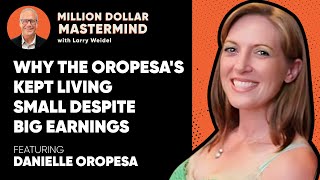
Danielle and Omar Oropesa earned over $800,000 while living in a townhouse and apartment, deliberately keeping expenses low for five years to build savings. They accumulated over $2 million before upgrading their home, and later dealt with toxic drywall that forced them to gut their house and move in with family for two years.
Questions this video answers
Almost 20 years
$99,000
Five years (three years in the townhouse, two years in an apartment)
Over $800,000
Over $2 million
Foreign.
Welcome to this edition of the million Dollar Mastermind podcast. This is where we pick the brains of high achievers from all walks of life and get their hard earned real world insights on winning. I'm your host, Larry Wydell. Danielle Oropesa from Parkland, Florida. Nearby is Coral Springs in Boca Raton. If you don't know, South Florida, right in the middle of the ghetto of South Florida where all the street crime and tough people live. Anyway, let's talk Danielle, and thanks for coming back, by the way. Thank you.
You're welcome. Thank you. Thank you for having me.
All right. Danielle was telling me she sent Omar out of the house so he wouldn't be butting in and answering her questions. For it could be interesting for him to listen to us.
Yeah. Yes.
Do you ever get the thing about, why don't you guys slow down? Why do you keep pushing? And they seem to imply it's almost like it makes them uncomfortable, the fact that you continue to grow and have fun and have adventures and able to move from one house to another house and be able to do these things and that things and having offices and expanding around the country, and it's almost like they make you feel like something's wrong with you. Get that?
Yeah. I think different people get very comfortable at different levels. I think when people see other people that aren't comfortable, even at a much higher level, then that does make them uncomfortable because then they start to think, okay, well, maybe something is wrong with me because I am comfortable at this level. Where we look at it, you can't do everything that you want to do at that level. At 250,000 in income, you know, it's a great living, but you can't live every day with no worry about money, how much things cost. You can't take your family wherever you want to go. You can't make all your decisions. That's what, to me, that's what all the growth in income has given us, is that we can live our life without really having to think about how much anything costs. And when we were growing in our business, I think that that's what kept us going, was that we had such a high level of expectation from the beginning. When we talked about our vision very early on, Omar and I have been married now almost 20 years. And so when we talked about our vision very early on, our vision was very big. Our vision wasn't just to grow a business and make a good living and live okay. And that wasn't our vision. Our vision was to grow a huge Business, make a lot of money, be able to affect a lot of people, help a lot of people get to a point where we can. I mean we give a lot of money to our church, a lot of money to our kids school. I volunteer a ton of time at the school. So we wanted to get to that level where money just wasn't an obstacle. That's what's continued to keep us uncomfortable, like comfortably uncomfortable. Because of course we're comfortable in our. Like the house that we have now is beautiful and it's very comfortable and we love our house. But there was an opportunity to buy a house down the street. It's literally down the street. We can walk the new house, but it's bigger and it has a bigger backyard, more beautiful pool, and has a four car garage. And we have three. And so it gives Omar and I both personal space. We're going to have a gym in our house. We have a sauna in our house. We saw that opportunity and we were, why not? We've been very, very smart with our money up to all through our business life. So now we're at a point where. And we still want more. We still uncomfortable.
Well, talk about the. You guys lived in an apartment for a long time, didn't you? Decant? We did. Focused on building up your nest egg just so you would have that independence and you wouldn't feel be under the gun financially. Talk about that. How long did you live in an apartment after you could afford to move out?
Yeah, when we first got married, Omar owned a townhouse. The townhouse was pretty much nothing. I mean he had bought the townhouse for $99,000. And our living expenses.
Home.
Living expenses were very, very low. So. So we decided to stay in that house, in that townhouse for many years. We stayed there several years. We probably were there for like three years. The first three years. And then we were really, really working. Now we had gotten into kind of like the peak of our working, the amount of time that we were working. And so our office was about 25 minutes drive from our townhouse. So Omar and I were well, if we sell the townhouse, we move into an apartment. We can live right by our office. We'll waste no time driving. We can run home, eat lunch real quick, run back to the office. We don't have to waste time eating out. We made that conscious decision to. So we lived altogether. It was three years in the townhouse and two years in an apartment because. So it was five years altogether that we kept our living expenses very, very low. We were actually living in the apartment, making over $800,000 in income, and we had over $2 million saved before we decided to. Then we had Brady. That was okay. Now we have a baby. My parents lived in Parkland. The apartment was about 45 minutes from where my parents lived. So we looked at houses close to my parents because we knew, okay, we have one child, we're going to have another child pretty soon. I wanted to live close to my parents, so that was when we looked to make the move. But we already had huge foundation under us of money invested, and our income was really, really great. We were able to look at houses and get really what we wanted for a house at the time without really worrying about it. And it wasn't a stress.
And the thing is that we don't have to beat it to death. But the deal is that you have the nice house. Now you're getting ready to move to another nice house. But your first house was a disaster with the asbestos, wasn't it? Is that what I remember? Like, you finally get people. You need to know that you're going to have bad things happen to you in life no matter what. In spite of why you're building. Because we talked about. You knocked yourself out. Omar hit the accelerator. Business is growing. Boom, boom, boom, boom, boom. Income's going up. But in the middle of that, you got all kind of problems. You got to figure out that. Not nightmares that you did not have anything to do with, but it's. Now it's in your lap. Or one thing was this house. You buy this great house, now the thing is asbestos, and you gotta tear it all out and have a battle with the contractor. And. What, were you living with your parents for a while or something like that, or.
Yeah, it was actually like asbestos. It was the drywall.
Drywall.
The drywall was. Yeah. Very high in certain chemicals. It was actually corroding all the copper, all the electrical, all the plumbing, all of our TVs were going bad. Yeah. So we were living in the house for maybe a year and a half because Brady was three and Olivia was a year and a half. So we were living in the house for a year and a half, two years. And we were like, stuff keeps breaking, and this doesn't make any sense. And all our air conditioning units, we're having to replace them. And. Yeah. Yes, you can make all great decisions. And through no fault of your own, things happen. And we had to adjust.
And life goes on. The business goes on. The people in the business, all of that, the sympathetic but they could really care less. They still needed to be taken care of. And now you've got to figure out how to get all of that done and squeeze what you're going to do with the family. You got the baby. What did you learn from that experience, let's say?
I would say we probably learned a couple things. We learned definitely to appreciate what we had. Sometimes you get a little. You think like, okay, now we have the big house and we have money coming in and we have lots of stuff and opportunity. There were days probably that we started to take for granted all that we had and that really having to deal with that. It was a lot all at once because like I said, we had a three year old and a one and a half year old. So I was very overwhelmed with being a mom at that same time. And we're trying to run our business and we're trying to figure out the house. And we didn't know what to do at first, how to fix it. We did end up having to gut the entire house. We moved out of the house for two years. That was something where Omar was very. So we definitely learned, I think we appreciated what we had even more, reminded us to appreciate what we have, reminded us to be grateful for what we have and we had. And then when we were looking at where we should live for those, we didn't know how long it would be that we needed to be out of the house. But we were. We were trying to figure out what to do. And so I said to Omar really wanted to rent a house because we were making the money. That wasn't a financial decision. But I said to him, look, you're working a lot. I'm very overwhelmed with two little babies. I said, I would really prefer to live with my mom and dad. They live right down the street from our house, five minutes down the street. So it'll be very convenient. Easy for Omar to go back and forth because he had to do a lot of like the general Overwatch thing. And it'll be very easy for you to go back and forth. I won't have to have the stress of moving into a new place and out of a new place and getting the babies. I'll have my mom and dad there to help me so that he was very selfless, unselfish, that decision. And he allowed us to do that, which really made my life a lot easier. And so I was able to just be a mom and focus on taking care of the kids and still be able to help him and be able to help in the business, but that allowed him to still continue to focus on the business as well.
Have you checked the Sheetrock out at your new place?
Fortunately, that house was built after the whole drywall thing.
Okay, all right. Do not get your Sheetrock from China. That's how they dispose of their toxic waste and make Sheetrock for Americans. Thank you for listening to Part one of this episode of the Millionaire dollar Mastermind podcast. Commit to your personal and professional evolution with our free training video. It's designed not just as an educational session, but as a transformative journey for those bold enough to aim for the stars. This isn't just any webinar. It's a roadmap to achieving the extraordinary. It's tailored for those who dare to dream big. And yes, it is completely free. Join us in a network of ambitious professionals ready to take their careers to a new heights. Secure your spot now@whitelonwinning.com and let's unlock your potential together. Thanks for being part of this community.
More from Larry







Rick Jordan on Self-Engineered Proximity, Cyber Security Moats, and Truth-Based Leadership

Fire Fast or Fail Slow: Kevin Brittingham Reveals the One Rule That Built a $100M Empire


