Part 2 - Turning One-On-One Sales Into A Successful Business
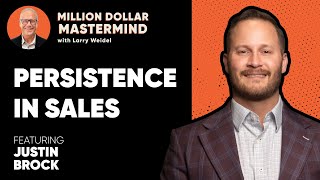
Justin left the military for Medicare insurance sales, grinding door-to-door until he landed a 72-person AT&T retiree group. He taught himself Facebook ads around 2013, scaled the inbound leads by hiring agents who assigned him commissions, and used contests and recognition to build a competitive team culture.
Questions this video answers
72
~2,200 square feet
Circa 2013–2014
Approximately $40,000–$45,000
Welcome to this edition of the million Dollar Mastermind podcast. This is where we pick the brains of high achievers from all walks of life and get their hard earned real world insights on winning. I'm your host, Larry Wydell.
So when you got out, what appealed to you? Were you just looking for an income and how did you get, what was your first year like out of this military?
Yeah, so I, I got recruited into insurance sales and thankfully the niche I got recruited into was the Medicare world. And basically it was here's a bunch of direct mail lead cards where people had filled out requested information and you're going to get in the car and drive 45 miles this way and 45 miles that way and knock on doors and put on your, put on, on your tie and comb your hair and try to get them to let you in the house so you can talk about Medicare plans. And that year was, would have been rough. I was, I would say by the typical standards, I was good at it. But I also knew, like pretty quickly I was like, there's gotta be a better way than me, you know, selling three or four policies a week, knocking on doors, getting yelled at sometimes. And some people were very nice. It wasn't like I was, I was going in and genuinely trying to figure out how to, how I could help put them in a better place. But there was of course, a lot of reluctance to that and it is a grind, but you got to do what you got to do. And that's, I think that is a defining point is a lot of people, they want to skip into a level that like, straight away that maybe you do need to put that sweat equity, you know, in or, or get to the grindstone and see the people eyeball to eyeball in that process, start at that base level. So I'm glad that I started there. It also helped me gain respect. Now when I hire salespeople and I put them in a telephonic role they're doing on the phone and they're like, man, this is brutal. They all know that the guy that owns the place started out driving around knocking on doors and getting dog sicked on them. So it's definitely. The phone can be brutal, but it's not face to face. So it's not the same way. So it's a little bit more safeguarded. But that first year taught me that I needed to figure out a way to get in front of more people. And actually what happened was I, I was on one of those appointments and I was probably 10 or 11 months in, and I met someone whose husband, and on one of the appointments I went on, whose husband was a retiree from a large company. And that large company was going to lose their. All losing their coverage. And he wanted me to come speak to their retiree union. Paraphrasing a little bit. But I went and spoke to them and there were 72 people there. And I wrote a whole bunch of policies off of this group because they were all like, we like this guy, this young man who's a Marine. And you know, they liked all that. And so I, I helped a bunch. It was an AT&T retiree union. And when I helped all them, I thought, how in the world can I get in front of 72 people again that actually want my help versus this one and one and one and one? And so it started making me think a little bit bigger of how can I amplify that. And that's when I started really, really studying marketing and, and how to use marketing to get in front of more people.
What would you say is the most. You look back, meant the most to you, to your development, to kind of prepare you to take advantage of that when it came along. I mean, were you listening to tapes? Were you doing any extra kind of sales training? Do they have it in the company? What were you doing to keep yourself going? Because that is a grind.
Yeah, so I was. I commonly say I was driving around in a fully unloaded Corolla, manual, windows, cloth seats, the works. But I had a. One of those AUX tape deck players where you could put it in and like listen to MP3s and podcasts. So I was downloading podcast episodes and listening to them on the road. Some of the early ones that everybody is listening to is the ones where they reference University on Wheels as a Zig Ziglar. You talked about the University on Wheels. So I was listening to Zig. And then. But then I would get into finding kind of niche specific people, like in the life insurance world that we're talking about things that I was like, okay, this makes sense. It's very close to what I'm doing. But. And I mean, it started out with like organizational podcasts, like time Organizational, but getting into just listening to on the road podcasts. And then I found this podcast called the Art of Paid Traffic. I think he's changed the name of it now, but basically it was just this guy talking about Facebook ads back in 2013, 14, when they first monetized the platform. And that's when I. My first segue into like, learning how to be a marketer was Facebook, but it came from podcasts. I was learning on podcasts, so that's why I like doing podcasts now. So hopefully, hopefully, podcasts will help people like it helped me.
Yeah, giving back. That's why we do it. And, you know, I've heard people say, like, my. My car was my university, and you could choose. You could choose your professors and you could choose your curriculum. You can make it very focused on what you want to hear. And so how did you start to put your company together?
Yeah, so what happened was I started marketing on Facebook and I had some great success. Right away. I thought I was a genius marketer. Turns out it was. It was at a period where there was not a lot of competition in the demographics I was targeting. And so I was having a lot of success. But I was getting my phone ringing, you know, heavily, running some dental ads and some other things. And it got to the point where I was getting so many phone calls that I couldn't sell all of the policies. And up until that point, I had already thought like a salesman. I thought, okay, I'm a salesman now. I'm a marketer. But I'm. I'm still just an individual, one person. But I thought the only way that I can scale this is to start bringing other people in. And so then we went out and. And started like, hiring agents to work with us. And these agents would assign their commissions to me, but I would handle all the lead flow for them, and then I would pay them a reduced commission based on me doing all the marketing. And then that kind of started to create that nucleus of that structure and it. And turned into a small agency. Probably a couple of years into that, we had eight or nine employees working out of an office. We opened up an office. It was like a 2200 square foot little retail space where we had a couple of admin and the rest of us agents in there, and we were driving traffic to the office, mostly still through Facebook. We use some traditional media like television or direct mail. And it just started growing that way. And of course, the profit started to grow exponentially just by that compounding effect. That's kind of how it started there. There have been some other nuances since then of like, other. Other verticals that we've gotten into, but really it just came from saying I could either. I could have either spent less money on ads and just kind of took what I get and made what I wanted, but I just wanted to keep growing. I just had this. I don't know where this came from. But now I always tell people if you're not growing, you're dying. You gotta, you got, you can't, your business can't just sit there and be stagnant. Like if you have to continue to let it grow, it's designed to grow. And so that's why I started hiring people.
For those of you who are sick and tired of fooling around and are dead serious about wanting to move up fast, I've got something especially for you. I've combined the best insights from over 40 years in business and making $70 million in income and compressed them into a free webinar. That's right. It's a free resource. If you want to find out exactly what the concepts are that I use in coaching million dollar earners, Register now@widelonwinning.com youm'll discover the five part framework used by so many to reach their financial, personal and professional goals. You can find that link in this episode's show.
Notes. Well, a couple of points I'd like to pass on and to make for people listening and they're wanting to move up. They're, you know, maybe they're working inside of a corporation, but the idea is to learn what you can do it as well as you can. But get your eye on moving up somewhere. You can move up at another company. Keep learning, keep moving up. Keep the pressure on in your career. Don't wait for things to come to you because at every step that creates more possibilities for you. And so as you did, the staggering thing I'd like you to think about and comment on is probably hundreds and hundreds of thousands of young people come into the market every year and they get a job in one area of sales or another. Like you. I don't know if it's selling books or they sell encyclopedias door to door anymore. Pasta pans, however they're selling. But they're, you know, direct sales. And you go out there and direct sales, financial services, whatever, hundreds of thousands start. And we've all seen these offices where they have 40 to 50 new recruits every week.
Yeah. Because they have to burn through them because the failure rate is so high.
And so from that ocean you emerge.
Yeah, it's kind of staggering, isn't, is it? So I think it's Napoleon Hill's book where they talk about the premise three feet from gold. Most people are thinking about short sales as a short term career. And there's a lot of people that have made a lot of money just as a salesperson. I know Some guys that are recruiters or individual insurance salespeople that will make a million a year with no employees. And what they did is persisted, they stayed at it long enough. I mean, obviously it's, you know, there's ways that you can, you can make it happen faster than others. Of course, how aggressive am I, how many contacts am I making, how many relationships I'm making? But to be frank, I know plenty of people that are not that great, but they're in it long enough and they're making 250, $300,000 a year. But when you think of sales as a short term thing, it is not. When I first started, it was, if I wouldn't have had that big win 11 months in, I would have probably made $40,000 that year, 45,000, busting my ass. That right there probably put me a little bit further than that. That helped me out. But the thing is, the harder you work and the more people you see, the luckier you'll get because you're, you're putting in that time in those contacts. And I think thankfully, by content and trying to go to events where I got around other people doing big things, I believed that those big things were happening. And by believing that those big things were happening, it gave me the perseverance to make it through those times.
And so the thing, Justin looking about the uniqueness of how you propelled yourself from just being the successful salesperson and had a lot to do with marketing. I mean, it was marketing, right? Because what triggered you getting more people involved was you figured out the marketing funnel and how, how to fill that up to where there was not enough hours in the day for you to get to all the leads that were coming in. So that seems to be the big marker, the big trigger point. And how did you talk about again, how you figured that out, how you made that happen, or did you even realize that was such a big thing that you were doing?
I think I definitely did. And early on when I started having a lot of success with paid traffic or digital marketing, I started making relationships, going to top producer events with other people and, and they, we would talk about marketing. And I quickly realized that I was, I was probably doing better at, at digital marketing than anyone in the space at the time. Now it's come to the point where there's a lot of people doing it and so it's much more competitive. But I was one of the early adapters. In fact, when I first started running Facebook ads for the 65 plus community as part of the, as the Demographic people would tell me, oh, people over 65 aren't on Facebook. I knew that was a lie because my grandmother at the time was in her late 80s or mid-80s, and she was, she was on there asking me for farmville bucks every day. So she was, I was like, she's clearly on there. 5:30 in the morning. Every morning I'm getting Farmville notifications on Facebook from my grandmother. So I knew that wasn't true and I knew she couldn't be the only one. So it gave me the confidence to go out and try it. And yeah, I mean, once the phone started ringing, because when you get an insurance sales, nobody's asking you to sell them insurance. You're having to ask them to let you sell them insurance or to let you at least pitch the product or at least review what they have so you could see if you could do better. When you run ads and you start getting people calling you saying, hey, I saw you on Facebook and I'd like you to help me with my Medicare plan. And then when that happens enough times where you knew it wasn't a fluke, you knew you were onto something. But the compounding effect of being able to help so many people and allowing the Internet to build the trust back then really manifested in the, the commission starting to roll in. Once the commission started to build, I knew I was on to something. I do think that next echelon was the ability to create a high efficiency team out of it. But of course, without the marketing, I just don't think you can do that.
You know, the thing is about salespeople that great salespeople, it's like athletics, it's like Michael Jordan would not be a great NBA coach. The fact that Larry Bird did it, you notice that Magic Johnson didn't stay a coach very long. We knew that wasn't going to last. But Larry Bird actually pulled it off for a while. But very few, it's different skills, you know what I'm saying? And for you to go from sales, a high level salesperson to a high level sales manager is unique combination of skills. But you have to develop those skills. One thing you got to learn to have more patience.
Yeah, absolutely. Yeah. You start realizing that not all people are created equal, you know that. But nothing will, nothing will really manifest that knowledge into a more clear painting than managing a lot of people and trying to put them all in the same types of positions. And the good thing is not everyone has to be the same to do well. And not everyone has to be the top performer there's going to be people that just have. Every now and then, if we. If I hire 10 agents tomorrow, a couple months in, one of them will emerge as the most badass guy there. That just happens every time. And then a couple of them will quit, right? And then. And then a few of them will be above average, and then a few of them will be average or below average. That's just. It happens every time. It's the same. The same mix. But one person always, you know, just turns into that. That alpha. And most of the time, it's grit. It's. It's there, the chip on their shoulder. I mean, if I find a guy with a good chip on his shoulder that wants to prove to somebody he's worth something, they'll just go to great lengths to do it.
How do you find out if they've got a chip on their shoulder?
Man, I think you really just have to hire. So when we hire, we'll hire based on our. It's really just a perceived. Like, is this person smart, hungry and humble? We hire based on Patrick Lencioni's principles and the ultimate team player. Yeah. And. Or it's. Or the ideal team player. And he says smart, hungry and humble. So we're looking for people that are intelligent enough to have a good conversation, that are hungry for more than they're getting out of life. Not like crazy hungry, because it can be. I'm like, okay, that's not. You're probably not going to get that here. You need to go start your own business. But then humble somebody that can. That can, you know, present themselves as not like some bombastic person we hire based on that, but the person with the chip on their shoulder, you identify after they're already hired. I don't know that I could identify ahead of time. And as a matter of fact, I probably weed out some people that have chips on their shoulder in the interview process, because what you don't want, and this, because I've made this mistake, is hiring the ultimate salesman. Because the ultimate salesman is fine if they don't work in my office, but the ultimate. The ultimate salesperson is. Is typically not always a great team player. And they can create a rough cult.
Prima donna, unfortunately.
Primajuana. Yeah, that's. That's what happens. There's a book by Chet Holmes called the Ultimate Sales Machine, and he talks about hiring, like, these insane, you know, sales studs that have egos that are hard to keep in check. And the thing is, they will sell a lot, but if you put them on A team, they will always try to steer that ship in the direction of what benefits them versus the team. And that's not a, that's not what you want.
And sooner or later they're going to make a demand that you just can't put up with. You know what I'm saying? They're going to, they're going to test you, test you, test you. And they're gonna. But a lot of times you get a lot of production out of them before that.
That's why I have to, I have to tell some of my long term employees at this point that I've had since the beginning. They'll identify these people at a time. They're like, they'll kind of tell me or make some kind of comment about it. And I've had one of them that's especially, she's very smart and she picks up on these people early on. And I have to keep telling them, like, just ride the wave. Yeah, just ride the wave. We don't have to make any, you know, any rash decisions right now. Just ride the wave. And you know, if we have to deal with it, we, when it comes, we'll deal with it.
Yeah. Well, one way of quickly finding out who's got a chip on the shoulder is get them in, get them trained, get them started and then have the first contest and then have. Oh yeah, and then have a recognition thing where you make a big deal out of whoever won.
Oh, yeah, yeah. Those people that want that have the chips on the shoulder, they like accolades, awards. And I did too. I mean, I think I had a chip on my shoulder early on in the. I enjoyed the awards. Eventually the new wears off of that and you're just like, now I'm just chasing, I'm chasing revenue.
So you create, but what you can do is you wind up creating a chip on their shoulder towards producing. If it's not there, you can crystallize it. You know, I used to have, whoever finished second in the contest, I'd make a big deal out of it. Like, he won and unbelievable. Blah, blah, blah. Come on up soundstage and everybody, you know, and, and I said he almost. Once he's up there, I say almost. Almost took first place. But I got him up here because I'm so proud of him. I want to let him help me introduce the guy who won.
That's good. We just start doing that. Yeah, I'm going to steal.
You could create some of that chip on the shoulder with Reiki.
That's how contests and all you brought up Jordan earlier. I'm sure you've seen some of the footage from, like, the Last Dance documentary where he talks about some of the stories that he would pretty much make up to create additional chips on his chart to give him that competitive edge.
Always.
Yeah.
And what I love about that series was at the end, most people don't pay any attention to the end, but at the end, he addresses the people that are critical of him. He says very quietly, calmly, says, I know a lot of y' all think that I'm just mean and was too tough for my teammates and, you know, didn't need to be that rough and everything. And everything. And he said, I know, and well, you feel that way and that's fine. He said, I understand it. But he said, that's because you've never won anything.
Yeah, that's right. I love that clip. Yeah, when he says. He says that's you because you've never won anything. Yeah, I love.
But that's true. And so the thing is, folks, do you want to win anything or not? I'd like to thank you for listening to part two of this episode of the million dollar Mastermind podcast. Timing is everything. You may feel that now is the time to get moving forward so you.
Can do something even greater with your life. Now, if that sounds like you, I've.
Got a free training video to show you how that transformation can take place. Getting introduced to how the cycle of.
Success works has been a major transforming.
Event for so many current million dollar earners. And that's exactly what this video is all about. And yes, it's completely free. Join us at the video@wearlyllonwinning.com and thanks for being part of.
More from Larry







Rick Jordan on Self-Engineered Proximity, Cyber Security Moats, and Truth-Based Leadership

Fire Fast or Fail Slow: Kevin Brittingham Reveals the One Rule That Built a $100M Empire


