Part 2 - Why True Wealth Starts With Ownership
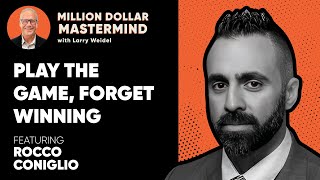
Nicole's husband explains why ownership beats W2 employment for building wealth. He lost his mother young, which pushed him to start a business in 2013 focused on unmet needs in long-term and mental health care. He borrowed systems, automation, and team-building lessons from corporate work and competitive sports.
Welcome to this edition of the Million Dollar Mastermind podcast. This is where we pick the brains of high achievers from all walks of life and get their hard earned real world insights on winning. I'm your host, Larry Wydell. What was going, what was in your suit that cost you to start a business at the stage of life you were in, taking on your father? You had to. Basically, that was a new job. Having. That's disruptive. And something had to be driving. You had a burr in your saddle somewhere. And it probably didn't happen overnight.
No, it didn't happen overnight. It was like, I would say I had always thought about it for quite a long time and I knew just being in corporate that you really had to have ownership if you wanted to create wealth.
And would you say that again?
You really have to have ownership if you want to create wealth.
Thank you.
Yeah. And you're not going to make that with a, you know, W2 and working for somebody else. So that was one thing, I think the other thing was I lost my mom abruptly, like when I was 29. And so it just, that hit me pretty hard. And so when that happened, that just created like a sense of urgency for me because when you lose your parents, you're, at least for me, when I lost my parents, it just creates more of a, a sense of your own mortality. I think when you're, when you're young and they're around and you can lean on them, you kind of don't feel as, as much of that. I only have certain amount of time here. Right. So what am I going to do with it? And when that happened, that really accelerated my push to, to really think about, okay, I want to. I would always lay out what my goals are every single year, what I want to do, what I want to accomplish. And the more I started to do that and to visualize that and the more those things started to happen for me, then it, it, it made me more confident that I could take bigger risks and accomplish those things. And it was up to me to, to put the responsibility on myself to make those things happen. So those were the things that really pushed me. And at that point in my life, I was like, well, if I don't do it now, I'm not going to have the time ahead of me to be able to get to where I want to go.
Yeah, yeah. You've got to factor in the time element. It's, you know, at some point you got to go and you don't want to do it to where it's hard enough to have. You're going to have sleepless nights if you start a business. You know, I hate to. Hate to tell. Bust anybody's bubbles. And it. It is better the younger you are. Sleepless nights are better the. You don't want to have sleepless nights. Nobody gives you a plaque for doing sleepless nights. And people say you just work so long. It's like I said, it's just. I'm just no good. If I was good, I wouldn't have to work as much. I'm trying to get good.
But I think the other thing is you answer some questions for yourself if you're able to take some of those risks. Because I look at it this way. I wasn't. I didn't come from wealth. I didn't come from. I didn't have any money. So I wasn't really going to be worse off if I failed. Right. At least I knew. At least I would know that, hey, I took a risk or I took some risks and it didn't work out. But, like, it's not like I would look back and have regrets because I didn't try. So I've always tried to have that type of mentality of, like, what's the downside? Okay, well, I fail. And so what? Like, you can fail. And a lot of people say, like, hey, fail forward. And you learn a lot of stuff when you fail. You probably learn more than when you fail than you do when you succeed.
Yeah. Now, looking back and thinking about where you were when you started, what skill set, what experiences, what had you gained from your experience working inside another company that served you the most, launching your own business?
That's a good question. I would say just seeing how large organizations run is really valuable. You can see how professional organizations run. You can also see inefficiencies. But understanding, I mean, like, for us, we had, like, operating systems in place from day one, even. It was just me. When it was just me and my wife, Nicole, we used a lot of technology. We used a lot of automation. We started to make relationships with outsourced vendors that could start to. We could start to outsource mundane administrative things to make ourselves more efficient. And a lot of that came from learning on our own. A lot of that came from experiencing things within some of the companies that we both worked in. She had worked at the Cleveland Clinic. She had worked at University Hospitals in Cleveland. So she saw how large health systems worked. I've worked within those organizations. I worked within, like, a lot of large companies, like McKesson Medtronic, Phillips Healthcare. So you could kind of see how they built those organizations and what was really helpful and what wasn't. And so you could use a lot of those teachings when you built your own operation. The other thing I would add is that the culture of. When you experience a good culture, you learn a lot and how the culture is run. And there are subtle. There are a lot of subtle things that go a long way. Like, for instance, when I was at Spectranetics, the executive team there, they never referred to people as supervisor, boss, employee, this, that, and the other thing. It was always like, you're a teammate. Okay, so the CEO is a teammate. To the. The guy that's on the manufacturing floor putting the devices together, it didn't really matter. So the hierarchy was there. But it also was like, it was emphasized that everybody was working together as a team rather than this hierarchical structure that made everybody feel inferior or superior to others. And that one, I think that went a long way. And coming from a place where I played sports a big part of my life, I really appreciated that because. Because in order to have a successful team, you do have to have that mentality that no one is bigger than the team.
So you were in a football program that went 68 and 1.
Yeah, yeah.
We.
Yeah, yeah, yeah.
It causes you to fall in love with the sport when you can do win.
Yeah. I played football from the time I was in fourth grade to the time I was 22 years old. I was fortunate to play college football. And I played at University of Mountain Union, which is kind of like the Alabama Division 3. I think they've got like 14 national championships now. I was part of four of those from 97 to 01 and played for a great coaching staff. Coach Karras was the head coach of that football team. And just an amazing group of coaches, an amazing group of leaders and an amazing culture as well that they put together there.
Well, to not belabor the point, but I think parents that have their kids in sports programs need to be aware the influence on attitude and everything of the program and the coaches and how they react. You don't have to win all the time, but they have to react to losing, getting beat the right way, and keeping their head up and keep moving forward and taking the positives out of it. But a positive sports program being a part of that really does instill things in your bones that you carry with you right on up, don't you think?
Oh, yeah, I totally agree. I mean, I think that being part of stuff like that is I think there's some people that don't relate that to other parts of their life. And that's unfortunate because I think there's a lot of lessons to be learned when you play sports. So I think it's really important to play sports. I think that it teaches you how to work with other people, especially in a team environment. There's a ton of work that goes into preparation and being successful and competing. And then there's an individual aspect to those team sports, too. So being able to kind of get inside your own head and figure out like, okay, well, how am I going to compete, how am I going to get on the field, how am I going to win a job and what can I do to make myself better? How am I going to push myself? Like, all those things are really important. And you have your own the team and individually you have your own challenges that you're all you're going to face, whether that's trying to get better or fighting through injuries or just mentally just making yourself tougher mentally to be able to fight through adversity. I mean, all those things are really valuable in sports.
Well, we found that, recruiting tens of thousands of people, we found that invariably, not always, but invariably, there was a high likelihood that if you had a high achiever, they played high school sports in one way or another, or they were in the band or there was some kind of competitive environment where they had to push themselves and learn what it is to push themselves and challenge themselves and go on exhibit, put on performances and things like that, because things you learn from that you're not going to learn any other way.
Yeah, I agree. I also think it's interesting you mentioned that, because the high achiever thing, like, if you listen to some of Nick Saban's speeches, he has one where he says high achievers can't stand to be around mediocre people, and mediocre people can't stand to be around high achievers.
Yeah.
So, like, when you think about cultures, it's really important to make that match. Right. You want to surround yourself with high achievers in order to be ultra successful. If there's tension within a team, it's probably because you haven't found that right mix of people. And you have. You have a group that's okay with mediocrity and you have a group that's not okay with mediocrity and they're high achievers. And. And so that. That isn't a good mix. That's not a good culture.
Yeah, yeah. And you find the Top leaders are incredibly attitude sensitive. Like if they come in to an area or a team or they're in an event, the first thing they're going to pick up on is the energy level and the attitude of everybody there more than anything else, you know, because that's where they're looking for. And it's like a smell, you know, winners, winners can smell success, but they can also smell losing. They can smell a bad attitude or whatever like that, that doesn't fit. And that's one of the things for a, the most important thing for a leader to do is to make sure that the right ingredients for success are there. And that attitude that, that approach kind of permeates the organization. When you came in, what appealed to you about this particular opportunity? What was the, the business that you started? What was the service? And why did that appeal to you? Why, why do you say, we can get in here, we can make a difference? And then it did. It turned into a huge success. So congratulations on taking that bet.
Well, I would say my wife identified the opportunity. Like Nicole, she was working in the long term care industry. She said, I'm getting a lot of, a lot of patients that have psych mental health issues in this particular space. There's not a lot of providers that work in that particular vertical within healthcare that can provide those type of services. And I think there's a huge need here that's unmet. So we talked about it, this is back in 2013. We talked about it for a while. She wanted to start something and I did too. And I said, yeah, let's do it, let's. But we did some homework on it before we made the leap. I mean, the first thing that I did was I said, let's go see if there's a model out there right now that has been formed. Because at least if there's one that we can point to that's large and has scaled, we can say, okay, this is a proof of concept, right? And some would say, you know, some might argue, well, if someone else is doing it, why would you do it? Well, that actually gives me more confidence that there's a market for it if someone else is doing it. If someone else isn't doing it, then you're almost on a level of like you're saying like I'm an inventor or I'm like an Elon Musk like type type of guy where I'm just going to go do something no one's ever done before, which is extremely challenging. So when we looked at the market, there Were tons of signals that said, like, this is going to. There's a market here, there's an unmet need. And so at that point, we just said, all right, let's just take the leap of faith and work really hard and make it happen. And we did.
That was a smart move. I don't know if you realize how smart that instinct was to look for a model right from the beginning. Because the bottom line on success, you can make yourself a success at pretty much everything if you work hard, you're going to beat half of the people just by working hard. And then you beat another 40% by having a good track to run on. And the way you get those, you find those good tracks to run on is look at the people who are already successful doing what it is you want to success and start. Start modeling their behavior and picking up things that fit. Fit your style and keep working hard in a certain path. And so for you to have that instinct right from the beginning, rather than, I think a lot of people, they kill themselves because they don't have a model.
Right, I agree. Yeah, models are. I think it's really important. We were just talking to a business partner of mine about this yesterday, and we were just talking about the amount of work that we're putting into what we're doing now. And I just said it's important to do that now because the faster I can learn this, like, the faster I can learn something, then the more I'm able to narrow in on the most efficient way to do it. And then the more efficient I get at it, like, the less time I'm actually spending doing it because I've created a model, I've created a model in my head of like, how it looks, and then I just get faster and more efficient as time goes on.
Right. And that allows you to develop those kind of systems, put things in place that allow you to stay on track. And is there anything that we should add to your insight that when you worked inside big companies, you saw how big companies work and you were implying that successful big companies work? Is there anything to that that we should add to pass on to people that you learned that they could incorporate, bring, make sure they have in their business as they put it together?
I think, yeah, I do. I think that when you're in those big companies, don't take it for granted. Try to learn as much as you can when you're there. It's there for you. You're an insider at that point. So one, if you take an interest and you and you learn some of these things, the whys behind it. Why have they chosen to do certain things? Why have they deployed certain systems and not others? How they evaluate things. Number one, like that's going to set you apart from like 95% of the rest of the people that just kind of go along and don't really understand the why behind what the company is doing things for, right? So as far as like career path, like that'll definitely set you apart. And then on the other hand, if you decide to ever do something on your own or as an entrepreneur, you've actually learned more deeply why decisions have been made. And then you can evaluate for yourself on whether they made good decisions or bad decisions, if the criteria they used to make those decisions were good, was a good set of criteria, or not. Foreign.
I'd like to thank you for listening to part two of this episode of the million Dollar Mastermind podcast. Timing is everything. You may feel that now is the time to get moving forward so you can do something even greater with your life. Now, if that sounds like you, I've got a free training video to show you how that transformation continues take place. Getting introduced to how the cycle of success works has been a major transforming event for so many current million dollar earners. And that's exactly what this video is all about. And yes, it's completely free. Join us at the video@widelonwinning.com and thanks for being part of our community.
More from Larry







Rick Jordan on Self-Engineered Proximity, Cyber Security Moats, and Truth-Based Leadership

Fire Fast or Fail Slow: Kevin Brittingham Reveals the One Rule That Built a $100M Empire


