Part 3 - How a Tiny Brewery Landed a Mega Deal with Publix
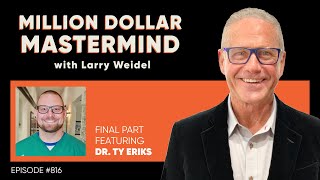
Ty grew a brewery from a small taproom in 2018 to 250 Publix locations and 450 bars across the state. He runs a dental practice while his wife manages the brewery day-to-day, handles twice-weekly canning runs with an in-house line, and credits a strong team and distribution partner for the growth.
Welcome to this edition of the million dollar Mastermind podcast. This is where we pick the brains of high achievers from all walks of life and get their hard earned real world insights on winning. I'm your host, Larry Wydell.
You started selling in 2018.
Yes. Just here in the tap room. Minor distribution. Not a ton.
Yeah.
And the brewery, over time it just kind of showed us what kind of animal it wanted to be. And right now it's become a huge distribution forward. Cans are big. I mean, we just got picked up by Publix in 250 locations about.
Congratulations.
5, 4 months ago. Thank you. So the canning aspect of it becoming a. A big deal. So that's what work out of now. Switching gears a little bit to be able to support that and feed the business the way it needs to be fed.
So what are some of the other places you're in?
Oh, gosh. We're at 450 bars and restaurants as well, from Key west to Port St. Lucie.
Wow.
So we have a ton of places that we're serving kegs to and some take cans too. It's not just kegs, but. Yeah. So we're in quite a few. And it's taken again a. A great sales force and we have a phenomenal sales team here and a great distribution company that assists us in that as well.
So I'm gonna have to come down. I'm getting curious about this operation with. I mean, you must have semis or trucks in and out of there all the time. It must be a mad house.
It's a madhouse. It's a mad house.
I mean, it looks relatively calm here right now.
It's relatively calm, but it's brewery. It's a little bit on the noisy side. So I apologize for that again, guys. But. But yeah, I know it's busy. It's very busy. But hey, wouldn't want any other way.
How do you go and deal? I mean, is that really a Blessing to have 250 public stores that all of a sudden you've got to canned beer for?
Yeah, it could be the opposite problem.
Yeah.
You know, it could be sitting there looking at each other. Yeah, yeah, yeah.
I will grant that it's a happy problem, but it's.
Yes, it's a busy problem though. Yeah, there's no doubt about it.
How long did it take you to adapt to that? What's involved in something like that?
We had to buy canning line. So before that we were. Well, we bought the canning line before public. We had a satellite company that used to Come and help us. Canning equipment's expensive if you buy it on your own. But when it became more apparent that this was what the need was and what people were asking for, we made that investment and bought that. So we at least twice a week are canning large runs of cans, and we had to set up a bigger walking cooler to be able to store the product and all that stuff. So it's been a logistical, say, nightmare. It hasn't been a nightmare, but it's been busy. Been busy.
How did your. What is your method? Because what you've had to do ty to point out to you, you have been faced with one monster situation after another. Like just getting the legal side, getting the regulation, getting the permits, this. And they get all of these inspections. And yeah, get your equipment. You got these big vats and who knows where to get all this crap that's like barrels and cans and canning. How do you go about. It's like all of a sudden now you got to do this. How do you go about something you've never done before? It's a complicated thing. It's. You can't, like, figure it out. Go down and to the hardware store and get some stuff.
And Tinkerman, ask the question, what is.
Your approach of, you got a new phase, a new thing. We gotta figure this out. Everybody say, ty, what do we do now? How do you look at those and evaluate that and start to unravel the. Heal those onions?
Well, again, we do everything as a team. It's not just me. A lot of the back end research, cost analysis, all that, that was all done prior. We meet here at the brewery, we do weekly meetings and sit down, we talk about next moves you need to be done, what the needs are, how do we get there, how do we become more efficient? And we do that as dental practice student. We constantly are rebuilding ourselves to become better and more efficient in how we run the business. So I can't say it's definitely not just me. It's a group effort. And there is, again, some luck and, I guess, some vision. But again, I'm surrounded by a bunch of great people, and all of this would not be possible without being surrounded by the right people. And that's a testament to, in the brewery, my business partner that I had when we started the business, how we grew it and built it, and also the guy that I bought my dental practice from.
What's the key to getting a good team around you and keeping them to get the right kind of team around? What have you learned about that?
You have to, obviously have to interview and you have to make sure that when you begin relationship, you think you have the right tools together to be able to be successful. But also treating people the right way, being a good employer, paying people the right way, not taking advantage of people. Yeah, I think all that is unfortunately pretty rare. And obviously people really appreciate it and it could be, it becomes a family over time. You build that trust, you. And it goes both ways, right? I mean, I would do anything for my employees and they likewise, they do anything for us, my wife and I. So it goes both ways.
How have you found the best way to get those people is to grow them yourself, get them in, start them on small project, move them up, or bring people in from the outside that already have that training.
We've done it both ways. We've definitely done it from the bottom up, but usually it goes. We don't start from scratch. We get through our connections in whatever industry, whether it be the brewery or the dental world or whatever, we use our connections to get recommendations, people that are looking to change or whatever that have the tools that we're looking for. So try not to do it from a kind of throw an ad out there and see what comes in because usually it doesn't work best.
How would you explain to people how you compartmentalize and how you keep both of them running at Fever Pit? If I was guessing, I would say you've got numerical markers that kind of govern both businesses are key indicators you're doing the right things or you're.
Yeah.
And right activities, right results. But how would you say, how do you compartmentalize and keep them both going, add back?
Well, I have the brewery. My wife is not practicing attorney anymore, so she's now the general manager here. So she is completely running this side of the family business. And I do the. I come on Fridays again. There's things that are needed, analysis have been ran, that kind of thing. And we do our weekly meetings. But generally dayto day, my wife's running the show here so that I can focus on the dental practice and make sure that my focus is 100% there when I'm there. So again, it's a team effort.
Right. And so what are some principles? Do you. Or do you find that there's sayings, there's principles, there's concepts that you learned or you heard in your formative years from coaching, from just growing up and having your first areas of responsibility that where you role models and things like that, phrases, ideas that became internalized and a part of how you do and operate, even without thinking, but just kind of.
Right.
Anything like that that you. Comes to your mind.
Yeah, I mean, I think for me, sports specifically football was probably outside of my parents, obviously, like I spoke about before, but made me kind of search within my soul multiple times and come out of it and become better and then get chopped down and then have to work at it again. That kind of mentality, I think is probably the thing that has made me innately not care about things that are hard. Push through it and know that there's going to be another side, whatever that other side is going to be, just push through it. Because without doing it, nothing's ever going to happen anyway. Right. So I've always been a person for better, for worse, as my wife would tell you, that never quits and just continually pushes through things.
Talk about, explain what you mean by that. Like not put off by when things. I run into something and it's hard and that doesn't dip me or just like it's hard.
I've always been. Again, I think, again, I'm going to say it's through sports. And I've always had, like, even when I was younger, my goal was to be a starter on my team, then eventually get a college football scholarship and then hopefully eventually play in the NFL. All that stuff, all that is the goal. Right. And there's a lot of obstacles we got to get through to accomplish those goals. And working through those is extremely difficult sometimes, especially when you're trying to do well in school and in college, neurobiology major. You know, all those kids had really nothing else going on besides studying and doing that. And I'm traveling around playing games and studying on airplanes and everybody else is taking a nap and that kind of thing. That's hard on a young brain now. But being able to work through that has made me, I think, probably more resilient than. Than most and. And able to kind of brush off problems and just continually keep the goal at mind. Now, everybody falls and fails and. But it's how you pick yourself up and, and move forward that I think makes the difference in situations like this or in business. And like any, any situation, how you pick yourself up, how do you get.
To where you recharge? Because we can't go like on coffee around the clock forever. Have you ever had the thing where you just worked yourself to the bone?
Yeah, my wife will be the first to tell you. So hopefully you get here on this podcast. When I crash, I crash. I crash.
For those of you who are Sick and tired of fooling around under dead serious about wanting to move up fast. I've got something especially for you. I've combined the best insights from over 40 years in business and making $70 million in income and compressed them into a free webinar. That's right. It's a free resource. If you want to find out exactly what the concepts are that I use in coaching million dollar earners, Register now at WidelonWinning. You'll discover the five part framework used by so many to reach their financial, personal and professional goals. You can find that link in this episode's show Notes.
So I've always been a good sleeping. So I've I always try to get at least eight hours of sleep a night. Sometimes it doesn't happen like when you're building a in the building or whatever. But I my kid go down, I go down. I don't sit up and watch TV till midnight or anything like that. I go to bed at 9:30, 10 o', clock, get up at 6 and go at it again. So I know how important sleep is. And for me specifically, I know for some people it's not. But for me, I know myself and to be the best I possibly can be, I have to get the rest to be able to do it. So I do take care of myself that way and make sure that I try not to let anything get in the way unless it's absolutely necessary of that. Things happen. Kids need to study for tests or whatever and they need help, whatever. There's, there's circumstances. But as a general, general rule I try to get enough rest to where I can be as successful as possible.
The next day when you were coming up, were mentors role models more important or getting things out of books or tapes? Things like that?
I think I always saw my parents just work their tail off and I think that that really made a large impression on me. They got divorced when I was really young, so I saw each side of them just work their tails off to make sure that we had the life that we make sure we were set up as best as possible to become successful ourselves. So I think that probably made the biggest impression on me, to be honest with you. Yeah, without that kind of influence, would I have not gotten to the point where I am in terms of my mentality now? I I don't know, but it certainly helped quite a bit.
At what point or did you, have you ever in your life got to the point where you said you could see how you were and you could see how you wanted your life to be and then you could see other people and say no, I'm not going to do that.
That summer program I did, was it telling you that was the major change in my life was becoming competitive and basically looking around the room and saying hey, I'm going to be the best in this room in any way, shape or form it needs to happen. I'm going to do it. That was it. I mean honestly that was a major turning point in my life.
Did that happen right away?
Yeah.
It's funny how things can change when you change your mind and that it's.
And it was a direct mind change. It was just a different way to look at school and, and really sports. Honestly at that point in time, you know, I participated in sports but I wasn't overly competitive and just kind of going through the motions and all that. And yeah, it's amazing how three months of time can make such a big impact on long term life and how you run your life. Yeah, actually never really thought about that. I'm glad we're talking about this. That actually my oldest son, he's the one that came up and gave me a hug not too long ago. He's very much like me with school. He is very add and my wife and I thought about taking him for a summer to do that same program and I think we're gonna, we're definitely gonna do it. It's rather funny whether it's this summer or next summer. He's also a very competitive athlete. Still does a lot of travel stuff so we gotta work through that as well.
So maybe you could buy that school and open up a branch in Lauderdale.
I don't need any more problems.
I'm curious how your mind approaches the success in terms of. You're looking at this thing like 250 stores with Publix.
Yeah. A lot faster than I thought it was going to happen. But always approached, and it might not sound true, but I've always approached businesses like I said as a family. And success to me is being able to have everybody have success in this business, not just my wife and I. Right. So we're always here if something big ever happens. We're, we're, we get it together. We're not I guess the typical owners on that way. Whatever goals and stuff we get to, you know, we never sell the business, for example, for any substantial amount of money. I mean that's not something that we're going to take ourselves. I mean we're not the only people that made this happen. So it's a group effort, it's a family effort. And that's kind of. And never. And I'd say my employees, but really it's my family. I think they know it. And that really is a driving factor. People believe in, not only in the product, but, you know, who my wife and I are and the kind of environment that we demand, really. I mean, we definitely have had employees that don't fit the mold and they don't last long. And that's okay. It's just that we're looking the right fit. So just lucky in the dental world that it hasn't happened at all. And we're lucky also that it hasn't happened a lot here at the group.
So. So, you know, just from a competition standpoint, since we brought it up, how many? Because you went from somebody who knew how to make craft beer for yourself, basically made it in a bathtub.
Pretty much, yeah.
Where now you're supplying 450 individual outlets all over the state and 250 public stores now. So you become somebody in this business. How big is that? How many are there Alexes that are the decide breweries that are up to the size that you are right now. What does it look?
There's quite a few.
Because in a lot of you, the biggest in the state, biggest in the region. Biggest.
Oh, no, no, there's a lot of them, but a lot of them are owned by a lot of people too. I mean, I couldn't really tell you about individually owned breweries, to be honest about my head. I really don't know of any.
Yeah.
That are at our size or there's very few.
That's what I wanted to bring out. That's pretty substantial. I mean, congratulations.
Yeah. But there's plenty of craft breweries that are large, that are owned by multiple people. I mean, it's a group effort versus.
Well, congratulations.
One family.
Yeah, you've really. And again, you did that as a second business, so congratulations. I always let my guests appreciate you taking the time. I know you're busy.
Oh, absolutely.
What you got tomorrow? What you said you got a fishing tournament or something.
Fishing tournament. So, yeah, for the last. Really since we opened, we have partnered with a charity organization called the John Michael Baker Foundation. And John Michael Baker was a kid who unfortunately lost his life about, I would say, seven or eight years ago. And his parents started a foundation in his honor. And we have always made a beer for them for not only the tournament, but we also distributed to out to our network and we share profits with them as well. So it is their John Michael Baker fishing tournament tomorrow, which I am participating in with a couple friends of mine. So we're leaving my house at 4:30 in the morning.
Wow.
We're going to be fishing by you, Larry. We're going to be up in Jupiter.
Oh, are you telling.
A little bit. Okay.
All right. I'll keep an eye out for you.
Yeah, binoculars, right?
Yes, I've got a telescope. But I always let the guests have the final word, Ty. And so for those that have been sturdy enough and interested enough to stay with us the whole time, what kind of last word would you have for them as we break this off and let you get on back to the business?
I've always looked at life as. I've. Not to be grim or anything, but my dad unfortunately passed away and he was 65. And so I don't look at life as given. Life is what you make it. And things that I want to do or have the desire to do. Better time. There's no better time than now to try to figure out how to make those a part of your life. So really that's how these things have happened for me. Is. Hasn't always been the right time and again to get my wife on here. I'm sure she'll share those growing things with me. But we do it. And at the end of the day, it's most of the time it works out to the way we want it to work out. And it takes obviously a lot of effort and time and all that, but there's no better time than the present to do the things that you want to do in your life. It takes a little bit of effort and a little bit of grind to get it done. But I think that's the number one thing, is just do it.
It's easier to put in the effort and grind if it's something you want to do.
Correct.
And the sooner you do it, the sooner you can start to get the payoff from it. And like you say, and so many times, sometimes it'll take longer and everything, but sometimes it surprise you once it gets going like you had. That seems to me it takes like in the beginning, it takes forever. Forever. Like you had two, thought it was going to be six months, took two years. But then now it's like skyrocketing.
Yeah. Now it's becoming its own thing. There's no doubt about it. There's a lot of satisfaction that comes with that. And then being able to surround myself with people that I truly love. It's great. It's awesome.
And so you get going on something that you've got inside you to do, the quicker you can get to the point where Ty is and his family are in their business. Thanks so much, Ty.
I appreciate it. Mr. W. I appreciate you as always.
Yes, sir. We'll see you, man. Take care. Have a great weekend.
Take care. You too.
Goodbye. Bye.
Appreciate it.
Thank you for listening to the final.
Part of this episode of the Million Dollar Mastermind podcast.
Great ideas.
Don't care who used them.
If you're motivated to move up in a big way right now, I've created.
A free training video to remove the.
Mystery on how to set yourself up for big success.
This is the information that has changed.
So many of our lives and it can have the same impact on you.
And the video is completely free.
You'll find it@widelonwinning.com join us over there and thanks for being part of our community.
More from Larry







Rick Jordan on Self-Engineered Proximity, Cyber Security Moats, and Truth-Based Leadership

Fire Fast or Fail Slow: Kevin Brittingham Reveals the One Rule That Built a $100M Empire


