Ep. 13 - Health is Wealth
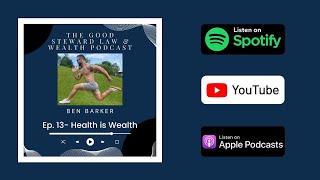
Ben Barker, a fitness coach and entrepreneur, argues that health is inseparable from wealth alongside faith, family, and finances. He recommends focusing on squats, pull-ups, push-ups, and sprints, and uses blood testing to track biomarkers. Barker shifted from a W-2 job to entrepreneurship for unlimited earning potential and emphasizes that exercise builds momentum even with a poor diet.
Chapters
Welcome to the Good Steward Law and Wealth Podcast, where host Ledly Jennings explores law and finance to help listeners become better stewards of their wealth. Each episode covers the latest trends and strategies in estate planning, elder law, investment, and wealth management. Tune in for the knowledge and tools for financial success and security.
Welcome to the Good Steward Law and Wealth Podcast. I'm excited today to have my guest, Ben Barker. Some people know him as the Neighborhood Alpha Dad, but goes by a lot of things on Instagram. And Ben is a kind of fitness, health, I don't know what you call yourself, coach, instructor, influencer, but I wanted to have him on to talk about, and you're probably thinking, why is this even related to estate planning or finances? But I think there's a big relation. So I wanted to have him on here to kind of talk about that stuff.. But I met Ben, he was training me when he was running an F45 gym. And that's where I first started kind of getting back into fitness and training with him. And then after that, he went out on his own and does kind of fitness programs and various things. But, um, Ben, thank you for being on and I'll kind of let you introduce yourself and how you describe what you do.
Cool. Hey, Ledly Jennings, thanks for having me. Number one, I got to say great podcast name. The good steward. I mean, I love that. And I know we'll touch on this, but, you know, you want to be a good steward of your finances. You also want to be a good steward of the health you've been, you know, rewarded or awarded. But man, I'm glad to be a part. And I also got to throw this out there. Ledly Jennings is a real athletic guy. I remember him jumping on the highest boxes and lifting the heaviest weights we had. So I just had to throw that out there, give him a nod.
I knew I had you on for a reason. Now we can just end it right now. But so what do you classify your job as now?
How do you—
when people ask, what do you do? What do you say?
Also, I want to throw a nod to you for first calling me a fitness coach rather than an influencer. I prefer that term. Influencer kind of has a negative connotation nowadays, but essentially I'm a fitness coach and I would also— I guess I'm classified as a fitness influencer. I essentially do like affiliate marketing for supplement brands, clothing brands, and fitness equipment on top of coaching people through fitness subscriptions and one-on-one coaching.
Gotcha. Yeah, and if you look on his Instagram is where I— how I follow Ben most of the time. And then I subscribed to his, um, home workout plan for a while before I had a gym to go to. So it's great stuff to, um, get involved in. He, he goes by the Neighborhood Alpha Dad, you know, a lot of, uh, at-home type workouts, and there's some entertaining stuff on, his Instagram. But, uh, really the first thing is just generally right now in your life, and this could be work or, um, family, really anything, what excites you right now? Like what gets you out of bed, um, each day?
Man, you view age different when you get in your 30s. And I remember, you know, when I was like 18 or 20, like, you know, once you're 30, it's over. Um, but what's cool is like when you go to a gym, uh, are you a member at the Athletic Club, Ledly Jennings?
Yep, I am.
So the cool thing about going to a gym like the Athletic Club is when you see guys in their 50s, 60s, and 70s who are still incredibly fit, you know, active in their career and just crushing life. And I think it's really cool when you're in your 30s and your 40s and you realize you still got a whole nother life to live. And you know, right now I'm 33. And it just keeps getting better. You know, I've been married for 11 years and our marriage is still going strong. I'm really enjoying the place I'm at with my kids. And when you start viewing aging, like, just as time to improve, you know, both, you know, spiritually, mentally, physically, financially, it just—
life gets exciting.
Yeah.
That, and that's exactly why I wanted to have you on. It was just because you kind of portray this and everything you put out there. Um, But like you said, being a good steward, most people think of your wealth, and when you think wealth, people think finances. And that is a big part of what I do is help people pass on their finances to their kids, essentially. But really, wealth has a lot of different tenets. You know, there is finances, there is your family, your faith, how you have an impact on the world. But also a big one is health. And I've been— I was reading a book here recently and a whole chapter was titled Wealth is Health. And when you think of that, how do you think about that and how you manage your health? Because I see you have more motivation than just, you know, looking good and being strong. I feel like you get your motivation elsewhere, man.
You— it all ties together. I think you hit the nail on the head in regards to you can be rich but not wealthy. I think you can have all of the money in the world, but if you're not making an impact on your community, you're not healthy, and you have poor relationships with your family, you're not wealthy. You might just have money. And I think when you really have wealth is, you know, on my podcast, I talk a lot about faith, family, fitness, finances, and freedom. And I think when you are well-balanced in those 5 areas, that's when you truly have wealth.
Yeah, that— I hadn't thought about freedom in a while, but that is a good one. Um, being kind of independent and having, you know, from different things that life throw at you, if you can handle it, that's kind of freedom to me because you prepared yourself. You know, whether it's sickness or injury for the health side, or unexpected death of a spouse, or just an economic downturn, I think about that a lot is how do we insulate ourselves so we're not dependent on other things.
Correct. And then, you know, on top of that, Ledly Jennings, if you're thinking about health, you know, think one day when you're 50 or 60 and you have a kid who's in their prime of their life and they're like, Dad, I want to go hike Pikes Peak. If you're not healthy enough to go attack that with them, you know, you might have money, but you don't truly have freedom because you're not free to go and do something at the drop of a hat. And I like to think when I'm 50, if my kid asks me to go do that, I'm not going to have to train for 3 or 6 months in order to prepare. I'll just be be like, yeah, like, when are we doing it?
Yeah, that makes me want to go work out right now. That's, that's some good motivation. My kid's only 2, so maybe I have a little bit before he asks that, so I got some time. But yeah, and how do you really balance the 3 Fs, you know, the faith, family, finance? How do you prioritize and balance those in your life?
It's tough, and I think at times in our lives we have to lend a hand more to some than others. And, you know, for me, I've never really— I've always had goals in fitness and I always want to improve. And like when I look in the mirror at myself, I'm not impressed with myself. I can look and pick out things I want to improve or in my lifts, you know. But for me, a big focus for me the last couple of years has been finances. I kind of reached a point where I said to myself, you know, I should be ahead of where I'm at. You know, I should be actively investing. I should be, you know, I want to get involved in real estate and things like that., and so I need more liquidity, right? And so I've really been focusing on that. And so I don't wanna say my fitness has been on autopilot, but I've been able to put the same amount into my fitness, right? And, and maintain, whereas I'm putting more effort into the fitness side of things. And so I think you've gotta work on all of them, but at times different parts are gonna need more attention essentially. And so I think you've kind of got to look. So I have a friend who's a part of a group called GoBundance. Have you heard of that, Ledly Jennings Jennings Jennings? I haven't. It's a really cool group. You have to have a certain level of net worth in order to be brought into the group. And they have this sheet called the One Sheet, and you can download it for free from their website. And it's essentially a Google Sheet and you score yourself. Their areas are the same exact as mine, but it's essentially, you know, your, your net worth, your health markers. So like, what's your LDL and your HDL, your body fat percentage? How many hours did you spend with your wife this week? How many hours per week did you spend, you know, on your hobbies, things like that? And so they score you based on those. And so I think having kind of some idea of where you're doing best and then also being able to look at it, you know, from 30,000 feet and saying, this is where I need to put my focus currently.
Yeah, that's really neat. I like that, especially it's more tactical to where you can see the big picture, but then narrow down to how you achieve that.
Correct.
I love that. And I didn't really plan to go this way, but I got to thinking as you were talking is a big part that I've seen since starting my own law firm is the value of really owning a business, being an entrepreneur, and the impact that you can have on your community, family, and that kind of thing. So like being a good steward is part of it is being a capitalist and, um, growing what you've been given. I'm just curious, how did you go into making that decision? Because I know at one point you were, I don't know your situation, but maybe salary or had a steady job and then you made the decision to go out on your own essentially and build something. What went into that train of thought?
Sure. So to anybody who has a normal W-2 job, there's honor in providing for your family. But I also think there's a lot of wisdom in building a vehicle that can grow exponentially, you know, because when you're in a normal 9 to 5, typically, you know, there's a ceiling there. And I just saw that my ceiling was pretty low. There's a book called The Millionaire Fast Track. And it sounds gimmicky. If you haven't read it though, I suggest it. You know, it just talks about, you know, when you're a job, you know, maybe say the ceiling's whatever, $250,000, let's just say. And that's a wonderful salary. But, you know, if you're an entrepreneur, there really is— there is no ceiling necessarily on how much you can earn. And I heard a guy in that GoBundance group once mention he was talking about, you know, people kind of like look down upon you. Like it's not popular to be like, I'm rich. You know, people don't like it when you say that, he said, but the ability to know that if there's like a need in my community and somebody needs to write a $30,000 check, you know, knowing that I can do that is, is worth a lot. And when you can make that type of impact in your community is huge. And I just saw that if I were able to grow my income, I can make a larger impact.
Yeah, that, that's, uh, right on point. Um, And, uh, has the discipline that you've learned in your life from the fitness, like being consistent and all that goes with that, has that applied to your business and just other areas of your life?
Have you seen that translate? 100%. And we're gonna, I'm probably gonna draw too many comparisons here and I'll just apologize in advance, but you know, with, with working out, it's very discouraging when you start. You know, say you've got 50 pounds to lose and you work out for 6 weeks and you lose 5 pounds and you're just, oh man, this is the worst. It's not going anywhere. You know, my time is better served elsewhere. But if you can get over that hump and continue working out and continue getting consistent, you know, you eventually get compounding interest. And, you know, maybe initially you're working out 3 days a week and you start to kind of like it and you just notice you feel better. Then you go 4 days a week. And you start seeing a little bit of results, and then you get excited and you start drinking more water, you start watching your calories a little bit tighter. If you can just hang in there and continue working and make it past the point where most people would quit, that's really when the magic starts to happen. And the same thing happens like in marriage, you know, like when marriage gets tough, most people want to quit. But if you can just kind of put your head down and continue doing the work, that's when stuff can get really good. And then the same exact thing with your finances. You got to put your head down, let compounding interest do its thing.
And that's where the magic happens. Yeah, that's exactly right. I think when I was working out with you at the gym and I got to the point where I was the fittest I'd been since, I guess, college. And it was at that time I didn't think I'm never going to work out more than a couple of days a week anymore. And then you start doing that, then you go to every day a week. And then you start thinking about what you eat just because of all the work you're putting in elsewhere. And it just slowly builds and builds. Um, and yeah, that makes a lot of sense. Um, and, uh, so you mentioned your kids going to want to ask, say, I want to go hike this mountain. Um, a lot of what I try to do with my planning is people want to know how to, you know, we pass on our wealth, but when you give it to your kids, you want to make sure they're able to handle it. And they're responsible with it and hopefully grow it because everything we've had is a gift. So when you're giving them a gift, you want them to grow it. But so some people ask, how do you pass on the values that built what you built to your kids? And in the lines of fitness and health, how do you hope— and I know your kids are younger, but how do you hope to pass on those values to your kids?
Man, I, I think it's The saying habits are caught, not taught. And I think if your kids see you living the way that you hope that they will live, they are much more likely, you know, to carry on that legacy. You know, if you mismanage your finances or make unwise choices, they're more than likely going to pick up those traits and habits as well. I think, you know, you know how it goes, Ledly Jennings, you see parents who do everything right. And their kids still mess up. There's always a chance for that. But I think if you are doing things right and you're teaching them these things while also living it out, they're much more likely to pick up those habits and carry on that legacy.
Yeah, that, that's exactly it. Um, and that's how I, I try to think about it is you live your life, your kids see that and visualize it. Sometimes people come to me because they plan for the worst case scenario. You know, what if something happens to you when you're um, I don't know, 5, or your kids are 5 or younger, you know you can't raise your kids in because you're not going to be there. Um, so something we do is, uh, kind of write down a list of values, maybe some books to read that you want them to read throughout their life, just different things. Um, is there any book that really comes to mind, or it could be, I guess, a podcast, anything that, um, you consider kind of a core book or something that you want to make sure your kids read?
Oh, that's good. And I— it's going to come to me later, the specific book. But something I'll tell you that's really cool that I could think potentially could make a bigger impact that my family and I did recently, um, at my church, uh, where you also go as well. One time the pastor mentioned, uh, that he and his family sat down and made core values for their family. And he talked about back in medieval times and stuff when people had like a family crest, their shield or crest might say like valor, honor, God, or whatever. And those were the 5 things that their family lived on. And I just thought that was so cool. And so recently I sat down with my kids and my wife, and some of them are pretty young, so they're not going to remember doing it, but my older kids will. And so we sat down and we came up with 6 family values that we're going to live by. And so I think it's pretty cool. I also did a podcast on it and I've also wrote a blog post on it. And so that stuff's going to live forever. And so I think it'd be really cool if you could sit down with your family, even if they're too young to remember it, and write down a list of core values for your family. You know, and that, and that can also address how you, you know, use your finances, how you're going to approach physical health, mental health, and how you're going to serve your community. Do a list of that for your family. That's something pretty cool that could live on forever for your kids. And I'm sure if you know a good estate guy, he can help you put that somewhere, you know, in your will or whatever you do that.
Yeah, and I'll be sure to link to some of that stuff in the show notes because I bet that's very interesting. And I was with you since that sermon. I've sat down and started thinking about what our family values would be, and it's been a process to try to narrow it down to something that fits our family. And I've been slowly doing that, but it's very important to incorporate that into an estate plan, like you said, is because when you pass on something, you want your kids to be able to know this is why I set it up, this is how I envision you managing it and how I earned it. Um, so yeah, that's a good point. Um, and so I guess I'll ask some actual fitness questions now. So, that people can get some kind of takeaway. And, well, I guess what would you say, maybe it's, favorite type of workout. If you had to pick a 1 or 2 workout movements, what would you say is most valuable for you?
Man, I think for men specifically, doing barbell lifts or any type of resistance training is an absolute game changer. And I think men, we want to go all in on stuff, and sometimes when we can't go all in and invest what we want, we just do nothing at all. So I would say one, something is better than nothing. Get in the habit of getting in 2 or 3 days a week, and we can always increase frequency as we get more consistent. But the squat, pull-ups, and push-ups are really tough to beat. You, you could base an entire workout plan, you know, 3 days a week on those 3 movements and see a lot of results doing them bodyweight, plyometric versions, and weighted versions. And that could be a beautiful program with just 3 exercises alone. Yeah.
One thing I remember you saying too is you're big on sprints.
Um, what's the benefit of that? Sprints are awesome. I assume anybody listening to this podcast is a busy person.. And I know ultramarathons are kind of the hot thing right now. Most of us don't have the time to train like that, you know, especially if you've got young kids. And those of you that do, kudos to you. I personally do not. And in order to run, you know, at a slow pace for a long time, you have to go really crazy long distances in order to get the result that you're looking for. Whereas with sprints, which are high intensity, you can do much less volume. Jack up your metabolism a little bit and get a lot more effect basically in less amount of time. Yeah, that makes sense. And if you're— if you haven't been sprinting recently, I'll just throw this out there real quick. Getting on grass is huge because it's less impact and doing hill sprints. It is a great place to start. It's a little bit easier on your knees and Achilles and a great place to start, build muscle and kind of ease into that without hurting yourself.
That's a good tip. Okay. Um, and then I guess maybe nutrition-wise, I know I've seen you at Heights Taco a few times, so I know you eat, but how do you balance your nutrition?
What are your key, uh, thoughts around that? So I kind of take the same approach to both nutrition and working out. If 80% of the time, you know, everybody's heard the 80/20 rule. If 80% of the time you can be on the money, you can afford yourself, you know, 20% of the time to live a little. And I have kids, Ledly Jennings, you know, you're in Little Rock, you know that they just put in a DeLuca's Pizza here. I love DeLuca's Pizza and you better believe I'm going to be there periodically. If you can get in the habit of where the majority of the time you're prioritizing, you know, lean protein, things like chicken breast, lean beef and fish, vegetables and fruits, nuts and seeds, and that's kind of what you base the majority of your diet on 80% of the time, you're gonna win.
Yeah, that, that makes sense because you gotta enjoy your food. I mean, I, I love some good pizza or cheese dip, so same.
Um, have you ever done any, uh, like blood testing and gotten in that side of fitness? I haven't yet, but I'm very interested because they've made it so easy now. I am not affiliated in any way whatsoever, but there's two brands currently. There's one called Hone, H-O-N-E, and there's another one called Blokes, B-L-O-K-E-S, and they literally mail you a little kit, and I assume you just prick your finger, send them in a blood sample, and they tell you all this incredible stuff about your health and things you can do to improve it, you know, testosterone level, all of that. And I'm actually really intrigued, and I think especially as we age, a really smart thing to look into.
Yeah. And I asked that just cause this last week I did something similar. It was like a blood and genetic test. Cool. The company is called Wild Health. It's more of a medical provider. But the cool thing that it came back is it comes back and tells you what kind of nutrition your body works well with. And that was really interesting. But another one is my genetic side. It told me that I had one certain gene that was predispositioned for dementia or Alzheimer's. So at first it was kind of scary, but then they go on to tell you, well, if you do these type of supplements, it helps. And even like sitting in the sauna or cold plunge has been proven to help with that stuff. So, um, I'm with you. I think that's part of the way the future is going now that it's so easily accessible to just know what your genetics and your blood makeup is. Um, yeah, I wasn't going to mention that, but I did that last week and I've been thinking about it ever since.
It was just really cool. I think that's so neat and And what would be unwise, especially it's so affordable not to look into stuff like that. And I got to touch on something real fast, Ledly Jennings. This is very interesting. I think everybody knows who Andrew Huberman is now. If you don't, probably the biggest podcaster in the health optimization space. And he did a podcast recently on warding off dementia and Alzheimer's essentially. And one of the things that they found that will ward off dementia and Alzheimer's. Again, don't quote me on this. I don't have this specific study, but when you force yourself to do things that you don't want to do that are good for you, that is one of the best ways to ward off dementia. And so he specifically mentioned, like, he was like, I love taking ice baths. So I obviously still get all of the, you know, immediate benefits, but that's not necessarily going to ward off dementia for him specifically because he loves taking ice baths. Whereas if you're a person who really, really, really struggles to hop in the ice bath, that is something for you that could ward off dementia. Or if you hate running yet you fight through it and have the discipline to make yourself do it, that is something that could ward off dementia.
That's really good because, yeah, I, I was happy when they said sit in the sauna because I love sitting in the sauna, but now cold plunge, not so much, and running, maybe not. So, right, that's interesting. Um, and I, yeah, so I was gonna, what I ask all my, uh, guests is what would you say is the biggest myth of your industry or misunderstanding?
It could be, oh, the biggest, I, okay, don't, don't shoot the messenger. Um, they say, a lot of people say you cannot out-train a bad diet. But stay, stay with me here. So I think when a lot of people hear that, they're— they just say to themselves, well, I guess I just won't work out, right? You know, because they're gonna eat bad no matter what. I think it's easiest for most people to start working out first. Dieting is the worst. It is, it is not fun. And when we need to lose weight, we just need to get in a caloric deficit, right? And so if you continue doing the same poor dietary habits, I just encourage you to go ahead and start working out. Because typically what happens, you know, you might walk by a mirror and you notice a little bicep popping out and you're like, oh man, look at that, you know, or you just start feeling better. And it's one of those things where discipline begets discipline. And if you get consistent in your working out, eventually you're going to want to improve other things as well. So can you necessarily out-train a bad diet? No, but I would encourage you to start with something. And usually, you know, Dave Ramsey style, you know, you get the debt snowball rolling. It's kind of the same effect. Just get any type of momentum going and it's going to help you win in the long run if you can stay consistent.
Yep, that's good. It's always interesting to hear people that are experts in their field like you, what to say, what the biggest myth is. That always fascinates to me. Um, does it matter the type of coffee you drink? Does it have to be good coffee or is Folgers okay?
This is a regular topic of debate when I go to my parents and my in-laws, cuz they both drink Folgers, right? And I always bring my own coffee grinder, kettle, and all my pour-over equipment. And I think they're slightly offended. I hear you. Um, I think quality coffee matters. And it tastes good. And also there's all of this stuff you hear about like mold in like the low quality coffees. And if you get a higher quality coffee, that's not going to happen.
So I'm just throwing it out there.
Gotcha.
Um, yeah, and I won't take up much more of your time. Just so I appreciate this because it's a big thing that I don't really know how to teach and portray to my clients. So I really am excited about using this as a way to show them. Another tenet of wealth. Um, I feel good about showing them finances and different values and things, but health, not as educated on. So I'm excited to have this. Um, but where would you direct people to find your information? Where would you think they should start on your website? What kind of—
how do they connect with you? So benbarkerfitness.com, and on the top of the website has links to all of my socials. And I also have a really cool free 4-week workout plan. There's literally a tab called free workout. You click on that and you can, obviously I, I capture your email, so full disclosure, you'll end up on my email list. Uh, but you get a free 4-week workout plan. And I always tell people, you know, my program's not the best, but any program is better than no program.
So if you haven't started, find something that works with you and get consistent with it. Yeah. And I think what you do, you make it simple to where they can understand it and start from zero, but also it scales with your level. And I haven't got annoyed with any of your email marketing. It's always interesting because you get some little tidbits, like you mentioned that blog on values and just different things. You get more than just fitness or you trying to sell a product.
So it's— I found it interesting.
Cool. I appreciate that, Ledly Jennings.
Yeah.
Well, I mean, that's all we've got here. I just wanted to show you that health is a part of your wealth and it integrates in your life because we've been given a body. It's not ours, and it's our job to manage it and do the best we have with it.
So I appreciate you coming on, Ben. Hey, thanks for having me. I enjoyed it.
You did a great job. Yeah, thank you. Oh, and check out his podcast. Uh, it's really good. Listen. Sorry.
And that's it. Thanks, guys. Thank you for tuning in to the Good Steward Law and Wealth Podcast. If you're ready to take control of your financial future, visit goodstewardfirm.com to book a meeting and sign up for our newsletter.
More from Ledly

She Drove a Camper Across the US to Crack the Medicaid Code with Tzivya Murrin

Office Chats with Linda and Ledly - Beneficiary Deeds. Revocable vs Irrevocable Trusts.








