Deadlift Tips with Female Powerlifter ALIZA TESSLER
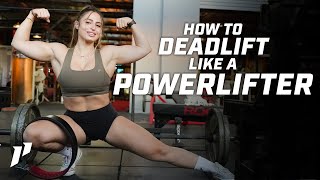
A YouTube tutorial (hosted by Aliza Tessler) that demonstrates deadlift setup, warm-ups, and technique tips aimed at powerlifters of all levels. Chunk 1 covers mobility (deep squats, hamstring/low-back prep), practical equipment notes (combo rack, deadlift jack), and the first warm-up with the empty bar. Emphasized safety and consistency: neutral spine, bracing (including belt use as a brace), pulling mechanics (legs/hips drive, arms passive), and recording lifts—especially while returning from a recent back injury.
Questions this video answers
20 kilos (about 44 pounds)
Chapters
What's up, y'? All? My name is Alisa Tessler. I'm a nationally and internationally competitive powerlifter and first form athlete.
We're out here at Madhouse Gaines Asylum and I'm going to be showing you how I deadlift, Some tips and tricks that I use to really maximize my deadlift. And if you're a powerlifter, beginner, intermediate, or maybe even advanced or just looking to get into it and learn a little bit more about it, this is the video for you.
So when you're dead deadlifting, you're mostly working your posterior chain. And a really common injury that people sometimes get when they're deadlifting is lower back injuries. So I just kind of want to make sure that I have blood flowing through my posterior chain, lower back, and I want to work through all ranges of motion, specifically with my lower back and hamstrings. So I'm going to start off with a deep squat.
I'm actually going to focus on kind of tucking my tailbone under and pushing out into my knees and then kind of rocking from side to side. So from here, I'm going to kind of send my hips up, lean forward and just reach for the floor. Then drive my feet into the ground, tuck my tailbone under and stand up one vertebrae at a time. I'm going to send my hips back, chest up, shoulders back, look up. You should feel your whole back kind of just squeeze when you do this and then tuck your tailbone under, pull your belly button in towards your spine, roll your shoulders forward and tuck your ribs. I'm just going to move through that a couple of times. And then from here, I'm just going to kind of go through like the deadlifting motion of setting my stance. You want your feet about hip width apart, not super wide. This should be narrower than your normal squat stance. Then I'm going to get into my neutral spine position, send my hips back. I really focus on feeling a stretch in my hamstrings. And then I'm going to consciously push my feet into the floor, squeeze my glutes and stand up. I'm going to try and move through that a couple of times.
So, like right here I feel that stretch and then push my feet, squeeze my glutes and feel your hamstrings contract. All right, I think we're ready to start our warm up with just the bar. So today I'm drinking First form energy for my workout. It's a really light workout and I wanted something a little bit more chill and also suitable for like you know, life after the gym. Normally I would take first four megawatt. And that's really great for if you need, like, intense focus, intense energy. But today's workout, again, on the lighter side. So this gives me that energy and focus, but not in a, like, scale, you know what I mean? This is a combo rack, and I'm going to actually take it apart. So the point of a combo rack is that you could both squat on it and also bench on it, then deadlift. You just really need the floor, so whatever. But basically.
The bench comes out and you can just kind of move it out of the way, not have a whole lot more space to deadlift. My first weighted warm up is going to be just the bar, which is 20 kilos or about 44 pounds.
And you want to, like, you want to treat lightweights like they're heavy. So you want to be bracing the same, you want to be setting up the same. And that same movement we did for our last warm up, where we kind of hinge forward, keeping that neutral spine.
Then push your feet into the ground, squeeze your glutes. This is called a deadlift jack, and it helps you load and unload for deadlifts. And I'll show you how it works right now. Your first warm up set with weight should feel extremely easy. Should be something that in theory, you could probably do 10, 20 reps of. The way that this works is you load it up, then you could tip the weight forward, put it down.
On the nice, even floor, and then move it out of the way. And again, this is relatively light for me, but we're going to treat it like it's heavy because you want to be treating your warm ups the same as your working sets. So that way your technique stays consistent no matter what. And the only thing that could fail you would be your strength. There's a space between the weight and the bar. There has to be set. You can put it on and take it off easily. You want to get rid of that space right by kind of pushing the ground away.
And you'll hear that little click. Like, before you even start lifting, you'll hear a click. Then the slack is pulled out. If you're not pulling the slack out, there's kind of extra energy you need to expend where it's like you're kind of just rough pulling a bike. It's a little bit more jerky. It makes it harder to use your legs, and you're not pulling with your arms. Cannot emphasize this enough. You're not pulling with your Arms. Your arms stay loosey goosey. They're just there to kind of support the bar. You're sitting back and pushing your feet into the floor, and then to stand up, squeeze your butt, push your feet into the floor like you're trying to make a hole in the ground and then back down. And even though these are pound plates, I'm actually going to be loading them like a power lifter. So the first plate numbers point in. The rest of the plates, the numbers point out. And I'm pretty sure that that's so during competition, they could see what's on the inside, but also what's on the outside. If you don't do it, it's not a big deal as long as you're going in and putting in the work. But just a little tidbit. Does anyone say the word tidbit? Whatever. So I'm going to be recording my sets. I need to send those to my coach that he could make sure I'm doing everything right. And also just so that I have a record of what I've been doing. I'm coming off a pretty recent back injury, so I just kind of want to be able to analyze every movement that could agitate it or help it, and I want a record of it. So I actually do recommend recording in the gym, if your gym allows it. And also in a respectful way, do I recruit in the gym. Never, ever, ever record anybody without their permission or with the intention of embarrassing them. I think that's. If you get one thing from this video about deadlifting, it's that.
Okay, so when you're powerlifting, you're going for a lower rep range.
And that's because our goal right now is to gain strength, and the heavier you go, the less reps you'll be able to do. So we want to be able to, like, push close to our max or get close to our max. And you can't do that if you plan on doing 10, 15, 20 reps. And even though I wouldn't usually I am going to be using my belt for this set. Contrary to popular belief, this isn't actually like an orthopedic device. It's not actually going to really help my back that much. What the belt is is something to brace against. So it's a physical stimulus, and it helps you create stiffness in your torso while you're bracing. So you kind of brace into it fully expand in all directions. So not just. Not just forward. You kind of want to brace your core into the belt. You also don't Want it too tight. Like, I've seen people like, like use this to help them tighten it. You don't necessarily want that. You want to be able to kind of exist in it. So right now I'm creating a lot of pressure. I don't want to hold that for too long, but you create a lot of pressure.
To help make this part stiff. So the things that I do before I deadlift is I want to check the distance between my shins and the bar. So I want to make sure that they're able to touch the bar with a little bit of knee flexion. And then from there I'm going to hit my brace, send my hips back, keeping a neutral spine. And then I'm going to kind of drop my hips as I raise my chest and push my feet into the ground. And again, your arms aren't doing much other than just hanging onto the bar.
So when I'm setting up, I'm kind of thinking about keeping my arms long. And you do want your lats engaged. You should think about kind of hiding your armpits almost basically. Just like everything else in powerlifting, you want to decrease the range of motion. So if you have loosey, goosey, long arms, it decreases the range of motion a little bit more than if you have that tight lat. Something that's a really big energy leak is keeping the bar too far away from you. It's a lot harder to stabilize it. And it also kind of just increases the lever. Like it makes it longer and harder to get up. So you kind of want the bar very close to your legs as you're standing up. Right. So a straight line is going to be the shortest way to get the bar up. As you're out here, it's not a straight line anymore. Sometimes you'll notice a little bit of like a form breakdown. You'll notice people with more rounded backs. A little bit of a technique breakdown is kind of expected and seen and I would say not, not unnecessarily risky. So if you do plan on competing and your form does start to break down a little bit as you reach higher numbers, but it's pain free, you feel okay? I wouldn't worry about it too much. What I would focus on is doing accessories and lighter weight work, kind of working in that range of motion. So you'll catch lots of Powerlifters doing back extensions and glute ham raises and just different things that make you run through that, like kind of rounded back motion. Really focus on just strengthening the muscles in your back to keep you pain free, just in general, not just when you're deadlifting, not just if you're a powerlifter. You just kind of want to keep your back healthy because lots of muscles there definitely work them, don't neglect them and don't be scared to work them either. You'll also see a lot of variations in how people set up for deadlift. You'll see maybe people studying with their legs wide and doing sumo deadlifts, and that's very legal in powerlifting competitions. It's just based on your leverages and your strengths. So when you're doing a conventional deadlift, it's a little bit more lower back, a little bit more glute. And when you're doing a sumo deadlift, it's also a nice amount of glute, but you're able to engage your quads better because it's almost like adding in like a almost squatting motion to it. So it really just depends on how you're built. And then I've got short arms, so conventional is the way to go. If you got long arms and short legs, like sum of that shit. All right, we're done deadlifting. Thank you so much for coming along with me. I'm going to go ahead and grab some post workout. So I always have a Formula one shake and usually I dry scoop my creatine. I'm not even going to lie about that, but you could definitely mix it in and it's super solid. This is going to be part of a series. So so far we covered deadlift in this video. We've got bench, we've got squat. Make sure you check those out. If you've got any other topics in fitness or powerlifting that you'd like for me to help you with or teach you about, go ahead and let us know in the comments and I'll catch you on the next one.