First-person interview with Jack Smiley, a 25-year-old NCAA Division III ice hockey player at Endicott College, recounting a career-threatening injury sustained in practice during his sophomore year that fractured a cervical vertebra and caused a brain-stem (Pons) stroke. He describes acute paralysis of his right side, loss of speech and core control, intense emotional shock, missing an academic year, and his determination to focus forward and return to hockey.
Questions this video answers
25 years old.
NCAA Division III ice hockey player for Endicott College.
During his sophomore year (in college), after being hit in practice.
A fractured vertebra in his neck sustained in practice.
A brain-stem stroke in the Pons.
Chapters
My name is Jack Smiley. I'm 25 years old and I'm an NCAA Division 3 ice hockey player for Endicott College. Always be grateful for what you have. I was riding high. I thought I had life by the reins, and it ended up growing me on a path that I was never prepared for at all. Physical tasks that I'd worked my entire life to be able to do and be able to accomplish a few moments later in a hospital bed, not being able to move my right side. I fell in love with hockey very early on. I was actually the first person in my immediate family to play. I think the average route is to be handed down by parents. Parents will play, hand it down to the kids. Picked it up around five years old when I got on the ice for the first time. And ever since then, loved.
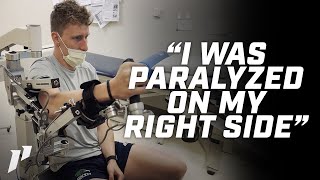
Once I got to college, I started to get hit with a little something a little more serious. I ended up having a stroke in my sophomore year. I ended up getting hit in practice. And I didn't know it at the time, but come to find out a little bit later, I ended up fracturing a vertebrae in my neck and that ended up leading to a stroke. I had a brain stem stroke. So a stroke in the Pons, which anyone who knows stroke is not where you want to have a stroke. It's not a location that's very optimistic for recovery, I should say. It controls a lot of your pathways moving down. So out of that stroke, I ended up being paralyzed completely on my right side, lost all function, my throat muscles shut down, so I couldn't talk very well. My core muscles shut down, so I couldn't sit up out of bed on my own arm, leg, anything you could think of. I couldn't walk, talk, eat, and that's going from being a college ice hockey player. So the first three days after the stroke were intense for sure. And I had never really believed in medical shock. I never really thought that was a real thing, or even if it was, it would never be something that I dealt with because I just never thought it would be something I would deal with. I was still coherent in that aspect, but I just had no idea what was happening. I couldn't control my tears. I cried for three days straight. And not out of self pity, not out of thinking, poor me, this should never have happened to me kind of tears. It was more just shock for where I had ended up. I had been skating on the ice at a college level and performing physical tasks that I'd worked my entire life to be able to do. And be able to accomplish right into just a few moments later in a hospital bed, not being able to move my right side. So, yeah, the hard part about strokes is there's really no set guideline. The doctors can't tell you exactly how much recovery you're gonna make.
I've learned through this process there are things you can think about and there are things you can't. If you get stuck all the time thinking about, oh, it happened in practice. I took my prime years of playing. It destroyed my life. In an age where I was kind of on top of the world, I was in my physical prime. I was able to do so many things. If you start thinking about all of that, you get sent to a really bad place at the end of the day, it happened. It was a freak accident, and all I can control is looking forward. So I don't really think about it at this point at all. My goal was always to get back to playing and get back on the ice. I've said from day one, my goal getting back into hockey is I just want to lay someone out for the last time. I want to crush someone. And because of my recovery journey, I missed an academic year, had to spend it at home. So since I got one more year left, I said, let's get out there for the real thing and try to put someone through the glass. My name is Jack Smiley, and I am first form.