Winning the Rolex 24 2022 | Ryan Hardwick's Racing Comeback Story
This is a first-person documentary-style YouTube video (uploaded April 10, 2022) in which Ryan Hardwick recounts his athletic background (childhood water-skiing and competitive jet-ski success: two national championships and one world championship), transition to car racing beginning in 2015 (first competitive series: Lamborghini Super Trofeo; 2018 breakout and World Championship; 2019 move to professional IMSA WeatherTech competition), a near-fatal 2021 crash at Daytona with brain swelling and bleeding, and the physical/mental rehabilitation, team support (notably First Form and Andy Frisella), and training that led to his comeback culminating in winning the Rolex 24 at Daytona. The video includes commentary from teammates, family/partner reactions, and descriptions of the physical demands and simulator/fitness preparation for endurance racing.
Chapters
So where does my story begin?
24 hours. A lot can go wrong. I started last year sitting in a hospital room. The MRI showed that my brain was swelling. Yeah, I've got a big chip on my shoulder at this event, this place. It took something from me.
My parents were both very competitive themselves. They were professional water skiers growing up. And my dad was also a professional off road motorcycle rider and racer. Very early ages, I was learning to water ski. My dad often reminds me I could actually ride a dirt bike before I could pedal a bicycle. But the sport that I really, kind of really found my competitive edge was jet ski racing. I found jet ski racing when I was a teenager. We grew up on a lake there in East Tennessee and we had jet skis that we rode for fun around the lake. And I remember seeing it on ESPN1 Saturday. They were televising a race out in the ocean and the waves were massive and there were huge jumps. And to me it was kind of like supercross, but on water. And I just thought it was the coolest thing and. And I spent all of my teenage years doing that sport, going up through the ranks from a local and regional level and eventually made it to the national tour, which was the professional tour that traveled all across the country. When I was 19 years old, I won kind of the top level amateur championship and then from then on turned professional. I spent several years racing professionally, raced for a couple of the different manufacturers, and went on to be pretty successful in that Sport. I won two national championships and one world championship in jet ski racing.
It wasn't until 2015 was the first time that I tried a racing car. I was hooked. I knew from an early stage that I could learn the sport and I thought that it was possible for me to compete at a high level. But I had no idea how long it was going to take. My first competitive car racing series was the Lamborghini Super Trofeo series, which is a single make series where all the cars are exactly the same. Every car in the field is this same Lamborghini based off the Huracan. And the only difference really is, driver, you're not allowed to modify the car outside of kind of how it comes. You can set the car up and learn about the geometry of the handling of the car, but outside of that, they're all the same. So that was a really great place for me to learn and test and improve myself. I spent several years in that series, went up through kind of the amateur step ladder there, Competed against a lot of great professional drivers and that's where I really cut my teeth in the sport. And I really learned both the dynamics and engineering of the cars and the physics of the cars and as well as all the driving skills, the handwork, the footwork, the vision. And in 2018 was my first real breakout year. And it was also my first year in partnership with First Form. I don't say I'd ever pushed it really hard, but I opened up the idea to Andy and he thought immediately that, like, man, that's awesome, you know, and he was watching the races and seeing it on TV and. Yeah, and he jumped in at a real early level.
We didn't know anything about this when we started. We're like, hey, let's. Let's do a race car this year. That'd be cool. And I'm like, yeah, let's do that. And that's how it started. And you know, people. People don't realize, like, you know, they look at it now and. And, you know, they think, oh, yeah, well, fuck, dude, we didn't know what we were doing. You know, like, let's just do. Let's. Let's try racing. That'd be cool.
I don't know if it was that First Form Blue or, you know, the confidence that being around people like Andy and Sal and everyone that I've met at first form, it definitely lifted me to a higher level. I demanded more from myself. I wanted to deliver results better than I ever have. And that year we did it. I won the North American National Championship in Lamborghini Super Trofeo in my division, and also went on to win the World Championship that year. The following year is when I made the jump in 2019 to go up to the professional ranks. And first form was right along with me. And that first year we stayed with Lamborghini, we entered the IMSA WeatherTech Sports Car Championship, which is what we race today. And that's also here in North America. That's the top level of sports car racing in our country. At the end of last year, in 2021, I was like, you know.
I have to believe more in myself and I have to believe that I can win and I can be a champion at this level. And changing that mindset was a huge difference for me personally.
The preparation is as much mental as it is physical. You have to do a lot of time preparing and trying to duplicate what you're going to run into in the race. And we do that a lot on the simulator. We do a lot of work on the sim where we're going through trying to run the same amount of times on the sim as what we will in the race. Our heart rates are elevated in that car a lot. It's very easy to be stiff with your hands gripping the wheel too tight. Also, we're using both feet with the gas and brake. So your legs are constantly working for hours on end. You have to hit the brake pedal extremely hard in these race cars. So, you know, all of your lower leg muscles are really working. You never get much of a rest. So for me, I do a lot of strength training, both in like circuit training and HIIT sessions where I can keep my heart rate elevated for long periods of time.
We train every single day. So my wife and I are responsible for the health of Ryan and Justin and also their families as well. So we do everything from their cooking. We look over the doctor's labs, endocrinology, things like that, that and then whip them into shape. And what people don't understand is the pressure that these guys are putting their bodies under. Like Ryan's hitting GS in the corners, a lot of neck stability action, a lot of core stability, VO2's through the roof. Heart rate is at 150, 160, 170, you know, for elongated periods of time. So what we try and do is emulate that in the gym, get a good base of fitness and on top of that, do a lot of reaction training under fatigue. So today we're going to be doing a little bit of hit, so about 20, 30 minutes a HIIT and then BRI will take over some yoga, some stretching, and that'll be us.
So welcome.
Let's rock and roll.
One swap it out.
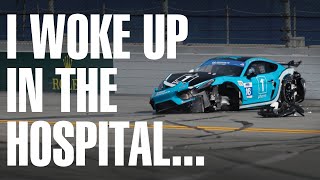
So last year, in the 2021 season, obviously I had the big crash in Daytona that took me out of being able to compete in the Rolex publicly. When it happened, we came out and said I had a concussion.
That was the truth, but that wasn't the entire truth.
Like I said, I lost control of the car in one of the highest speed parts of the track, exiting the bus stop and. And I went pretty much head on into concrete wall. Wasn't a soft wall. When I got to the hospital and went through and did the MRI and did a CAT scan, it showed that my brain was swelling in a certain part of my brain and that I actually had bleeding on my brain.
When I got the call that evening last January.
That was like one of the worst days of my life. I legit thought, like, I'm going to lose my best friend here. Like my best friend in the entire world. World, like, laid up in a hospital.
It's.
It's. It's a. It's hard. It's definitely hard knowing that he is in a race car going over 100 miles an hour for over an hour. And with all these different drivers and the driver changes, so many things can go wrong. We, you know, sat down, had that conversation like, where do we go from here? And I'll be quite honest, I was. I'm like, I'm not so sure that this is a good idea anymore. Like, you've got two young kids. You know, I'm here. I just don't feel comfortable with this. And by no means did I give him an ultimatum. And, I mean, kind of wish, you know, sometimes you're like, oh, gosh, maybe I should have. No, I would never. But.
He is an adult, and I told him how I felt. But ultimately, that is his decision, and in and of itself, that's what makes him happy. So once he made his decision, I just let him know that I was behind him 110%, because it is what makes him happy. It is driving him, and he knows that I am going to be there by his side, no matter what.
I mean, I almost quit. I almost walked away. I've done a lot in my life. I have a family. I have two young boys. I've got a beautiful wife. I've built successful businesses. I don't have to drive this race car. I do it because I'm passionate about it. I do it because I want to be the best. When I had an accident like that.
It was bad, right? Anytime that you lose complete memory and, you know, I was unconscious in the car. You wake up from being unconscious in an ambulance or a hospital room, and they tell you you can't leave here for many days. I was having a hard time standing. I didn't have very good balance. Yeah, man. It got my attention. And the thought crossed my mind, like, maybe we've come too far. I've pushed this, and I've kept stepping up to different levels. Different levels, you know, of the sport.
You know, if he really didn't want to do it, I support that, as I support that, too. But when I started to sense that it was more he was. I started to sense that the reason he didn't want to do it wasn't because he didn't want to do it. It was more so because he felt like he was becoming a hindrance to the progression of the team. And I didn't. I don't like that. Like, I want, I didn't believe that, I don't believe that to be true. First of all, he's super detail oriented. He wants to get better. He's organized about how to get better. He's, he puts in the time. I mean, this is the same reason why, why he's such a successful entrepreneur. It's not because, you know, he got lucky. It's because he's organized, he's disciplined, he's willing to do the work, he's willing to do whatever it takes. And here's the other thing. Like Ryan has the perfect mix of being humble and knowing that he's got to be better, but also being confident that he can go out and execute. And like, that's something that I think a lot of people struggle with. You know, a lot of people are too humble to the point where they, they can't perform because they don't think they're good enough. And then there's, you know, people who are too confident, we call them cocky, whose expectations of themselves exceed their skills to a point where they can't improve because they think they're already there. Right. And, and to be effective and to be a winner, you have to ride that line between two of those. And I think that's something that Ryan does, does extremely well, if not better than anybody else I know.
Maybe I, you know, bit off more than I could chew. Right. So all that self doubt starts to, you know, eat away at you. My family's, you know, saying, Ryan, what do you have left to prove? You don't need to prove anything to anybody, you know, but I had something, you know, that I wanted to bring prove to myself.
It took us a while to get our first win, but as soon as I got back, we were consistently finishing on the podiums, several second places, several third places, and we were starting to climb our way back up the championship point standings because we started the year with a big fat zero because I crashed the car and we couldn't compete in the first race. But since coming back, every race, podium finish, podium finish, podium finish, and we got our first win, got our first breakthrough win and that was huge. Catapulted us right up to in the top three in the championship. And then we were like, we had a chance to win this entire title with even missing that first race after being in a hospital room, you know, not knowing if I was going to ever race again. That was a monumental story for me. And that's what really was the catapult that led up to the very next race. We did after winning that championship was the Rolex 24 in Daytona.
So.
Hello everybody and welcome to Daytona International Speedway in Florida from the Hagerty Global broadcast booth. Everything in my life led me to be in Daytona competing with this team at the Rolex 24 at this race and all the hours spent in the gym or on the simulator or in review with our data and engineer teams and even all the way back to all, all my years spent on the motorcycle and on the Jet Ski and all the people I competed against there. That all was a building block up to this one point. And it's really, really humbling to see where all of that led up to. We knew deep down there's something different this year.
This race is a big one. I mean, this race is a race that most every Dr. Driver wants to win.
You have to have a sincere belief in each other that every person on the team is going to carry their own weight. You have to have a sincere belief in the drivers and the engineers and the team management that everyone is going to do their part because it takes everyone performing at their absolute best to compete at professional racing.
Sam.
The redemption that I felt being one year removed from an injury that nearly took me out of competing in a race car ever again, to come back the very next year to the same track, to the same event, but to ultimately prevail and to win that race.
Something I will never forget for as.
Long as I live, it was also surreal. Like, it was very surreal. Like I was actually down in the gym down here whenever we crossed the line and I don't know, it was weird. It was an out of body, weird, surreal feeling. Like, yeah, like.
Did that really just happen? It was weird, dude. And as a lifetime race fan and car guy, like I am and like he is, you know, it's, it's really impossible for people to understand how big of a deal that is unless you are also a race fan and a car guy. Even just sitting here thinking about it and like looking at some of these posters, you know, there's a Daytona poster there, there's another one right? There's a Sebring poster there. And those posters before hanging in my garage, it's not like I just put them there, like, and to walk by them and think like, yeah, we won that race. Like we run, we won that race. Like that's a pretty cool thing.
Yeah, you know, it wasn't easy at all, but.
Damn, was it worth it.
Sam.