How to Build a Brokerage That Agents Don’t Want to Leave with Charis Moreno
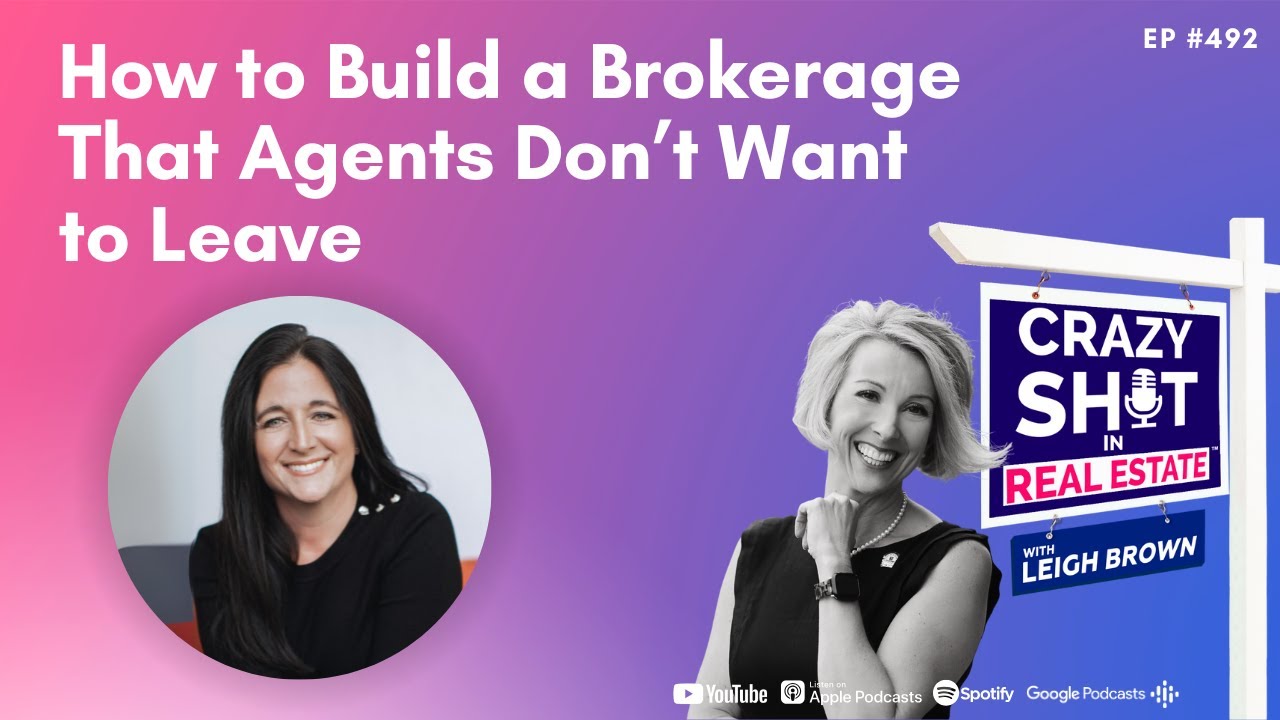
Charis Moreno, VP of Sales at NextHome, grew the franchise from zero to over 630 offices in a decade. She argues that culture and people matter more than brand or technology for keeping agents. Brokerages operate on razor-thin margins while agents often earn more, making retention about the relationship, not the tech.
Chapters
I'm Leigh Brown. This is Crazy Shit in Real Estate. Today I'm going to introduce you to somebody who's worked in the technology side of real estate and in the brokerage piece. Charis Moreno is with us today. I hope you enjoy this conversation and I'll see you on the other side.
I was in the podcast for about 6 minutes and all of a sudden, like, all these faces came on. I'm like, where's Leigh? So I don't know. I had, I had another meeting on my—
there was two.
I don't know. Anyway, who knows?
It's— anyway, so hello, how are you?
I'm amazing. How are you?
Good. Well, thank you for coming on the show.
Thanks for the opportunity. It's kind of fun. I'm excited. I've listened to a few of your podcasts and I know you're a friend of James and quite— we have a lot of friends that know each other and it's nice to finally connect with you. Personally.
Well, I'm glad to have you on the show and get you to tell our audience a little bit. So tell them name, location, how long you've been in and around real estate. Give them a little thumbnail of Charis.
So Charis Moreno, not short for anything. That is my real name, my full name, all the things. I have siblings, Ashley, Michael, and Stacy, and I apparently drew the short straw. So I just chalk it up to my dad was an alcoholic and I got a great name. I'm named after a cheetah. So all the things with the name, but I'm finding that my name now, Charis, is usually how people pronounce it, especially if you're in religion or Greek mythology or Greek in general, study the Bible, then it's Charis. But my name is Charis 'cause it comes from Uganda. It's Swahili. And that's, if you get to know me, it'll all make sense, which nothing makes sense. I've been in real estate, started my career in 2003. August 2003 with Realtor.com. It was an accident. Somehow a friend of mine worked there and said, we're having a job fair. I make $500 if you interview. I know you don't have a job right now. You just quit your job. Come and do this interview and I make $500. And I go, great, I'll see you there. I make $250. So I split the difference. Anyway, I ended up there and left there as their vice president of sales, ran their inside sales team. For a little over 7 years and then went to Trulia and was with Trulia for almost 8 years. And that's where I met James and Tay for about 2 years. I talked to James about this mysterious business that he wanted to launch, and here I am, 10 years growing this amazing brand that I now am an owner in called NextHome.
Well, I'm sitting here having a flashback because I was on ActiveRain when we got it started in 2005 and there were, I don't know, 12 of us that decided we were going to game Trulia. Yeah, we had a plan and we totally— we did it. We, we took Trulia for a minute just to prove that we could. And yeah, I don't even know if all of those people are still in the business. A couple are retired.
Yeah. I mean, I was with Realtor when they were Home Store, so it was fun. But both of my girls— I have two daughters. I'm married 28 years with my husband, married 22 years in May. My— both of my kids have watched me grow, um, you know, in this industry. It's, it's fun. Um, it, it's the best, worst— I, I try to leave this industry every single day, but I love it so much.
I mean, it's the— there's all kinds of ways to describe the relationship that we have with this beautiful profession called real estate, but the best part for me is that it does change all the time, and your pathway can change, and you never even really see it coming.
Yeah.
And I didn't know that Realtor.com was paying $500 for an interview in 2003. That's hilarious.
Yeah. Yeah. They were doing this huge job fair and they were paying their salespeople to recruit people to come and do these interviews. And listen, I mean, within 3 months I was, I was going to quit. I actually was ready that morning. I was, I was going to leave because I had prior to that I had ran a shoe company. So I had like 27 stores throughout California. And so I was traveling and and making really good money for that age at that time. And they wanted to give me like a $25,000 salary. I was like, I make like almost 4 times this. What? And then the commissions and all that. And I was like, yeah, no, this isn't for me. Took the job anyway because it was so interesting. 3 months in, I said, I'm quitting. And I found out I was pregnant, so I couldn't quit. And then got promoted while I was on maternity leave, which I don't even know how that happened. And then came back. And then, I mean, it's a wild ride and every Every time I've gone to quit a job, I have gotten promoted in that moment. Like, it was— it's just really weird. It's the strangest thing.
But anyway, um, okay, so I have to ask you a shoe question because, um, obviously we go in every direction we want to go on my show. But yeah, you know who the company Shoe Show is?
Uh, no, I don't.
So they're a— they're a Concord-based retailer. They do small shoe stores and strip malls all over the place, and it's our our most reclusive billionaire is here in Concord. And he wrote this wonderful book about his life growing his shoe show empire. It's out of print now, but it's the best book ever. And the Tuckers have just been the most staunch philanthropists in the area, and they're, they're just quietly amazing. So whenever you talk about shoes, like, I love shoe show. And he provided some semi-trailers to us at the beginning of the the Helene disaster to help us get supplies to the mountains, because it's nice when you have a company nearby that can just donate some tractor-trailers to you to go run.
All right. So yeah, there's a lot you can learn from the shoe business and you can change a woman's day just by helping them with a nice pair of shoes.
So I mean, honestly, it's like we all know at a certain age that if you like one pair of shoes, you buy every single color because you want to make sure you keep that fit because they're going to the model. That's right.
That's right. That's funny.
And look, I have my new Rothys on today. They have a new design out. They have a new insole. Oh, I love them. They're so comfortable.
I'm mostly in tennis shoes, but yes, like, you know, business on— I'm like a mullet, you know, business on top, party on the bottom.
So you can't do that when your name is Leigh Thomas Brown. Kind of a stripper sound to it. So I don't think that's going to help your case.
Probably not. That's okay though. When you get to know me, you'll get it.
Okay. So talk to me a little bit about what you're doing at NextHome. And of course, we're not a brand-centric show here. And as y'all know, I am an independent broker, but there's always interesting things to learn from different companies and what they're doing and seeing out there. So tell us a little bit about your journey in the brokerage side of real estate.
Yeah, I know. What's interesting is when I stepped over to NextHome, really from the portal side of the business to the industry side, the true industry side, I wrote an article or a blog or whatever you call it now that, you know, my first 90 days on this side of the business. And I went back and actually read it when I— when we had our 10-year anniversary. And sadly, what we were talking about 10 years ago and all the drama in the portals and the Zillow and all the things, we are still talking about that. So I don't know. I'm with NextHome where we are a franchise. I don't know that, you know, I need to really talk about that specifically to talk about my journey in this industry and what I'm doing with NextHome. So I am, you know, one of the partners. My job and role is to grow the footprint of the brand. So I recruit companies in to take our brand and then of course to recruit realtors to sell real estate. So, but what I love about what I do, so when I started, we had zero offices, zero. There was— and the craziest thing, this is what I found to be so interesting with the title of your podcast, is I have zero experience in franchise sales. And the fact that James picked me out of all of the amazing and most incredible salespeople and business-minded people and people that have, you know, degrees and all these things, and he chose me, it took me 5 years to really understand and Finally, I kept asking him, and the last time I asked him, he said, if you ask me again, I'm going to fire you. Like, I don't want to explain it anymore. You should just know. And if you know James, that's just James. And so I realized that, you know, going from zero and we're at right around 630 offices in 10 years, what I realized is it has nothing to do with your brand. And that's the secret that everyone knows, but no one really actually believes is if you work with the right people, if you choose the right people, whether they're people that you're trying to shepherd through the lifecycle of homeownership, whether it's, you know, people that you bring to, to, to sell your company or, you know, to represent your company, the people matter. And that's more important than brand, more important than tech, more important. And I did snooze all my stuff, so I'm sorry if you heard that. But it's more— it's literally the most important part of what I'm doing at NextHome. So really my title is Vice President of Sales, but I actually tell people my title is I am the Chief Culture Officer. My job is to identify the right people that understand what it's like to rep, to represent what we're trying to build. I don't compete with anyone. And that may be just a Southern thing because you told me to say where I'm at. I'm in California, but I am a Texan. I was born and raised there. I love California for a lot of things. But I am always a Texan. But I don't know if it was just the way I was raised in the South that you just have this— well, you're in the South South, I'm in a different kind of South. But I don't know if it's that or what it is, but I just know that it doesn't— for me, it's, it's about the people. I mean, nothing— I don't need to compete with you because what I bring to the table is very different than what you bring to the table. And I am uniquely and wonderfully made to do what I'm supposed to do. And there's enough business in this industry for all all of us, and who you attract to work with you is not going to work with me. And that's what I'm doing for NextHome and, and really for this industry. And I've done it all the way back to my Realtor.com days.
When you make a really interesting point, we are still having the same conversations today in the structure of the business that we were having 10 years ago and even 20 years ago. And as my dad would say, because he got in business in 1978, it goes all the way back. We always are talking about how is the brokerage model going to look in the future? And it really— there have been some iterations, but it really hasn't broken and rebuilt in a way that other professions have. And the core of why is in what you said, where it's the people, it is the culture. And this is an intensely personal business, which is crazy as big as it is. And you can have the biggest footprint on the planet and sell all the houses. But at the core of it, if you're not intensely focused on the humans that you serve, whether it's in the buying and selling cycle or the agents in your offices, you're going to die. And there's no way, in my opinion, that the portals can replace the humanity of real estate, although AI is going to try. But then I was reading a, reading a post on Facebook this morning by somebody that I do enjoy and respect very much, fussing about what representation looks like in AI. And I'm thinking AI is never going to replicate what we can do as humans and how we see each other. And if you're trying to make a an algorithm look like what you think it should look like, it's a losing game forever. And I think that's what the brokerages— they're sticky. So I'm curious for you, you came from portals to the brokerage side. I'd say in general you have a lot of brokerage people who go towards the portal side because it looks like a different outcome and maybe it's a little less stressful than the brokerage side. What's been the biggest— not just a surprise, but a delightful thing you've learned about the brokerage side, having come from the portals first?
First of all, the stress is the same. It just feels different, right? So there's stress in both sides. I have to duck sometimes when I say that I come from the portal side because there's a lot of people that vehemently despise Realtor and like, you stole our name and you take our data and you sell it back to us. And I'm like, It's actually not what happened, but whatever. That's— you do you, right? So I don't dispute that or even get into any of those conversations. I just say, you know what, if you would— if you would remove those glasses and identify how has the— how has— why is the number one real estate— the number one place where consumers go to find real estate, not a real estate company? I can't say that today, but I could have said— I said that back then. And if you would just take 3 or 4 things from what they have done and implement that locally, they could never pierce your veil locally. You— no one here in this industry can beat the portals. Homes.com is spending $1 billion, $1 billion for consumer eyeballs. Realtor spends hundreds of millions, hundreds of millions of dollars a quarter. Zillow is spending $50 to $60 million a quarter for consumer eyeballs, but that's nationally. No one can compete with that. So what is it that— why do people like going to Zillow? Why do people like going to Trulia? Why do people like going to Homes.com, etc., etc.? And make that experience on your website. That's really like the most pivotal thing that I learned and what I could carry from the portal side into the real estate side. What I realized on the real estate side, and this was— and it still blows my mind 10 years later on this side of the business is when you're on that side of the business, you think that you are 90% of the pie. If without me, without my eyeballs, without my reach, you can't sell real estate, right? And that's truly what we believe on the portal side. You need us to do this for you and we're going to bring those people directly into you and you wouldn't have that without this. But once I came on this side, I realize it is less than 1% of the entire pie. And then that carried into brokerages have no money. There is no money in brokering. And so that was also just incredibly eye-opening for me because here I am thinking, you know, I'm talking to some of the biggest brands in our industry, both franchise and independent, and I'm like, you don't have $5,000 a month to showcase your agents.
What?
And then I pull their credit down And I see it, I'm like, shit, they don't have $5,000 a month. They don't even have $500 a month. So that really was a big shift. And what I've been able to do when I work with our brokers is really look at how can you be profitable in a business that is almost impossible for being profitable in. And it really goes— always is going to go back to how you treat people. Because if you win, your agents win. If your agents win, their clients win. And to me, it's a triangle. If all three sides of a triangle are even and balanced, it's a perfect shape. But if you make more than me in this situation, but I did more work than you, that imbalance happens. If the franchisor broker is taking more than the agent or the broker and the customer, there's just this icky imbalance and that festers because culture is a living, breathing organism inside every single organization. And when you scratch and you cut someone, the cut may heal, but the depth of that cut is always festering. And then it'll take one thing that's not really the thing that blows that wide open. And so I don't know if that answers your question, but it— those are kind of like my three main learnings, is the portals think they're important, we think we're important, and the client thinks they're important. But we're really all— if we could just get together and figure out how we could all work together and put the humans first, the the real humans, there's no amount of tech or brand or reach that anyone could do to disrupt that.
So if you're in real estate and you're listening to this podcast or watching it and thinking, man, I need some more Leigh Thomas Brown answers in my life, well, guess what, friends? I have a new program that is launching right now called Answers.RealEstate, where I will give you every bit of insight I have to help you grow your real estate business. Help you better respond to consumers to provide a more excellent real estate experience so that the next time you land on crazy shit in real estate, you'll have a better solution to whatever you ran into. Answers.RealEstate. There are monthly plans available. You will love it. Get your coaching. Sign up with me today. Well, there is a reality that agents have to acknowledge, and that's that they're not going to be able to compete with the technology of a Zillow, a Realtor.com, a Homes.com. You don't have money to build that website. And so you hear this conversation thinking, but what am I supposed to do? All right. So you have to know if you let that go, you still have to have your website and it's still got to be a digital business card. That's really all it is. You don't have to have all the beautiful tools, but if you don't have the beautiful tools, you better have something to supplement that. And so, for example, I was with a client on— let's see, we're recording this on a Thursday, met with them 2 days ago on a Tuesday, and she pulled up a property on her Zillow and she said, I'm so sorry to have to show you on Zillow. I'm like, I don't care what app you use, that's fine, because I don't care. And she pulls up the property and she's like looking at the price history because she thought it had been reduced and that one had not been reduced. And I said, it's all right, you've looked at 18 properties, they all run together. My job is to help you sort out those 18 properties, to know the differences between this street and that street and this investment and that investment. And if you are a practicing realtor, you had better have enough knowledge of your area to be able to take the information from the app and make it something that's relatable to that consumer, to what the experiences they want. And this lady had told me, I need to be on a street where I feel safe in the daylight by myself. And I said, that's a pretty extreme way to describe crime safety, but that's what she relies on me for. So what do I give her? I give her the phone number to the sheriff's department and I give her the heat map for where the calls are coming in. Because as you all know, you can't violate fair housing. And I still think it's kind of amazing we can't talk about crime and they call that fair housing. That's a different discussion. And so you realize that you're just going to be a resource because you know things. Yeah, I don't have to know the bedrooms and the bathrooms and the pictures, even though I should. That's not the requirement. The requirement is that I go deeper. So back to your cut analogy, it's the, the depth of what I provide makes it more important. So a more important cut is a deeper cut than a paper cut, which stings and sucks, but it's gone right quick. And y'all spend too much time worrying about third-party things.
Right.
We got to talk about that broker thing for a minute because it is a misconception in the public that brokers are very wealthy. And I had a vendor this week tell me they were going to have to add an upcharge of $500. And I said, $500? You did not disclose that to me. And she said, it's only $500. And I said, I need to talk to somebody else right now because it flew all over me. Yeah. Spoke to the owner of the company. I said, I want you to understand something. Anybody that's in sales in a 1099 world who sometimes gets compensated and sometimes does not, when you sit there and have the nerve to say only $500, You are totally diminishing the amount of work that it takes for a 1099 person to come up with $500 spendable dollars because that's after taxes. That's after I've satisfied all these other things. So there's a, a disconnect on the broker side. Agents are making more than brokers right now. That's indisputable. But if the broker's charging something, to your point, do the agents even know what they're paying for?
Right.
I would say that's the disconnect between broker and agent. A lot of them do offer great benefits, but their agents don't know it because they've disconnected and that culture's broken. So everything goes back to the culture that you have. And if you're a broker who charges more to your agents, they might be okay with that if they know what they get for those dollars and they feel that it's a value that's worth having. Everything goes back to communication of value. Education of what somebody's desired outcome is.
Absolutely. Well, in price, if price is your only value, you have no value. And in our industry right now, it's a race to the bottom. And look, one of the most longstanding legacy brands in our industry has the highest retention of any agent ever. And the reason they do it— and they're the most expensive, and it blows my mind. But I mean, I think Thousand Watt put out a survey a couple of months ago, and I'm probably going to get the statistic wrong, but it's somewhere between, I think, 70 and 60%, the number one reason agents left a brokerage was culture. That was it. They either— and oftentimes they don't leave the brand, they leave the broker. So it— and, and so it's, it's really understanding what you bring to the table. And, and it has to be more than I answer the phone and I know the market. And, you know, it— there's so many parallels in, in our industry from— look, all a broker is is an agent. That just has a bigger liability and a bigger risk and a little bit more education. Right. And I don't mean it that like mundane. I mean, I know there's a lot more that goes into it, but there's value in putting your license on the line for 20 other people that are running around like cowboys and Indians. I don't even know if I'm allowed to say that, but I did.
It's okay because Thousand Walk has me blocked and they blocked me on X. Sorry. I don't have any idea what the data points are there. And I still don't really know why they blocked me because they've forgotten too. So here we are.
Well, we can have that podcast privately. And the reality is, is that, you know, if you're confident with who you are and you've educated yourself to know what you know, and I know what you know a lot more than me, and I know maybe in some areas a lot more than you, but together we can work together to make this industry a really great place. And that's what— look, if there was one way to do it and one way to compensate, one way the entire industry would do it that way. And there's not. There's 1,000 different ways to really help create homeownership in this, in this country. And, you know, I always say there's, there's, there's two ways to serve this country. One is military, um, you know, and join and put the uniform on and protect and defend. And the other is to help people find and create homeownership and generational wealth in this country. And to me, I remember at Realtor.com when I was working with Alan Dalton many, many years ago, he was my boss. And, you know, one of the things that, you know, we— he came up with this brilliant idea about moving America, right?
Or—
and it was like, that's what we We truly move human beings. And, you know, we contribute to like, what, 10 or 12% of the GDP in this country?
20.
20% of the GDP in this country. Like, if we— if this industry slightly shifts, we will go back. I mean, we could do it every downturn. All you have to do is look at the, at the real estate market. So we have such an important role, you know, in this. I am not licensed. I've never been licensed. And the reason I'm not licensed, because I got to do what I tell people to do, and I don't want to do that. But also, if I'm licensed, why am I in the role that I'm in if I'm really good at what I'm doing? And so it's a separate— and I respect the role of a realtor. And I think the reason why I was so successful early on at Realtor.com was before I got on the phones, they're like, oh, you got to make 100 calls a day and here's your list and you got to jam through them. I did not do that. I picked up the phone and I actually called— I called the number one agent in Ventura County at the time. And I said, can I come and sit with you? I have questions. I got to get on the phone and I got to talk to realtors. I got to sell them advertising. I want to understand what the day in the life of a realtor looks like. And she shockingly said yes. I thought I'd have to make 10 calls. She answered the phone, took my call and said absolutely. And when we were done, she said, do you know that I've been getting calls from Realtor.com for 5 years and not one person did that? And the fact— and she ended up being one of my biggest customers because she knew that I understood her business. She understood my business and we used that information together to help each other. And that's why I know what I'm going on a listing present. And I did that every year. I would stop and I would— because the market changed every year, the tech changes every year. So for me, the best thing any realtor, broker, anybody in this technology person out there creating the next big app that's going to change people's lives is really sit and talk with the people get rid of the noise and really focus on the things you can control. Because I can't control market, I can't control if someone buys a franchise from me or not, but I can control how they feel when we get done with our conversation and they go on and think about what we talked about. I can control that, you know, and I think if agents would just do that and the industry would just focus on that and we'd move past the litigation, like the litigation and move into 2025 and leave, you know, I would say litigate more in 2024. Like literally, that's all we did this year. Right. And let's thrive in '25 and leave '24 behind. Right. So there's such a new way of doing things. And I don't care if you've got 30 years experience in this industry. Everyone was brand new on August 18th. Everyone. You had to disagree.
I disagree.
That's fine.
But no, those of us that have been around from the days of the—
Yeah, yeah, yeah, yeah.
Been around for all these decades. We've seen seller agency, which is coming back. We know what buyer agency looked like before we had it by general statute. North Carolina, we've had buyer agency by general statute. And so I think it depends on the— yeah, you're located. And I'm very careful not to broad brush because North Carolina has been the gold standard for how things should be operating. And many other states have looked to replicate what we're doing here while we're simultaneously making it better for the consumer and better for the agents. And even when it comes to the universal cooperation and compensation, that didn't exist. In the distant past either. And so there's— it's just a cycle, cycle thing.
Yeah.
And it's why I get so frustrated with the Consumer Federation of America because they were the ones that screamed about buyer agency in the '90s until we had it. And now they're screaming to get rid of it because they're just a bunch of grifters. And I know James has tried to make friends with them, but I don't make friends with assholes who are trying to destroy my entire profession. But I want to point one great thing out about your your viewpoint of going to visit with that agent, you wouldn't necessarily understand everything about what she does. But making the effort to understand is the biggest step anybody can make. And frankly, if you're a practitioner who's watching this, you don't have to know everything about the practice of real estate to be a successful buyer agent or listing agent. You don't have to know everything about that neighborhood, but you have to make an effort. And so that means you drove around the neighborhood to get your eyes laid on the streets. So do you intelligently talk to the buyer or seller about it? Very similar to the fact that you rode around with this agent that would never qualify you to compete with that agent. But my— it is night and day versus the person who's just burning up the phones to find somebody on that other end who's going to write a check. Now, you've never had a license. You're working in a real estate brokerage side. You've worked in the portal side, but I bet you've bought and sold houses.
Yes.
Of course, my viewers and listeners are always interested in one of those crazy moments or something you didn't expect when you were transacting real estate. So I'd love to know what story you brought for our listeners and viewers today.
Yeah, so it's my current property. So I stocked the house that I live in for about 3 years, literally stocked it. One house.
Yeah, one house.
But I purchased several other houses prior to this one, but I knew that I needed a home long long term. I wanted a ranch-style home, one story, and I wanted land. And in California, you can't get land unless you live in like Timbuktu. And, um, anyway, there's this one neighborhood in our city, and I live in Simi Valley, California, um, and you literally— people have to die to get into this, into this neighborhood. No joke. Like, we have original owners that purchased in the '60s and '70s. And, um, so I found this property by, um, by running, and my husband found it as well. So my husband works with the sheriff's department, so this was an area that he, that he patrolled at that time. So we loved this neighborhood. Well, um, I've worked with the same realtor for all of my purchases, and I'm very loyal. And but I knew the only— so this house, we made an offer on this house in, uh, let's see, I bought the house in like, oh, it was like, God, probably 2000— let's see, yeah, about 2010, I think, something like that. Anyway, I made the offer. When I made the offer Originally, the house was for sale, um, for— it was listed for $982,000, and I offered $775,000.
And hey, all you buyers, that was 2010. We don't have time machines. Don't think that's—
yeah, no, this is not— this is a crazy story. And so the, the realtor on the other line said, you're absolutely crazy. And I said, well, I'm telling you, you're crazy. This market is— it was like, it had to have been '08 when I made the original offer because it was like 2 years before I bought them. And it was top, top, top, top of the market. I said, that home is not worth that, and this market is going the other direction. You should take $775,000, I'm telling you. And the realtor's like, yeah, my, my client won't budge. I said, no problem. And we stayed where we were at, continued to run, continue to run. One day, one Saturday morning, Sunday morning, I'm running by and the garage opens and I see boxes all in the garage. And I was like, so I stopped and the lady's coming out and I go, hey, are you guys moving? And she just starts starts, you know, destroying the house out of the roof and the pool and murmur, murmur. And her husband comes out and he goes, can I help you? And I said, yeah, I'm just wondering, I, I wanted to buy this house a couple years ago. And he goes, yeah, we're moving out, we can't afford it anymore. Don't listen to her, this house is perfect, we just can't afford it, we're moving. And I was like, okay, when's it going on the market? He goes, actually in 2 days, the realtor's gonna come and put the sign in. Picked up the phone, called the realtor, and I said, hey, I will give you both sides if you do not put that home on the MLS But tell me, what are they, what are they listing for? He goes, what's your offer? I said, well, my offer is $735,000. And I just threw it out there. And he goes, okay, give me 10 minutes. He hangs up. He calls me back. He goes, we'll take it. So I had to call my realtor and say, I'm so sorry, I had to give this guy both sides. But I, you know, and we talked and she kind of worked us through it. Anyway, long story short, we're sitting at the— very long and too late, but we're sitting at the table and the— we had a few things that we needed to— they had to fix. That were required to be fixed. And the guy looks at me and he goes, "You offered me $775,000 a couple years ago." I said, "I told you to take it." I made, I later literally made like $50,000. I said, "So thank you." And we are now still living in this house. I will die in this house. And I wish I could sell my house and then buy it for what I bought it for just to take the equity of where it is now. But that's probably my craziest market source. The first time in my life that I made a good purchase that actually, benefited me.
So everybody listening right now is thinking, how do I get a sheriff's deputy to keep an eye on a neighborhood for me? Because they're thinking your husband would know if somebody died in the house before.
Oh, we know. I know where the meth houses are. I know all of it. But that's a— that's for another pod. So, um, but it also—
it's a— it's a reminder of the stickiness of real estate. And I think a lot of agents and consumers forget that in a world where we scan apps like— and house, house, house, house, house. The one you land on is a long-term purchase. Yeah, flippers have a hard time making money right now. But even if you're an investor, you're buying something that's going to go through multiple tenant cycles. If you move yourself into that house and you think you're going to move in 2 years, then you remember, oh my God, this was a terrible hassle. I'm not moving for a long time. And now the American average is 13 years people stay in a house. House, slow down a little bit. Maybe that house that you wanted to buy isn't right, so go ahead and wait. Rates might go up, prices might go up, but this is a long-term purchase, and sometimes it's worth waiting for the right neighborhood, the right street, or the irritated husband who's yelling at his wife in front of the garage. Awkward moment, but it paid off. Yeah, no, that's—
yeah, it— that was interesting. But, you know, look, and that's the— it's one of those where her reason for moving, she was sad. This is a great house, right? But I mean, at the end of the day, everyone has own story. And, and, and I think that's what we do in this industry, is we're more than an MLS listing, we're more than an app, we're more than a sign, we're more than a flyer. Um, you know, it's our job to really help connect people to, you know, their next home. No pun intended, but all the puns—
always the puns are intended. All right, so if anybody wants to reach out to you and find out more about what you're doing, what your company offers, or any other general stuff, how do they find you?
So I'm on Facebook. You can usually look me up by Charis Nash, which is my maiden name, Nash Moreno. Or you can just Charis at NextHome, Charis@NextHome.com. Or my handle on Instagram is One Fit Texan. My husband says if I ever gain weight, I'll just change one letter. I'll be One Fat Texan. But that's P-H-A-T. It's 3 letters. It's okay. But that's kind of my personal side. And then, you know, I'm not hard to find. I'm pretty I'm pretty findable.
So, and she's even easier if y'all will just check out the show notes for this episode. We'll have her contact information available so you can reach out and connect and see if there's a way that you could learn from this amazing Texan slash Californian. So thank you for coming on the show and thank you for all the different ways that you've impacted the profession over all these years. I'm very grateful to have you on the show.
Thank you. It's been my pleasure and I really appreciate the opportunity.
All right, guys, say something nice down in the comments and don't say ugly things about her husband's joke, because we all know if our husbands joke like that, it's something we can lean on forever. And make sure you subscribe for more episodes and come back for more. And we'll see you on Crazy Shit in Real Estate. By the way, friends, don't miss my brand new coaching program at Answers.RealEstate where you can have access to Leigh Thomas Brown, submit your questions, have them answered, meet like-minded professionals, have an entire library to help you build your business no matter what happens in the market, get signed up today. I promise you'll be glad you did. So if you found value in this episode, please like and subscribe to this channel, turn on the bell, and catch another amazing episode by clicking above. Crazy Shit in Real Estate is also available on all of your normal podcasting platforms. Podcast apps. So if that's where you like to hang out, go find me, click subscribe, and most importantly, leave me a review that says you think I'm awesome, my guests are awesome, or this content is just exactly what you were looking for. And then by the way, if there's something you need, you want to learn about something, you can comment below anytime. You can also send me a direct message if you need to remain anonymous. No judgment. But anyway, I'll only judge if you forget to subscribe and click. I'll see you next time.










