How To Fight Back Against Squatters with George McCleary
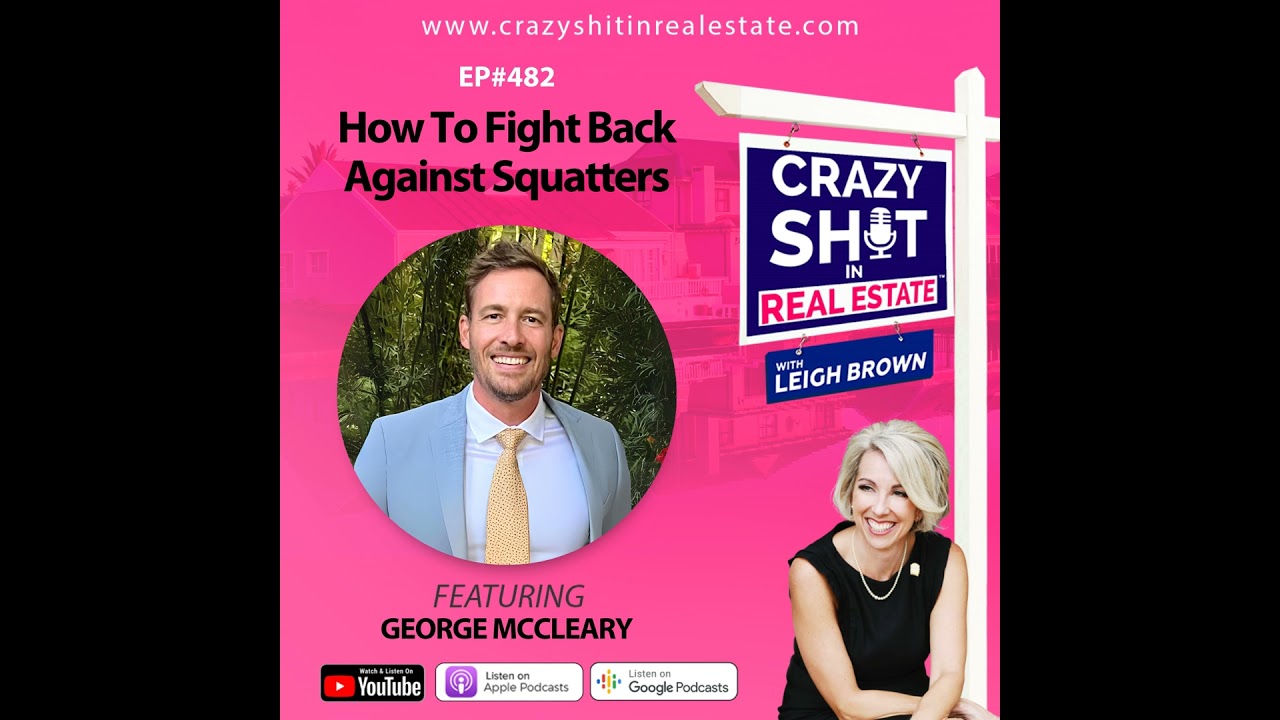
George McCleary, a Portland real-estate veteran, explains how squatters exploit vacant homes and criminals forge deeds to steal properties. His viral TikTok "I Stole a House" revealed the problem. He discusses quiet-title actions, why county recording offices miss fraud, and offers courses and title-monitoring services to fight back.
Chapters
You're listening to Crazy Shit in Real Estate. You'll be amazed at all these wild but true situations that others have found themselves in. Because on this show, you'll hear uncensored, unbelievable stories from the world of real estate. I'm Leigh Brown. Let's dive right in. I'm Leigh Brown. This is Crazy Shit in Real Estate. And today we go back to the world of squatters. And if you saw my episode with Repossessor Brian Biggs, that's the one to start with because now we're gonna talk more about squatters, and then we're going to dig into title lock fraud or title fraud. Holy smokes, y'all, there's just so much going on out there, and this is your awareness episode. So enjoy the conversation. I've got George McCleary, and that name sounds familiar. You've seen him on TikTok and Instagram. So enjoy this, and I'll see you on the other side. I've been recording the whole time. I'm going to decide what I keep and let go of.
Oh boy, here we go. All right.
Thanks for a really organic conversation.
Love it. Love it. All right. Well, I'm George McCleary. I hail from Portland, Oregon. I'm an investor, developer, real estate professional of 20 years. And what happened to me was I woke up one day back on Super Bowl Sunday of 2024 and I made a video called I Stole a House. And it's about squatting. It's about taking over a house and the ease with which squatters can occupy a property in Portland, Oregon, or really anywhere in the country. It totally blew up. It got tens of millions of views. It landed me on talk shows like Fox News, News Nation, mentioned on BiggerPockets, um, articles on BiggerPockets. Joe Rogan talked about me. It was kind of insane. So my life kind of changed at that point.
I don't know Super Bowl years. What year was that?
Oh, it was in February of 2024. Okay.
Oh, you landed on Joe Rogan. Okay, that's huge.
It would be pretty cool. He didn't say my name, but he's like, yeah, this guy on, you know, TikTok was explaining how to be like a squatter as you break into the house. And he just kind of went through it. I'm like, whoa, he's talking about me. And like, 5 friends, like the whole world was like texting me and emailing me the whole time, like, oh my gosh, this is crazy. Like, I saw your video. And but then other people were getting in touch with me saying like, yo, you know, I've got a squatter right now, or you won't believe what happened to me with my squatter. I lost like $100 grand. And I started hearing these stories. I'm like, hey man, can you Zoom? Because what I realized was that there's no consolidated source of information about squatters and how to contend with them. So I was like, okay, This is a great opportunity for me to serve an underserved market and to help people. So I started Zooming with everybody that had had these squatter and title fraud issues. That's when I discovered what title fraud was and created a couple of products, Squatter Defender and Title Fraud Defender. And now I'm on a mission to go help people not lose their shirt over these type of real estate fraud.
What does that lose your shit? That don't lose your shirt.
A lot of people lost their shit over my video. Hopefully because of that, they won't lose their shirt.
There you go. I mean, this, this might be a new tagline for you. And so I'm gonna expect—
Yeah, I'll, I'll send you royalties on that, Leigh.
It's easily worth a nickel.
Absolutely. Yeah.
It blew up on you. Tell us a little bit about the, the scenario. How did it occur? Were there any legal protections for you at that time? And just give us a little bit of backdrop.
So the reason I made the video in the first place is, so I've had like, you know, let's just call them low-level squatters in my project. So in my development projects, you know, like an addict will like fall asleep on like in the framing or whatever and it's no big deal. I say, hey, move along. And they usually do. And then in like a flip project, it'll be like an uncompleted house and a guy will like, you know, I've had guys like kind of bust in through the door and that's not cool, but like they usually like understand like the jig is up and they leave. But I'd had some colleagues that had like professional squatters, the people that had like forged leases, put utilities in their name, done like the whole scam, like A to Z. I just couldn't believe that not only were they getting away with it, but they were— it was— they were not being prosecuted and they were being able to stick around for like a year. It was utterly insane to me. And so— and that was coupled with a lot of policy choices that Portland was making at the time, which I really didn't agree with. So it was starting to overlap with my livelihood and I was like, yo, enough is enough. And I'd voiced political concerns online, same as you have, Leigh. You know, when things have just kind of bubbled up and you got to talk about it, I did the same thing. And so, and this one in particular just really struck a nerve and it totally blew up.
Well, I'm glad you mentioned the progression of squatting because I've been in real estate for a long time. During the recession, we did have a lot of those. Somebody wanders into a vacant house, spends the night, you surprise them and they leave. Today, it's a whole different ballgame because they do have the upper hand in many situations simply because until last year there were no protections in any state until Florida started the ball rolling. And I, I was shocked by that. I'm like, well, surely North Carolina has protections. And then I come to find out we have nothing and the sheriffs don't want to mess with it. And we're going to get our legislation passed. I think we'll get it this session. But it has been so shocking. But you said it led you into— and by the way, y'all, all of his Instagram and all the handles are in the show notes for the episode. So you can go binge to your heart's delight and watch all of the super viral moments, all the educational stuff. But you said it led you into understanding what was going on with title fraud. So share with us a little bit about what that space looks like, because we have not had an episode all of my seasons on title fraud. So I'm super excited that you're bringing this up today.
Yeah, let's talk about that. So what happened was, so first of all, I had never even heard of title fraud, but in the course of hearing about people's squatter stories, I heard about a person that had, had somebody move in and instead of like forging a lease or just lying to the police and like moving their friends and creating like a plausible scenario that they actually lived there. What they did is they actually forged a deed to have themselves on the deed of the property. So you kind of got to figure like, this is a dumb criminal. You can't just like file a deed and expect to get away with it. But the reality is that chain of title is set in stone. If you want to mess with it, you can't just call up the recorder's office and say like, hey, this was fraudulently done. You got to fix this. No, they can't just do that. You got to have like a court order. You got to do like an action to quiet title. It's a big deal. So meanwhile, this person's like occupying the house and they're on title. I was like, well, that's insane. But the ease with which they did that was really frightening because you've seen a deed before and all those stacks of real estate documents, you know, loan documents. Among them is the deed and it's just grantor, grantee, the property address, legal description, and then the notary stamp saying like, yeah, I saw these people sign this thing. The notary stamp, that is the security instrument. That's all that is protecting that document from being forged. And it's a friggin stamp. It's a stamp. It's not a $100 bill.
It was a one-day class at the community college. And there were people in there that I probably would not give a lot of— I don't know how to say it nicely.
Notaries themselves might be wonderful people. They might not be, who knows, but—
I can take that document that I see at closing. Type it up, have a notary stamp it, and run down to the courthouse. And that's—
I mean, why even bother having an actual notary stamp it? I mean, because then you've got somebody who's seen you. You just forged the ink or you forged the stamp. It's a very low-level forgery. And then you march it right down to the county, say, here you go. And depending on what county you're in, they either do dozens or hundreds or thousands per day. So they take a look at it. There's the information and they record it. So that happened to that person. But then I kind of, I was like, this is way too easy. I bet this gets, I bet this gets worse. And oh, it sure frigging does. So then you think about like, okay, well you can like occupy a house like as a deed fraud squatter. What if somebody like forged an ID? So I tracked down a lawyer who specialized in this actual thing and I was like, yo, what actually happens here? Like how are people using this for like illicit financial gain? He is like, well, And basically what's happening is people are getting identity thefting people off the internet, getting their social address and everything, getting a fake ID with their name and then getting the title forged into their name, into that name, into the fake name, but with them on the driver's license so that when they steal the deed, then they can sell the house to a wholesaler and pocket all of the equity.
Okay, so wait a minute.
I can explain that again because it's— because it's important.
Not there.
I lose you.
They have an imaginary name, an imaginary ID, Yeah.
Of a real person, of a real person with a real social.
Oh, so it's just identity theft.
And so yes, they have identity theft.
They stole the ID, put the stolen person on the deed. They've sold the house as the stolen person. They pocket the cash and run away, which is another— wholesaling should be outlawed because this is— a wholesaler has no way of checking it. Okay. This is intense. All right. So what about the mortgage? So they put themselves on title. They recorded the deed from Bob and Mary. Bob and Mary owed $300,000 on the mortgage. How does that get recorded on top of an existing mortgage?
So you're not going through title. The person is just going down to the recorder's office and recording the deed. So the lien still remains on the property. And so then when the wholesaler goes and opens up, because any wholesaler, any, any new buyer is going to open up escrow and they're going to pull title and say like, okay, looks like title transferred, you know, a few weeks ago because Steve makes sure like it worked, like, you know, title transferred. And that usually takes a few weeks to update and They put it into escrow and the escrow agent says, okay, it looks like title just transferred like a few weeks ago. Got a mortgage from like a previous owner. Oh, that. Yeah, no, I assumed it's subject to. That's where you take over the loan payments for somebody else. It's against the loan. It's against the terms of the loan. But investors do it all the time. There's like courses on it. You can see about assuming subject to. Yeah, no, I just assumed the loan, but it's worth like $650,000, right? So just, you know, use the proceeds, pay off the loan and go ahead and wire me the rest of those proceeds and we're good to go, right? It's like, oh, the escrow's like, okay, are you who you say you are? Yep. I got the ID right here and send your notary over. It'll be a perfect match and we'll have a nice real notary and everything will be just fine. And they're like, cool. And the wholesaler wants to get it through because you're giving them a heck of a deal because that thing has a property value of like a million bucks and like, oh yeah, I'll sell it to you for $650,000. So you pocket the equity and out the door you go.
So this would not be allowable then in states where wholesaling is outlawed, right? So in Kentucky, they just passed a piece of legislation last year, no wholesaling.
Well, it could be anybody who's— it could be a wholesaler. It could be— it could be you, Leigh. You could— they could call you up and somebody says, yo, I'll sell you this million-dollar property for $650,000. I just— I got to get rid of this thing. You'd probably buy that property.
And I'm a skeptic. I'm too cynical. They have to call somebody who's not cynical. But yeah, so, oh my God, people will call realtors.
People will call realtors and say and be like, yeah, will you sell this? This is a big problem.
The ID matches the fake name on the fake ownership chain of title.
Yeah. Yeah. Sometimes they'll call up a real estate agent, but a lot of times they won't do that because it gets publicly listed. And if it's publicly listed, the original owner might find out about it, or a friend might be like, oh, hey Sally, you're selling your house? Wait, what? No. And then they get tipped off. So that's why they will go to a wholesaler or just a private buyer and be like, hey, you, you wanna buy this house? So it's irrelevant whether or not wholesaling is legal or illegal. It's just Finding an end buyer very quickly and doing the transaction privately so that it doesn't actually go public and people don't get tipped off.
Okay. So when Sally does get tipped off that her house is now for sale by somebody she has no knowledge of, what is Sally's next step?
So the company I started, Title Fraud Defender, basically what we do is we like just, we just monitor your title because unless you want to push refresh on your county website every single morning with your morning coffee, it's going to get a little cumbersome to make sure that your title isn't being transferred. So if you find out that your title's been transferred, so that's not a bad thing, but that's damn near impossible to prevent because the way that things are recorded, you just can't put a stop to that. But what you can put a stop to is people stealing your equity, and they steal your equity by reselling the property. So you stop them from reselling it. You sound the alarms, you file an affidavit of false filing, you call a title company, you basically, you red flag it with a little procedure that we, that we outline within Title Fraud Defender. And so at that point, you know, the jig is up and they're not going to be able to sell the property. They no longer have marketable title. So you've accomplished that, which is, which is great. But then you got to get title back into your name. And the way you do that, unfortunately, you have to hire a lawyer and file an action to quiet title. And that is what changes the chain of title. Back to you, back to the way it was before. But it's a lawsuit. You got to go through it. There's no two ways about it.
So I'm going to eat legal fees because a scam artist snuck up into my property and put it in their name. So is there a way to prevent this at all? Because I know there's a— I can't remember the name of them, but there's somebody that advertises on the SiriusXM Patriot channel that I listen to a lot, and they talk about how you can Is it Title Lock? I can't remember the name of them, but—
So Home Title Lock is essentially the same thing as Title Fraud Defender. That's just title monitoring. There's no way to like—
Oh, thank you.
It's a bit of a misnomer. There's no such thing as like locking your title, like kind of like freezing your credit. I know, darn, right? So there's no way to prevent somebody from stealing your title. There's just no way to do it because the way that our recording system works for literally every county in the country is you just walk into the recorder's office with a piece of paper.. And someday I'm hopeful that this will change and it will go on blockchain and there will be checks and balances. But today is not that day. Tomorrow doesn't look good either. And as of now, you can't prevent it, or at least nobody's given me any credible way that you actually can prevent it. So Home Title Lock, uh, they're selling what we're selling except for they're $20 a month and we're like a few bucks a month.
Okay. So I'm panicking a little bit now because I own rental properties and so I need to watch rental properties in multiple counties, in multiple states. When every state obviously operates differently, some have electronic filing, some require you to go in person. If you were going to design the perfect filing system for deed recordation, what do you think is the, the best way to do it? Is it to go electronic and go blockchain and, and lock down that, that system? Or is it to stay on paper and they check IDs and only lawyers can file it? What's the answer?
I wish I had one for you, Leigh, and I've gotten this before.
Come on, your specialty, man. We're counting on you. BiggerPockets will put you back on the podcast.
I have, I've earned, I promise you, Leigh, I've earned like a PhD in squatting and defraud over the past like 6 months, and it's, it's been an intensive study. But I guess this is like the next graduate level course I need to take. Um, there are companies that are trying to put this on the blockchain, and basically the best solution that I've heard is putting it on the blockchain and, and having a system of checks and balances so that when deed transfers, both the grantor and the grantee are notified and have to sign off on it in a way that's actually verifiable prior to title being transferred. So what that system actually looks like, I don't really know, but I do know that you shouldn't be able to transfer title without having an absolute surety that the grantor, the person selling the property, knows about it and is good with it because the only thing they need now is a signature and there's no way to verify that signature right now. And it's, you know, a notary stamp, supposedly that's the verification, but it's easily forged. So that's, that's essentially the solution is on the blockchain, verifying grantor, verifying grantee. And it hopefully is not going to be a cumbersome process because like I said, like thousands of these get processed every day in America. So it's got to be something fluid. And if somebody has a great idea, then yeah, it's the next, you know, billion-dollar company. But we don't have it as of now.
Well, and I don't know that you can get there because since we're a constitutional republic and every area does things differently, you won't see conformity there just by the nature of things. But now I'm realizing, so North Carolina has had a spate of land scams, and I think they've been in many states where somebody calls a realtor using a fake name to list a piece of vacant land. They can verify the information. They give us the fake ID, you list the land, and then they want to price it below market so they can get a cheap buyer on. I think they know that land is just not as visible in marketing as houses are. And it can actually close before the real owners ever find out. But before they figure it out, yeah, probably because there's seldom a mortgage or a lien on vacant land like there is on the house. So you take out that one hiccup from the process.
Totally. Yeah. So the, the, that actually adds a layer of complication for the title thief. So I said before, like, yeah, I assumed it's subject to, the lenders have some checks and balances. So, so sometimes it'll get caught with them because they want, they like, you know, they'll go back to the buyer and be like, yo, what's up?, but usually it's done with parcels or properties that have no debt. And so what you're talking about, Leigh, this is, that's like impersonation. You're pretending to be the seller and whether you have a fake ID or like, you know, that takes another level of sophistication, but it's not that hard to get a fake ID on the dark web. But you're essentially impersonating, you're skipping that, that fake ID step and just impersonating, impersonating that person. And then as long as you got a way to get the, get the proceeds transferred into a bank account because you know, I'm sure it's the same in North Carolina. You've got to have the proceeds for the person on title have the same name on the bank account. You can't have Leigh Thomas Brown LLC sell a property and then transfer the proceeds to Jingying Ping in China. It's without, you know, without a series of checks and balances.
It's so overwhelming to think about the people that spend their time trying to find a way to scam the system when they could be curing cancer if they would turn their brain to something productive. All right, let's jump back to the squatter side for a minute. So you're on the left coast and honestly, you guys have issues out there that can become contagious to the rest of the country. But currently Portland and Oregon have been trying to dial it back because they realize they went a little too far with some of the—
I think they swung a little bit too far in the wrong direction.
I mean, when you allow all drugs to be legal, you're creating an unsustainable—
What could possibly go wrong, right?
Nothing. So luckily they're pulling that back in. But what are you seeing for relief for property owners in Oregon in your experience? Are they looking at legislative action? Is there any kind of— is it going to become criminal to squat in a house? Because in North Carolina, y'all can watch the episode with Representative Brian Biggs because he's a realtor and a state legislator. We were talking about the fact that the sheriffs want to treat it as civil. We in real estate want to treat it as criminal because somebody's stealing your property. And that's not civil at all, but it's been—
Nothing civil about it.
Very vibrant conversation. So what does the conversation look like in Oregon?
So a lot of it revolves around landlord-tenant law because that's essentially what the squatters are exploiting. If you can get inside a house and establish that you have like been there for a certain amount of time or establish with a police officer that, you know, you have some credibility that you do have the possib— like the possibility that you are occupying the property legally, then you can dupe the police officer into thinking that you actually have a legitimate claim to it. And then you have to go through, you know, well, at least people think that you have to go through the court system at that point. And then when you have municipalities like Portland that have very robust landlord-tenant laws that very much favor the tenant, then you've got those protracted periods of time to just essentially kick them out as a tenant. They were never a tenant. They're a trespasser. But people think that's the best thing to do. But what I heard after talking to all these dozens of people after I went viral is that some people didn't go the conventional route. They said, okay, no, I'm doing this a different way. And a lot of commenters on the video, like on X and Twitter, they're like, yeah, I would shoot them or I would take them out at gunpoint. And so of course I'm listening to this thinking like, okay, like, yeah, you could, but like, I feel like there's going to be some liability if, you know, you're bringing, you know, a confrontation like that into the equation. And sure enough, like, there's been a lot of cases where either the squatter or the owner has been, been either harmed or unalived, as they say, because of the confrontation. And whether it's the squatter dying or the, uh, or the, the owner, it's not a good thing. So what people were doing a lot of times is kind of operating in the gray. They were like doing things like introducing animals, like, you know, throwing a bunch of rats down the chimney, or snakes was one of them. True story.
Yeah, yeah. That wasn't just somebody on the internet saying they were gonna do it legit?
Yeah, no, there, there's people that did booby traps, bear traps, and then there's— yeah, I heard all manner of things, and some like, you know, some grosser ones that I won't mention, but use your imagination.
It's like your whole TikTok channel is all of these little ways to deal with squatters because I was sworn to secrecy by them.
Like, I can't— so I can't like actually like go and go on there and have like— so I go on podcasts, I talk about like, hey, somebody did this or whatever. But like, I do make a lot of content about like, you know, squatters and, you know, deed fraud, saying like, hey, this is a problem, just kind of trying to spread the word. But those unconventional methods—
I mean, if Chris Rufo can expose what's going on in the school systems, I think you could be the citizen journalist that goes with your little iPhone to all these little squatter situations and says, somebody dumped a box of rats down the chimney. Let's see what happens next. I would watch that channel all day long. And especially if you take some of the traps they used on Gilligan's Island, you remember Gilligan's Island where they set for the natives and for animals. I mean, it could work for squatters. You can't, can't prove me wrong yet.
So, oh yeah. Yeah. No. So all those unconventional methods are not only hilarious, but a lot of them have actually worked. And there is, there is like a middle ground because I'm not, I, I, I tell them in Squatter Defender, like, you know, here's what happened. I can't recommend this, but you know, here's what some people did. But there is sort of like a middle ground that doesn't involve going through the court system. And I talk about that in the course. And there are things that you can do that don't get you in like a legal entanglement with the court system. And. I don't recommend like confronting squatters directly because you're dealing with very desperate people and bad things have happened and bad things can and will happen. And the same reason that you can't go after these people like with like a civil claim to try and shake them down for money is because they have no money. That's— they got nothing to go after. And you're probably the deep pocket. And if they go after you because you did something, That could end badly for you, not just by physical harm, but like just going after your wallet. And there are lawyers that will be more than glad to do that in any state.
And I don't think vigilantism is generally the best way to go. So I'm more in favor of digging a hole and putting a fake palm frond over the top as a trap instead of other pathways, depending on which state you're in. I guess I should say that that's the whole beauty of a constitutional republic in some states.
Mm-hmm.
You probably have different freedoms than others, but not all states are experiencing huge amounts of squatter activity. How bad is it in Oregon in your experience? Is it frequent? Is it infrequent?
It's generally worse in blue states and bluer municipalities. There's squatters and title thieves in literally every state, in every city. It's less frequent in, uh, multifamily. It's more frequent in single-family houses. And yeah, you go—
so just because the person will, uh, snitch on you.
Yeah, well, put yourself in the position of the squatter. You want to not be discovered, not be seen, and you want to be there as long as humanly possible. So you get to your— get to a place with your own four walls. You're not waving to people as you come in and out. And because if you do, then there's a chance that somebody might snitch on you. And there's much more likelihood that someone is going to do that in like a rental house. So if you got a rental house then, you know, oh, looks like there's a new tenant in there. That's going to be a whole lot less likely than— it could happen in a multifamily and it does, but single families are most, most frequently targeted. There's no like, you know, card swipe to get in or whatever. You just, you know, you watch a YouTube video, you pick the lock, you get in with no sign of forced entry. The cop is thinking like, okay, well, there's no window broken. They didn't break the door down. Like, there's furniture in here, there's people. This is a plausible scenario, even though you've got the owner right there saying like, this is not a tenant, this guy's a squatter, get him the heck out of here. The cop is like, well, mm, got a he said, she said situation here, sir. So, um, sorry, but you're, you're, you're gonna have to take this guy to court.
I mean, those are the things we've seen online. The people that were in New York, and of course we're recording this in September heading into snowbird season. Live in a cold state and you go to Arizona or Florida for the winter, you're going to have to be thinking about how you protect your house from being taken over while you're gone. So does your— does your class talk about how to— how to go out of town safely? And can you give us, like, one of your— your number one top tip for how to go out of town and not have your house stolen?
For sure. So the Squatter Defender course covers squatter prevention, detection, and ejection. So we talked a little bit about getting rid of them. Prevention, as they say, prevention is worth a pound of cure, right? Or an ounce of it. So the number one thing is, is, is really just very intuitive. It is an alarm system because you got to know who's coming and going from your property. And so for Squatter Defender, if you buy the course, you get 50% off a SimpliSafe system that is portable. You can take it from one property to the next and it has an alarm like a siren. With the keypad, and then a motion sensor. So if someone walks in there, you know about it. And it has a camera, so you can pull up the footage and you can have it notify the police for $25 a month if you really feel like it. But you don't really need to. You just need to have a notification on your phone so that if it gets tripped, you pull up the camera and be like, okay, oh, that's the plumber, forgot about them. But if you see, you know, Frankie the Stealer coming into your house and kind of looking around all shifty-eyed, you know, chances are he's probably not going to stick around after the alarm is going off. But even if you forgot to, you know, if you forgot to set the alarm or, you know, you got the camera, you can, you can make, you can make sure that whoever is going into your house has the right to be there. And if they don't, you're going to know about it quickly because what you're up against here, Leigh, is time. It takes time for these people to get established. They get into the house and then they got to like move in furniture. They got to establish plausibility. So that when the police officer inevitably shows up, whether it's a day, a week, a month, a year later, once the owner figures it out that there's somebody in there, that he's— the, the cop is going to walk up to an empty house with an alarm going off in the background, a video of the guy, you know, tampering with the lock to get it— to get in there. And it's an open and shut case. He's going to be like, okay, clearly, clearly this guy has no right to be here. I got an owner saying that he broke in. Like, yeah, he looks like, there's a video of him picking the clock. We're taking this guy out. Whereas if you don't have— if you haven't been tipped off and you're not going there frequently enough, because like, how often do your property managers swing by vacant properties? Maybe once a week. So a week is fully enough time for the guy to move in a few sofas, get his scuzzy buddies living in there, like, and his, and his 4 dogs. And so by the time the cop shows up there, you got, you got plausibility. And so that is so that that's the low-hanging fruit. There's the alarm and, you know, if you buy the course, we give you half off and it ends up being like $100 or something. It's a really tiny amount and you can change it from one property to the next. And it's, it's, it's simple and easy and hardly anybody does it though.
I'm just, I'm just still so surprised that anywhere in this country the police would say that, sure, you own the house, but these people get to have it. That's what's been so mind-boggling to me that there is such a loss of respect for property rights that owners have to put up with squatters until some future date when the courts decide they have to go. It's, it's astonishing and it's got to stop.
It does. But the thing is, Leigh Thomas Brown Brown, that is, that it comes back to possession. If you are in possession of something, you are assumed to be the owner of it. The shirt on your back, the pearl necklace you have, it's assumed to be your own if you're in possession of it, unless somebody else can prove otherwise. And if you're in possession of a house, you are assumed to have the right to be there unless somebody can prove otherwise, or it's like patently obvious that you don't have the right.
But I own it. I own it.
I believe you. I believe you. And I don't think anybody's going to make claim to the necklace. But in this case, no matter what state you're in, there's going to be some form of landlord-tenant law. And if tenants have a bundle of rights that are afforded to them as occupants of real property, it's not a bike, it's not a sack lunch, it's a house. And so there's a bundle of rights that's afforded to tenants in any state, and that's why they're able to maintain possession of it after they, you know, stop paying. And if they, you know, if they can fool a cop into thinking that they're a tenant rather than a squatter, they kind of, they, they, they get, they tacitly gain those rights. And it's insane, but it's the convergence of, of certain laws that have just gone a little overboard. And just like you said, Leigh Thomas Brown Brown, like our rights as property owners are being trampled on in this case, but it's with the intention of protecting tenants against bad actors, bad landlords. But has, has it been overshot in my opinion? 1000%.
But it also means if you're in real estate, you better make sure that you've talked to your property manager about landlord-tenant laws where you live. So you're aware of what the bundle of rights are in your area so that you can be prepared for all of this. Investors have to pay attention to squatters too. It happens in Airbnbs or other short-term rentals, happens in long-term rentals, and it can happen in your primary residence. And if you're a consumer, then you really got to pay attention to things like your title until we get smarter legislators, frankly, that are able to think their way through full processes. I think we're going to see more scamming before it's all over. George, what's the best way for people to find you, take advantage of your courses and get some of these details that you are sharing?
Yeah. So if you want to take a look at the course, it's at squatterdefender.com. And for your listeners, Leigh, with the promo code Leigh Brown spelled just like your name, woohoo, you get 20% off. And then same with Title Fraud Defender. That's at titlefrauddefender.com. That's your title monitoring, monitoring service. And it's great for investors because we give big discounts to people who own multiple properties. And that also has that same promo code, Leigh Thomas Brown, and that's for 20% off. And you can also find me on social. I always tell people I'm very easy to find. Just Google George McClary, TikTok, LinkedIn, or whatever, and there I am. McCleary Realty and Development is the name of my real estate company. So you can see like development projects I'm working on. This educating people on title fraud and squatters is kind of my side hustle right now, and I'm going to see where it takes me. But my regular job, my day job, is as a realtor, developer, house flipper. So find me at McCleary Realty and Development on Instagram, on TikTok, and, and write me a message. I'd be happy to hear from you. And if you've got a crazy squatter story, I definitely would like to hear from you because I'm kind of— I've become like the source for these crazy stories and I've consolidated all of it and put it in the Squatter Defender course. I'm going to keep updating it and so that people are going to know what to do if they have a squatter.
And I'll just point out, I really want y'all to reach out to George if you have a story about how to get rid of your squatters and it's creative because those sound the most interesting to me. So Maybe you have devised a way to send, I don't know, ants into a house and we all hate ants. So that may be— I don't know if it'll run anybody off though, but we'll find out. George, thank you so much for coming on the show. Thank you for talking about very uncomfortable topics that people need to be aware of so they can make good decisions. And of course, y'all, you can drop your comments below, reach out to George about the Portland market, about his courses, lots of reasons to reach out to him. And of course, in the show notes, all your contact information. Thank you so much for coming on the show. It's a pleasure to meet you.
Pleasure. Thanks so much, Leigh.
All right, guys, hit the bell, subscribe for more. I'll see you next time. As always, I'm so super thrilled that you joined in for more crazy shit. And if you're a realtor, investor, inspector, lender, or just a regular human being who happens to have an unbelievable story that you need to tell the world about, or frankly, you just need to one-up the story you just heard, then make sure Be sure to DM me on Instagram @leithomasbrown or tweet me @leighbrown or frankly any social network where you hang out. I'm there. And if you had some fun, then you totally want to subscribe so you don't miss out on any future episodes.










