Meth in Real Estate: What Every Homeowner Needs to Know
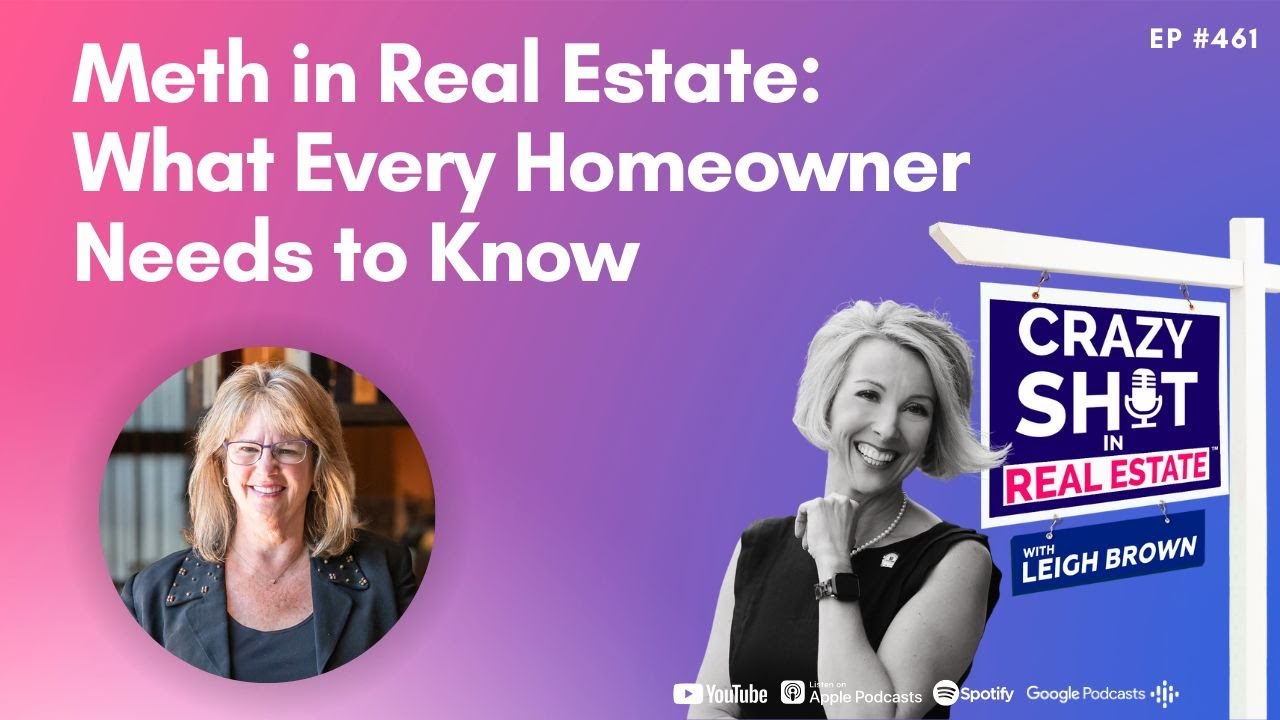
In this episode of Crazy Shit in Real Estate, host Leigh Thomas Brown interviews Kathy McCarty, a former banking executive who became a meth‑toxin advocacy leader after her own home was covertly turned into a meth‑lab and THC‑extraction site. Kathy recounts how, within 90 days of placing a tenant, she discovered extensive chemical equipment, a large stash of meth, and hazardous fumes that forced her out of the house. She explains the health risks of meth residue—how chemicals permeate drywall, ventilation, and structural components, making full remediation nearly impossible, especially in log‑home construction. The conversation covers the stark lack of insurance coverage for meth contamination, the limited and uneven state disclosure requirements (only six states mandate post‑remediation disclosure), and the financial fallout that left her unable to remediate or sell the property without disclosing the contamination. Kathy shares practical advice for buyers, sellers, investors, and property managers: always Google property addresses, check public health and police databases, and demand thorough tenant vetting. She also describes her organization, Meth Toxins Awareness Alliance, which provides education, advocacy, and resources, including a searchable database of contaminated properties. Leigh promotes his Answers.RealEstate coaching program throughout. The episode serves as a cautionary tale and a guide for real‑estate professionals to recognize, assess, and navigate meth‑related hazards.
Chapters
I'm Leigh Thomas Brown. This is Crazy Shit in Real Estate, and today we're going to talk about meth labs, specifically meth labs in houses and things you may or may not have known about this topic. So if you're in real estate, there's great information for you. If you are a buyer, seller, investor, or tenant, you should probably be listening along as well. So enjoy the conversation. I've got Kathy McCarty here to bring you a true-life cautionary tale and information. I'll see you on the other side. So if you're in real estate and you're listening to this podcast or watching it and thinking, man, I need some more Leigh Thomas Brown answers in my life, well, guess what, friends? I have a new program that is launching right now called Answers.RealEstate, where I will give you every bit of insight I have to help you grow your real estate business, help you better respond to consumers to provide a more excellent real estate experience, so that the next time you land on crazy shit in real estate, you'll have a better solution to whatever you ran into. Answers.RealEstate. There are monthly plans available. You will love it. Get your coaching. Sign up with me today.
Hello, Leigh. Good morning or good afternoon, maybe to you in North Carolina.
Yeah, it's just hit afternoon. So now it's Friday afternoon for me. Where are you located?
TGIF. I am in the Front Range of Colorado.
Oh, nice. So what town does that make you near?
Well, it makes me near Denver. Currently, you're finding me in the foothills west of Boulder.
Okay.
If you're familiar with Boulder.
Yeah, the blueberry, the bluest of blueberries in Colorado. The very expensive blueberry.
Well, that's true. I think it's probably one of the top counties in the state as far as real estate and whatnot, and home of the CU Buffs. If, uh, if you're a college football fan.
One of my good friends, he's got an office in Boulder and I was asking him, I said, what do you do if you have a first-time person? And he just laughed. He said, either they have to have access to venture capital or Bay Area kind of money, or you just live several counties away. And I I hope one day you can live near Boulder. And I said, that's just wild because the average price is like well into 7 figures, isn't it?
Oh, I think it's over a million. Yeah, exactly.
I'm glad to be in the cheap seats in North Carolina, that is for sure. Well, I'm so excited to have you on the show, Kathy. Why don't you tell my listeners a little bit about how long you've been in and around real estate? Give them a little bit of color commentary before we dig into what you're doing in life.
Absolutely. I have been around real estate well over 30 years as an affiliate in the lending and banking industry. And that's where my roots started. Based off of my, my mission and my message though, it relates to methamphetamine toxin contamination. And that is a new journey that through divine intervention and, uh, Actually, through the gifts of God, I was able to turn my lemons into lemonade through legislation as well as learning. So that's my journey. You know, I have a story and it's pretty compelling. It's one of those things, like your title said, you just can't make this shit up.
So tell us, how do you land in the meth advocacy space after being in mortgage lending for a long time? I know that when we talk about substance-related things, people get very uncomfortable. And so we often don't talk about it enough. And we have a fentanyl crisis in the country. The meth issue has been going on for some time, and they're still pervasive in so many communities, and nobody wants to talk about it because it hits too close to home, I think. So why don't you talk just a little bit about how you landed there? What was that journey? And absolutely, listeners know a little bit more about it.
Absolutely. Here, I'll give you the Cliff Notes. Um, basically, in early 2016, I had a career in banking at the executive level. Like I said, many years of lending and banking, even at the executive level over 3 decades. And in early 2016, I did have a serious health event. And I'm here to say I have nothing but gratitude for navigating through that. But in 2018, when my youngest went off to college, I chose to leverage my largest asset, my home, and offset some medical costs and work on my next chapter because I couldn't go back to my career in banking, managing a very large commercial bank here in the Colorado Front Range, in the Denver metro area. That being said, when my youngest went off to college, I put, I put what I thought were all the right provisions in place. I put the right insurances. I hired a management company. I did a lot of vetting. I went through a very detailed account for what my expectations were for how they vetted a tenant and things like that. And actually what happened was, is within 90 days of them placing a tenant in my home through divine intervention, and I learned that my home had been turned into a meth lab and was destroyed.
Oh, so that's soon after they moved in? So they moved in and right away turned it into a meth lab?
Absolutely. And it was within 90 days through a— what I was told was a minor maintenance issue at the home. I ended up going up to the house when I learned there was some digging going on. It was the maintenance issue that was supposed to be water line related. It wasn't minor by any means. There was this huge excavator on my property that I was never informed about. It's a huge story and something that I turned into a continuing education class for realtors and property managers here in the Front Range. But that being said, through being on the property and then going behind the home after a period of time, and I just got some really bad vibes, I found equipment that I could not recognize. And that, that was not the methamphetamine-related manufacturing equipment. That turned out to be an extraction system to make high-potency THC products. Right? And I lived in the forest in a bedroom community west of Denver called Evergreen. In fact, I lived within eyeshot, literally, of our sheriff's substation property up there. And so this wasn't way out in the boonies or anything. But the bottom line was, is that That equipment behind the home was very flammable, very dangerous. It put all my neighbors and our whole community at risk. And I was able to engage the local sheriff's department who then immediately called our drug task force, West Metro Drug Task Force. Within a day and a half, got a search warrant and then found large amount of methamphetamine, over 800 grams, all the manufacturing chemicals and some hardware, a small arsenal of guns. And the place was fully trashed within 90 days of his being a tenant.
Okay, so since I'm from a state where marijuana is not a legal substance, were they breaking the law with the THC stuff? Do you have to have it in a special facility? Absolutely.
Absolutely.
Okay, so you can't do, you can't do the manufacturing at home. And then of course we know meth is illegal, but why don't you tell our listeners and our viewers a little bit about what methamphetamine production does to a property, because obviously every state looks at meth houses differently because they're an environmental hazard in addition to being wildly illegal. So why don't you give us the quick down and dirty, so to speak, on what you would find in a house that's been infested by this?
Right. In the case of my home, once he did move out, you couldn't even tell there was manufacturing going on. He was arrested. On 12 felony counts, and that's a whole nother Oprah journey. But that being said, there was no signs, like, the place wasn't trashed, like burn marks on the walls. It did have a chemically smell to it, but he was— it was very disgusting the way he backed up the toilets and did other things. So there was a lot of smells that were odors that were compounded in there that weren't traditional to what is considered to be normal for law enforcement to look for a meth house, like, maybe a urine, cat urine kind of smell, but you don't always have that. It was very chemically. And my health issue related to my eyes and my eyes were very sensitive. I couldn't even stand in my home for more than a minute without them burning to be where I had to be outside. So I knew I couldn't ignore this. I couldn't even go back and live in my home. You can't just clean it up and surface clean it and think you could live back in it. I had something I had to really deal with. And you're absolutely right. The components that go into making meth, you know, battery acid, lye, phosphorus, Drano, all sorts of things. When you mix them together, there's a very significant health event that is secondary. It's a petroleum product that is very— when you smoke it or manufacture it, it gets into the air and then the residue adheres to all of our surfaces. Like the walls where I'm at right now are drywall, so that's very porous. It'll soak into the drywall. And a lot of times it cannot just be cleaned. You actually have to take a property down to the studs and it gets into the ventilation system, the attic spaces, the crawl spaces, anywhere where air goes, methamphetamine toxins can travel. And so it's, it's almost impossible through the experts that I've learned to actually eradicate it fully, but you can get it down to extremely low levels where almost 100% of the population won't have any effects, but there still are, can be health effects, especially for somebody like me that has a preexisting condition. The standards that we have here in Colorado, and, and I did look up North Carolina, you know, they're usually based off of a child's body mass size because they're smaller. And so a same amount of contamination exposure for an adult like me may be less severe than to a newborn or an infant or a small child.
So if you were selling that house that had previously been used as a meth house, even if you clean it up, is that something that has to be disclosed in Colorado, or is it a caveat emptor to buyers?
Half the states in the nation have some regulation about meth contamination. The other half has none. The states that do have some level of regulation, either statewide, county, or city, like Florida, it's not fully around the whole state. Only 6 states have some requirement of disclosure post-remediation. And what I learned is a home could be remediated to the state standard, but that doesn't mean that it's gone.
Right.
And so I'm a proponent that no matter where the property is, you cannot profile geographically a home, no matter if it's a high-end area of this county where I'm at in Boulder, right now or in an inner city, high crime, low income area, you can't profile that anymore. It's anywhere USA, rural or urban users. It's not even necessarily the manufacturing that is the biggest issue in today's environment. It's really the usage and the usage from smoking because you can consume meth by injecting it or snorting it. Years ago in the '70s, '80s, and '90s, that was probably most popular., but by smoking it, it's more intense. And that's where smoking it can leave a residue that will cause physical harm. But then in my case, especially, and in a lot of people's cases I've learned since my research, the financial impact is devastating. And in the case of my home, here's the big aha, Leigh. Insurance, 99.9% of the time on residential real estate, which is 1 to 4 units, insurance does not cover contamination, and meth is included in that caveat. And then the second—
you're the property owner and your tenants are doing this and you have no knowledge of it, you still don't have coverage.
You don't have coverage. And this isn't just as an individual major carrier. I've checked with brokers for— this happened to me over 5 years ago. I have friends that are in the insurance industry for carriers as well as brokerages that represent hundreds of carriers and nobody's offering an endorsement that you can buy to cover you specifically for this type of situation. The other piece of this is, is that I had— the tenant had a policy on my property as a condition of his home for being a tenant. He had to have a policy, a tenant's policy for my home, because those do— those things cover accidents or they can cover stupidity, but they don't cover criminal activity. So because he, his conduct was willful and wanton, there was no coverage there. My coverages were declined. In the case of my home, it was a '56 restored log cabin. I was not intending to have this as my, um, as a rental income later on. This was the home that I bought as a single mom in a community, uh, where I raised my kids, uh, my family for over 25 years. And then eventually the legacy I was going to leave to my children, but before then, uh, to enjoy a mortgage-free security because of my age. Currently I'm coming up on 64 now. So, and I was within single digits when it happened of paying my property off. Now I've just had my—
what did it cost you to get it back? What was the remediation cost?
My home could not be remediated. I had several companies up there and because of the high levels and the fact that it was log, there was no drywall to take to the studs. It was gorgeous beams of logs. I'll send you a picture that you can have. There was no remediation. So I ended up selling the property fully disclosed, fully contaminated with the intent that I thought a builder would buy it because I had a gorgeous view of one of our 14ers out here.
Nobody wanted to touch it.
Uh, well, people did want to touch it, uh, you know, at a fire sale. And I thought a builder would, would buy it, level the home, and eventually build a property. And I would at least get enough money to pay my mortgage off and move on. I did have to pursue some litigation with the property management company also in hopes of getting whole for my equity and my, my expenses. But that turned out to be— it was an 18-month experience that, uh, is not for the, the faint of heart in our civil legal process to hold them responsible for what I thought was a lack of their fiduciary responsibility and their neglect and misconduct, because it turned out they never vetted the tenant. There was no vetted file.
None.
None. There was an application and there was not even a credit report in the file when I asked them to turn it over. I am not here. There are a lot of great property management companies out there, and I'm, I know that we found smoke, but we never found the smoking gun to whether there was a connection. But the bottom line is here is that I just want people to know the transparency. Here's what happened with my home. That's important. What I think is important for your viewers to know is that somebody did buy my home. They took a chance that they could have it remediated to the state standard, and they were not able to get the levels low enough. But there's a secondary process that I knew about because I went and sat with the health department and talked to them. It's called encapsulation. They seal the meth in with an approved material, approved substance, you know, a clear substance, and that's supposed to seal it in. But there's not enough data that I've learned from the experts to support that that seal stays forever. And then they were able to sell it 5 and a half months after they bought it from me, undisclosed. Because it met the category of remediation here in the state of Colorado. And they sold it for more than twice what they bought it for, almost $300,000 more than what they bought it from me, getting all my equity. And I know there was some investment, but— and my question is, if it's so safe, if the process of remediation is so safe, What's the big secret? Why not be transparent? Why not allow people to, like any other material defect in real estate or toxin that you have to disclose, like mold, radon, asbestos, and lead, why not disclose meth and allow people to come in and decide if they want to test again, just to ensure that the property is still safe. And if it does have some hotspots, which I've learned from situations this has happened, you can negotiate that in a sale or make a decision for you and your family of what's best, like any other material defect.
It's a, it's a great question. And I'll just point out, if you are a buyer or seller, what Kathy's talking about here is the very interesting space of where we don't have disclosures. And so when you're buying a house, you're definitely in that caveat emptor space. Always, always Google the address because the police reports will come up even if there is nothing else disclosed. And then you have a basis for asking some questions because when your family's health is going to be at risk, you have a right to know that. And even though these are not everyday scenarios, meth is, as Kathy mentioned, all over the country. It's not just in white trash trailer parks, which is how it is portrayed. It is something that's bled over everywhere because it is affordable in the eyes of the drug community. But when you're buying a house, Google the address. It's kind of similar to if somebody dies in a house, that is not a disclosure item. But there are a lot of cultures that do not want a house where somebody has physically died in the property. The agent may or may not know and doesn't have to disclose, and the seller may or may not know or disclose as well. Always look it up. And this is why even with the best professional realtor, ask lots of questions. And when you have a great property manager— and Kathy, I love that you're very careful not to try and trash property managers because that's not your goal there. But there is a good interview process that should go in to a tenant. And your property manager, if you're an investor, should be the person who's investigating that tenant to make sure you have at least an idea of who's moving into the house. And in fact, I love property managers that go to the house every month to change the air filter, to make sure the heating and air is moving properly, check the smoke detectors. So they're looking after the safety, but at the same time they get to lay eyes on the house and see if there is something that's out of whack. Because if you had not had that water maintenance issue in the yard, how much worse could this have been? I mean, gosh, it could have been very—
the equipment inside the home was very explosive. The THC extraction system behind the home. And we were in a, we had just come out of a phase 2 fire ban in Colorado in that area, down to a phase 1, which is still no open fires. And I lived in the forest. So he had very explosive equipment related to manufacturing THC products that could have burned down the community. And this was only a month before what happened in Paradise, California, which was not related to drugs at all. It was just, it was a power line issue that came down, but 90% of the community burned down. And so I, you know, I had a very lovely area, but there were homes all around me that you couldn't even necessarily see through the trees, but it could have been catastrophic. That's where my gratitude comes from, is that in this situation, as bad as it was for me, emotionally, financially, physically, Nobody was hurt or worse. And that's the gratitude where I feel the cabin, somewas, was magical, called me home in a way. And through divine intervention, this was able to be caught early enough to where it didn't have an impact on my neighbors or community. My mission here is not to instill fear, but really just to empower positive change and the way we look at it and the way that we understand Meth is a real issue. The manufacturing isn't as common, but the residue left from previous properties, it doesn't go away. It doesn't dissipate over time. You can't smell it. You can't see it. You can't recognize it. As people come in and out of homes, it could be painted over, encapsulated through no knowledge of previous occupants even knowing that it was even in there, but it can work its way through as we do home improvements or hang pictures. Encapsulation of sorts in that product, like in my home, that seal could be broken, or it's just one toxic product on top of another. And it's just about making people aware so they can do their due diligence and understand that whether they're renting a property or they're testing. We did get some legislation passed last year, not the full disclosure requirements that we were navigating towards. And I'm not going to stop. I'm going to keep keep going for that. But our state health department had a private database of properties that in the past have been contaminated that is now public-facing. And it's something that I, in the workshops and the classes that I teach, I walk people through how to use it and what they can get from it and the type of information that they can pull from that database and use it to advocate professionals to advocate for their clients or for clients to be able to— buyers and sellers to be able to advocate for themselves.
So, well, that's a huge success. How fast you— if anybody in the audience wants to follow up with you and find out more about how they can support your legislative efforts if they're in Colorado, how they can replicate your legislative efforts if they're not in Colorado, or to reach out to you about your educational offerings around this topic, what's the best way for them to find you?
You know, I'm on all the platforms of social media. Meth Toxins Awareness Alliance is the organization that I founded, and it's a social good organization with 3 pillars of focus: education, advocacy, and resources. Because we want people to be educated. And you can, through the website, under resources, you can drill down to your state on the link and, and your, even your county, your communities to see what your local county health department regulations are, or your state health department regulations are in relation to meth contamination. Some of them have requirements for testing. Others, they only focus in on whether a property was found to be where meth was manufactured, not just usage. And I'm here to say usage is a huge problem. So I'm on LinkedIn, Kathy McCarty with an I, K-A-T-H-I, as well as my website, Meth Toxins Awareness Alliance, and You Google me and I think I'm all over there. So I just feel it's really important that when we lead with integrity, we leave a profound impact for generations to come. And that drives how we act today, our moral compasses, and then what we leave for our children and our children's children.
Absolutely. Now, friends, all of those links will be in the show notes for this episode. So make sure and check out these resources that Kathy has put together. I love that you are creating a good place for people to go get information because, as you know, friends, leading with integrity means if you now have access to a new informational source, you got to take it and use it and become the best possible resource in your communities. We can make things better all around us. Kathy, thank you for what you're doing for all of your neighbors in Colorado through your own experience, which is the best way we learn. And thank you for spreading the word to make other things better. We appreciate you.
Thank you for having me today. I'm truly honored.
All right, guys, say something nice about Kathy in the comments. Let us know when you go check the links. And if your area is missing any kind of requirements or regulations, please reach out to Kathy. I bet she'll have the next steps for you to make your community safer and stronger. Make sure you hit the bell and subscribe for more, and I'll see you next time. By the way, friends, don't miss my brand new coaching program at Answers.RealEstate where you can have access to Leigh Thomas Brown Submit your questions, have them answered, meet like-minded professionals, have an entire library to help you build your business no matter what happens in the market. Get signed up today. I promise you'll be glad you did. So if you found value in this episode, please like and subscribe to this channel, turn on the bell, and catch another amazing episode by clicking above. Crazy Shit in Real Estate is also available in all of your normal podcasting platforms. Podcast apps. So if that's where you like to hang out, go find me, click subscribe, and most importantly, leave me a review that says you think I'm awesome, my guests are awesome, or this content is just exactly what you were looking for. And then by the way, if there's something you need, you want to learn about something, you can comment below anytime. You can also send me a direct message if you need to remain anonymous. No judgment. But anyway, I'll only judge if you forget to subscribe and click. I'll see you next time.










