Real Estate Restart: Systems, Referrals & CRM That Actually Work with Bob Percesepe
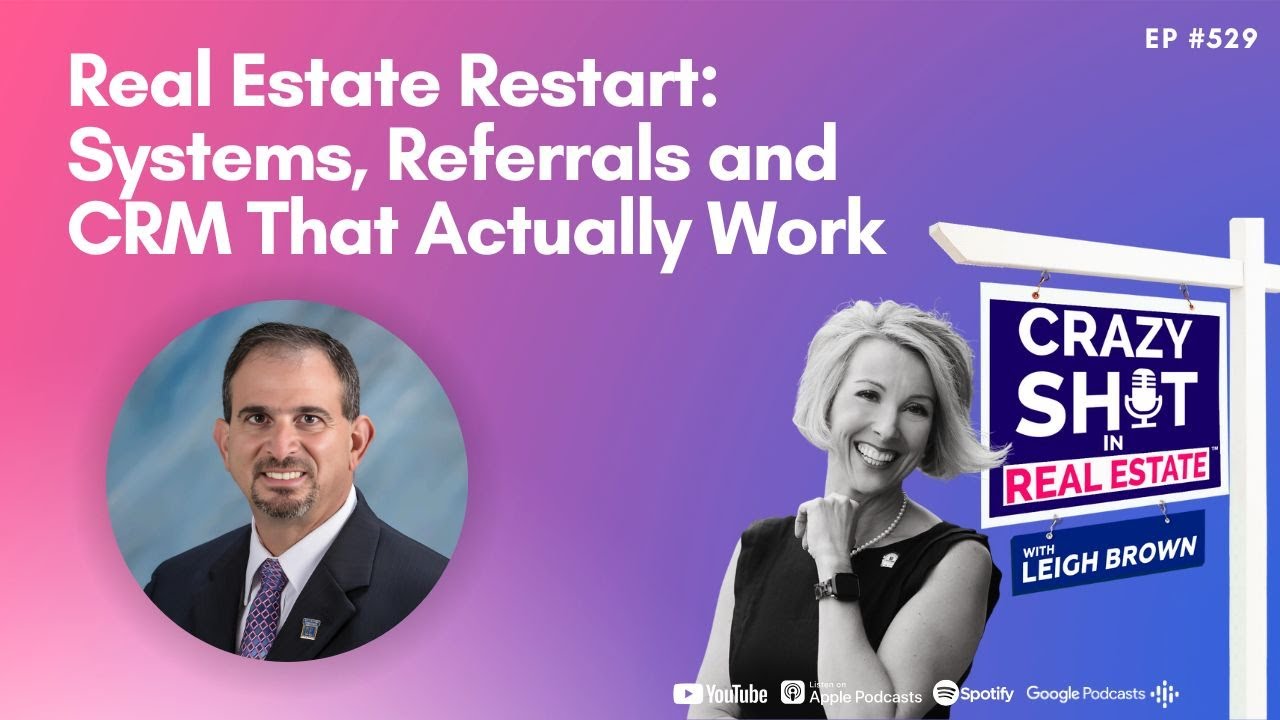
In this long‑form interview, host Leigh Thomas Brown chats with veteran realtor Bob Persisepe about his 40‑year real‑estate career, his move from upstate New York to Southport, North Carolina, and how he rebuilt his business from scratch. Bob recounts his deep involvement in REALTOR® leadership (NYSAR, NC Realtors, Leadership Academy), his role in local coastal policy (the Terminal Groin Project and school‑calendar alignment), and the political advocacy work that connects realtors with elected officials. The conversation then shifts to practical systems: cleaning and maintaining a saleable database, choosing a CRM, disciplined prospecting (15‑call daily rule), referral‑building, and transitioning a book of business when relocating. Bob shares concrete tactics—birthday/anniversary reminders, “platinum” referral clients, and the importance of phone calls over technology. Leigh promotes his new coaching platform, Answers.RealEstate, and both encourage listeners to connect, refer, and support each other in the industry.
Chapters
I'm Leigh Thomas Brown. This is Crazy Shit in Real Estate. Today I've brought you Bob Persisepi, and no, you can't spell it, but it's okay because all of his information's in the show notes, which you can go to as soon as you enjoy this really fun conversation. And he'll answer that question that's so eternal. Can you really change markets in real estate, especially if you're a Yankee moving to the South? Enjoy the conversation and I'll see you on the other side.
How are you doing?
I'm fantastic. I hope you are.
I am. It's a beautiful day on the beach. Thank you.
Let's see, what do we have? We have 83 degrees here and it's really nice and sunny outside.
It's warm here on, on the, in Southport. It's been, it's been really nice. I'm really enjoying this weather.
I love Southport. Steve and I need to come back to our favorite little Airbnb down there because Southport's the coolest little town.
It is. And you know, we, we're in the thick of it here. I mean, Debbie and I literally are in the thick of it and she gets mad at me when I say this, but I'm like, yeah, stop by anytime. We live in the greenhouse. I'm like, the greenhouse? Yes, we live in a greenhouse. If you can't find our house, you probably shouldn't be driving in Southport.
So let's see, you know that little coffee shop that has, um, it's like a restaurant and coffee shop. What's it called?
Um, the Port City Java?
No, no, no, that's the chain. It's independently owned place. Um, they have like a whole from scratch, farm to table kind of a mindset. Oh, let me see. Judge, we could walk to it out of our Airbnb like it was, um, oh gosh, Moore Street Deli?
No, little place on Moore Street Deli.
Let's see, Southport. Let's see, coffee. It was real good. It's not Southport Coffee Co. Hmm, I bet if I could think of it, you'd know what I was talking about.
Oh, I'm sure.
It's not— it's not that big a place.
There's Cafe Koya.
Oh yeah, that's the one.
That's the place. Yes. Yeah.
Yeah. It's like right outside the Airbnb that we like to stay at because we could, we could scoot right through to it. It's wonderful.
Yeah. Yeah. You're probably staying on Nash Street right by the water tower.
I don't know. It's very, it's very inexpensive, little hidden place. We could walk to everything. I could run from there because I like to have a place where I can go run easily.
Yeah. Yeah.
Yeah. Okay. Look, so see people, that's how you know where you travel based on the restaurants, not based on anything else. So that's, That's right.
That's right.
How this realtor travels anyway. All right. So, Bob, you got to tell my listeners, who is Bob Persisepi? Where are you now? How long you been in real estate? And you can also give them the where are you from? Because that's part of your whole story.
Hey, I'm Bob Persisepi from Southport, North Carolina, coastal, southeastern coastal North Carolina. So we're like further south as far as you can go in southeastern North Carolina before you get to South Carolina.
Oh, you're north of Ocean Isle and Sunset Beach.
Yeah, just north, just north of Ocean Isle, Holden Beach, that area. So, but it's kind of at the lower part of the state. I'm the broker owner of Blue Chip Real Estate in Southport. We're a virtual boutique office. And I'm also the owner of Homelendia Mortgage American Dream. We're a, we also own a mortgage company.
Oh, I didn't know that. Yeah.
I've been in, been in Southport for, 15 years. You know, started here right from the beginning and my story's a little crazy. Debbie, my wife and I have had a crazy story about how we got here and how we started over here. And after being in real estate for 25 years in upstate New York, I've been in the business, like, I hate to say it this way, but like 4 decades. Literally.
Are you going to get Realtor Emeritus soon?
Oh yeah. Oh yeah. Well, maybe not. No, because I did not become a realtor until 1994. I was one of those guys that worked outside. I worked for a company where I did not have to be a realtor, never saw the value of it, believe it or not. And here I am today, heavily engaged in our local association and our state association. But I did not become a realtor member until '94, and I I was in the real estate business for about 8 years before I—
Look how heavily engaged you are. I have your installation on my corkboard.
Oh, that is hilarious. That is so funny.
Yeah, you're on my corkboard.
And I appreciate you. I appreciated you when you came down for that. That was where I started to get to know you and I appreciated that so much.
Great way. So 40 years of real estate, but 31 years of Realtor life and 6 years, 7 years of hardcore volunteer service, partial volunteer service before that, but hardcore.
Actually, I was quite engaged in New York State Association of Realtors when I was there. I was very engaged in New York State.
I didn't count NYSAR, Bob. They don't count. North Carolina Realtors. NYSAR is a dim, foggy imitation of North Carolina.
I agree with you. And if George is listening to us right now, he'll probably agree as well.
Oh, and Andrea might make Duncan listen to this because she'll be like, see, I told you.
Yeah. Oh, I remember when Duncan was hired. Uh, actually, George Waneka and I, we went to Leadership Academy together.
Oh, that's how long ago. Isn't he older than you?
Uh, George's quite a bit younger than me.
Oh, so you just don't look as old as George does.
Oh yeah, George looks old. Yeah.
And the thing is, you talk about George Jr., that is George Sr. is obviously older.
Oh, I'm talking George But George Jr., so you are older than George Jr.
I thought y'all were, I thought he was older. George, don't be hurt.
It's just, I hope I'm not hurting your feelings, George.
I hope Laura's listening to this and laughing hysterically, which I think might be happening. So anyway, carry on. So you were heavily involved at NYSAR, went to Leadership Academy. What was that like? Why did you do Leadership Academy in New York?
Um, you know, I was a president of my local association there. I was moving up the ladder at the local level. Um, And I was pretty engaged in my local association in Northern Dutchess County, which is, you know, like in the Hudson River Valley. And I just saw the need and the value to be part of that. And there, you know, it was a crazy era, you know, leading up to that. The world was in a weird place, you know, and I just felt that it was a good place for me to be. I was pretty involved in government affairs there, and I later became involved, of course, here in North Carolina when I came here. So it was just a very natural evolution for me. And, um, I, I've enjoyed it all.
So what did you specifically get out of the leadership program? I mean, in addition to lifelong friends like George, because you— it's so hard to characterize how valuable those, those friendships are. They're more than professional relationships. You actually get to know one another's families and you do life together. It's a, a beautiful thing. But what else came out of leadership besides your friendships?
Oh, I, well, I, I learned a lot. I can tell you that. I had been in the business for some time, you know, and I had been a realtor for some time before I jumped into Leadership Academy. And you're right. I mean, met so many wonderful people and just, you know, we're still all buddies and friends and, you know, do things together. And I have this little mini vision of having a Leadership Academy reunion in May when we go to NAR meetings and, in, in, uh, DC. Um, and there will be one or two of my classmates that will get together for, you know, adult beverages or whatever. Um, but I pulled so much out of Leadership Academy, uh, like that I use every single day, even right here in my local association in Brunswick County, uh, in my service, service with NC Realtors. Um, uh, RPAC, Government Affairs, you name it. I mean, the foundation all started there, particularly with governance and even the simplest things of running a meeting, whether it's a committee meeting that's quite casual, running a board meeting in your local association with 10 or 12 folks, or even in a committee meeting at the state level where things are bigger and lots of dynamics. I learned all of those fundamentals at Leadership Academy. It was a really good experience, even though it happened in New York.
I mean, obviously all the New York stuff lands down here anyway, so we may as well find the good part.
Eventually it, I call it the, you know, the North Carolina trickle-down theory.
Well, the moving truck come down full and go back empty almost every time.
That's right. That's right.
You've said government affairs multiple times, whether you're dropping it into the NYSAR leadership side or what you've gotten involved with in North Carolina. As we both know, most realtors don't have the foggiest idea that there is a political side to real estate. And if there is, a lot of them say, oh, I don't want to do it. I hate politics, blah, blah, blah. When you first got exposed to what we do on the policy side, where we're working with local governments, state governments, the federal government, what was the biggest surprise to you of the things that you learned right out of the gate?
Oh, how effective it is, really. The advocacy helps. It works. I was particularly impressed, especially here. I mean, I had some great, great relationships in New York as well, and it's been a long time, but I am amazed at how easy it is to stay in front of our elected officials and how much they want to hear from REALTOR® members. You would think that it would be completely the opposite, but I will tell you The realtor voice is strong even here in little old Brunswick County. We're not a very big county, but our elected officials are— my gosh, they are so easy to work with. They're so reachable. I stay in very close contact with both of our legislators here, our local senator who's heavily engaged at the state level as well, of course, and several county commissioners. I, you know, I can pick up the phone and call any of them. And I see them often. So, um, they love the interaction with the realtor community in Brunswick County. And I'm seeing it more and more across the state, which is really, you know, kind of cool. And being kind of the new kid on the block, this kind of shocked me. Um, you know, cause I am kind of the new kid on the block in North Carolina. I am. And it is kind of interesting to me that The same stuff happens all the way across the state. You know, our state political coordinators, they can all pick up the phone, call our elected officials, get in a personal conversation and say, hey, this is a challenge we have in our local market, or is there anything I can do for you? And we sometimes forget to ask that. Is there anything we can do for you? Those relationships really impress me. They do. And I enjoy it and I appreciate it.
Well, and I would just say to all the listeners, you don't have to be a REALTOR® to build those personal relationships with your elected officials. And Bob has given you the best advice ever here is that you reach out and just check on 'em because they're doing really hard jobs, especially right now. They're in the flurry of bills and debates and hearing from whatever specialty you're in can give them some insights they may not have otherwise. And in real estate, we know if our legislators have 240 bills on their desk, If they're not in real estate, how else would they understand the perspective of property rights if we don't bring it forward? Now you talk about the things that are effective. You were already in Brunswick County when the Terminal Growing Project got started, right?
Oh, oh yes. Oh yeah. Yeah.
Because to me, that is one of the shining star, excellent wins we've had in a local area to improve the environment and the building, the development, the community. All of those pieces, and the realtors were an integral part of that. And can you just explain to our viewers and listeners very briefly what the Terminal Groin Project is and how it came to be? Because it's a wildly important coastal issue.
Yeah, well, there's lots of— the Terminal Groin issue was, you know, specific to maintaining and nourishing and keeping up the one thing in tourism that you have to have if you're in a beach community, and that's let's make sure the beaches stay intact, you know, and those projects were big and massive and required, you know, funding. And the terminal groin one was really big, specifically in our Ocean Isle area and Sunset Beach area, which are big tourist markets, you know. And of course, right now, the one thing we're working on that we have to maintain is the school calendar. Now, people think, well, why would realtors care at all about the school calendar.
Because this realtor has a beach house.
That's right. And you know, we have the— If there's uniformity in our school calendar where North Carolinians all have the same calendar, people vacation in the mountains or they vacation on the coast, the uniformity of that calendar determines whether or not they have a truncated season or not, or maybe an extended season. So look, we had a longtime member who passed away last year that was very involved in that 20 years ago, and his daughter is an incoming NC REALTORS® president. You know, Buddy Rudd was very instrumental in putting that all together, and we have to keep that calendar together. It's critical to the economic maintenance of this county.
Well, and we should also point out it's not just the vacationers, it's the workers.
I mean, and the workers that, that part I just overlooked, need to be able to show up and work throughout the season.
And if your school calendars don't match, then you might be missing out on some young people who need to be working. Let's be honest, they need to be out there earning a living.
Very true.
It's very true. It's a definitely an ecosystem that's wildly important to the state because tourism is one of our top economic drivers in the entire state. Plus we are right there at South Carolina. So what happens here has a bleedover effect into South Carolina. And it's, it's, it's a bigger deal than people like to think about. And it seems so silly. Why are we worried about school calendars? Well, it's because different parts of the state, in a state that if you drive from Murphy to Maneo, you're talking 8.5 hours, there's a lot of different issues that occur across the state. That's so interesting that you say that, Leigh, because, you know, I have to add in something here about Brunswick County that people don't know, because you're in a beautiful town. It's historic in Southport, y'all. If you've not been to Southport, you have to go. It's amazing. My beach house is at Ocean Isle. That's our retirement income one day. Brunswick County, where those beautiful beaches sit, is one of the poorest counties in the state. And the reason it's poor is because the money rushes in in May, June, July, and part of August, and then the money rushes back out and the year-long residents don't have a 12-month economic engine. They're having to crush the bulk of their income into those summer months. So when we mess with the school calendar, we're actually messing with people's budgets all year long. And it's just one of those impact things. I don't know, we talk about it enough, Bob, because people think Brunswick County's rich, but I've done a lot of work with people in Brunswick County that are not wealthy and—
Yeah, it's, it's, well, it's a challenge across the state for sure, Leigh, but, um, we're impacted by it and you brought up, you know, young people that work in, you know, college students, you know, 2 weeks of extra work in the summer for a college student is a big deal. But think about the business owners, you know, the business owners that are in food service, the business owners that are in tourist related You know, ancillary businesses, their season is short. They bank on a really, you know, very small timeline in order to generate their revenue. Look what happened in Western North Carolina during your guest a couple of weeks ago during leaf season. Cut right, you know, just decimated. So, uh, we appreciate folks that come to tourist and spend their, spend their time in Brunswick County and all along the coast because eventually those folks become buyers.
Like you. So did you and Debbie, did y'all vacation in Brunswick County before you moved down from North Carolina, from New York?
How'd you— yeah, we, we did. Um, we actually, uh, spent a lot of time in the summers here when we were— before we were even— the concept of moving into North Carolina was something we were even remotely considering. We spent a lot of time in Oak Island and Southport. And I mean, like, late '90s, like, I don't even know if we were married at the time. It was a long time ago. Kids in college, kids in high school, you know, we were just juggling that whole life. And Oak Island and Brunswick County in general became our, you know, dream place to be. And then a series of events that happened in the craziest way. You talk about crazy shit in real estate. Our story about how we got here is just beyond weird. And, you know, and I try to explain it and think about it and, you know, I look back 15 years ago how this all evolved. It makes me realize more and more every day, God protects stupid people. No question about it.
Well, they say he protects drunks and little children. So you're saying the Lord protects drunks, little children, and stupid people?
Stupid people probably should be on top of that list because, yeah, yeah. But our, our story was, was bizarre. Mathematically, we could have never orchestrated it to happen as perfectly as it did without some type of godly divine intervention because the way that it happened was, was, was crazy.
So what year was it that your transition started?
Well, it actually went back, if you can believe it, in, during the recession, actually in '08, we were like every realtor in the country, we were struggling. You know, I had a real estate business there for many years. I was really dug into my marketplace there. You know, I was very engaged in a business. I was a younger man and, you know, Debbie and I had always had in our heads that, you know, when the kids are out of high school or out of college, We gotta get outta New York. We really do. And then the, you know, for every reason you can imagine, the, the economics of living in the area that we lived in, south of Albany, New York, were, were crazy. I mean, it was not sustainable. And we recognized this some time ago. And then along comes the recession and my business was like just decimated and slowly rebuilt it in '09. And actually in '09, one of the best years I ever had in real estate. But lo and behold, we had made a decision as our youngest son was getting out of, we have 5 children, 5 boys. And as Mitchell was, you know, getting through high school and getting onto college, we started kind of toying with the idea. And Debbie was, and you've met my wife and she's awesome. She's not just a woman of character. She's She is a character. Yes, she is a genius.
Smart as shit.
Yeah, she is smart. And, um, you know, I always say I don't have to be that smart because Debbie's plenty smart for both of us. But, um, we were kind of bouncing this idea around and well, her company that she had been working with, she's was involved in, she's worked in the nuclear industry, which has a roster of employees, you know, teeny weeny. And she got laid off from her job, and she actually had a buyout from her job where they were like downsizing and eventually closing the nuclear plant that she worked at in New York. And she took a job at working for a civil engineering firm for about a year and a half, which she hated. But the seed was planted then. 2000, late 2009, Craziest story ever, I think. You know, I came home from work one day. It was a long day at work. I come home. There's one light on in the house. I pull in the driveway. We lived in like a little rural community. There's one light on in the house and there's little Debbie, you know, in the attic and she's cleaning out the attic. She's pulling all this stuff out of our attic. And, uh, I said, what's going on? And she said, um, we're moving. And I said, I wasn't aware that we were moving.
Right.
Um, did you get a job that I'm not aware of? And she said, no, but we are moving. And she had put out a couple of feelers in her industry, and the criteria for her headhunter was like, it's gotta be in the Carolinas and it's gotta be near water. That was it. And it's gotta be in the nuclear industry, which that kind of narrowed things down to basically one facility in southeastern North Carolina. And it happens to be in Southport and it happens to be with Duke Energy. At the time it was Progress Energy. So, you know, that was a joke for me because anybody who works in the industry that Debbie works in knew that the nuclear plant in Southport, literally somebody had to pass away for you to get a job there. And it was literally like that. So fast forward a few weeks, we're sitting down in the Keys on a beach on vacation, enjoying the time. Our phone rings and, and I'm watching her chat with somebody on the other end and she hangs up the phone and she said, I just got a job offer at Brunswick Nuclear. In Southport, North Carolina. And, uh, like, I spit my beer across the, you know, the beach, and I'm like, really? And she said, yes, I'm interviewing next week. It just blew me away. We go up to Southport.
She went to a job, basically. So she starts packing and then she has a job.
She was packing, you know, you talk about a woman of vision. She was packing. Weeks before, months before. Yeah, this was even, even a, even a very brief concept. So, uh, crazy shit. So we get home, she goes back down, interviews a week later, has a second interview. 5 weeks later, we are in our new home in Southport. We didn't have a home. We, we were homeless. I mean, literally homeless. And at the same time this is happening, we had to sell our home post-recession. Things were pretty bad. I was, you know, involved in a very, very engaged real estate business. Had a huge book of business, had an inventory, had all the stuff that goes along with your real estate business from day to day, you know, people on my team, everything. And we're packing up and moving and there's a moving van in our driveway 5 weeks later. And, you know, by grace of God, she found a rental house for us in Southport. It, it was just insane. The day that the moving truck was in our driveway was the installation for me as the president of the, of the Dutchess County Association of Realtors. So literally the moving van's pulling out of the driveway, that big United tractor trailer in a snowstorm is pulling out and I'm putting a tuxedo on with Debbie and we're going to my installation at the Dutchess County Association of Realtors.
Did they know you were moving or no?
No, they didn't have a clue.
Did you feel guilty?
Horribly. Horribly. And I burned up a car that year. I commuted nonstop between North Carolina and New York, back and forth, countless amounts of times. I had one foot in Brunswick County, one foot in Dutchess County. You know, this was really before we're as virtual as we are today, you know, and just an absolute crazy year. But what made it even crazier is I needed a little thing in North Carolina that I hadn't really even given a thought to, and that was I didn't have a real estate license.
Well, that's what I was fixing to ask. You're doing all of this and all you have is a New York license, but you're physically moving to North Carolina and we didn't have online licensing back then.
No. Oh, it was. And New York and North Carolina do not have reciprocity, obviously. So, uh, that made things even more complicated. Oh, and did I mention I'm a Yankee?
And there's a lot of y'all in Southport though, but maybe more now than there were then.
Yeah, it was, it was, that was a, that could be another story of crazy, crazy shit. But, um, I had to start a business over here and I only really knew how to do one thing and that was sell real estate, an entire career in real estate. I only really knew how to do that. So that's what we did. And it turned out to be so fortuitous. I mean, everything that developed was definitely had God's hand on it because I'm not smart enough to orchestrate that chaos. You know, there's just no way. And Debbie was just We'll just figure it out as it goes. What else are we gonna do? You know, let's just figure it out as we go. I was in my office in New York and I shared an office with a, with a, um, with a colleague of mine that I had known for many, many years. We shared an office and, uh, two big dynamic personalities in a 10 by 10 room, you know? And, um, when Debbie called me, uh, to tell me, well, I got the job and we're moving. I sat back in my chair and I hung up the phone and I said to Leigh, I said, well, it happened. She said, what happened? We're moving. We're going to North Carolina. And within 10 seconds, Leigh said to me, what are you going to do with your book of business? And we hammered it out. We hammered out an agreement. In a matter of 30 seconds, we hammered out an agreement between her and I on how to do that. And now you got to keep in mind, you know, a book of business. I've always taught, coached, mentored people. You know, there's 4 things you should be doing in real estate, but one of the top 4 things you should always be doing in real estate is building, maintaining, and nurturing a saleable book of business. And the key word there is saleable book of business.
How, how, how clean was your database there, Trainer Bob?
Pretty good. Not through anything of my own making, because Debbie, during the interim period of time when she was kind of in between engineering jobs, she became the CRM Nazi, and we cleaned up that book of business. I mean, birthdays, anniversaries, anniversary of their home purchase. And I had a book of business that was— it wasn't just a book. I mean, it was a Bible. It had over 800 people that I had worked for at multiple levels. And keep in mind, when I was in New York, I didn't sell very many just, you know, plain Jane single-family residential homes. I sold a lot of multifamily homes. I mean, thousands of them. That was my niche. So those are folks that were small investors that had 2-family, 3-family, 4-family houses. They were very, very popular in my market. So we had a huge book of business, and I literally was able to take that book of business and hand it to Leigh Thomas Brown Brown. Well, I didn't hand it to her physically, actually. I mean, I handed it to her in a database,. And I said, well, if you do the following things, you should get about 20 to 25 deals a year out of that book of business without too much work. If you just, you know, follow the mail call, see Floyd Wickman always taught us mail call, see, I'm a Floyd Wickman guy.
Sweat hog.
Sweat hog. I am a hardcore sweat hog. But Floyd always said, you know, mail people every month. Visit once a year, you know, see them once a year, call them once a month, you know, and I still do that, you know, 35 years later.
Because it works.
Because it works.
It's not rocket science. It's consistency. It's two different things. Your wife is rocket science. You are disciplined in something else.
That's right. That's right. That's the best way you can frame it too.
So if you're in real estate and you're listening to this podcast or watching it and thinking, man, I need some more Leigh Thomas Brown answers in my life. Well, guess what, friends? I have a new program that is launching right now called Answers.RealEstate, where I will give you every bit of insight I have to help you grow your real estate business, help you better respond to consumers to provide a more excellent real estate experience, so that the next time you land on crazy shit in real estate, you'll have a better solution to whatever you ran into. Answers.RealEstate, there are monthly plans available. You will love it. Get your coaching, sign up with me today.
So, you know, that's, that's what we did. And, um, I'll tell you that, that agreement that I put together with Leigh Thomas Brown was so helpful because, um, we had to do a whole bunch of stuff in order to do that. I mean, you know, we had, I had a huge listing inventory. Um, remember the year we're talking about?
Yeah. Short sale world. How many of them were short sales?
Lots. Lot. We had lots of inventory, you know, and we had to go, we, we got in our car for 3 or 4 days, 5 days, whatever it was. And we went from homeowner to homeowner to homeowner. And I introduced Leigh and I said, you know, you may know Leigh because she's very recognizable in our marketplace. I'm moving. She's taking over my business. Do you have any objection? And of course everybody said yes. We had one person that did not keep their listing going with her, but that was simply because they made a decision to rent the house. Okay. Yeah, just a business decision that was disconnected from our relationship. And Leigh sold every one of those properties over a span of about a year, which by itself was pretty amazing. But our agreement was a 3-year agreement. So I was getting these little referral checks, you know, every time she put a deal together, every time she put a deal together, every time she put a deal together and That's what got me started here. That was, you know, that helped fund us, you know, and it was, again, it was definitely crazy shit.
So I'm totally using my Johnny Carson hat. I know what's being said in the comments right now. Bob, I've been in the business a long time. My database is a mess. Where do I find a Debbie? What do you tell people when they ask you how to clean up the mess that they have? Because let's just be honest, most real estate agents, if they have a database, it is really just a bunch of names and emails tossed in. It's an online Rolodex. They don't have birthdays and anniversaries. They haven't called these people in years. How do you clean it up? Where do you start? Can you hire somebody for that? Give them some counsel from you who lived it.
Well, I'm going to tell you very, very strongly, you have to be as personal with it as you can. And you're, you know, you know, how do you eat an elephant? You know, one bite at a time. It's going to take you a little while to do it. First of all, get yourself a CRM of some, some kind of CRM, whatever it might be. I mean, it doesn't matter what it is. You know, back then we were using Top Producer. Everybody had Top Producer back then. A little heavy, a little clunky, but it worked.
Way too expensive. So Wise Agent, Contactually.
Yes. Go get, go, go. Yes. Go, go right to NC Realtors Partners. Okay. There, there's a dozen of them in there that you can choose from and they're all reasonable. They're all cheap. You're not going to do it without a CRM. Get a CRM.
And if you're not in North Carolina, by the way, check your own state's website because each of the state associations has some partnerships. Bob and I are just lucky that North Carolina Realtors has staff that are focused on making sure ours is really, really current. So just check your state website. Sorry to interrupt. Carry on. What's step 2?
I would say step 2 is, you know, it's like prospecting. You know, I know I have to call 15 people a day no matter what, 60 calls a week no matter what. It's the thing that drives my business. It's the foundation of my business. When you're cleaning up your database, you have to have that discipline. You've really got to do it. Hi, Mrs. Smith, do you remember me? I sold you a home. And by the way, you can't call up a consumer that you've worked for in the past and say, Hey, Joe, remember me? I sold you a house 5 years ago. Do you remember that really crappy job I did selling your house 5 years ago? Do you know anybody else I can do a crappy job for? You can't do that. You've got to have the relationships that you've had that were grounded, and then you have to go to the next level. Floyd always says, who do you know? Who you know? Do you know somebody else that I might be able to help and get them in your database? Every lead that comes across your desk, every inquiry that comes across your desk, every person that you have a casual conversation with, get them in your database. Those are lead sources and you can mature them, you can develop them. And by the way, everything else that you do in real estate is $10 an hour work. This is $300 an hour work. You know, I don't like to do $10 an hour work. That's why I own a transaction service company. I don't like $10 an hour work. I like $300 an hour work. And, you know, building your CRM, you will find that when you pick up the phone and call people that you've had relationships with in the past and say, I know this is a crazy question. When's your birthday? When's your husband's birthday? When's your kids' birthdays? What— when did you buy your house? Wasn't it June of 2012? You know, the anniversary card of the ownership of their home. It is so powerful. That's how you maintain those long-lasting Lifelong relationships with your clients. And, you know, if you take the time to build that database and build that CRM, you know, it doesn't have to be 800 names. It can be 75, 80. It doesn't have to be that big. My database right now is pretty big, but my platinum people, I've only got about 80. And keep in mind, I haven't lived here that long. You know, I haven't lived here long enough to really get too much repeat business out of folks, but build that.
You define your platinum people, by the way. How do they qualify for the top level of Bob's database?
People that refer me business. You know, if they're the weakest link and they're not referring me business, they get off the platinum list and they go down. Yeah.
You know, they're nickel people. They're not platinum. Yeah.
They're not exactly. They're not, they're not platinum. People that refer me business, you know. And any realtor who's been in business long enough can tell you who those folks are. You know, if they're referring you business at any level and you're getting something from them, look, those are the guys you want to send the Starbucks card to and say, hey, I'm just thinking about you. I was wondering how things are going. Here's a cup of coffee on me. Call me if you need anything. Always a pleasure. Click.
You know, or Port City Java. You said the local coffee shop. Come on, Bob.
That's right. Port City. It's my, it's my office. Port City Java is my office.
I mean, honestly, it's, it's a very pleasant place to hang out. All right. So they're going to have to get on the phone and call people. What do you say if you sold a house to somebody 8 years ago and now you're picking up and moving and you got to call them to clean your database up? How do you eat crow, Bob? What's your best advice on that?
Well, avoid it. You will be absolutely shocked at how people respond to you if you haven't called them in a while, especially when you start the conversation and say, I have to own this. I probably could have done a better job in staying in touch with you. I'm so sorry. I'm not going to let that happen again. You know, and lead up to it that way and make sure that, you know, 6 or 8 weeks later you do it again. You know, you can't just touch them and then forget them. You know, building and nurturing a database is something that takes time. It takes energy, but it's saleable. It becomes saleable. You know, I don't know when God's going to let me exit this business. But I will have another saleable book of business. You know, I know that, you know, um, I didn't plan it that way when I left New York. It evolved on its own and it had a life of its own, but it was just a crazy story about how it did happen. Um, but trust me, people, when you, if you're a listener and, um, you want to get anything out of this, just remember that don't be terrified about making a movement to a new partner, my realtor friends, because it's not that hard. If you've got a system and a process on how to exit, and then you've got a system and a process of how to restart, and that system and process to restart is 10 times easier than the system to exit. You know, I had a very simple system. When I came here, you know, I didn't know one soul. I mean, I literally didn't know one soul. I didn't, I knew where Main Street was and that's it.
All right. I mean, you were driving back and forth for almost a year, fulfilling your volunteer commitment. Where do you start in a market where you don't have old high school friends, you don't have family, you didn't have a former career there, your wife is in a new job too. So what was the first place you found some people?
All right. So there's going to be a lot of your listeners that are going to cringe when I say this. They will cringe because there's—
And you're going to say BNI?
No, no, BNI wasn't too friendly with me. They didn't like me.
Wait, why? Because you're Yankee?
Because I— Yeah, yeah, pretty much. I didn't talk like them.
Shame on them.
Yeah, shame on them. They missed out. I know. And no, I'm just kidding. But I am a sweat hog. And there's a, there's an entire 2 or 3 generations that don't have a clue what I'm talking about.
Go look it up. It's not on YouTube, but if you look on eBay, you might find somebody's old sweat hog materials because they're dead and their spouse is dumping them out.
I've got them right here in my desk drawer.
I've got the old Kennedy stuff, Howard Renton Star Power, buy all those.
That's right. Now you're talking my language, right? Yeah. You might see some Walter Sanford stuff in there. You might see, we're talking about way before the The Feenies and the Fairies. Okay.
Danny Kennedy was the, uh, quick speaking. I loved her.
Yeah. I saw her a couple of years ago at the Floyd Wickman event in Vegas, you know, and she's working with Floyd now. No, no. She used to come and do, she used to come occasionally and speak at his events.
Her book's around here somewhere.
Yeah. Oh, she was—
I don't get rid of any of this. Yeah.
If she's listening, she's probably, you know, like, what?
Hi, Branny. We love you. We know you.
She was, she's awesome. But I was in that generation, you know, and when I first came into the business, and I was not a very good salesman when I first came into the business at all. I was not very good at this business at all until I met Floyd. And then here we are, you know, all these years later, and I have become his biggest ambassador. I've spoken with him many, many times on stage. The last time was in 2015 at the Mastermind Summit. Which was just wonderful. But Floyd's retired now and he's, he's doing well, but he, you know, he, um, the foundational principles of what he taught me, because I sat at his feet for many years, they're timeless. They're timeless. And Floyd's thing was always call people, call people, call people, you know, call people you don't know. That was it. That simple. Call people, you know. So think about the year that I moved here. Okay. Just go back to the year that I moved here. A lot of expired listings.
Oh yeah.
Man, while I was picking them up, I listed 76 properties in that first year I was here.
Wait, in your first year? You didn't know anybody and you got 76 listings?
76 listings. 76 good listings. I mean, a good list. I wish I could get those listings now.
Yeah, I know. Me too. I miss those days a little bit, but I had 76 listings.
The broker that I was working for at the time, his assistant called me into the office and said, you know, he wants to speak to you, Bob. And I'm like, sure, why? He just come on in and talk to him. So I go into his office and it's somebody that we all know. And he said, Bob, I kind of knew who you were, but I've got to ask you this. Nobody, no single agent lists 22 properties in a month. And I was like, well, I'm going to have to disagree with you because number one, I did. And number two, let me tell you this, a trained monkey can list 22 properties in a month if you've got a system. And if you're afraid of the phone, your system's already broken down.
Oh, say that again. Now, whoo, that's true.
If you are afraid of the phone and let's remember, Leigh, that, you know, I'm the biggest fan of that younger generation that's coming up behind us.
You know, we'd like for them to buy us out. They are going to replace us and we welcome that.
That's right. I have spent the last Several years trying to encourage younger realtors, you know, I love your technology. I love the stuff that you guys do. And, you know, Danny Kinstall and I were very, very close and her and I disagree about a lot of things when it comes to technology, but she can't get her head around the idea that picking up the phone and cold calling, it's not cold calling, guys. It's not cold calling. It's calling people that are, they're begging you. They're asking you, please come help me. And you can help them because you're smart and you're trained and you know how to do it. You just have to introduce yourself and let them know that I'm here to help you. What can I do to help you? Floyd always says, you know, people don't care how much you know. They just want to know how you— that you care. They just want to know that you care. And the best way to do that is to pick up the phone and just say, can I help you? I'm not calling you to list your house. I'm calling to help you get in the direction you want to go. What can I do to help you? You know, anybody can list the house, you know, so I had a lot of time on my hands. So I just called a lot of people. That was it. Like, you know, and I'm a, kind of a nerd about calendar management, and that worked for me. I wish it would still work that way now. The world's changing a little bit, but that fundamental process is still in place. So, you know, if you're moving into a new market, yeah, you're going to have lots of different ideas in how to dig yourself into the new market. And there's probably a lot of technology that can help you do that. You know, whether it's your social media, whatever it might be, you know, but guys, nothing beats the phone. It don't work. If it does, I'm not aware of it.
Well, the truth of the matter is there's so few people willing to make phone calls. If you are the one who's willing to, you will stand out so dramatically nowadays. It is wild. And especially when I think about this whole idea of the expired listings, they're starting to come back as our markets are getting a little bit quieter. There's your chance, but you should also call the listings you do have and say hey to them. Don't let them expire. If they're able to get reasonable, don't forget 'em.
But Bob, I mean, I had, you know, I had a few experiences with local agents that got a little cranky with me. I didn't know them, of course, at the time. They got a little cranky with me. Who's this kid? Who's this guy? You know, gobbling up our listings. And I had to, you know, a few times say, hey, you know, it's a competitive business. And let me just remind you, if you were so in love with that listing, you should have protected it. Exactly. So that's fair. Let's, let's, let's be honest and let's be real and let's be friends. And, uh, and of course I'm friends to 1,600 realtors in Brunswick County.
Because that's good for our business that we can have good cross-sales, but reality is somebody's going to win. And you're already paying for the phones. You may as well use it.
Yeah. You know, it is, it's funny now here we are 15 years later. I mean, my competitors with offices in Brunswick County very regularly ask me to come and speak to their agents.
Oh, really?
I think that is the biggest compliment.
Absolutely it is.
I mean, to me, that's like, you know what, I would love to come to your office and talk about things that can help you grow your business. It makes us all better. We all get better, you know, and that's what makes real estate unique. We compete, we cooperate, and we love each other. And that's what I love about this industry.
And the best agents definitely have that attitude of abundance because there is definitely enough to go around for the ones that are doing the work. So Bob, if somebody wants to reach out to you about the Coastal North Carolina market, if they want to talk to you about leadership or about government affairs, or if they're in Brunswick County and they're curious curious about you, what's the best way for people to find you?
Go right to Google. Bob Persasepe, Blue Chip Real Estate. I have a funky name, but if you start it with P-E-R, you'll find me on Google.
Or just do Bob Blue Chip and I'm sure you'll find him.
Or Blue Chip Real Estate. You'll find me on Google. My name's a little funky to spell, but bluechiprealestatenc.com or just Google me. Easy peasy.
And it's all right here in the show notes for this episode. So just click on show notes, contact Bob, reach out, send him your referrals, ask him your questions. And Bob, thank you so much for all that you've done in New York and that you're doing now in North Carolina. And let's work together to make George and Laura move here because they would love North Carolina too.
I'm working on that. Thanks, Leigh Thomas Brown. Thanks, Leigh Thomas Brown.
All right, guys, hit the bell to subscribe, say something nice about Bob in the comments, and I'll see you next time.
Thanks, Leigh Thomas Brown.
By the way, friends, don't miss my brand new coaching program at Answers.RealEstate, where you can have access to Leigh Thomas Brown, submit your questions, have them answered, meet like-minded professionals, have an entire library to help you build your business no matter what happens in the market. Get signed up today. I promise you'll be glad you did. So if you found value in this episode, please like and subscribe to this channel. Turn on the bell. And catch another amazing episode by clicking above. Crazy Shit in Real Estate is also available on all of your normal podcast apps. So if that's where you like to hang out, go find me, click subscribe, and most importantly, leave me a review that says you think I'm awesome, my guests are awesome, or this content is just exactly what you were looking for. And then by the way, if there's something you need, you want to learn about something, You can comment below anytime. You can also send me a direct message if you need to remain anonymous. No judgment. But anyway, I'll only judge if you forget to subscribe and click. I'll see you next time.










