What Most Agents Get Wrong About AI (and How to Fix It) with Alejandra Teran
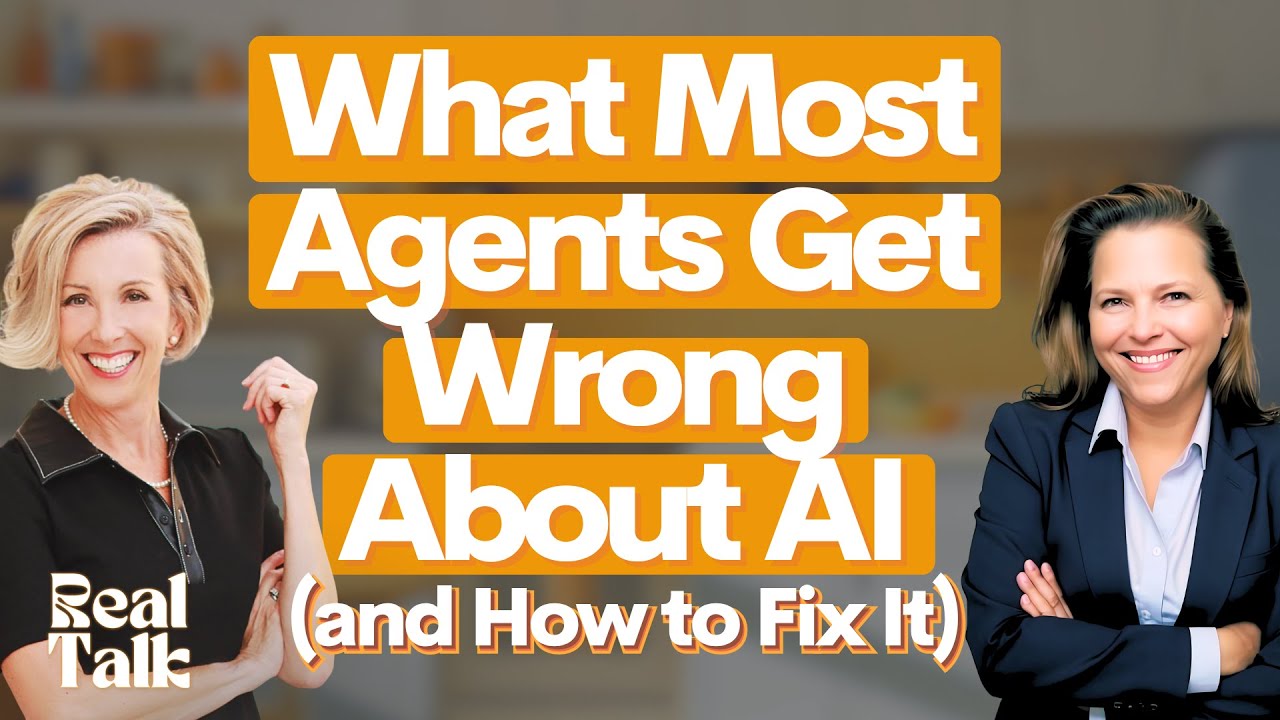
Alejandra Terán, an AI advisor with 25 years in corporate tech, breaks down seven concrete ways agents use AI wrong and how to fix it: building client personas, generating content at scale, automating chatbots, enhancing CRMs, analyzing contracts, coaching sales, and custom GPT assistants. She warns that AI hallucinates, reflects training data bias, and should supplement human judgment, not replace it.
Chapters
This is Real Talk with Leigh Thomas Brown. Today we're going to have a conversation with my new friend Alejandra Terán about AI. And yes, I still think it's a tool of the devil. And yes, I'm still using it in some ways in my business. And she's here to challenge me and provide some inputs and feedback on where real estate professionals and other entrepreneurs can start considering the space of AI in your business world. So enjoy this conversation and I'll see you on the other side. All right, well, I'm super excited to meet the Chief AI Whiz and find out a little bit more about who Alejandra is and what you're doing in the world. So welcome to the show.
Thank you, I'm excited to be here.
So give my audience a little bit of a thumbnail. Tell us where you're located, what you do in the world, and just a little bit of snapshot.
Well, I'm in sunny Miami, Florida. I'm an AI advisor, Leigh Thomas Brown, specialized in real estate, helping brokers and agents adopt AI to get the benefits of this amazing technology. So formerly a managing director at Deloitte, I spent 25 years in corporate, and I'm an entrepreneur, and like yourself, and real estate investor, and really excited to be here so we can talk about a little bit more about AI and what's going on in with this technology and how top producers and how folks are applying it in the field in real estate.
Well, I'm very interested in this because obviously everybody's trying to figure out what to do with AI, how much to let in. I don't like it personally because I think we give away too much of our power to it. But with that being said, I do know which tools I can use because I'm really thoughtful about that. And so I guess part of what I'm curious about is the degree to which you think the average agent should be looking at this. And of course, I know you're going to give us some tool recommendations, but when I look at the world of real estate right now, of course the markets aren't doing great because of supply issues, inventory issues, and then just general consumer confidence issues. So we have realtors that are operating in a bit of a panicky space right now, and then they're told that AI is probably going to replace them. So there's also that fear angle, and then they let AI in, in ways that maybe aren't helpful to them while simultaneously worried about it. And so it's a very strange environment that we're in. And of course, it's changing every day because as we continue to train the tools, the tools get better, which I think people forget that piece of it. But anyway, I'd love to know how you got involved in the AI side.
Did you—
were you an early adopter of it? Were you just watching it and you could see that's where the trend was going? Or did you internally just feel a need to give people a little more guidance in a world where there's very little guidance being offered?
I love the question. I actually got into the AI space in 2017, uh, when Salesforce CRM— Oh, early days. Yeah, Salesforce CRM launched Einstein, the, what we, what we knew about as AI prior to, you know, ChatGPT, which was really machine learning, you know, and it was very good at recognizing that if you watch a bunch of content, you know, with similar patterns, it will pitch you the next logical movie, right? Then, so I've been in the Salesforce ecosystem for 20-something years in tech and in leadership roles in technology. So when ChatGPT was born and came out in at the end of 2022, so when gen AI became mainstream, I immediately recognized we're in front of, you know, this is different. This is a, the kind of technology that really has the power to change everything. And so I went all in, all in on AI. And, uh, so since then, Leigh, I've, you know, basically trained myself, you know, put my, my grab and, and, and absorb as much content as I could. You know, I, I literally, you know, like most of it, because this is new. So train myself on AI, um, build, uh, courses on AI. I've trained over 400 real estate professionals and also business leaders, like from Fortune 500 companies like Visa. And so I, I developed agents, assistants, and things like that, automations, and Cumulative, I've had over 5,000 flight hours in applying GenAI to real use cases for my business and for my clients. So that's how I got into this. And I really think that we're now a once in a lifetime opportunity for our generation. And because it's going to really change everything, it's being built, it's becoming infrastructure. And so I love how you share your experience about AI. It sounds like you're more on the camp of being cautious about it and maybe a little bit fearful. Fearful, you know, there are legitimate things.
Oh no, no, I'm not fearful. I will just say it is a tool of the devil because when you, when you realize what it can do, you find that people will give it too much authority. And so you actually mentioned the difference in the language. The thing I don't like about the name being AI is that it can't be intelligent because intelligence is a human characteristic. But when you're talking about your 2017 work with Salesforce, you call it machine learning. That's what it is. And it's continuing to learn from us humans what outputs to give us. That's not intelligence, that's parroting back. And so what I'm concerned about, not fearful of, because I know that there's always a great winnowing out when we have new technologies that come through. I mean, we've seen it in, well, I'm old enough to have gotten an email address when they were brand new in 1993, and I knew how to break into the computer server at Duke University while I was at Carolina. And I didn't do anything unethical, by the way, but I was maybe looking at a guy's email. But anyway, when I knew how to do those things early on, different world now. And of course, email went from the penultimate tool to now it's become the, you know what, I'll just use it when I have to sign up for something. And people really have treated it as an old technology and as something that is dated, which is kind of fascinating to me. Whereas the telephone went from the only way we communicated to nobody using it. Now it's coming back because of issues with privacy. And so you have all these cycles that happen. But with AI, I think you're absolutely right about how it becomes infrastructure. I love that phrase. But if I look at the infrastructure of the building that I'm in, the foundation's not intelligent, but is it important? Of course it is. Is it integral to the structure of the building? Yes, has to be here, but it doesn't control the building, doesn't control its outcomes unless I allow it to.
All fair points. And I think what's different about this technology, Leigh, is that it has the potential to do what you just described. So it is, it's becoming infrastructure, meaning it's why it's becoming widely accessible, widely adopted.
Right.
Uh, but it is different from the, what we've known as infrastructure. If we compare it, for example, some people compare it to electricity. Electricity is the same electricity since it was invented, you know, the, the flow of power, whatever it is, right? Since Thomas Edison, uh, you know, uh, create, figured out a way to light the light bulb. It's just that it's everywhere and we don't even think about it until it's gone. But it's the same technology. You could argue the same thing with Wi-Fi. It's just maybe faster. And of course it's everywhere. You could argue the same thing about computers. Everything is powered up by a computer, maybe a little bit more of a change there or transformation. AI is different in the sense that every week we find out that it can do things that we didn't even think it could do a week prior, a month prior, a year ago, like building, you know, amazing hyper-realistic videos, uh, voices. I mean, more solving problems, coding. So it's, it's evolving much faster than anybody anticipated and it's constantly changing. And I think that's something very unique. And of course, generative AI, different to machine learning can create new things. I think that's a, that's a very important distinction between the two. So think of, you know, if we level set real quick with, with our audience that may, may not necessarily understand the, what's under the hood without being technical. Think of generative AI as a very, very smart chef that it, it can, it's trained on all the ingredients in the world, all the recipes ingredients in the world and it can create any dish that you want. And it has obviously a very fancy kitchen, right? And if we, in that analogy, think of your ingredients as your data, whatever you type into the box, you know, right? Help me write a better email, your prompts, the documents that you upload, all of that are, is the equivalent of the ingredients. The, the, the fancy kitchen are, are the algorithms, the computing power, the neural networks to process your, your, your, the order, right? Through the kitchen. Then the recipes are the models, right? We've heard about large language models. So these are, this is like the secret sauce, the Coca-Cola sauce, right? In, in the embedded into each of these models. ChatGPT has its model. Gemini has its model. So each of them have been trained. You pre-train on data and that's the P in GPT, pre-trained data. And then obviously the better the prompts and the better the ingredients, the better the dish that it can create. And it could be something entirely new and that's The beauty of the technology when you want it to brainstorm and think creatively out of the box, but it's also one of the conditions of it that we need to be mindful because it can hallucinate and make a bunch of stuff up and commit, and obviously, you know, it's prone to errors because it can create things. So it's a little bit different in the sense that, but it's definitely getting smarter, more autonomous. We're moving from using AI as a passive assistant. Right, where you ask, help me plan this trip, and it spits out an answer and stops. It's like Q&A to an agentic era where you can create an agent, give it a task like book my trip, and it will book the trip. It will stop at asking you for your password to log into the airline, or, and obviously to pass, you know, to pay for it, right? It's not gonna pay for you. It's also becoming more accessible. We talked about it becoming, uh, infrastructure. More affordable because the cost of these models to use it, like through the paywall, is, is going down drastically. So now for $20 a month, you, you can get access to Einstein, basically Einstein level of, of geniuses. Uh, more adopted. We talked about every company using it, but not every company realizing the ROI yet, right? So every, virtually every company's dumping tons of money on GenAI, but only 1%, according to a recent survey from McKinsey, are claiming to, that they're seeing the ROI. So that tells us that everybody's still experimenting and piloting things with AI. And of course, the technology is changing constantly and the private sector, the governments, everybody's dumping tons of money. It's become, it's now a national priority right now here in the, in the States. So consumers, businesses, governments, everybody's all in. And this is why we need to pay attention and figure out how to use it for our benefit, regardless of how people feel about it, I think there's one quote that for me really captures how we should potentially think about it now, short term, which is, AI is the new performance-enhancing drug that we should all be using today, right? What do you think about that?
Well, just as we found out how negative performance-enhancing drugs were on the human taking them and how it destroyed the level playing field, probably a pretty adept parallel there. But I would just— the thing that I watch on all of this is that there's a common phrase we've used in the data world forever, and that's GIGO, garbage in, garbage out. And so when you talk about the machine learning systems, it does actually matter who the humans are that are building the inputs and building the machine learning. And we've seen this— ChatGPT is, of course, the most visible example. Where it will espouse left-wing progressive ideals and it will act like it knows nothing about conservative ideals when we know that it knows, but it was programmed to not provide those outputs. And I was, I was really astonished this, I guess it was about a week and a half ago, I was reading a white paper about the resources that ChatGPT is built on. So where is it gathering its data?— well, also including from us who pay at $20 a month. Just remember, y'all, you're paying to give your information to make the machine stronger. So they're making money on you making them better. So just FYI, because we always trade our privacy and our data for tools, and we don't even pay attention to what we're doing. But anyway, I was reading this white paper and found out that 61% of ChatGPT's information comes from Reddit, which is the dumpster fire of the internet. And so if you're getting your information from the dumpster fire, of course there's really interesting threads on Reddit. I've learned a lot over there. I've gone there for advice on different plumbing ideas, and I've looked for recipe hacks. I mean, there's a thread for everything. But in addition to the very useful threads, there are really horrific, awful, terrible, hate-filled, lie-filled, just garbage over there. And so ChatGPT is filling itself with that, then You just always have to ask the question. And so I guess the way I look at it is you're right that it is growing in importance. It's everywhere. Every time my stupid phone updates, it throws more AI into more of my tools. And I'm thinking, stop telling me how to finish a word. I know how to spell, but that's because I'm a Gen Xer who knows how to spell. And I know the young people have been a little hamstrung in this because they're not learning spelling because they rely on this. So this increases their reliance, which makes it a more necessary infrastructure because now they have to have it because they've had it in the past. So it's almost a self-fulfilling prophecy. Now, all of that being said, I'm very curious about the real estate side because I know that agents are always looking for a silver bullet tool to make their businesses more effective, to be more profitable, frankly, to show off to their potential buyer and seller clients. Where are you finding the most reasonable and easy to adopt places that real estate firms and agents can start implementing AI, assuming they're not already using some kind of tool? Where should they start?
A great question. And, and I'll start just saying that I don't know if this statistic will surprise you, but according to NAR, to the National Association of Realtors, 28% of agents, uh, reported that are using AI, you know, according to their latest survey. Out of those, 9% are saying that they're using it daily. And so no wonder AI is the number one topic that, you know, we, we perhaps think that everybody's using ChatGPT, right? That is like common knowledge, everybody's using it. And, but the adoption's still not quite, you know, there in, in real estate, right? So there's, there's opportunity and, and there's also a narrow window, right, of of adopting it, of the first mover advantage for real estate brokers. So I think that the best use cases right now, I've tracked over 40 different use cases specifically for real estate, you know, from helping you develop and craft your, you know, think strategically about your business strategy, your marketing plan, you know, everything that has to do with business strategy to developing, creating marketing content, right? There's And that's a big bucket. That's an area where AI can help a ton. To, for example, how to go to market, right? Sales, engage clients or automate some of those client interactions using AI. To, for example, backend operationally, how to use AI to help you be, become more productive, to help you work smarter, like analyzing contracts and documents and things of that nature. So those are kind of the big categories. My playbook, what I work with and teach agents on how to apply AI includes, for example, I'll give you like the 7 things that we can double-click on any of these, uh, the one that gets your attention. But, uh, I think we using AI to start with building, if we, if we build the perfect picture of an ideal client profile or persona, right? AI is really good at that, at acting as a, you know, psychologies, you know, marketing strategies and help you craft something that normally you would have paid an agency to go and put a panel together and figure it out. What are you thinking? What are your fears, pains? What are your failed attempts? Uh, what are your objective needs and wants? So you can create a really good, uh, ideal avatar of who you're targeting. Is it international investors? Is it renters? Like, and what is really, what's the voice of the customer? Because we want to use those statements, right? Like, like as if you're standing in their shoes to craft the marketing strategy materials and all of that. So clear picture about who your customer is, who are we talking to, defining your marketing strategy and sales funnel. That's something AI can help you again evolve the, okay, now that we know who we're talking to, how do we reach these people? Where are they? How do we think about, you know, from awareness to conversion, crafting strategies and, and, and content that will resonate with them, right? With the investor or a lead magnet, whatever whatever it is. So then we now have to execute, right? Now that we have some ideas, okay, how do we put these, how do we translate these ideas into, in content pillars, into actual, you know, copy for the video scripts, for these and that, for the posts for Instagram. So creating the copy, uh, is another excellent way of using AI. Uh, so now you don't have to break your head about what to write and what to post, and you can get AI to actually will do it for you. And if you train it well, you can really make it sound, I would say, 90% there, you know, how you sound, you know, in your tone of voice and, and, you know, but you have to give it samples about this, this is how I talk, this is how I sound, these are the transcripts of my podcast. So you start training it so that it really puts an output that, that doesn't sound generic, but it sounds more and more like you. So That's number 3, standing out with marketing content, creating what I call an AI content factory, okay? Because not only you can create the scripts, but you can also execute by creating videos using your avatar, right? You can create your own avatar and now it's, you can have your virtual, your assistant, for example, creating a bunch of ton of videos every week without you having to record your own videos. I mean, It's a supplement. I'm not saying that it's a strategy where you're going to just do everything with the avatar, but it really helps kind of avoid the burnout of producing videos and scale your content production. So number 4, it would be automating some of those client interactions. Now that you put a ton of content out there, you want to exchange value for leads, for the contact, phone number, email. So you can use tools like ManyChat to automate that backend interaction, comment the word Leigh and, or, or real talk and boom, you get the guide, right? Automatically. Uh, and things like that. Then number 5 is you need to use a smart CRM. Many of the CRMs that realtors already use are being enhanced with a bunch of AI features. So look for the little star anywhere in any tool you're using because the star is no longer NASA and space. It's AI and that's changing every, every week. And then number 6 is use it to work smarter. Like I said, you know, to help you analyze contracts. On average, a realtor has to use, has to review like 10, 12, you know, documents per transaction, you know, from the offer to the inspection reports to the appraisal, blah, blah, blah. So you can use it to help you identify like clear, you know, red flags and things like that. Summarize information, not to replace obviously legal advice, but it's a great way of, you know, quickly getting answers. And number 7 is help you elevate your sales, your game with using AI as your coach. Okay. You know, you know how expensive it is to pay, you know, the coaches in the industry, the best of the best to help you come up with how to overcome objections, how to say this, how to say that. You need an accountability partner. You can use AI to help you with all of that.
Well, that's interesting. I hadn't thought about number 7 and there, I'm just thinking about, you know, the loss of Zig Ziglar because we lost him several years ago. Greatest sales coach of all time. If I can. Have an AI Zig Ziglar coach me based on what his books are, that might feel pretty good. As a broker, I'm going to tell y'all, please don't use AI to evaluate your contracts and repair inspection reports because if it misses something, you're still on the hook and so is your broker. So I would say that if you want to go that route, use it as a starting point to give you a couple of highlights, then read the whole report, read the whole paperwork. You cannot let AI take over the most important part of your function as a professional. I have to add that in, but let's go back to number 3, because I find that with most real estate pros, the hardest thing is implementation because they will get into that space of it needs to be perfect. It needs to be this, it needs to be this. I don't know what to do. I don't know what to say. And so they, they wind up in a. A real funk of not taking action. So what I will tell y'all is that AI can actually be your best friend ever when it comes to content ideas, but I want you to think of it as content ideas. And so when it spits something out and says, this is what an estate sale buyer wants in Miami, Florida, you look at that and start reading it because if you cut and paste it, we will all know that you used AI because you'll have the em dashes in it. You will see all little emojis jump up, which you can actually train it out of that too. But I want you to read it because the grammar can be off and the phrasing can be off. And so for me personally, I have so much content on the internet. I can ask it to write things in Leigh Thomas Brown's voice, and it's creepy how close it is until I read it carefully. And I'm looking at it thinking, uh, you got that colloquialism wrong. That grammar's incorrect. We don't end sentences with a preposition. And so I can start finding the corrections in it, which also forces me to take out this sentence, change this idea. That's not exactly what I would say and start modifying. But for many of y'all, implementation will happen when you modify instead of starting from scratch. So give yourself permission to start somewhere. And I love that you're giving them a really good roadmap, Alejandra, because I think that's what gets a lot of professionals stuck, especially in entrepreneur space where you're doing a thousand things simultaneously. You don't really have a business plan, but you need one, but you can't get it done because you're over here reading the inspection report. And then you didn't prospect because you were reading the inspection report and then the phone rang. And so you're talking to this person. So you were all over the place. So just think about this as some chunks you can start focusing on as you retain your personality and retain your genuine nature as a professional and what you bring to your community. Using AI as a supplemental tool. So with that being said, we're kind of running up on the end of our time here. I'm very curious to know, as a real estate investor yourself, what would you say to investors out there about the ways that they can use AI? Because my guess is that even as an investor, you utilized a real estate professional because your time is limited and a real estate professional can help with so much of the burden-carrying Where do we see the tools being helpful in that space?
The way that I'm, that I'm using it as an investor is to help me find projects. So I, I use a lot, you know, the search the web or deep, uh, search, uh, from tools like Perplexity and ChatGPT to help me find projects that meet certain, you know, characteristics, my criteria. And also once I find project to be able to quickly analyze, to get a first pass at the analysis, right? And I usually, I love seeing things in a table format. So for example, I would specify, okay, summarize all of these things for me and present it in a table format. So, and then once I get that, I use it to analyze the documents. So usually, you know, there's operating agreements and things like that that you have to read or the initial, I use it to give me the first pass and to flag things that would be unusual terms. And how to help me understand how could I potentially, you know, think about it or negotiate or mitigate this risk or whatever. So those are some of the ways that I use it.
I love that because you already know what you're looking for and it's just really consolidating your time. For those of y'all that are watching or listening and you're trying to get into investing, or maybe you're a real estate professional that wants to represent investors, you may want to use ChatGPT as a question an answer session of what do experienced investors look for? What data points do I need to know? What should show up in a table? So use it as an education tool, and then you can supplement that with classes like through the CCIM program, which is of course commercial real estate. That's the highest designation available. Then you bring a base of knowledge into your classwork, which will make it easier for you to understand the terminology. So you can serve people really well. And I do think the space of real estate investing will start to shift as the public mood against hedge fund investors continues to grow. I think our legislative bodies and our regulatory bodies are gonna start figuring out how to stop BlackRock from buying all the housing stock. So as they start to let go of some of their assets, there'll be a chance for mom-and-pop investors to add a property near them or help buy something that they can rent to the kids. And It'll be wise if everybody understood a little bit more about the language and how we can learn more about it.
Opportunities. Absolutely. And one more thing I almost forgot, but a trained GPT, which I actually have one in my team of GPTs or AI assistants, which is called Roy the ROI Wizard. And so he's trained to do an ROI analysis on a property. So once I find something that gets my attention, I will just use AI to help me analyze it, to help analyze the numbers, to see if they make sense.
Okay. So before I let you go, explain to the audience what the trained GPTs are, because when I learned that in a class, it was very much a "whoa" kind of a moment. And so now I go back to those trained areas and it's wonderful not to have to repeat myself because I don't like repeating myself. So explain that to our audience, if you don't mind.
A GPT is a version, a customized version of ChatGPT that is trained to, that you can train to do one task really well. And it's fairly straightforward to do it. You go to your ChatGPT, click with GPTs, create a custom GPT, and you give it certain instructions so that it can perform that task over and over and over, right? And you can upload documents so that it's trained on those knowledge documents. And it's very simple. And also there's a whole library, library of GPTs that, you know, people like me have created. You can go there, you can use a trained GPT already., for pretty much anything you can think of, right? It's a very useful, uh, piece of, of, of feature of ChatGPT.
And for those of y'all that are active real estate professionals, let me give you a, a sample tool of what I'm using all the time. There's a constant conversation around the National Association of Realtors about member benefits and is it worth it to belong to the organization? And I believe yes, but I still believe the organization has to do a better job selling itself to its members. That being said, every year there's research conducted and they produce this document called the Profile of Home Buyers and Sellers. It's every year. It's based on thousands of inputs from people who bought and sold real estate. So you'll get this document with over 100 pages with feedback. When you build a ChatGPT or build a GPT around the NAR Profile of Home Buyers and Sellers, you can upload that giant PDF and now it's got it. And now you can go through and ask it, what is the average age of a home buyer based on the 2025 survey? It'll spit the data out. What are the top places that home sellers found their real estate agent? Then you don't have to page through the whole thing looking for it. I gave the PDF to the system where now it can hunt and spit back, which helps me as I want to learn more data points, which serves my buyers and sellers as they try to understand real estate before they conduct it. So thank you for giving us that quick little lesson. And of course, all of those 7 inputs that people can consider. Now, Alejandra, I presume you're teaching on this somewhere. Are you providing this as a class to brokerages and associations?
I am. I have an AI masterclass for top producers. Sometimes I do live trainings as well. I'm a speaker and I also have the 15 real estate AI assistants or GPTs that I've trained on very common use cases for, for realtors, and they're all available in my website. If you go to academy.chiefaiwiz.com, so if anybody wants more information.
Perfect. So we will include all of the links to Alejandra's work in the show notes for this episode. So if you want to reach out to her, go click on her site, look at her offerings, and feel free to reach out with any questions. And you can also ask a question here in the comments on this episode. We will make sure that she sees them and can respond back. And in the meantime, y'all should say something nice about something you learned here or something that's going to cause you to look at your real estate business, maybe with a different perspective, but always with an eye towards how we can build and promote the American dream through the entrepreneurs who are active in the marketplace. Alejandra, thank you so much for coming on the show and giving us so much good actionable information.
It was a pleasure. Thank you for having me, Leigh.
All right, friends, hit the bell to subscribe. Make sure you say something nice in the comments. And most importantly, come back for more Real Talk with Leigh Brown. Now, if this episode brought you value, made you laugh, cry, or in between, then don't forget to subscribe, leave a 5-star review, and share this with somebody else in the real estate trenches. You will find Real Talk with Leigh Brown on every major podcast app, so hit follow And I'll see you in the next conversation. Don't forget to DM me if you've got a story. I might just want to feature you next.










