Why humans (not compute) are AI’s biggest bottleneck | Alexander Embiricos (OpenAI)
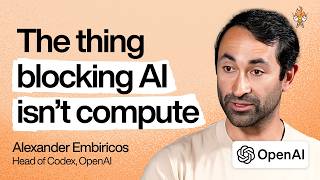
Alexander Embiricos, product lead for OpenAI's Codex, explains how the coding agent has grown 20x since August by integrating directly into developer workflows. Codex now serves trillions of tokens weekly and is reshaping how engineers work: the real bottleneck isn't compute, but human review and decision-making.
Questions this video answers
December 14, 2025
Reportedly over 10x and later stated as 20x since August.
GPT 5.1 Codex Max.
Serving many trillions of tokens per week.
Sora Android app: built an employee-playable version in ~18 days, 28 days to public launch, reached #1 in the App Store.
Chapters
Do lead work on Codex.
Codex is OpenAI's coding agent. We think of Codex as just the beginning of a software engineering teammate. It's a bit like this really smart intern that refuses to read Slack, doesn't check Datadog unless you ask it to.
I remember Karpathy tweeted the gnarliest bugs that he runs into that he just spends hours trying to figure out nothing else a solve. He gives it to Codex, lets it run for an hour and it solves it.
Starting to see glimpses of the future where we're actually starting to have Codex be on call for its own training. Codex writes a lot of the code that helps like manage its training run the key infrastructure and so we have a Codex coder of is like catching a lot of mistakes. It's actually caught some like pretty interesting configuration mistakes. One of the most mind blowing examples of acceleration, the Sora Android app. Like a fully new app. We built it in 18 days and then 10 days later, so 28 days total. We went to the public.
How do you think you win in this space?
One of our major goals with Codex is to get to productivity. If we're going to build a super assistant has to be able to do things. One of the learnings over the past year is that for models to do stuff, they are much more effective when they can use a computer. It turns out the best way for models to use computers is simply to write code. And so we're kind of getting to this idea where if you want to build any agent, maybe you should be building a coding agent.
When you think about progress on Codex, I imagine you have a bunch of evals and there's all these public benchmarks.
A few of us are like constantly on Reddit. You know, there's a, there's praise up there and there's a lot of complaints. What we can do as a product team, just try to always think about how are we building a tool so that it feels like we're maximally accelerating people rather than building a tool that makes it more unclear what you should do.
As the human being at OpenAI, I can't not ask about how far you think we are from AGI.
The current underappreciated limiting factor is literally human typing speed or human multitasking speed.
Today my guest is Alexander Embirakos, product lead for Codex, OpenAI's incredibly popular and powerful coding agent.
In the words of Nick Turley, head of ChatGPT and former podcast guest, Alex.
Is one of my all time favorite humans. I've ever worked with and bringing him and his company into OpenAI ended up.
Being one of the best decisions we've ever made.
Similarly, Kevin Weil, OpenAI CPO, said, Alex.
Is simply the best. In our conversation we chat about what.
It'S truly like to build product at OpenAI.
How Codex allowed the Sora team to ship the Sora app, which became the.
Number one app in the App Store.
In under one month. Also, the 20x Growth Codex is seeing.
Right now and what they did to make it so good at coding, why.
His team is now focused on making.
It easier to review code, not just write code, his AGI timelines, his thoughts on when AI agents will actually be.
Really useful and so much more. A huge thank you to Ed Baze, Nick Turley and Dennis Yang for suggesting topics for this conversation.
If you enjoy this podcast, don't forget.
To subscribe and follow it in your.
Favorite podcasting app or YouTube.
And if you become an annual subscriber of my newsletter, you get a year free of 19 incredible products, including a.
Year free of Devin, lovable, replid, bolt.
N8M, linear, superhuman, descript, Whisper Flow, Gamma.
Perplexity, Warp, Granola, Magic Patterns, Raycast, Chapbeard, D, Mobin, Post, Hog and Stripe Atlas. Head on over to lennysnewsletter.com and click product Pass. With that, I bring you Alexander Embirikos. After a short word from our sponsors.
Here'S a puzzle for you. What do OpenAI, Cursor, Perplexity, Vercel, Plaid and hundreds of other winning companies have in common? The answer is they're all powered by today's sponsor, workos. If you're building software for enterprises, you've probably felt the pain of integrating single sign on SCIM, RBAC, audit logs and other features required by big customers. WorkOS turns those deal blockers into drop in APIs with a modern developer platform built specifically for B2B SaaS. Whether you're a seed stage startup trying to land your first enterprise customer or a unicorn expanding globally, WorkOS is the fastest path to becoming enterprise ready and unlocking growth. They're essentially stripe for enterprise features. Visit workos.com to get started or just hit up their slack support where they have real engineers in there who answer your questions super fast. WorkOS allows you to build like the best with delightful APIs, comprehensive docs and a smooth developer experience. Go to workos.com to make your app enterprise ready today. This episode is brought to you by Fin, the 1 AI agent for customer Service. If your customer support tickets are PILING up, then you need Fin. Fin is the highest performing AI agent on the market with a 65% average resolution rate. Fin resolves even the most complex customer queries. No other AI agent performs better. In head to head bake offs with competitors, Fin wins every time. Yes, switching to a new tool can be scary, but Fin works on any help desk with no migration needed. Which means you don't have to overhaul your current system or deal with delays in service for your customers. And Fin is trusted by over 6,000 customer service leaders and top companies like Anthropic, Shutterstock, Synthesia, Clay, Vanta, Lovable, Monday.com and more. Because Fin is powered by the Fin AI engine, which is a continuously improving system that allows you to analyze, train, test and deploy with ease, FIN can continuously improve your results too. So if you're ready to transform your customer service and scale your support, give Fin a try for only 99 cents per resolution. Plus fin comes with a 90 day money back guarantee. Find out how Fin can work for your team at Fin AI Lenny. That's Fin AI Lenny Alexander.
Thank you so much for being here.
And welcome to the podcast.
Thank you so much. I've been following for ages and I'm excited to be here.
I'm even more excited. I really appreciate that. I want to start with your time at OpenAI. So you joined OpenAI about a year ago. Before that you had your own startup for about five years. Before that you're a product manager at Dropbox. I imagine OpenAI is very different from every other place you've worked. Let me just ask you this. What is most different about how OpenAI operates and what's something that you've learned there that you think you're going to take with you wherever you go, assuming you ever leave?
By far, I would say the speed and ambition of working at OpenAI are just dramatically more than what I can imagine. And I guess it's kind of an embarrassing thing to say because everyone who's a startup founder thinks, oh yeah, my startup moves super fast and the talent bar is super high and we're super ambitious. But I have to say, like, working in OpenAI just kind of like made me reimagine what that even means.
We hear this a lot about, you know, it feels like every AI company is just like, oh my God, I can't believe how fast they're moving. Is there an example of just like, wow, that wouldn't have happened this quickly anywhere else.
The most obvious thing that comes to mind is just like the explosive growth of Codex itself, I think it's a while since we bumped our sternal number, but it's like the 10xing of Codex's scale was just like super fast in a matter of months. And it's like, well, more since then. And, you know, like, once you've lived through that, or at least speaking for myself, like, having lived through that, now I feel like anytime I'm going to spend my time on, like, you know, building tech product, there's that kind of that speed and scale that I now need to meet. If I think of, like, what I was doing in my startup, it moved like, way slower and I, you know, there's always this balance with startups of, like, how much do you commit to an idea that you have versus, like, find out that it's not working and then pivot. But I think one thing I've realized at OpenAI is like, the amount of impact that we can have and in fact need to have to do a good job is so high that I have to be like, way more ruthless with how I spend my time.
Now, before we get to Codex, is there a way that they've structured the org or. I don't know, the way that OpenAI operates that allows the team to move this quickly because everyone, everyone wants to move super fast. I imagine there's a structural approach to allowing this to happen.
I mean, so one thing is just the technology that we're building with has just transformed so many things from both how we build, but also what kinds of things we can enable for users. And we spend most of our time talking about the improvements in the foundation models. But I believe that even if we had no more progress today with models, which is absolutely not the case, but even if we had no more progress, we are way behind on product. There's so much more product to build. So I think just the moment is ripe, if that makes sense. But I think there's a lot of sort of counterintuitive things that surprised me when I arrived. As far as how things are structured. One example that comes to mind is when I was working at my startup and before that when I was at Dropbox, it was very important, especially as a pm, to always rally the ship. And it was make sure you're pointed in the right direction and then you can accelerate in that direction. But here I think, because we don't exactly know what capabilities will even come up soon and we don't know what's going to work technically, and then we also don't know what's going to land. Even if it works technically, it's much more important for us to be very humble and learn a lot more empirically and just try things quickly. The org is set up in that way to be incredibly bottoms up. This is again, one of those things that, as you were saying, everyone wants to move fast. I think everyone likes to say that they're bottoms up, or at least a lot of people do. But OpenAI is like truly, truly bottoms up. And that's like been a learning experience for me that now, like, it'll be interesting if I ever work at like, I don't think it'll ever. It'll even make sense to work at a non AI company in the future. I don't even know what that means, but if I were to imagine it or go back in time, I think I would like run things totally different.
What I'm hearing is kind of this ready, fire. Aim is the approach more than ready, aim, fire. And there's something. And as you process that, because that may not come across well, but I actually have heard this a lot at AI companies is because you don't know. And Nick Charlie shared, I think the same sentiment. Because you don't know how people will use it, it doesn't make sense to spend a lot of time making it perfect. It's better to just get it out there in a primordial way, see how people use it and then go big on that use case.
Yeah, it's like, okay to use this analogy a little bit. I feel like there is an AIM component, but the AIM component is much fuzzier. You know, it's kind of like, roughly what do we think can happen? Like, someone I've learned a ton from working here is a research lead and he likes to say that, like at OpenAI, we can have really good conversations about something that's like a year plus from now. And you know, there's a lot of ambiguity in what will happen, but like, that's a right sort of timeline. And then we can have really good conversations about what's happening like in like low months or low or weeks. But there's kind of this like awkward middle ground, which was like as you start approaching a year, but you're not at a year where it's very difficult to reason about. Right. And so as far as like aiming, I think we want to know, like, okay, what are some of the futures that we're trying to build towards? And like a lot of the problems we're dealing with in AI, like, such as alignment, are problems you need to be thinking out, like really far out into the future. So we're kind of aiming fuzzily there. But when it comes down to the more tactically, like, oh yeah, like what product will we build and therefore how will people use that product? That's the place where we're much more like, let's find out empirically.
That's a good way of putting it. Something else that when people hear this, they people sometimes hear companies like yours saying, okay, we're gonna be bottoms up. We're gonna try a bunch of stuff. We're not gonna have exactly a plan of where it's going in the next few months. The key is you all hire the best people in the world. And so that feels like a really key ingredient in order to be the successful at bottoms up work.
It just super resonates.
Basically.
I was just like, again, surprised or even shocked when I arrived at like the level of like, individual, like drive and like autonomy that everyone here has. So I think like the way that OpenAI runs, like many. You can't like read this or be listen to a podcast and be like, I am. I'm just going to deploy this to my company. You know, maybe this is a harsh thing to say, but I think like, yeah, very few companies have the talent caliber to be able to do that, so it might need to be like adjusted if you were going to implement this.
Okay, so let's talk Codex. You lead work on Codex. How's Codex going? What numbers can you share? Is there anything you can share there also? Just not everyone knows exactly what Codex is. Explain what Codex is.
Totally. Yeah. So I had the very lucky job of living in the future and leading promise on Codex. And Codex is OpenAI's coding agent. So super concretely that means it's an IDE extension, a VS code extension that you can install, or a terminal tool that you can install. And when you do so, you can then basically pair with Codex to answer questions about code, write code, run tests, execute code, and do a bunch of the work in sort of that thick middle section of the software development life cycle, which is all about writing code that you're going to get into production. More broadly, we think of codecs as what it currently is, is just the beginning of a software engineering teammate. And so, you know, when we use a big word like teammate, like some of the things we're imagining are that it's not only able to write code, but actually it participates early on in the ideation and planning phases of writing software and then further downstream in terms of validation, deploying and maintaining code to make that a little more fun, One thing I like to imagine is if you think of where Codex is today, it's a bit like this really smart intern that refuses to read Slack and doesn't check Datadog or Sentry unless you ask it to. And so no matter how smart it is, how much are you going to trust it to write code without you also working with it? So that's how people use it mostly today, is they pair with it. But we want to get to the point where it can work. Just like a new intern that you hire, you don't only ask them to write code, but you ask them to participate across the cycle. And so you know that even if they don't get something right the first try, they're eventually going to be able to iterate their way there.
I thought the way I thought the point about not reading Slack in Dave Dog was it's just not distracted, it's just constantly focused. And this is always in flow. But I get what you're saying there is it doesn't have all the context on everything that's going on.
And, like, that's not only true when it's performing a task, but again, if you think of like the best human teammates, like, you don't tell them what to do, right? Like, maybe when you first hire them, you have like a couple meetings and you're like, hey, like, you kind of learn, like, okay, these prompts work for this teammate. These prompts don't, right? This is how to communicate with this person. Then eventually you give them some starter tasks, you delegate a few tasks, but then eventually you just say, like, hey, great, okay, you're working with this set of people in this area of the code base. Feel free to work with other people in other parts of the code base too, even. And yeah, you tell me what you think makes sense to be done, right? And so we think of this as like, proactivity. And like, one of our major goals with Codex is to, like, get to proactivity. I think this is critically important to achieve the mission of OpenAI, which is to deliver the benefits of AGI to all humanity. I like to joke today that AI products, and it's a half joke, they're actually really hard to use because you have to be very thoughtful about when it could help you. And if you're not prompting a model to help you, it's probably not helping you at that time. And if you think of how many times the average user is prompting AI today, It's probably tens of times, but if you think of how many times people could actually get benefit from a really intelligent entity, it's thousands of times per day. And so a large part of our goal with Codex is to figure out like, what is the shape of an actual teammate agent. That is sort of helpful by default.
When people think about cursor and even cloud code. It's like IDE that helps you code and kind of autocompletes code and maybe does some agentic work. What I'm hearing here is the vision is, is different, which is it's a teammate. It's like a remote teammate building code for you that you talk to and ask to do things. And it also does IDE autocomplete and things like that. Is that a kind of a differentiator in the way you think about Codex?
It's basically this idea that, like, we want the way, like, if you're a developer and you're trying to get something done, we want you to just feel like you have superpowers and you're able to move much, much faster. But we don't think that in order for you to reap those benefits, you need to be sitting there constantly thinking about, like, how can I invoke AI at this point to do this thing? We want you to be able to sort of like plug it in to the way that you work and have it just start to do stuff without you having to think about it.
Okay, I have a lot of questions along those lines, but just how's it going? Is there any stats, any numbers you can share about how Codex is doing?
Yeah, it's been. Codex has been growing like absolutely explosively since the launch of GPT5 back in August. There's some, definitely, some interesting, like product insights to talk about as to how we unlock that growth, if you're interested. But the last stat we shared there was well over 10x since August. In fact, it's been 20x since then. Also, the Codex models are serving many trillions of tokens a week now, and it's basically our most served coding model. One of the really cool things that we've seen is that the way that we decided to set up the Codex team was to build a really tightly integrated product and research team that are iterating on the model and the harness together. And it turns out that lets you just do a lot more and try many more experiments as to how these things will work together. And so we were just training these models for use in our first party harness that we were very opinionated about. And then what we've started to see more recently, actually, is that other major sort of API coding customers are now starting to adopt these models as well. And so we've reached a point where actually the codecs model is the most served coding model in the API as well.
You hinted at this. What unlocked this growth? I am extremely interested in hearing that. It felt like before. I don't know, maybe this was before he joined the team. It just felt like Claude code was killing it. Just everyone was sitting on top of cloud code. It was by far the best way to code. And then all of a sudden, Codex comes around. I remember Karpathy tweeted that he just has never seen a model like this. I think the tweet was the gnarliest bugs that he runs into that he just spends hours trying to figure out nothing else has solved. He gives it to Codex, lets it run for an hour, and it solves it. What would you guys do?
We have this strong sort of mission here at OpenAI to, you know, basically to build API. And so we think a lot about what, how can we shape the product so that it can scale. Right. You know, earlier I was mentioning, like, hey, like, if you're an engineer, you should be getting help from an from AI like thousands of times per day. Right. And so we thought a lot about the primitives for that when we launched our first version of Codex, which was Codex Cloud. And that was basically a product that had its own computer. It lives in the cloud, you could delegate to it. And, you know, the sort of the coolest part about that was you could run many, many tasks in parallel. But some of the challenges that we saw are that it's a little bit harder to set that up both in terms of environment configuration, giving the model the tools it needs to validate its changes and to learn how to prompt in that way. And so my analogy for this is going back to this teammate analogy. It's like if you hired a teammate, but you're never allowed to get on a call with them, and you can only go back and forth asynchronously over time, that works for some teammates and eventually that's actually how you want to spend most of your time. So that's still the future, but it's hard to initially adopt. So we still have that vision of that's what we're trying to get you to a teammate that you delegate to and then is proactive and we're seeing that growing. But the key unlock is actually first you need to land with users in a way that's much more intuitive and trivial to get value from. So the way that most people discover, like the vast majority of users discover Codex today is either they download an IDE extension or they run it in their cli and the agent works there with you on your computer interactively. And it works within a sandbox, which is actually like a really cool piece of tech to help that be safe and secure, but it has access to all those dependencies. So if the agent needs to do something, like it needs to run a command, it can do so within the sandbox. We don't have to set up any environment. And if it's a command that doesn't work in the sandbox, it can just ask you. And so you can get into this really strong feedback loop using the model. And then over time, our team's job is to help turn that feedback loop into you, sort of as a byproduct of using the product, configuring it so that you can then be delegating to it down the line. And again, analogy keep coming back to it. But like if you hire a teammate and you ask them to do work, but you just give them like a fresh computer from the store, it's going to be hard for them to do their job right. But if as you work with them side by side, you can be like, oh, you don't have a password for this service we use here's the password for this service. Yeah, don't worry, feel free to run this command. Then it's like much easier for them to then go off and do work for hours without you.
So what I'm hearing is the initial version of Codex was almost too far in the future. It's like a remote in the cloud agent that's coding for you asynchronously and what you did is, okay, let's actually come back a little bit. Let's integrate into the way engineers already integrate into IDs and locally and help them kind of on ramp to this new world.
Totally. And it was quite interesting because we dog food product a ton at OpenAI. So dog food as in we use our own product. And so Codex has been accelerating OpenAI over the course of the entire year. And the cloud product was a massive accelerant to the company as well. It just turns out that this was one of those places where the signal we got from dogfooding is a little bit different from the signal you get from the general market. Because at OpenAI, we train reasoning models all day and so we're very used to this kind of prompting and like, you know, think up front, run things massively in parallel and, you know, it would take some time and then come back to it later asynchronously. And so, you know, now when we build, we still get a ton of signal from dogfooding internally, but, you know, we're also very cognizant of, like, the different ways that different audiences use the product.
That's really funny. It's like, live in the future, but maybe not too far in the future. And I could see how everyone OpenAI is living very far in the future and sometimes that won't work for everyone.
Yeah.
What about just like intelligence training data? I don't know. Is there something else that helped Codex accelerate its ability to actually code? Is it like better, cleaner data? Is it more just models advancing? Is there anything else that really helped accelerate?
Yeah, so there's like a few components here, I guess. You were mentioning models, and the models have improved a ton of. In fact, just last Wednesday, we shipped GPT 5.1 codecs max, a very accurately named model. That is awesome. It is awesome both because for any given task that you were using GPT 5.1 codecs for, it's roughly 30% faster at accomplishing that task, but also it unlocks a ton of intelligence. So if you use it at our higher reasoning levels, it's just even smarter. And that feedback or that tweet you were saying Karpathy made about, hey, give us your gnarliest bugs. Obviously there's a ton going on in the market right now, but Codex Max is definitely carrying that mantle of tackling the hardest bugs. So that is super cool. But I will say it's like some of how we're thinking about this is evolving a little bit from being like, yeah, we're just going to think about the model and let's just train the best model to really thinking about, like, what is an agent actually overall?
Right.
And I'm not going to try to define agent exactly, but at least the stack that we think of it as having is. It's like you have this model, really smart reasoning model that knows how to do a specific kind of task really well. So we can talk about how we make that possible, but then actually we need to serve that model through an API into a harness. And both of those things also have a really big role here. So for instance, one of the things that we're really proud of is you can have GPT 5.1 Codex Max work for really long periods of time, that's not normal, but you can set it up to do that, or that might happen. But now, routinely, we'll hear about people saying, yeah, it ran overnight or it ran for 24 hours. And so for a model to work continuously for that amount of time, it's going to exceed its context window. And so we have a solution for that, which we call Compaction. But Compaction is actually a feature that uses all three layers of that stack. So you need to have a model that has a concept of compaction and knows, like, okay, as I start to approach this context window, I might be asked to prepare to be run in a new context window. And then at the API layer, you need an API that understands this concept and has an endpoint that you can hit to do this change. And at the harness layer, you need a harness that can prepare the payload for this to be done. And so shipping this Compaction feature that now just made this behavior possible to anyone using codecs action, working across all three things. And I think that's increasingly going to be true. Another maybe underappreciated version of this is if you think about all the different coding products out there, they all have very different tool harnesses with very different opinions on how the model should work. And so if you want to train a model to be good at all the different ways it could work, maybe you have a strong opinion that it should work using semantic search. Maybe you have a strong opinion that it should call bespoke tools, or maybe you have, in our case, a strong opinion that it should just use the shell work in the terminal. You can move much faster if you're just optimizing for one of those worlds. And so the way that we built codecs is that it just uses the shell. But in order to make that safer and secure, we have a sandbox that the model is used to operating in. So I think one of the biggest accelerants to go all the way back to your answer regression is just like we're building all three things in parallel and, like, kind of tuning each one and, you know, constantly experimenting with how those things work with, like, a tightly integrated product and research team.
How do you think you win in this space? Do you think it'll event. It'll always be this kind of, like, race with other models, constantly kind of leapfrogging each other. Do you think there's a world where someone just runs away with it and no one else can ever catch up? Is there, like, a path to just.
We win Again, comes back to this idea of, like, building a teammate. And not just a teammate that participates in team planning and prioritization, not just a teammate that really tests its code and helps you maintain and deploy, but even a teammate, if you think, again, an engineering teammate, they can also schedule a calendar, invite or move, stand up, or do whatever. In my mind, if we just imagine that every day or every week, some crazy new capability is just going to be deployed by a research lab, it's just impossible for us as humans to keep up and use all this technology. And so I think we need to get to this world where you kind of just have an AI teammate or a super assistant that you just talk to, and it just knows how to be helpful on its own. And so you don't have to be reading the latest tips for how to use it. You just plugged it in and it just provides help. And so that's kind of the shape of what I think we're building. And I think that will be like a very sticky, like, winning product if we can do so. So the shape that, in my head, at least I have, is that we build. You know, maybe a fun topic is like, is chat the right interface for AI? Actually, chat is a very good interface when you don't know what you're supposed to use it for. In the same way that if I think of, like, I'm like, on teams or in Slack with a teammate, chat is pretty good. I can ask for whatever I want, right? It's like, it's kind of the common denominator for everything. So you can chat with a super assistant about whatever topic you want, whether it be coding or not. And then if you are a functional expert in a specific domain such as coding, there's like a GUI that you can pull up to go really deep and look at the code and work with the code. So I think what we need to build as OpenAI is basically this idea of you have chat chatgpt. And that is a tool that's ubiquitously available to everyone. You start using it, even outside of work, to just help you. You become very comfortable with the idea of being accelerated with AI. And so then you get to work and you just can naturally just. Yeah, I'm just going to ask it for this and I don't need to know about all the connectors or like all the different features. I'm just going to ask it for help and it'll surface to me the best way that it can help at this point in time and maybe even chime in when I didn't ask it for help. So in my mind, if we can get to that, I think that's how we really build the winning product.
This is so interesting because with my chat with Nick Charlie, the head of ChatGPT, I think he shared that the original name for ChatGPT was superassistant or something like that.
Yeah.
And it's interesting that there's like that approach to the Super Assistant and then there's this Codex approach. It's almost like the B2C version and the B2B version. And what I'm hearing is the idea here is, okay, you start with coding and building and then it's doing all this other stuff for you, scheduling meetings, I don't know, probably posting in Slack, I don't know, shipping designs, I don't know. Is the idea there this is like the business version of ChatGPT in a sense, or is there something else there?
Yeah, so we're getting to the one year time horizon conversation. A lot of this might happen sooner, but in terms of fuzziness, I think we're at the one year. So I'll give you a contention and a plausible way we get there. But as for how it happens, who knows? So basically if we're going to build a super system, it has to be able to do things right. So we're going to have a model and it's going to be able to do stuff affecting your world. And one of the learnings I think we've seen over the past year or so is that for models to do stuff, they are much more effective when they can use a computer. Right? Okay. So now we're like, okay, we need the Super Assistant that can use a computer or many computers. And now the question is, okay, well how should it use the computer? And there's lots of ways to use a computer. You know, you could try to hack the OS and like use accessibility APIs, maybe a bit easier is you could point and click. That's a little slow, you know, and unpredictable sometimes. And another way it turns out the best way for models to use computers is simply to write code. Right. And so we're kind of getting to this idea where like, well, if you want to build any agent, maybe you should be building a coding agent. And maybe to the user, a non technical user, they won't even know they're using a coding agent. The same way that no one thinks about are they using the Internet or not. It's just, they're more just like is WI fi on? Right. So I Think that what we're doing with Codex is we're building a software engineering teammate. And as part of that, we're kind of building an agent that can use a computer by writing code. And so we're already seeing like some pull for this. It's like quite early, but we're starting to see people like, who are using codecs for like coding adjacent product purposes. And so as that develops, I think we'll just naturally see that like, oh, it turns out like we should just always have the agent write code if there is a coding way to solve a problem instead of, you know, even if you're doing a financial analysis, right? Like maybe write some code for that. So basically like, you know, you were like, hey, is this like the two ends of, of, of this product for the super assistant, right, of ChatGPT? In my mind, like just coding is a core competency of any agent, including ChatGPT. And so like what, really what we think we're building is like that competency. But so here's, here's like the really cool thing about agents writing code is that you can import code, right? Code is like composable, interoperable, right? Because if we, you know, one very reductive view we could have for an agent is it's just going to be given a computer and it's just going to like point and click and you know, go around. But, you know, that is the future. And then how we get there is difficult to sort of chart a path because a lot of the questions around building agents aren't like, can the agent do it? But it's more about, well, how can we help the agent understand the context that it's working in? And like the team that's using it, you know, probably has a way that they like to do things. They have guidelines. They probably want certain deterministic guarantees about what the agent can or cannot do. Or they want to know that the agent understands sort of this detail. Like an example would be, you know, if we're looking at a crash reporting tool hitting a connector for it, every sub team is probably has a different meta prompt for like how they want the crashes to be analyzed, right? And so we start to get to this thing where like, yeah, we have this agency in front of a computer, but we need to make that configurable for the team or for the user, right? And let them like stuff that the agent does. Often we probably just want to build in as a competency that this agent has that it can do. So I think we end up with this generalizable thing that you were saying of like, an agent that can just write its own scripts for whatever it wants to do. But I think that the really key part here is can we make it so that everything that the agent has to do often or that it does well, we can just like, remember and store so that the agent doesn't have to write a script for that again. Right. Or maybe, like, if I just joined a team and you are already on the same team as me, I can just, like, use all those scripts that the agents have written already.
Yeah. It's like, if this is our teammate, we can. They can share things that it's learned from working with other people at the company. Just makes sense as a metaphor.
Yeah.
It feels like you're in the karpathy camp of agents today are not that great and mostly slop, and maybe in the future they'll be awesome. Does that resonate?
I think so. I think coding agents are pretty great. I think.
That'S right. Yep.
And then I think, like, agents outside of coding, it's still, like, very early. And, you know, this is just my opinion, but I think they're going to get a whole lot better once they can use coding, too, in, like, in a composable way. This is. It's kind of the fun part of, like, when you're building for software engineers. Like, I. At my startup, we were building for software engineers, too, for a lot of that journey. And they're just such a fun audience to build for because they also like building for themselves and are often even more creative than we are in thinking about how to use the technology. And so by building for software engineers, you get to just observe a ton of emergent behaviors and things that you should do and build into the product.
I love how you say that, because a lot of people building for engineers get really annoyed because the engineers are so. They're just always complaining about stuff. They're like, ah, this sucks. Why'd you build it this way? I love that you enjoy it, but I think it's probably because you're building such an amazing tool for engineers that can actually solve problems and just, you know, code for them. Kind of along those lines, you know, there's always this talk of what will happen. Jobs, engineers, coding. Do you have to learn coding all these things? Clearly, the way you're describing it is it's a teammate. It's going to work with you, make you more superhuman. It's not going to replace you with the way you just think about the impact on the field of engineering, having this super intelligent engineering teammate, I think.
There'S two sides to it. But the one we were just talking about is this idea that maybe every agent should actually use code and be a coding agent. And in my mind, that's just like a small part of this broader idea that, like, hey, as we make code even more ubiquitous, I mean, you could probably claim it's ubiquitous today, even pre AI, Right? But as you make code even more ubiquitous, it's actually just going to be used for many more purposes. And so there's just going to be a ton more need for people with this, like humans with this competency. So that's my view. I think this is like quite a complex topic. So, you know, it's something we talk about a lot and we have to kind of see how it pans out. But I think what we can do, what we can do basically as a product team building in the space, is just try to always think about how are we building a tool so that it feels like we're like maximally accelerating people, you know, rather than building a tool that makes it like more unclear what you should do as the human. Right. Like, I think, like to, to, you know, give an example. Right now, like nowadays when you work with a coding agent, it writes a ton of code. But it turns out writing code is actually one of the most fun parts of software engineering for many software engineers. And so then you end up reviewing AI code. Right. And that's often a less fun part of the job for many software engineers. And so I actually think we see that this plays out all the time in a ton of micro decisions. And so we as a product team are always thinking about, okay, how do we make this more fun? How do we make you feel more empowered whereas it's not working. And I would argue that reviewing agent written code is a place that today is less fun. And so then I think, okay, what can we do about that? Well, we can ship a code review feature that helps you build confidence in the AI written code. Okay, cool. Another thing we could do is we can make it so that the agent's better able to validate its work and it gets all the way down into micro decisions if you're going to have an agent capability to validate work. And let's say you have, I'm thinking of Codex Web, right now. You have a pane that reflects the work the agent did. What do you see first? Do you see the diff or do you see the image preview of the code it wrote? I Think if you're thinking about this from perspective, how do I empower the human? How do I make them feel as accelerated as possible? You obviously see the image first, right? You shouldn't be reviewing the code unless first you've seen the image, unless maybe it's been reviewed by an AI. And now it's time for you to take a look.
When I had Michael Chirrell, the CEO of Cursor, on the podcast, he had this kind of vision of us moving to something beyond code. And I've seen this rise of something called spec driven development, where you kind of just write the spec and then the code. The AI writes code for you and so you kind of start working at this higher abstraction level. Is that something you see where we're going just like engineers not having to actually write code or look at code and there's going to be this higher level of abstraction that we focus on?
Yeah, I mean, I think there's constantly these levels of abstraction and they're actually already played out today. Right. Like today, like coding agents, mostly it's like prompts to patch. Right. We're starting to see people doing like spec driven development or like planned and driven development. That's actually one of the ways when people ask like, hey, how do you run codecs on a really long task? Well, it's like often collaborate with it first to write like a plan md, like a markdown file. That's your plan. And once you're happy with that, then you ask it to go off and do work. And if that plan has verifiable steps, it'll like work for much longer. So we're totally seeing that. I think spec driven development is like an interesting idea. It's not clear to me that it'll work out that way because a lot of people don't like writing specs either. But it seems plausible that some people will work that way. A bit of a joke idea though is if you think of the way that many teams work today, they often don't necessarily have specs, but the team is just really self driven and so stuff just gets done. And so almost that is like, I'm coming up with this on the spot. So it's not a good name, but chatter driven development, where it's just like stuff is happening on social media and in your team communications tools and then as a result like code gets written and deployed. Right. So yeah, I think I'm a little bit more oriented in that way of, you know, I don't even necessarily want to have to write a Spec. Like, sometimes I want to only if I like writing specs. Right. Other times I might just want to say, like, hey, here's like the customer service channel, and, like, tell me what's interesting to know. But if it's a small bug, just fix it. I don't want to have to write a spec for that.
Right.
I had this sort of hypothetical future that I like to share sometimes with people as a provocation, which is, like, in a world where we have, like, truly amazing agents, like, what does it look like to be a solopreneur? And, you know, one terrible idea for how it could look is that it's actually, there's a mobile app and every idea that the agent has to do is just like, vertical video on your phone. And then you can, like, swipe left if you think it's a bad idea, and you can, like, swipe right if it's a good idea. And, like, you can press and hold and, like, speak to your phone if you want to give feedback on the idea before you swipe, you know, and in this world, like, basically what your job is just to, like, plug in this app into, like, every single, like, signal system, you know, system of record, and then you just sort of sit back and like, swipe.
I don't know. I love this. So this is like Tinder meets TikTok meets Codex.
It's pretty terrible.
No, this is great. So the idea here is this thing is this agent is watching and right, listening to you, paying attention to the market, your users, and it's like, cool, I hear something I should do. It's like a proactive engineer. Just like, here. We should build this feature. Fix this thing.
Exactly. I think it's communicating with you in, like, the lowest, like the gym.
It's like the modern way we communicate.
Yeah.
Swipe left or right and in vertical feed and then the Sora video. Okay, I see how this all connects now. I see.
Yeah, to be clear, we're not building that, but, like, you know, it's a fun idea. I mean, in this example, though, one of the things that it's doing is it's consuming external signals. Right. I think the other really interesting thing is if we think about what is the most successful AI product to date, I would argue. It's funny, actually, not to confuse things at all, but the first time we used the brand codex at OpenAI was actually the model powering GitHub Copilot. This is way back in the day, years ago. And so we decided to reuse that brand recently because it's just so good Codex code execution. But I think actually auto Completion and IDES is one of the most successful AI products today. And part of what's so magical about it is that it can surface ideas for helping you really rapidly. When it's right, you're accelerated. When it's wrong, it's not that annoying. It can be annoying, but it's not that annoying. And so you can create this mixed initiative system that's contextually responding to what you're attempting to do. And so in my mind, this is a really interesting thing for us as OpenAI as we're building. So for instance, when I think about launching a browser, which we did with Atlas, in my mind, one of the really interesting things we can then do is we can then contextually surface ways that we can help you as you're going about your day. Right. And so we break out of this like, you know, we're just looking at code or we're just in your terminal into this idea that like, hey, like a real teammate is dealing with a lot more than just code. Right. They're dealing with a lot of things that are web content. So, like, you know, how can we help you with that?
Man, there's so much there. I love this. Okay, so autocomplete on web with the browser. That's so interesting. Just like, here's all the things that we can help you with as you're browsing and going about your day. I want to talk about Atlas. I'll come back to that. Codex code execution. Did not know that. That's really clever. I get it now. Okay. And then this chatter. What is a chatter driven development? I had a. No, this is a really good idea. But it reminds me, I had John G. Don G. On the podcast CTO of Block and they have this product called Goose, which is their own internal agent thing. And he talked about an engineer at Block just has Goose watch him with like his screen and listens to every meeting and proactively does work that he should. Will probably want to do. So ships a pr, sends an email, drafts a Slack message. So he's doing exactly what you're describing in kind of a very early way.
Yeah, that's super interesting. And you know, I bet you the. So if we go. If we went and asked them what the bottleneck to that productivity is, the did they share what it is?
Probably looking at it, just making sure this is the right thing to do. Yeah.
Yeah. So like we see this now, like we have a Slack integration for Codex. People love you Know if there's like something that you need to do quickly, people will just like mention Codex. Like why do you think this bug is happening? Right? It doesn't have to be an engineer even like maybe, you know, data scientists often here are using Codex a ton to just like answer questions like why do you think this metric moved? What happened? So questions, you know, you get the answer right back in Slack. It's amazing, super useful. But as for when it's writing code, then you have to go back and look at the code. And so the real I think bottleneck right now is validating that the code worked and writing code review. So in my mind, if we wanted to get to something like that a friend you were talking about world, I think we really need to figure out how to get people to configure their coding agents to be much more autonomous on those later stages of the work.
It makes sense.
Like you said, writing code. I used to be an engineer. As an engineer for 10 years, really fun to write code. Really fun to just get in the flow, build, architect, test. Not so fun to look at everyone else's code and just have to go through and be on the hook if it is doing something dumb that's going to take down production. And now that building has become easier. What I've always heard from companies that are really at the cutting edge of this is the bottleneck is now like figuring out what to build and then it's at the end of like, okay, we have all this all 100 PRs to review. Who's going to go through all that, right? Yeah.
This episode is brought to you by JIRA Product Discovery. The hardest part of building products isn't actually building products. It's everything else. It's proving that the work matters, managing stakeholders, trying to plan ahead. Most teams spend more time reacting than learning, chasing updates, justifying roadmaps and constantly unblocking work to keep things moving. JIRA Product Discovery puts you back in in control. With JIRA Product Discovery, you can capture insights and prioritize high impact ideas. It's flexible, so it adapts to the way your team works and helps you build a roadmap that drives alignment, not questions. And because it's built on jira, you can track ideas from strategy to delivery all in one place. Less chasing, more time to think, learn and build the right thing. Get JIRA Product Discovery for free at atlassian1.com Lenny that's atlassian.com Lenny what has.
The impact of Codex been on the way you operate as a product person? As a pm, it's clear how engineering is impacted. Code is written for you. What has it done to the way you operate and the way PMs operate at OpenAI?
Yeah, I mean, I think mostly I just feel like much more empowered. I've always been sort of more technical leaning pm, and especially when I'm working on products for engineers, I feel like it's necessary to dog food the product. But even beyond that, I just feel like I can do much, much more as a vm. And Scott Belsky talks about this idea of compressing the talent stack. I'm not sure if I've phrased that right, but it's basically this idea that maybe the boundaries between these roles are a little bit less needed than before because people can just do much more. And every time someone can do more, you can skip one communication boundary and make the team that much more efficient. Right. So I think we see it in a bunch of functions now. But I guess since you asked about product specifically, now answering questions much, much easier. You can just ask Codex for thoughts on that. A lot of PM type work, understanding what's changing. Again, just ask Codex for help with that. Prototyping is often faster than writing specs. This is something that a lot of people have talked about, I think. Something that I don't think is super surprising, but something that's slightly surprising is we're mostly building codecs to write code that's going to be deployed to production. But actually we see a lot of throwaway code written with codecs. Now it's going back to this idea of ubiquitous code. You'll see someone wants to do an analysis. If I want to understand something, it's like, okay, just give Codex a bunch of data, but then ask it to build an interactive data viewer for this data. Right? That's just like too annoying to do in the past, but now it's just like totally worth the time of just getting an agent to go do something. Similarly, I've seen some pretty cool prototypes on our design team about if you want to. Well, a designer basically wanted to build an animation and this is the coin animation in Codex. And it was like, normally it'd be too annoying to program this animation, so they just vibe coded a animation editor and then they use the animation editor to build the animation, which they then inject into the repo. Actually, our designers, there's a ton of acceleration there. And speaking of compressing the town stack, I think our designers are very pme, so they do a ton of product work and they actually have an entire Vibe coded side prototype of the Codecs app. And so a lot of how we talk about things is we'll have a really quick jam because there's 10,000 things going on. And then designer will go think about how this should work. But instead of talking about it again, they'll just Vibe code a prototype of that in their standalone prototype. We'll play with it. If we like it, they'll Vibe code that prototype into or Vibe engineer that prototype into an actual PR to land. And then depending on their comfort with the code base, like codec CLI's in Rust is a little harder. Maybe they'll land it themselves or they'll get close and then an engineer can help them land the pr. We recently shipped the Sora Android app and that was one of the most sort of mind blowing examples of acceleration actually, because the usage of codex internally at OpenAI is obviously really, really high. But it's been growing over the course of the year both in terms of like now it's basically like all technical staff use it. But even like the intensity and know how of how to make the most of coding agents has gone up by a ton. And so the Sora Android app, right, Like a fully new app, we built it in 18 days. It went from like zero to launch to employees, and then 10 days later, so 28 days total, we went to just like ga to the public and that was done just like with the help of Codex. So pretty insane velocity, I would say. It was like a little bit, I don't want to say easy mode, but there is one thing that Codex is really good at. If you're a company that's like building software on multiple platforms, so you've already figured out like some of the underlying like APIs or systems. Asking Codex to like to port things over is really effective because it has something you can go look at. And so the engineers on that team were basically having Codex go look at the iOS app, produce plans of work that needed to be done, and then go implement those. And it was kind of looking at iOS and Android @ the same time. And so, you know, basically it was like two weeks to launch to employees, four weeks total. Insanely.
Fast. What makes that even more insane.
Is it was the, it became the number one app in the App.
Store. I don't know, this just boggles the.
Mind. Okay, so yeah, so imagine remember what happened in the App Store with like a handful of engineers. I think it was like two or three, possibly in a handful of.
Weeks. Yeah, this was.
Absurd. So yeah, so that's a really fun example of acceleration. And then like, Atlas is the other one that I think Ben did a podcast, the engine on Atlas, sharing a little bit about how we built there. You know, many. Atlas is actually. I mean, it's a browser, right? And building a browser is really hard. And so we had to build a lot of difficult systems in order to do that. And basically we got to the point where that team has a ton of power users of codecs right now, and, you know, got to the point where they basically were, you know, we were talking to them about it because a lot of those engineers are people I used to work with before my startup. And so they'd say, you know, before this would have taken us like two to three weeks for two to three engineers. And now it's like one engineer one week. So massive acceleration there as well. And what's quite cool is that we shipped Atlas on Mac first, but now we're working on the Windows version. So the team now is like, ramping up on Windows and they're helping us make codecs better on Windows too, which is admittedly earlier. Like, just the model we. We shipped last week is the first model that natively understands PowerShell. So PowerShell being the native shell language on Windows. So, yeah, it's been really awesome to see the whole company getting accelerated by Codex, most obviously also research and improving how quickly we train models and how well we do it, and then even design, as we talked about, and marketing. Actually, we're at this point now where my product marketer is often also making string changes just directly from Slack or like updating docs directly from.
Slack. These are amazing examples. You guys are living at the bleeding edge of what is possible. And this is how other companies are going to work. Just shipping again, what became the number one app in the app Store and just bloved all over the. It just like took over the. I don't know the world for at least a week. Built, you said a 28 days and like, I don't know, 10 days, 18 days just to get, like, the core of it.
Working. Yeah. So like 18 days we had a thing that employees were playing with, and then 10 days later we were.
Out. And you said just a couple engineers. Yeah, two or three. Okay. And then Atlas, you said, was. Took a week to.
Build. No, no, no. So Atlas, not the whole week, but Atlas was like a really meaty project. Yeah. And so I was talking to one of the engineers on Atlas about, like, you know, just how what they use Codex for And it's basically like we use codecs for absolutely everything. I was like, okay, well like, you know, how would you. How would you measure the acceleration? So basically the answer I got back was, previously it would have taken two to three weeks for two, three engineers, and now it's like one engineer, one.
Week. Do you think this eventually moves to non engineers doing this sort of thing? Like, does it have to be an engineer building this thing could sort of build. Been built by, I don't know, a PM or.
Designer. I think we will very much get to the point where. Well, basically where the boundaries are a little bit blurred. Right? Like, I think you're going to want someone who understands the details of what they're building, but what details those are will evolve. Kind of like how now if you're writing Swift, you don't have to speak assembly. There's a handful of people in the world and it's really important that they exist and speak assembly. Maybe more than a handful, but that's like a specialized function that most companies don't need to have. So I think we're just going to naturally see an increase in layers of abstraction. And then the cool thing is now we're entering the language layer of abstraction, like natural language. And the natural language itself is really flexible. You could have engineers talking about a plan, and then you could have engineers talking about a spec, and then you could have engineers talking about just a product or an idea. So I think we can also start moving up those layers of abstraction as well. But I do think this is going to be gradual. I don't think it's going to go up to all of a sudden nobody ever writes anything and you know, any code and it's just specs. I think it's going to be much more like, okay, we've set up our coding agent to be really good at like previewing the build or like at running tests. Maybe that's the first part, right, that most people have set up. And it's like, okay, now we've set it up so that it can like, execute the build and it can like, see the results of its own changes. But, you know, we haven't yet built a good integration harness so that it can, like, in the case of Atlas, like, by the way, I don't know if they've done any of this or not. I think they've done a lot of this. But, you know, maybe the next stage is like, enable it to like, load a few sample pages to see how well those work. Right? So then, okay, now we're going to like set up, set up to do that. And I think for some time at least we're going to have humans kind of curating like which of these connectors or systems or components that the agent needs to be good at talking to. And then, you know, in the future there will be an even greater unlock where Codex tells you how to set it up or maybe sets itself up in a.
Repo. What a wild time to be alive. Wow. I'm curious, just the second order effects of this sort of thing, just how quickly it is to build stuff. What does that do? Does that mean distribution becomes much, much more important? Does it mean ideas are just worth a lot more? It's interesting to think about how quick how that.
Changes. I'm curious what you think. I still don't think ideas are worth as much as maybe a lot of people think. Still think execution is really hard. Right. Like you can build something fast, but you still need to execute well on it. Still needs to make sense and be a coherent thing overall. Yeah. And distribution is.
Massive. Yeah. Just feels like everything else is now more important. Everything that isn't the building piece, which is coming up with an idea, getting to market, profit, all that kind of.
Stuff. I think we might have been in this weird temporary phase where, you know, for a while like you could, you could just. It was so hard to build product that you mostly just had to be really good at building product and it maybe didn't matter if you had an intimate understanding of a specific customer. But now I think we're getting to this point where actually if I could only choose one thing to understand, it would be really meaningful understanding of the problems that a certain customer has if I could only go in with one core competency. So I think that that's ultimately still what's going to matter most. If you're starting a new company today and you have like a really good understanding and like network of customers that are currently underserved by AI tools, I think you're like, you're set. Right? Whereas if you're like good at building like, you know, websites, but you don't have any specific customer to build for, I think you're in for a much harder.
Time. Bullish on vertical AI startups is what I'm hearing. Yeah, I completely agree. There's like, you know, there's like the general thing that can solve a lot of problems and then there's like, we're going to solve presentations incredibly well and we're going to understand the presentation problem better than anyone. And we're going to plug into your workflows and all these other things that matter for a very specific.
Problem.
Okay? Incredible. When you think about progress on codecs, I imagine you have a bunch of evals and there's all these public benchmarks. What's something you look at to tell you? Okay.
More from Lenny


Why every company now needs to think and operate like a lab team | Josh Woodward (VP Google Labs)








Why most actions on the internet will soon be taken by AI (OpenAI’s head of ChatGPT, Tibo Sottiaux)
