ALEX HONNOLD: The Mindset That Helped him Climb Taipei 101 LIVE Without Fear
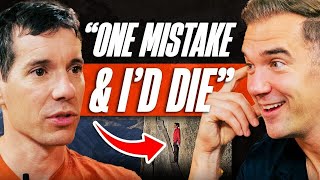
Alex Honnold talks about free solo climbing, where one mistake means death. He discusses his historic ascent of El Capitan without ropes and the mental discipline required to climb at that level.
Chapters
Of the 30-ish things that I did to lead up to El Cap, nobody's actually repeated any of them. You know, when you're like, oh, has anyone done El Cap? I'm like, well, no, nobody's even started down the path.
Like, nobody's even-- Wow. Nobody's even aiming in that direction. More people will walk in the moon than will do what Alex Honnold has done. Alex's death-defying, rope-y to find, routeless ascent.
Of El Capitan landed the film Free Solo a documentary Oscar, and also cemented Alex in the history books as truly one of the greatest athletes of all time. No, no, I mean, you have those thoughts. Like, you should definitely be aware that if you make a mistake, you're gonna die. I mean, I kind of prefer a sport like climbing where you basically never get injured, but you're always facing a tiny, tiny risk that you could die. If you have a dream like that that's kind of a fragile dream, like you don't totally believe you can do it, and then all of your friends are constantly telling you you shouldn't do it, you're never gonna try.
So you wanna keep it like pretty close to the chest.
So you don't tell people your dreams? No, not for free solving stuff. Do you think it's hard for you to feel loved? Yeah, yeah. Why do you think that is? I mean, if we're really going deep.
On relationship stuff, I mean, this is.
A common point of contention in my marriage, is that... What are you most.
Afraid of these days? [No translation] Welcome back everyone at School of Greatness. We have the inspiring Alex Honnold in the house. Good to see you sir. Welcome to the show. I have to read this really quick so people can understand how inspiring of an athlete and human being you are. More people will walk on the moon than will do what Alex Honnold has done. For me, just reading that in your bio, I was like, this is unbelievable because not many people in the world can do or ever will do what you've done. And I'm curious if you could explain to people that don't know anything about you what it is you actually do that you think makes you so great.
Well, so I mean, I'm a professional rock climber and a rock climber my whole life. I mean, the thing that I'm most well known for is free soloing, which is climbing without a rope. And I mean, I think the quote that you just read is specifically referring to Free Soloing El Cap, which is a wall in Yosemite National Park, which to date, I'm the only person to have done.
No one's ever done it again.
No, no, no.
And what is the, what is it you actually did? I mean, I watched the documentary, it was incredible.
But those are the things that I've seen. Yes, the documentary Free Solo kind of covers it, but it's a Free Solo at El Capitan, which is a 3,000 foot granite wall. So yeah, climbing this big wall without a rope.
Without a rope. Yeah.
Which was very challenging. It's funny now it's been a little while and I'm like, oh yeah, let's just climb it. I did this thing. Yeah, I did this thing climbing. But no, it was something that I was working on for many, many years and sort of dreaming about for many years before then.
And how long did the actual climb take?
The actual climb took, I think, 356 or three hours, almost four hours.
Four hours.
Which for context though, the average party climbing all-caps. So typically you climb that 3,000 foot wall with ropes and equipment and people normally camp on the wall and they.
Normally spend three to five days on the wall.
Really?
Yeah. So they take three to five days.
To get it in under four hours. Yeah, but though it's kind of like the difference between ultra running and backpacking, where it's like once you decide not to take all the camping stuff, then it becomes ultra running and you'd wind up going a lot faster.
Right.
So some of it is just a product of the style, like by choosing to go without ropes, you just wind.
Up going a lot faster.
You have to put them, but it's obviously a lot more extreme to go without ropes.
So, no, has anyone attempted but they've come down or how?
No, no. Like, I don't even think anybody's playing in that space right now. Like, really? Nobody's really doing anything quite like that.
Why is that? And why is no one else trying to do that? And why were you so curious to do something like that with no rope?
I mean, okay, so, There just aren't that many people free soloing right now. And part of that, I mean, part of that might be broader trends in the climbing world, like climbing winning at the Olympics in 2020 in Tokyo. And so right now I think the sort of cutting edge of rock climbing is more on the competition front and the Olympics and World Cups and things like that. And so I think that a lot of the talent in climbing right now is sort of focused on competitions. Whereas when I was growing up, I think some of the sort of cultural, the coolness in climbing was more around speed climbing and big wall climbing and free soloing and things like that, like more the adventure side of climbing. Like if you think of climbing as a spectrum between sort of athleticism and adventure, like I grew up and the pendulum shifted slightly more on the adventure side. Right now I think it's slightly more shifted on the athleticism side, which I think is maybe part of the reason that fewer people are doing big wall solos and more people are going to the Olympics. but whatever, I mean that's just the way a sport grows up. I think the main thing is that nobody is really doing that much free soloing right now.
In general, not even just smaller walls or smaller mountains.
Well there must be people doing some stuff that I don't know that much about, but there's just nobody. Well okay, so when you ask like, has anyone free soloed El Cap? Kind of like, man, for me to free solo El Cap took this very long journey and I did maybe 30 or 40 other big walls around the world that sort of led up to it. El Cap is a very particular kind of challenge. And so to tackle that kind of thing, you start by climbing smaller walls or slightly more difficult walls or walls that are maybe smaller but harder in some way or smaller and easier in other ways. And basically you mix and match all these pieces until eventually you feel comfortable doing something that big.
And that takes years.
Yeah, that took like years and years. But at this point, nobody's even done any of those other pieces. Of the 30-ish things that I did to lead up to El Cap, nobody's actually repeated any of them. So, when you're like, oh, has anyone done El Cap? I'm like, well, no, nobody's even started down the path.
Nobody's even aiming in that direction.
So people are still climbing El Cap with ropes though?
Yeah, yeah, people climb El Cap all the time. All the time with ropes.
But no one's tried it or completed it without ropes. No, free soloing is a completely different thing. Wow, man. I mean, climbing it with a rope, obviously requires a degree of skill and you have to be a skill climber. But it's by no means elite. Like any average person with, who's like read enough books and had, yeah, you could climb El Cap with the route. Come on, no way. I mean, it would be the biggest adventure of your life. You'd spend five days on the wall.
You'D come out totally haggard, but you could do it. Really?
Yeah.
It seems like it's a straight up.
Wall though, I mean, with like very little, if you, I'm so big though, I'm 230 pounds. How am I gonna hold myself up? So if the two of us went up El Cap together, and I was able to lead more of it, you'd be able to ascend ropes, you'd be able to camp on the ledge. Really? You could get up it, yeah. You'd be worked, you know, like it would be hard for you. It might take me two days. But you could do it, you know? But the difference between that and free soloing, the difference that and climbing without.
A rope is vast. Yeah, that's true. I would argue you'll never do it. Yeah, yeah, yeah, yeah. I don't even know if I could.
Climb like 30 feet without a rope on anything, you know, unless it was like, I could walk it. I mean, I think that anybody can learn how to climb, to a high level if they're interested and passionate about, you know, if they're curious. But then there's another step between that and then free soloing walls. Yeah, yeah. Because that's like sort of you have to devote your, like, devote your life to it.
It's like a, you know, when did you first think, like, I want to do climbing in general? How old were you? What it was there something you saw or some, someone that experienced it with you that you were like, oh, this is something I'm really interested in.
No, there wasn't, like, a specific moment. I just, I I've always liked climbing. And now I have a daughter who will be two soon and she climbs on things all the time and it's really hard to tell how much that's nature versus nurture because she sees her mother and father climbing all the time and basically everybody around her climbs all the time. So part of that has probably just hurt me being influenced by the people she's around but also she seems particularly into clambering on things and it makes me think that that's probably just how I was as a child because I got into rock climbing because my parents took me to a climbing gym when I was 10, but it's because I've been climbing trees and buildings and things my whole life.
Before that, you were climbing.
So like, okay, let's put him in the gym. Yeah, I was like, yeah, I was really in, you know, I was the kid that was always running across the top of the monkey bars because you're like, oh, look, I can balance, you.
Know, like that kind of just testing yourself on cool things. And so my parents thought that the.
Climbing gym would be a safer outlet, and so they took me in to learn. Did you ever have any like big falls as a kid when you were climbing trees or the monkey bars? Yeah, I fell off my arm twice as a little kid.
Really? Like before I learned how to rock.
Climb, I fell off a place structure, two different place structure things and broke my arm twice. And then I also broke my arm again at the climbing gym when I was a teenager.
Did that pain ever hold you back.
From thinking, maybe this isn't for me? No, no. If anything, you just learned that a broken wrist is no big deal. Like, oh, six weeks later, you're totally fine. It's like, yeah, that's no thing. Was there ever a time? I mean, I fell out of so many trees. Really? Yeah.
I mean, yeah, when you're a kid.
Learning how to climb stuff, you just fall down all the time.
But you never were afraid to fall?
Well, no, I think I was afraid to fall. I mean, I don't want to get hurt, but I really like climbing things. And you always think that you're gonna make it. It's like, you never think you're gonna fall off.
Was there ever a climb that you did that is supposed to be really easy? Like almost the most basic climb ever? Like someone like me could do it easily, or someone, you know, maybe someone with some beginner skills could do this easily. that you thought you got into a very sticky situation where you thought, oh, I'm in a bad situation and I could actually fall and potentially die.
I've been in a lot of sticky situations. I'm not sure if any of them were on things that should have, they were actually that easy. I mean, I guess the challenge though is that if you think something should be easy for you and then it winds up being just a little bit harder than you think it should be, you know, when your expectations mismatch reality. then that can be... I mean, the thing with reselling is so much of it is psychological. So anytime your experience doesn't match or like your expectations don't match the reality, then it's easy to get out of control mentally a little bit. Because if you start to get scared, you start to second guess, you start to hesitate. Like all of those things where none of those things help your performance. So then it can start to be sort of a negative spiral where It gets quite scary.
What do you think has helped you keep your mindset so clear under challenging situations? Is it the.
More from Lewis







Secret Service Agent: Your Neutral Face Is Making People Distrust You (Here's How to Fix It)



