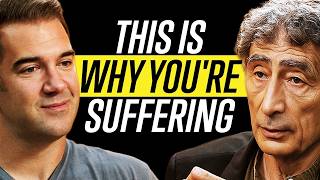
This content was created by Lewis Howes. This content was uploaded by Lewis Howes. This is a YouTube video titled "The Doctor Explains Why So Many Are Suffering | Dr. Gabor Maté" featuring a discussion between Dr. Gabor Maté and another speaker about the disconnect between modern medicine and the holistic understanding of health, emphasizing the importance of integrating mind and body in medical practice.
Why do you think in, you know, in our modern society, with all the medical and scientific advances and all the knowledge out there, that there's so much chronic pain, though, so much suffering, when we have more information and knowledge and tools than ever before?
Actually, we don't. We have less. What we have is a lot more physiological, physical science, which is great. You know, I mean, if I needed a heart transplant, I'd be very grateful for modern medicine and. Or, you know, if a broken bone or anything, but we've forgotten something that human beings have always known. And, for example, I. I write about this friend of mine. His name is Louis Mel Madrona, and he's an American physician. He's Lakota background. Okay? And he told me that in this. And he's a. And he's just like me. He's full of respect for Western medicine. I was trained in it. He was trained in it. We also see what's missing. And he said that in his history, when somebody gets sick, the whole community gathers and thanks the person and says, you're carrying some dysfunction in our whole culture, so your healing is our healing. Wow. So they get that the individual represents the culture and the environment and the family and the community. Now, Western medicine totally forgets that we separate the mind from the body. So often when I speak to groups, I ask people, if in the last five years, you've been to a neurologist or an oncologist or a cardiologist or gastroenterologist or rheumatologist, any kind of an ologist, put your hand up. So people put their hands up. I said, keep your hands up. If they ask you about stress in your life, trauma in your childhood.
Relationships.
Relationships. Exactly. How you feel about your work? How do you feel about yourself as a human being? Very few hands stay up. And those questions, which have to do with, number one, the unity of mind and body, which is only scientific fact, and the inseparableness of one human being from another Western medicine completely ignores, which is contrary to science. It's not only contrary to ancient wisdom, it's also contrary to modern science, because we have tens of thousands of studies to show that you can't separate the mind from the body. Tens of thousands of studies showing how emotions significantly influence the onset of illness. How relationships do you know? There's a wonderful psychiatrist here in la. You may know of him or him. Daniel Siegel. And Dan Siegel talks about what he calls interpersonal neurobiology, which means that our brains are not separate. Something in. You will sense the tension in me and we'll pick up on that. And that'll change the intuition. Yeah. And that'll change your brain. And I take it a step further. I talk about interpersonal biology so that what happens to people physiologically is very affected. And I'll give you two examples. Yes, but affected by their culture and their family. So we've known for decades that children whose parents are stressed are much more likely to have asthma. The the parent stresses affect the physiology of the child. Breathing, the breathing that they narrow the air to, they cause inflammation. By the way, how do we treat asthma? With stress hormones, adrenaline and cortisol. We know American black women. The more experiences of racism then you have to endure, the greater the risk for asthma. Really. We know that men who were sexually abused in childhood, the risk of heart disease triples. I could go on. Women who suffer symptoms of PTSD severely, the risk of ovarian cancer doubles. Why? Because you can't separate the emotions from the body. It's one unit, scientifically speaking. Not just from the point of view of indigenous wisdom, but modern science. So when I talk, when you say despite all this knowledge, I'm saying what's missing from the knowledge is wisdom is the wisdom. And not just the wisdom, even the science. That's just so ironic. So I'm a physician and as doctors, we always talk about evidence based practice. And I say, my God, I only wish we had evidence based practice. Let's look at the evidence.
Right.
You know, what's the evidence for separating the mind from the body? But multiple sclerosis, this mysterious illness. The guy who first described multiple sclerosis was a French neurologist called Jean Martin charcot in the 19th century. He said that it was a disease caused by grief and long term worry. Since then, there's been multiple studies showing the relationship of stress, trauma and multiple sclerosis. You go to the average neurologist with symptoms of ms, nobody's going to ask you about your trauma, nobody's going to ask you about your stress. And why is that significant? Because if you deal with the trauma and the stress, your multiple sclerosis can actually improve significantly. Wow. So there's a huge gap between, between the scientific evidence and how we practice medicine and what we call scientific evidence based practice is miraculous. It's amazing, but it's way too narrow. Things that are considered normal in society are not at all normal from the point of view of human life and human needs. The addictions that people develop are actually normal responses to an abnormal situation.
How do you think in our modern society with all the medical and scientific advances that there's.