The Jonas Brothers: "We Had EVERYTHING But It Wasn't Enough. THIS is What REALLY Matters!"
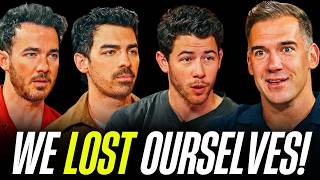
Kevin, Nick, and Joe Jonas talk about two decades in the music business. They had massive success and money early on, but say it wasn't fulfilling. What mattered most was staying authentic and keeping balance in their personal lives.
Chapters
What people forget about this business is that it is a business and that what we do is like, oh, cool, we have to release this project. But the amount of stuff that comes with it, the amount of stuff that, like, happens on the backside of it, to even make that a reality is challenging sometimes. They're arguably the most famous and successful musical brothers of the last decade.
Please welcome Kevin, Nick, and Joe the Jonas Brothers. How do you block it out the outer world and the inner world and just say, hey, we're just going to create art today.
You realize that this is audience's show and they deserve the best, and it's totally okay to be like, yeah, this is tough. But, like, I'm here, and I think people respect it more. Authenticity wins always. Everyone's going through something.
Hitting a version of rock bottom for all of us made this second, maybe third bite of the apple even more special. Getting on stage and feeling that is like, pinch me.
Wow.
What was the core issue that you needed to resolve as a family to be able to come back together and let go of the envy or the jealousy or the whatever was swept under the rug?
There's a lot of things we probably needed to have real tough conversations about, primarily as a core of, like, a band. I think it was.
It's the first time we've done this. We've had three people on at once, really. We got the Jonas Brothers in house. Good to see you guys. Thank you for being here. I got to start with this. So much has happened in 20 years. And I'm curious, what is the thing that you've learned the most about fame, success, and money that you could share with the world? Like, the lessons you've learned about fame, success, and money, either from 20 years ago, like, it coming into your life when you were just, like, riding around in the van with your dad, you know, the malls, trying to, like, perform for 20 people to then. Oh, now it's a ton of it. Fame everywhere, success, money. To 20 years later, how it's evolved.
Oh, man, for me, I think it's.
It's a.
It's.
It's been interesting to have this relationship with. With fame for as long now as we. We have. Because fame often doesn't equal success. It doesn't equal money.
That's true.
In fact, at times, it can. It can create more hurdles and, you know, preclude you from getting to those goals of success and money. And so I've had to. To redefine what the benchmarks of success look like at different stages and also what Realistic benchmarks of success and goal posts are financially. And the biggest learning in that has been that anytime I'm in my creative flow and doing something that's making me happy, the results are better. And it sounds very simple and it also, I understand, sounds very privileged. And I will balance that with saying writing a song is incredibly difficult. And if you're not feeling positive in your spirit, if your life's not balanced, then you're not going to write a good song in the same way that an athlete is not going to play a good game if things are out of balance in their life. And you know, I try to make something great while I'm in a great place that then creates a financial opportunity and result that is net positive. But sometimes you do something that you love and you feel great about and no one responds to it.
How do you feel about that when people don't respond to something that you love?
Well, I think that, you know, it's, it's very much as we get to know each other, it's very me to say no one responds to it. I mean.
Right, right, right.
You know, it doesn't hit number one. And so as the, the game has changed so much in this 20 year period. You know, 10 years ago when I launched my solo music, it was very different. The process would be you go into, you know, radio station, do an interview and watch the song slowly grow at radio and then hopefully people start, you know, buying it or streaming it. Now it's just a completely different landscape and, and the way the algorithms are set up on streaming services and everything really make the, the listener more in control. But what it does is it then makes it harder for things to break through. And when, you know, you reference music coming out 10 years ago there's probably a thousand songs that came out on any given Friday. Now there's thousands of songs. And so I've had to start saying what really matters most to me. And the three things are feeling like my life is balanced, staying in my art, staying creative and having fun and then creating a sustainable touring business that doesn't depend on the success of a song on the charts or it's more about super serving our fans who are absolutely incredible and have supported us for this 20 year period. And then if something starts to connect on a, on a larger scale, it's just an added bonus. But I've, I've, you know, we have built the foundation to sustain without the need for an anomaly. And I think in any business that is the, the key is, you know, building Something that. That can. Where the floor is not going to fall out and. And the ceiling is attainable.
And because you don't need one hit, you don't need a big hit song to make money. Right now. You have multiple layers of your businesses, from touring to merge to whatever else it might be.
And then, you know, there is that. That rare thing that just finds its. Its way and breaks through and it continues, you know, to give us motivation creatively as we. We get further and further into our life and career to just be honest in our music and the stories that we're telling. And, you know, that's why I think this album, this album title really, like, resonated with us, was because it's about just getting back in touch with our roots and making music that feels like we're back in our living room in Wyckoff, New Jersey, with our dad playing music. So sorry, it was a long winded answer.
I love it, man. Kevin, what about you? What's the biggest lesson you've learned from money, success and fame over the last 20 years?
Yeah, I've seen it both ways, right? I've seen the beginning of the success to financial success, not knowing what money really was and understanding it to not having. To losing almost all of it. Seeing bad, really bad business deal. Yeah, no, I had a.
You almost lost all your money?
Like. Yeah, most of it, like down to the one like 10% left, you know.
Really? When was this?
About nine years ago. Investing in a bunch of property and doing other things. And I was building at the time, and sadly, it just wasn't the right partnership, if you know what I'm saying. Can't really get too much into it.
I get it.
But the sad part of it is learned I've learned a lot of lesson in that and thank, thankfully, for life in general. Like, we had a second shot and bite at the apple with the band coming back together, and it actually was like, kind of fortuitous in a way. Like, I learned this lesson. Never wanted to learn it, but I did.
Painful lesson, man.
But then at the same time, re evaluated how to approach life and from that perspective and looking to the future and at the same time was able to really feel honored that we could have a second shot at it. And then I think from the business side of things, I look at our business as we are like a startup, like any kind of thing, right? Like starting artists and other things. They have an album that they work on, their first albums there, you know, most of the time, 20s, you know, 18, whatever. It is they've worked on that album for 18 years before that album's out. Right? That's their first album. Is they're 18 years in the making, then you have pretty much the pressure to put out another album a year later, two years later. So the. The window of time, the life you spend between projects can sometimes be important. I think we've learned that. I think it's helpful for us to do that, live a little bit of life to talk about it, you know. But then I think we look at our. The. I look at a band like ourselves as like a startup. You know, you've got. You have. You start in your garage making music. You're, You're. You build your product, you go out, you get an investor.
Label was our lead investor.
Yeah, our dad was our lead investor. He, you know, supports you. You go on, you start, you go on the road show. All of a sudden, you know, you get a. You say a second investment, and that's the label. And then you have distribution. And now there's so many more. Like, what people forget about this business is that it is a business and that what we do is like, oh, cool, we have to release this project. But the amount of stuff that comes with it, the amount of stuff that, like, happens on the backside of it, to even make that a reality is challenging sometimes. And putting up a tour and having to make, you know, choices to. To. To where to go and what kind of venues to play, and these are all really complicated conversations and decisions that sometimes need to be made. So it's nice to be able to have a teammates with these guys and our. On our management team that has been with us for so long. And I think, you know, we're a good unit now, and sometimes it takes time to make decisions, and I think that's okay. I think for me, that's the hardship that I should face. Like, I just want to make a decision and move and continue. Sometimes it's nice to, like Nick said or Joe said, actually to take it, take it easy. Like, that's what I've learned, I think, in all of this, is to take some time is okay to make a decision. You don't need to make it in the room. And Nick's really good at that. He's like, I'll let you know.
He's like, give me some time.
But, like, he'll say that it's like, I don't know yet, and it's okay to not know. And I think, like, for me, that's always like an insane thing.
Stresses you out. You want to be like, let's figure out.
Stress me out. Because I just want to. I want an action plan. I just want to start moving forward. That's my own complications.
But it's good, though, because you need some of that. Otherwise, if it's just like, yeah, we'll think about it for months. You know, you need someone giving the pressure of like, all right, here's the deadline. How long you can think about it.
Right, Exactly.
You think about it, and then we'll get back to me in a few weeks.
Yeah, totally.
Otherwise, you know, artists could be like, I'll think about it forever.
Right.
It's like, yeah.
I think oftentimes, too, artists get a bad rap for, you know, for being less structured. But I have worked with people that I really admire and respect who you would think, based on their work would be really efficient killers in the room, making decisions and leading. Often, those are the people who just go, I don't know. And I might not know today. Two days, three days, I'll let you know. And they come back with something that is as good as the time that they were awarded to think on it.
Yeah.
And even in the moment, if you're like, this isn't efficient. This isn't the logical thing, it's like, it does end up. The results are better.
It's the artistic mind. My brother, my older brother, he's 11 years older than me. He's the number one jazz violinist in the world. So he's played and traveled the world with all the top jazz artists, musicians, and he's just. It's another. The jazz world is another level of, like, artistic expression, of improvisation. And it's just. His mind is incredible, but he's probably the extreme version of you where it's like, you know, hard to make a decision. And everything needs. And he's got some of you. It's like he's so hard on himself if it's not the perfect thing at every moment. So it's like the indecision can kill him sometimes. And then needing to look a certain way, and it's like, what has to be my perfect artistic expression. And it's like, I'm never going to do this type of art because it's. You know, it crushes my soul if it's not this way. And so I'm like, yeah, but you could make a lot of money over here, too. And he's like, but I can't put something out there unless it's true to the art form of jazz. And I'm like, all right, man. You know, it's what makes him great, but also like kind of a challenge that hurts him from like almost enemy. Yeah. Making more money or, you know, being more commercial or whatever it might be. So yeah. What about you both for biggest lesson you've learned from fame, success and money? What has it taught you?
I think probably fame and success.
I think success used to be like plaques on the wall and sold out stadiums and arenas and now it's just like a quiet morning and quiet time with my kids or like a destination. Like that's success, like just being happy. Fame, I think is like, it's something that naturally you look at and it's like, oh, I like when I meet young artists, I always ask them like.
Do you have any advice?
And the first question I asked, I.
Asked them a question back.
I'm like, why do you want to do this? And if they say they want to be famous, I'm like, I usually look at their mom or dad, I'm like, maybe they should stick and stay in music class for a little longer, see if they like it. Because I think if you're getting into it for fame, it's just not. That's just not what it's about. I think like it's. That is such a double edged sword and we've been, I guess, poked many times by the other side of the sword in a negative way where it's just not fun. And it comes with a lot of pressures and especially as a young person, like we started. And there are amazing things that it also comes with naturally being able to help other people through the power of music. We've met some incredible people just recently, people that have been affected by cancer. And we've spent so much incredible time with people who are sick kids or are going through some crazy things. And you play a song that you think, well, this is like, oh, this is. We're going to play this one on set list. And you look out and you're like, oh, that's. That person's like that got them through something crazy. And you hear these real stories and.
You'Ve sung it thousands of times, of.
Course, and it brings up like ours. We have a song Little bird heard, we wrote it.
We.
We have this song that is essentially a dedication to our, our daughters. And now it's kind of taken a life of its own.
It's.
It's people usually holding signs. Can you sing this about my father or parent who's no longer with us or my child is no longer with us, and you're just like, oh. And so the fact that we can help, I think genuinely a reason to do what I love is the fact that I can help others in some way, whether it makes them feel something or distract them at a concert. Like that part of fame.
Great.
If I can help people, that's what it's about. Now, money. I think I am probably. Probably least money smart here, but I think I also love to take as long as I'm able to take care of my friends and family.
And I'm good.
I've smartened up because I had to having kids, But I think surround myself with great people that know what they're talking about and that can make sure that there's longevity there, but also have fun in the process. I mean, I think it's like, I don't want to be just behind a desk, and I'm not. I'm grateful for that. But I should say, like, in the sense of, like, just working all the time. I want to be able to enjoy why I'm doing this and go live life and find the kind of simplicities. That's what it's about. So I think, like, if I can create amazing things for my kids and also keeping them in somewhat, like, humble creatively, that's what I hope for sure.
Sure. If you could go back before your first gig as a group 20 or whatever years ago it was, and you can play your life 20 years in advance to where you are now. But all the ups and downs, the success, the fame, the money, the loss, the, you know, heartbreaks, the. All the different stuff. What's one thing you'd say to your younger self right before you started about where you are now? One piece of advice. Would you start.
I have one funny one, and then I'll say the actual one. But remember your guitar. On the first night, the first night we went on stage, I literally left it in the dressing room and had to run off stage stage and missed the one of the two songs we played. So don't forget your guitar. But realistically, it's. Enjoy the moments because. Learn to celebrate even the little. The little moments. Because we kept going so hard so fast that we would kind of never look back and we never celebrated. And I think we missed opportunity to grow as people because of it.
Okay. Beautiful.
I would say fame and criticism are two very different types of obsession, and they have different tastes.
And learn to not overeat. Mmm.
Interesting. Okay, Nick.
Anytime throughout this 20, 25 years, I guess I've been Doing this, I've second guessed my first instinct and, and gone a different cut, a different direction. I've regretted it. I feel like I would encourage myself to trust my first instinct and stand by it. If it, if it doesn't accomplish what you thought it would accomplish or wanted it to, stand by it. Because more, more often, you know, the result is something you can be really proud of than if you've spent time cutting a different direction. So, yeah, don't second guess yourself.
Beautiful. You ever walk out of the grocery store or fill up on your tank and just think to yourself, how is everything this expensive? Feels like prices are going up everywhere. But how great would it be if just once, just once something actually went down in price? It'd be pretty amazing, wouldn't it be? Well, at Metro, that's exactly what's happening. They're lowering their prices and are giving you a five year price guarantee on talk, on text and on data one line now 20% lower. Family plans also lowered. Oh, and you also get a free, free 5G phone, all with no ID required and no activation fees. Stop by your neighborhood Metro store, visit metrobyt-mobile.com or call to find out about their amazing offers. I had Rick Rubin on a couple years ago. I don't know if you guys know Rick Rubin, the producer very much. You guys worked with him or you guys know him or just know audience comes last.
It's my favorite Rick Rubin code.
Yeah, yeah, yeah.
We had not worked with him. I would love to.
Yeah.
I asked him about his creative process on the show and I asked him about if he worries about what the audience thinks when he's making his music and he says no. He says, I make the music for me. Essentially. I'm paraphrasing him and I try not to concern myself on how well it does commercially. Now maybe he's older and got all the money in the world and he doesn't have to worry about that.
He's had all the success, right?
Yeah. Who knows? But it sounds like he's kind of always been that way. Who knows? I don't know. That's, you know, I would like to think that way when I make, you know, an interview or book or whatever it is, I'd like to think, I don't care what people think. I'm making this for me, essentially is what he's saying. How do you guys navigate that? You kind of mentioned it a little bit about really getting in a flow state of doing the thing you love, making music or performing from a place of love, whether it's a sold out audience or, you know, half sold out. I mean, not that you guys never sell out anymore, but it's like, how can you show up when it's like, oh, we didn't sell it the way we wanted to, or people didn't react or respond the way we thought they would? How do you guys make art without worrying about the audience, but also making sure you make money to survive?
Yeah, the show I just did is an example of this. You know, it's eight shows a week.
And.
The theater holds about a thousand people, so that's 8,000 tickets a week, or roughly around 8,000, which is a lot of tickets. And that over, you know, 14 week period, it's easy to look out and go, oh, this is only a thousand seats. This should be pretty easy. But, you know, it's. It ends up being a lot of tickets to sell. And so, yeah, there was a few shows where the houses were a little lighter. And on top of what Joe mentioned earlier about staying motivated amidst some criticism and what I truly believe to be just a theme in this last Broadway season of a feeling that there wasn't. That there were some critical voices that were louder perhaps than the audiences were, the audiences would come and see these shows. It wasn't just our show.
More from Lewis







Secret Service Agent: Your Neutral Face Is Making People Distrust You (Here's How to Fix It)



