What It ACTUALLY Takes to Become a Man | Scott Galloway
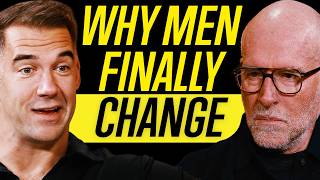
Scott Galloway talks with Lewis Howes about what masculinity actually means today, drawing on his own experience as a father. He pushes back on outdated ideas of manhood and explores what it takes to grow up in a world that keeps changing the rules.
Chapters
I used to think that you become a man, and maybe it's more emotionally or spiritually when you have a child and when you lose your father, like, you have to step into some type of spiritual breakthrough. And. But then I was like, okay, well, anyone could have kids. They could just have lots of kids, but not really be there as a father, as a dad. So. And when I lost my father a few years ago, I really felt like, oh, something shifted in me.
I think a lot of people have kids and never become men.
That's true.
And a lot of people, you know, who have parents live well into their 50s or 60s, never, never become a man. But what you say resonates in the sense that I think of kind of the two. I would say, what motivated me to be a better man or get to manhood. And they both involve women, and one's more virtuous than the other. And that is when my mom. I was kind of sleepwalking through life, didn't get my act together until I was about 25, 26, and my mom got really sick, and I didn't have the money. She called me from graduate. I was in graduate school. She'd had her second mastectomy and got discharged early from the hospital because hospitals are expensive. And she was at home, and she called me and said, you need to come home. I'm really in a bad way. My mom was not dramatic. So I got on a flight back from Berkeley, and I walked into the situation, Louis, that I. I just didn't know how to deal with it. And I. And there's just certain things a son can't do for his mother. And I remember thinking, I need to get her a nurse. And I called the nurses for 35 bucks an hour, and I had about $700 in my name. And just the shame. It's like, okay, I'm the man. I'm the only son, the only child of a single immigrant mother taking care of me my whole life. She's really vulnerable right now, and. And I can't live up to my expectations.
Yeah, that's tough.
That was really upsetting. And at that moment, I decided, look, you can't decide to be economically secure, but you can decide to kind of go all in. And that's when I really got my act together and said, okay, you can't control the market. Trumps individual dynamics. And there's some exceptionally talented people that work really hard their whole life and take risks and never get there. So you can't control that. But the things you can't control. I decided I was gonna work really hard. That was very motivating for me. And then the other thing is less virtuous. I noticed early that guys who had their shit together professionally and economically, they attracted more women, seemed to be attracting a broader selection set of mates. And I even saw it through ucla. The freshmen were interested in guys that were funny and cool and dressed well. And by the time they were seniors, they were very interested in that guy going to medical school. And we don't like to talk about this, but women are attracted to men for three reasons. The first is to signal resources. And you don't have to show up with a Range Rover or a Panerai. You can just be someone who has his shit together. It's like, this guy's gonna be a good provider. The second is humor. We talked about this in the last one. Or intellect. And then the third, and this, I think, is the most underleveraged secret weapon in mating for a man is kindness. And that is women instinctively believe at some point they'll be vulnerable because of gestation or they're physically smaller. So they're very drawn to men who demonstrate kindness. And that is acts of generosity with no reciprocal expectation. So. And that's the most people. Most men understand 1 and 2. But what they don't understand is they need a kindness practice. Because I do think you can learn kindness. It starts with manners. But if you try to, you know, small acts of generosity every day, I do think it starts to become second. Second nature. But I wanted to take care of my mom, and quite frankly, I wanted more dates. And that was those. Both those things were very motivating for me to try and be a better man. And then what? You talked about having kids.
How old were you when you had kids?
I started late. I was 42.
Yeah, me too. You're 42?
Oh, you're 42? Just.
Just had kids.
Yeah. You at 42 is a different look than me at 42. Anyways, I. But when my kid came marching, or had the poor judgment to come marching out of my girlfriend, it was 2008, and I had lost everything. Right.
At the housing crisis.
Yeah, I had gone, always gone all in. I. I kind of came. A professional agent, San Francisco, where you're supposed to go all in, borrow money against your stocks. And I. You were kind of taught if you're really talented, you're in it to win it, and you can. You know, I'm so awesome that if I throw myself at something 100%, it's going to win. Not recognizing again, the power, diversity. So I've been wealthy three times, which means I've lost it twice. And I lost it in 2000. Then I crawled my way back, had a kid, and literally at that moment, lost everything because I was too stupid to diversify. You written a book on money. I hadn't learned the power of diversification. And when my kid entered the world, it wasn't bright lights and angels singing. I literally felt anxiety and shame. I'm like, not only have I screwed up for me, but now I've screwed up for someone who is totally dependent upon me. And granted, I struggle with depression, so I have a tendency to see dark things as black. But I remember I was so nauseous and so anxious that I had to sit down. They were more worried about me, I think, than the mother of the kid at that point. And I couldn't say, I feel failure. I feel like I've already let this thing down, you know? So for me, that was very motivating. I think having kids is stressful. I'm not saying it's for everybody, but it definitely has made me a better man because I want to model good behavior. I take being a provider and a protector much more seriously now. So I do think this kind of the three legs of the masculinity, stool, provider, protector, procreator. I do think those are decent legs of the stool. And the skills and strengths and attributes you want to develop to be all three of those things are, loosely speaking, what I believe it means to be, quite frankly, masculine. But the book is really more about where I screwed up and what I learned from it and tried to evolve around it. But, yeah, my first encounter. I know you just had twins. You're doing much better than I was at that moment. But I felt a ton of stress and anxiety. But it also is very productive for me. And one of the things I worry about with my kids is that I didn't grow up with a lot, at least not economically. And I always say, if I had what my kids have, I wouldn't have what I have. And a lot what I think about is, how do you instill that sense of grit? And a little bit of fear is probably good in kids, because the things that really motivated me, if I had what my kids have, the only things I know I would have engaged in is like, a Range Rover and a cocaine habit. I'm a fundamentally lazy person. When I was younger, I didn't want to save the world. I wasn't kind. I wasn't trying to add value. I wanted economic security because an absence of it had caused so much anxiety in my life. Men are struggling. 4 times as likely to kill themselves. 3 times as likely to be addicted or homeless. 12 times the likely of being incarcerated. You go into a morgue and there's five people that died by suicide and four men. If it was any other group, I think we weigh in with programs and empathy. I think more and more of them are going to be alone in a room with a screen.
More from Lewis







Secret Service Agent: Your Neutral Face Is Making People Distrust You (Here's How to Fix It)



