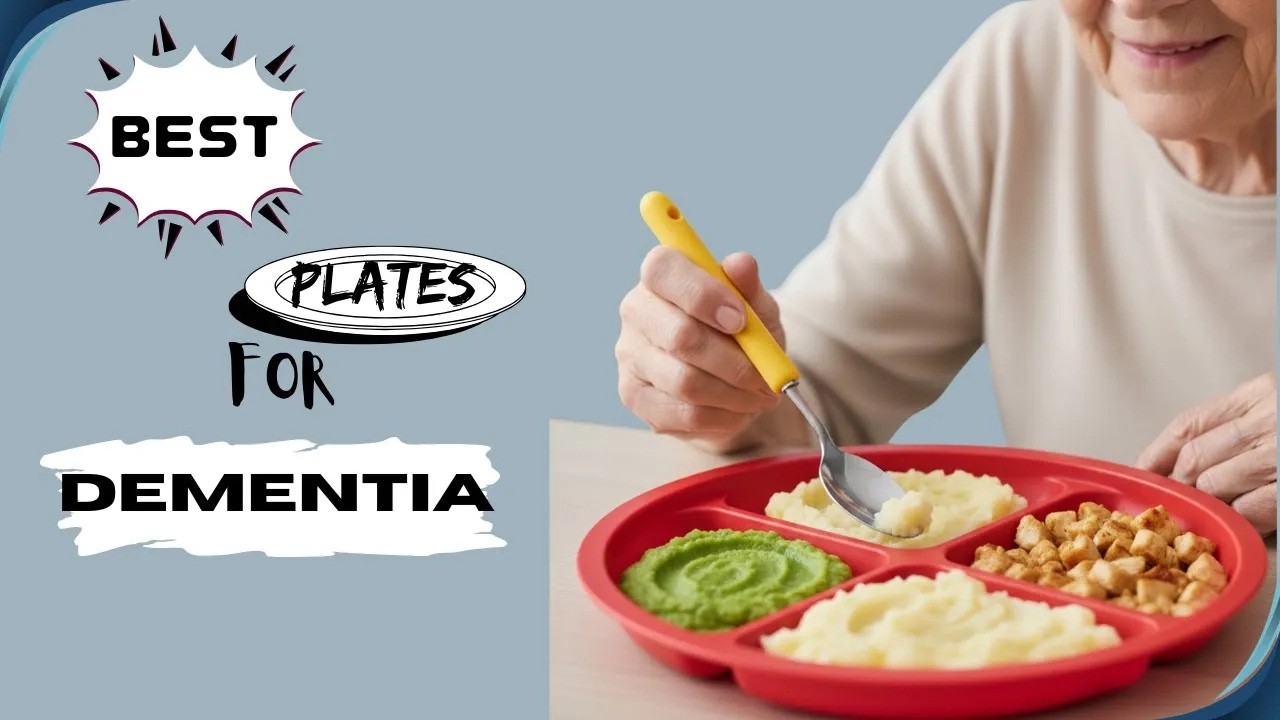
In this 5‑minute YouTube product‑demo, Lisa Skinner of Minding Dementia (also host of The Truth Lies in Alzheimer's Show) explains how dementia‑related visual‑perception deficits—such as reduced depth perception, color‑confusion, and difficulty distinguishing objects—interfere with everyday tasks like eating and using the bathroom. She demonstrates a series of low‑cost, high‑contrast assistive products that she has observed working in memory‑care settings: (1) plates with a built‑in lip and bright red or blue colors that contrast with a lighter placemat, helping users scoop food without spilling and clearly see the plate’s edge; (2) blue toilet‑tank tablets that turn flushing water blue, giving a visual target for men who have trouble aiming; (3) contrasting‑color toilet‑seat covers that make the seat distinguishable from the bowl; and (4) simple visual signage (stickers or signs) placed above or on the bathroom door to cue the location of the toilet. She repeatedly points viewers to the product page on mindingdementia.com, emphasizing that these inexpensive adaptations can dramatically improve independence and safety for people living with Alzheimer’s disease or other dementias, and for their family or care‑home caregivers.
Chapters
Hi everybody, this is Lisa Skinner from Minding Dementia and The Truth Lies in Alzheimer's Show, a weekly podcast that I've been doing for almost 100 episodes. We're just almost at the 100th episode, but I'm here today because I want to tell you that over the 30 years the last 3 decades that I have been working with families to help them navigate the heartbreaking challenges that accompany living with Alzheimer's disease and dementia, and all the caregivers out there that care for people living with Alzheimer's and dementia, I want to tell you that over those years I have run across some of the most amazing products that are out there that you may not be aware of. And I want to make sure you are, because just about everything that I'm going to be presenting to you on this little, uh, YouTube video that I'm going to probably be do— posting on a weekly or biweekly basis will make hands down your lives as caregivers, as family members, and the people living with dementia so much easier in all of these situations that crop up on a daily basis. So the one I'm sharing with you today is based on some of the ways that people's cognitive functions are impaired during the progression of the dementia illness. And some of these people aren't really aware of, or if they are, How can they make the situations easier for the people living with dementia? Because as we know, dementia can affect cognitive functions like perception, interpretation of visual information. When individuals living with dementia have difficulty differentiating between colors, of distinguishing objects. Did you know that this will impact their activities of daily living? And let me explain it a little bit more. So dementia, as we know, involves a decline in cognitive functions, including memory. Reasoning, and judgment. This decline can affect how individuals process visual, visual interpretations and visual information. When they're looking at something, they may struggle to recognize objects, understand the significance of the objects, or remember how to interact with a certain object. This is very common. Dementia can impair the brain's ability to process visual stimuli. This includes difficulties in several areas of daily cognitive functions. So it can impair their depth perception, which means understanding the spatial relationship between objects This can become extremely challenging. Individuals may have trouble distinguishing objects that are similar in color or brightness, making it hard to differentiate a plate, for example, from a table if they are similar in hue or color. They can experience color perception changes. Some forms of dementia, particularly Alzheimer's disease, can affect how colors are perceived. The brain may not be able to still process color information as efficiently as they once were able to do, leading to confusion when trying to differentiate between similar shades. The setting can further complicate visual perception, meaning there's poor lighting or there's clutter in the environment, and a lack of visual cues can make it much harder for a person with dementia to distinguish between objects. So that's what I want to share with you today. I have discovered, and this is in my boots on the ground day of being in memory care, in a memory care environment, that these wonderful plates have been created to not only help people living with dementia have an easier access to scooping up the food, because as you can see, there's a beautiful lip built right into the plate that they can just take their utensil and scoop it up right against that lip, and it won't come falling over the edge and landing in their lap. So this is one of the products that has been made available to make just the process of eating food much easier to navigate. But the reason why it's red— this particular plate is red. They do come in different colors. I know on our website we do have a red one and a blue one. But the point being is to make it easy for a person living with dementia to distinguish between the plate that will hold the food and the table. The trick is to make sure that the plate is put on a contrasting colored surface. So in other words, you would not want to put a white plate on a white tablecloth. A white plate on a, um, on a white background, because they then cannot tell the difference between where the plate ends and the table begins. It's all just one big, um, mess. So as you can see here, I have the red plate on a lighter colored placemat. And when I put that plate on that lighter colored placemat, you can definitely tell the difference between where the plate is and the placemat is very obvious. That doesn't happen if they're the same color. So that's, that's the first thing I want to share with you, and I do have the red plates and the blue plates. On mindingdementia.com/products. And if you're interested or think this might be a benefit to the person that you're caring for and make meal times much easier, then they're available on mindingdementia.com/product. The other thing that occurs with people Because of these visual impairments that happen somewhere in the progression of living with dementia, it are problem seeing, differentiating between toilet seats and the bowl. This is a very common occurrence, especially for men being able to aim correctly into the toilet bowl. Without accidentally hitting the floor or the toilet, the rest of the toilet. So, there's a couple of fixes for that, and I don't— I have one sample with me today. One of the ways to basically correct part of that situation is, you know, those little blue tablets. This is actually a laundry detergent, but it's blue, and you put them in the tank, and every time the person flushes the toilet, the water continues to stay blue. Well, guess what? That is the perfect solution for somebody living with dementia who has visual impairment problems and problems with distinguishing contrasting colors or non-contrasting colors, because it'll turn the water blue and they'll be able to aim and aim for that blue color versus white water or clear water looking too much like the whole toilets, the whole toilet, and missing. So that's another handy suggestion for caregivers or family members to implement to make it easier for people to use the toilet. Another fantastic product or suggestion that I've discovered is to change the color of the toilet seat itself, the toilet seat cover, to a contrasting color. So in other words, you wouldn't want your toilet seat cover, the one that you lift up and down, to be white if the rest of the toilet is white. They can't distinguish that. So if you place— replace the white cover with a contrasting color, then they'll be able to differentiate and know what they're supposed to lift up to get to the toilet bowl.. And those are on the website too. And then finally, cues are extremely important for people living with dementia, especially when they get to the mid and latter stages of their condition. So what I recommend, and they're available on the website as well, is to put a sign up that identifies where the toilet is. You can hang it right above the toilet. There are stickers on the wall, on the door, so they'll be able to find the toilet more easily. So there are several suggestions for you to take advantage of. And again, you can find all of these products on mindingdementia.com/products. Products and, um, discover how to make your world easier to live in and their world easier to live in. So that's it for today's, um, product demo, but I'll be back with another one very shortly. Thanks for your time today. Bye-bye.