Sleep Apnea – An Inconspicuous Menace Everyone Needs To Be Aware Of! with Mr. Kirk Huntsman
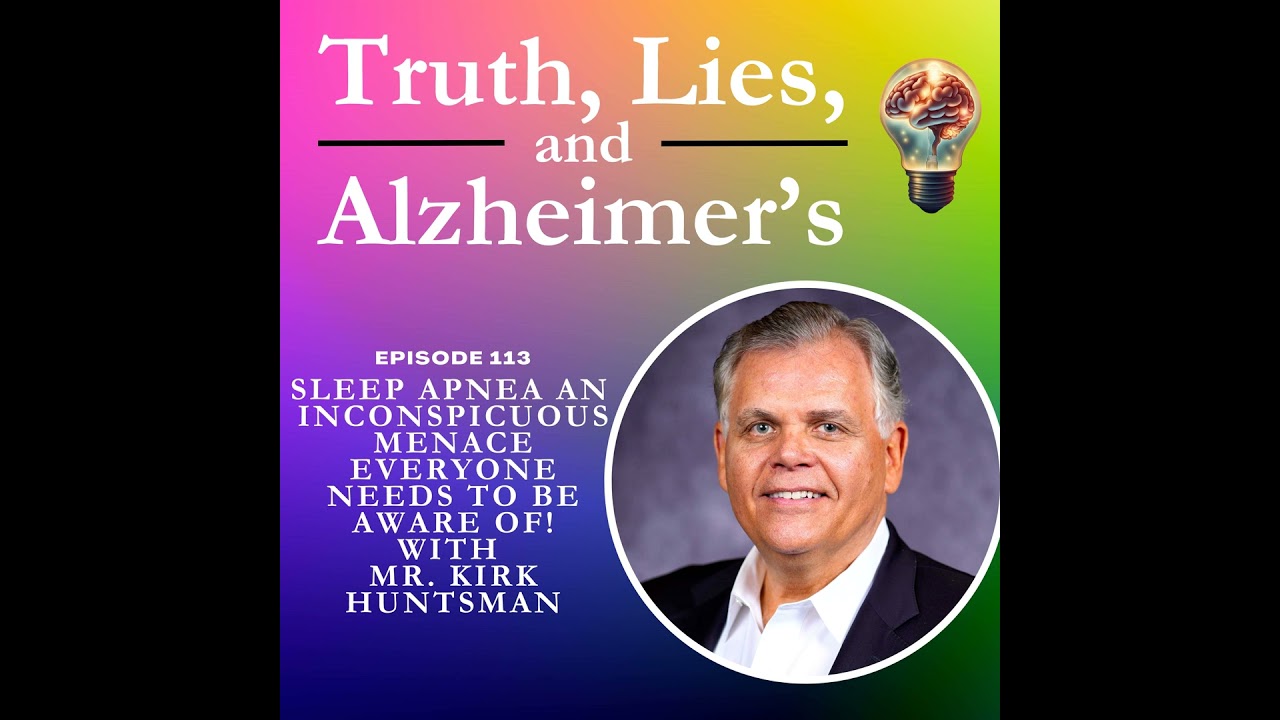
Kirk Huntsman, CEO of Vivos Therapeutics, explains how untreated sleep apnea disrupts the brain's ability to clear toxic proteins during sleep, raising Alzheimer's risk. An estimated one billion people have undiagnosed sleep apnea. Vivos offers an oral appliance that can resolve it in 9-12 months, unlike CPAP machines that many people abandon.
Chapters
Are you caring for a loved one with dementia? You don't have to figure this out all on your own. Welcome to Truth, Lies Alzheimer's, the show that helps you reimagine a new relationship with your loved one, a relationship a little more free of stress and anxiety. Join host Lisa Skinner and her 30+ years of experience as she guides you on a new path to a better relationship with those you care for. Here's Lisa.
Hello everyone, welcome back to another brand new episode of The Truth, Lies Alzheimer's Show. I'm Lisa Skinner, your host, and today we have a very special guest, and I'm really excited that he's here to talk about this very, very important topic. And I've talked about it before on my risk factors episodes because it happens to fall under one of the risks that does increase an individual's risk of developing Alzheimer's disease, and that's his expertise. So we're going to be able to do an even deeper dive into this topic. Topic, and that is the link between sleep apnea and Alzheimer's disease. And as I said, we already know it is a huge risk factor, and he's going to go into a much more in-depth, comprehensive explanation of why it is a risk for developing Alzheimer's disease. So without further ado, let me please introduce Kirk Huntsman, and Kirk is the CEO and chairman and co-founder of a company called Vivos Therapeutics. Hi Kirk, and welcome to the Truth Lies and Alzheimer's Show. I'm really excited about you being here today because this sleep apnea is something that a lot of people actually live with, whether they know about it or they don't know about it. But as it turns out, it is considered one of the risk factors that can increase a person's risk of developing Alzheimer's disease. And it falls into the category of a modifiable risk factor because it can be treated. So I know that's one of the things that you're kind of going to go into a little bit more details about whether or not a CPAP machine, using a CPAP machine, is going to help reduce that from being a risk or not. So we can't wait to hear what you have to say about— because a lot of people live with this. So let me start off by asking you, how did you get to this juncture in your career and specializing in sleep apnea and then founding Vivo Therapeutics?
Well, Lisa, thank you for having me. First of all, it's a real pleasure to be here. I think you're doing the kind of work that needs to be done in terms of just getting the word out. And so that's one of the reasons why I'm here as well, because I think there is such a dearth of knowledge out there and understanding, and we're just now coming to understand some of the complex biochemistry and biomechanisms that are at play here as we think about sleep apnea and its connections to a wide range of what are called comorbidities. So, so my, you know, my background is I'm a serial entrepreneur, have been in the dental and medical space, healthcare space for most of my career. I've been the founder and CEO of a number of healthcare companies. My joy, my love, my current passion is really the sleep medicine space. We are acquiring— right now we're acquiring sleep practices around the country. We're where really we see, and we just did a documentary called "The First Symptom." And one of the things that we've seen is that there's common, you know, there's over 40 different things that obstructive sleep apnea is comorbid with. And what we're finding is that for many people, understanding that they have a sleep and breathing problem is a first clue to why a lot of other things that are going wrong with them that they haven't been able to quite figure out or that their doctors are a little befuddled by. The first symptom oftentimes is improper breathing, which disrupts sleep, and sleep apnea is right there in the middle of all that. So my firm, Vivos Therapeutics, is actually a medical device company. We have a technology that it's the only FDA-cleared oral appliance device in the world that has been cleared by the FDA to treat all levels of severity in obstructive sleep apnea in both adults and children. So we're really excited about being able to bring to the market an alternative to CPAP. You know, it used to be that everybody who got— who was diagnosed with sleep apnea was, was given a CPAP machine, and right. And most people, I mean, they just loathe the thought of having to wear one of those nasty things every night for life. It's not very sexy. It's not very becoming. It's not— it's a disruption to the whole cycle of life. And so nobody looks forward to that. But, but for a lot of people, it's, it's a godsend in the sense that it actually keeps them alive and keeps them right, living to fight another day. Well, we've, we've come along with a, a really viable alternative that can actually it actually holds out the prospect of resolving the disorder within a period of about 9 to 12 months. So not only do you not have to be on some type of a device for life, you can actually get it done and it's a one-and-done type treatment. So you wear this every night and then it's kind of over with. So let's talk about sleep apnea. What an apnea is, Lisa, is it's when the airway actually collapses. So, and there's no ability for the body to respire. So typically there's a collapse and then there's a period of time where the body's sort of, the diaphragm is trying to fire, it's trying to open it up, but it can't because there's a collapse of the upper airway. When that happens, there's a whole cascade of neurological things and the brain eventually realizes, oh my gosh, we're not breathing. And so it, it, there's a, an arousal where you actually gasp for air and you, and then it resets, right? And then you go through that again. The number of times that you have an apnea or hypopnea, hypopnea loosely defined is where you have a concurring desaturation of blood level oxygen. So if you have an, if you have a hypopnea or an apnea, they count those events up throughout the hour, and they come up with an index called your apnea-hypopnea index, or your AHI. Your AHI score is basically used by the clinicians to tell you how severe your sleep apnea is. So almost everybody has apneas throughout the night to some degree. So if you have less than 5 an hour, you're deemed to have no obstructive sleep apnea. If you have between 5 and 15, it's mild. 15 to 30 is moderate. And then above 30 is severe. And I have actually seen patients with, you know, as many as 100 or 120 or 150. These people are having severe obstructive sleep apnea. And what happens is, is that there is a— a compromise in the cardiovascular system due to inflammation and other cascading things that are happening here biochemically and biomechanically in the body as these apneas take place throughout the course of a night. And people with sleep apnea very rarely get into, or they have trouble, let's just say this, they have trouble getting into REM sleep, which is an important thing I wanna talk about in a minute. But the key factor here in the connection to these inflammatory diseases, one of which is, we're finding, is Alzheimer's disease. What's happening is that there is, throughout the night, as the body struggles to get proper levels of oxygen and to disgorge the CO2, What happens is, is that there's inflammation, there's the endothelial linings of the veins and various other structures in the lungs, et cetera. These, and the nasal passages, they're blocked from really doing everything they need to do and they become inflamed. That inflammation creates a problem. And what it also does specific to Alzheimer's is it interrupts something called the glymphatic system. And I don't know if you've talked about the glymphatics on your program, but the glymphatics, basically, if you think about the human brain as sitting in a pool of liquid, it's not blood, it's not water, it's glymphatic fluid. It's something called, actually, it's called the cerebral spinal fluid, or CSF. That CSF, it has its own circulatory system and its purpose, primarily its purpose, is to flush the brain of the toxins that are created as the brain does what the brain does throughout the day. And so at night, our bodies need to get into this deep REM sleep for that sewage system to take place.
Right.
Sleep apnea interrupts that process of allowing the body to get into a position where the glymphatic system can take over and flush the toxins. And if the toxins aren't flushed because there's no deep REM sleep, then what happens is, is that they, they aggregate in the— they know, they, they just stay within the brain. And they stay within the— they don't— you can actually see them on radiographs. You can see the— sometimes they will harden into, you know, various forms. They'll calcify and other things, and you can see these areas of a lack of drainage in the radiographs of the brain. So you have a CAT scan or you see some other x-ray of your brain, you can actually see these things, and the neurologists can actually identify where these things are and what they may mean in different areas. But when the brain, I think what you're, I want your listeners to understand is when they're not sleeping properly and getting to that deep REM sleep, their body is unable to flush the brain toxins that accumulate throughout the day. And what happens there is then they stay in the brain and they interrupt proper brain function and the electrical impulses that need to go on for proper brain function. You get all kinds of brainwave-type disturbances and you get all kinds of other things. But at the end of the day, I think the simple connection is to remember our brains need to cleanse our body, to be cleansed of these toxins. And they need to do that, that happens mostly during sleep.
Right. I've read so many studies about this, and it really makes a lot of sense to me in terms of plaques and tangles, as we're finding out, aren't the only root cause of Alzheimer's disease. This is an example of another one, just from not getting quality sleep. Because our brains are not cleansing itself out when— if we're not reaching REM sleep. So it's more than a combination. I mean, yeah, it's more— it's more than just plaques and tangles. And this finally explains to me why at the— the results of the Nun Study and other similar studies showed upon autopsy of the brain that people— and this has been substantiated, this is through scientific research— that there are many people who have been asymptomatic of Alzheimer's symptoms, but they have still found plaques and tangles in the brain. And the exact opposite, they have shown symptoms of dementia, Alzheimer's disease, but have had no plaques and tangles in the brain. So I think what we're discovering is that the cause of Alzheimer's disease, or perhaps some of the other brain diseases, is actually multifaceted. And that's the whole reason why we have these other known risk factors, like sleep apnea, that are showing a correlation between developing— with developing Alzheimer's disease and being at a lower risk if you're not living with it. One other thing I just wanted to clarify before we move on, because I think it's important for our listeners to understand the bottom line. So these apneas that you're talking about, the bottom line is people actually stop breathing while they're sleeping.
Oh yeah.
And that is one apnea. So when you said that you're aware of people who in a sleep study have demonstrated 100 apneas in the— an hour while they're going through the sleep study, that means they have stopped breathing 100 times an hour during this 12 hours or whatever the length of their sleep study test is. Isn't that correct?
It is. And one of the things too, just to be a little more granular about that, the technical definition is that the apnea has to last at least 10 seconds.
Okay, good. Good to know.
Yeah.
So, but the interesting thing about that is because that is the technical definition of an apnea, What happens is, is that what if a person has a lot of apneas that don't last 10 seconds, right? What if they only last 9 seconds? They don't get counted in that. So it's really important for people to get a sleep test. Now, one of the things that's happened over the last, really the last 5 years, maybe the last 7 or 8 years, but in the last 10 years for sure, The technology for getting tested for obstructive sleep apnea has just come, you know, it's just really come a long ways. And so you can actually wear a simple ring. You can get a ring, you wear it to bed, and it will communicate with your cell phone. It'll link up to your cell phone via Bluetooth. This ring will actually then— and there's a number of different products like this on the market, but it'll actually sync up to your cell phone, and it'll give you a medical-grade sleep test that can be read by a board-certified sleep specialist, and they can interpret some of these nuances. The one thing I want your readers to understand is that sleep apnea is complex. It's not just, it's not just, oh, you know, so-and-so's just stopped breathing. Well, there's different kinds of sleep apnea. There's obstructive sleep apnea, which is a physiological, you know, physical obstruction where the airways collapsed. There's also something called central sleep apnea, which is a neurological thing. Now, what we find is, is that patients who have central— high levels of central sleep apnea, they may have certain toxins that they're dealing with. So they may, they may be, um, they may be, let's just say, black mold. They may live in a house or at an area of the country where there's a lot of black mold and these they may have some sort of a toxicity, and it could be any number of things. I use black mold as an example, but the toxicities may cause central apneas. And again, these things need to be evaluated by somebody who understands, because what we have to do is look at if somebody is starting to have early onset Alzheimer's, early onset dementia, early onset any of these conditions, by removing some of these toxins, by removing some of these things that are upstream from that, we may be able to slow the progress of the disease, we may be able to reverse the disease, we may be able to intervene early and get that and prolong that patient's ability to be without the disease, right? So, so that's why getting a sleep test, if I, if you're, I hope your listeners if they leave here today with nothing else, if they understand, A, that this is a risk factor, it's an important risk factor, and what we're learning in the research and science right now is incredibly revealing about the overall impact of our sleep and breathing on our overall health, and specifically some of these neurobehavioral, neurological conditions, such as early onset dementia and Alzheimer's, et cetera. Et cetera, et cetera. And so, and to get sleep tested, get a sleep test. If your primary care physician has never had you go get a sleep test, ask for one. They're inexpensive, insurance covers it typically. It's easy to do, you can do it in the comfort of your own home. Get a sleep test and then get to a board-certified sleep specialist who can help interpret that to provide some type of a pathway forward from a therapeutic standpoint If there are things that are troublesome or worrisome, that, that to me would be something that every, every adult has it. One of the things that always amazes me is how many people are living with either people in their family, people in their neighborhood, people in their circle of friends who are struggling with CPAP machines because they don't know what else to do for their sleep apnea. And people are curious about this. People are wondering how they can find other ways of getting help and assistance. And if you have a genetic predisposition towards something like Alzheimer's or early onset dementia, by all means, please get a sleep test because that's the real, that's the real first step to understanding what your particular situation is and what can be done about it.
So traditionally, if somebody submits to a sleep study and it is determined that they have one of the sleep apnea conditions, the next step would be that the doctor would prescribe what's called a CPAP machine. You want to explain to people why the CPAP machine is used to basically treat sleep apnea, what it does, and that could kind of be a segue into how your device is different, but the same, what it accomplishes, how it's easier to use, how it's much more convenient, but the Before we do that, the one thing I do want people to understand, because this actually is creating a, a serious situation for anybody who does live with sleep apnea, whether you're aware of it or not aware of it, it definitely is worth being tested because my understanding is, and correct me if I'm wrong, Kirk, The older you get, the higher your risk becomes. If you do live with sleep apnea and you do stop breathing X amount of times every hour, the older you get, the higher your risk is, is that you will not start breathing again and pass in your sleep. And that's a really scary thought. And I've had doctors tell me that I've interviewed that a lot of older folks do pass in their sleep from sleep apnea, but then they don't even know they had it.
Now, that's so true. That is so true. Let me, let me, uh, let me talk about sleep apnea in that vein for just a moment. You know, perfect. So sleep apnea first appeared in the medical literature just 60 years ago. I mean, if you think about, if you think about that in the context of other diseases, other problems and challenges to our health and wellness that we've known about for centuries. We really didn't identify sleep apnea as a specific medical condition until about 60 years ago. And interestingly enough, Charles Dickens referred to the Pickwickian man, the Pickwick, and it was called the Pickwick, or the Pickwick man is the Pickwickian syndrome that eventually sort of had its initial nickname because the medical community didn't really know what this was. They knew that it affected obese people, it affected males, it affected elderly males who were obese more frequently than any other segment of the population, but they didn't really know what it was. And so it's only been 60 years that we've had the ability to really understand this. And it was only, you know, it was only named in 1976 which doesn't seem that far back, but it's 1976 where we actually coined the term, and it's Christian Guilleminault, Dr. Guilleminault, who passed away a few years ago, but that's where we first got the term obstructive sleep apnea and some of these other things. So what's happened is, 40 years ago, this Australian, Dr. Sullivan, he came up with the continuous positive airway pressure. That's what the acronym CPAP stands for, continuous positive airway pressure. And literally it looks like a Darth Vader mask. And you took, they seal up your entire respiratory system and then they pump, it's literally a pump that provides a continuous positive airway pressure. In effect, what they're doing is they're pumping up your airway like a bicycle tire. And we've all had, you know, experiences as kids where we're pumping away and trying to get the air into our tires. That's exactly what this is. To maintain an open and patent airway, they use continuous positive airway pressure. Well, you know—
And this is air, it's not oxygen.
It's air, right?
Air.
It's air. And so what happens is, is that, now some people also get supplemental oxygen to go along with it, but that's, especially here, I'm in Denver, Colorado, in the Rocky Mountains where you're living at altitude, A lot of people get supplemental oxygen to go along with their CPAP, but the challenge here is that it's— people feel a lot of claustrophobia. Some people that have an upper airway sort of nasal challenge, it's called upper airway resistance syndrome, and other challenges, they really are CPAP intolerant. And so the CPAPs for a lot of people are just eventually people just stop wanting to hassle with them and they set them, they're under the bed, they're up in the closet, they're, you know, they're thrown out, whatever. They stop using it. So the effectiveness of CPAP is greatly diminished by the rejection that the patients have to it. And so it can be very helpful. Its helpfulness and effectiveness as a therapy is oftentimes diminished by the lack of compliance because people really don't want to wear it. And so, you know, spouses are always, you know, the elbow, put your CPAP mask back on. And, you know, the, the, the, the guy or the gal who's got sleep apnea, you know, they really don't want to do that. And so, so compliance is a big issue. If you have severe sleep apnea, it will take about 10 years off of your life expectancy. So, so that's a really big risk factor for things you talked about a minute ago, which is this is a scary deal, not waking up in the morning. We have one of the most famous episodes of this in Judge Antonin Scalia. You remember a few years ago when he was out hunting in West Texas and he and his buddies were drinking late. He got back to his room, forgot to put his CPAP on, and he didn't wake up the next day. And so he passed away prematurely. We have other examples, Reggie White, the famous NFL football player, anybody that has a 17-inch neck, a male with a 17-inch neck or greater has a 96% correlation to having sleep apnea.
Do you have any current statistics on what percentage of the population actually does live with sleep apnea? Apnea regardless of they're aware of it or not aware of it? I mean, I guess, I guess statistic wouldn't reflect people who haven't been diagnosed, but what about actual—
yeah, let me give you those stats because they're scary. So we now know, and this came out just a few years ago, that we now know that a billion people on this planet are walking around with sleep apnea. 80 to 90% of them don't know they have it. You figure there's 8 billion people on planet Earth, and really, we know the risk factors in a modern Western societal culture. We have all the more, we have more obesity, we have a certain kind of food diet, we have access to alcohol, all of those things. Like, if you have a glass of wine before bed, or a couple glasses of wine before bed, you have a much greater chance of experiencing sleep apnea throughout the night because of what alcohol does to your system. So, so, uh, in the United States, and when we do— in my firm, we do about 75 to 80— I mean, about 7— let's just say 75,000 sleep tests a year. We have almost 1 in 2 patients —Wow. —that are tested who have sleep apnea. Now you won't hear that, because what happens is, and I've noticed this in the literature and it drives me crazy, is that in the scientific literature, everybody cites the person right before them and nobody checks to go back to see, well, what's the current situation now? I'll give you an example. In the pediatric population, just 10 years ago, the highest figures you could find where from 7 to 9% of the pediatric population has OSA. And a lot of people don't even realize that kids get this too. But now I still hear people saying, well, it's only 3 to 5%, or it's maybe as high as 7% or whatever, which are antiquated decades-old data. The current numbers are in excess of 20%. And so in the last decade, from 2015 to 2025, it's absolutely more than doubled in a pediatric population. In postmenopausal women, we now know that, that the incidence of sleep apnea doubles when you get to a postmenopausal state of life. And so there are all these things that we're learning about sleep apnea. Now, that's why I went back to tell your audience, we are just learning all there is to know, or as much as we can know, we're still learning and discovering things about sleep apnea, literally on a month-to-month basis.
And so those numbers are absolutely shocking, especially hearing that children also do live with sleep apnea. Um, so for those of you out there who aren't aware you might even have this, isn't it true that most people who have sleep apnea, one of the telltale signs is they're a snorer?
Oh yeah, yeah. Now, not if you snore.
If you might want to consider getting a test because it's a good chance that it's due to sleep apnea. Is that a, is that a, uh, honest statement? Yes.
So here's the thing about snoring. Snoring is clearly an indicator that something more serious is going on, but it's not 100%. So it's not like if you snore you have sleep apnea. That's not, that's not the way this works. But if you snore you are more likely than not to have sleep apnea. And so I think, yes, what you just suggested there, that if you're, if you, or, and the problem with sleep apnea is that we sleep through it, right? And unless we have a bed partner there who's giving us the elbow going, okay, come on, something's not right here. Either you're snoring loudly or you're gasping for air. I've actually seen spouses who have filmed their spouse their partner, who is gasping for, literally gasping for air, and they show it to them and the people can't believe it because they slept through the entire experience. And so remember now that when we don't sleep, we, or when our sleep is constantly interrupted by these arousals and the intermittent, you know, apneas that happen, we don't get into REM sleep the way that we need to. We don't get adequate REM sleep, and that's where our— the glymphatic system is unable to wash our brain of the toxins that were created throughout the day as the brain does what the brain does. And so it's that interruptive biomechanism that really is what is causing a lot of the problems, especially when it pertains to things like Alzheimer's, where where we see a buildup of these toxins in the brain that we know are there. And we haven't always understood why some people get them and some people don't and all that sort of thing. But I think we're drawing more and more connections here as we go.
Yeah. Well, before we run out of time, tell us about this new device that you think is going to become the state-of-the-art treatment for sleep apnea that people can actually tolerate and might wear to help save their lives?
So listen, we looked at the sleep medicine industry and we realized that what sleep medicine was all about was trying to manage the disease state. And that's what CPAP does. 95% of patients were being prescribed CPAP and it was to manage the disease. You gotta wear those crazy things every night for life in order to maintain the benefit. Well, we came up and said, you know what, there's gotta be a better way. And so by repositioning and redeveloping the jaws and the oral cavity, we actually open up that airway. Very slight changes. What we discovered was very slight changes in the size and shape of the, dental arches and the relative position of the jaws. And we can make a dramatically disproportionate effect on the size, shape, and patency of the airway. So we get in with our oral appliances, we redevelop the oral cavity, the dental arches expand a little bit, they kind of get a little wider, the palate drops, nasal passages open up, the tongue and everything comes forward a little bit and all of a sudden the airway just boom, it just pops right open. And when that happens, a lot of the physiological impediments, the obstructions in obstructive sleep apnea go away. And even central apneas, we've seen diminish. And so a patient that has maybe a moderate to severe condition of OSA, a lot of times they'll get to the point where it's mild or there's none at all. And so, and that takes about 9 months. You wear these things at night. You take it when you're done in the morning, you wake up, you put these things in their little container and you wash, rinse, and repeat the next night.
But you can— Is it like wearing a night guard?
It's like wearing a night guard or a retainer of some sort if you've had orthodontics, right? It looks like that, but it's got very specific materials, design, and protocol for use. That actually allows the body to sort of adapt to this shape. It guides the development and restructures the, the, uh, and actually it creates a, a slightly better jawline. So, you know, about 20% of, of especially women are getting this to actually look better. It's improving their jawlines, improving their, their facial profiles, and, and it's really a fascinating—
Does it also help with TMJ? It does. Actually, it does.
Absolutely. Absolutely. We're actually—
So if you get the headaches from your temporomandibular joint being, you know—
That is not a normal state to have a TMF temporomandibular joint problem. And if you've got pain or suffering from that, yes, our doctors, our devices can actually help with that. We train on that. We teach the doctors how to use them for that application. And it's a comprehensive look at what's going on to help that patient sleep and breathe more, more in a more relaxed, deep way. And then all these other things have a much lesser level of incidence. That's what we're trying to do.
So it's a twofer. If you have TMJ, you're gonna have that corrected and also your sleep apnea. There you go. And you'll feel like you're a brand new person, right?
A lot of our patients, you know, the first thing that they report is that they dream again. They breathe through their nose. They breathe through their nose. And when you breathe through your nose, you get the good nitric oxide. A lot of the nitric oxide that we need is actually created in the endothelial linings of our nasal cavity. So when you breathe through your nose, you restore nitric oxide and you start to dream again, which is one of the very first positive things. People are like, I haven't dreamed in years. I haven't been able to breathe through my nose since I was a teenager. So all these things start to happen and it just sort of just through the course of about 9 months or so, maybe 12 months, but through the course of that therapeutic time, everything just sort of improves and it really starts. And then it lasts. It's a one and done treatment. So you throw these things away when you're done. That's the other part of it.
Well, this has been an absolutely fascinating conversation. I think that We've all learned so much from what you've shared with us. Besides your advice that one of the number one takeaways that we can all get from this episode is get sleep tested and start there. What else would you want to tell everybody? Because this could be like a surprise to a lot of us out there. It's like, oh my gosh, I know I snore, but I had no idea it could be sleep apnea. And this sounds really serious. It sounds dangerous. So I'd say that getting tested would absolutely be the first step to knowing if you do have this serious problem. What else would you like people to know?
Well, I think the other thing is You're never too young and you're never too old to either get treated or to have this condition. We've treated patients in their mid-80s, okay? So it's not like, it's not like we can't affect patients of all ages, as young as 3 and as high as about 86, as old as 86. So, so it's never too early or too late to get treated. And the benefits of treatment in terms of overall health and wellness are just staggering. I mean, the testimonials we get of patients are staggering. So get tested and then know that you're not relegated to a lifetime of CPAP if you test positive. Don't be afraid to be tested and get tested positive because there's alternatives now that go way beyond just the traditional CPAP. I think those two things are most important for your audience to understand.
I think that sounds That sounds like excellent advice. I have one more question for you, and then you can tell us how everybody can get more information, more details about this. So my last question, because it did catch my attention, you did say something that caught my attention. You had referred to early onset Alzheimer's disease. And just for those of you Just to clarify, early onset Alzheimer's disease is Alzheimer's disease, but it shows up before the age of 65. And I have read studies that are showing that more people today are actually being diagnosed or suspected to have early onset Alzheimer's more so than any other time in history. And can we make this, this correlation that it could be due to what we've been talking about here today, the sleep apnea, and why it's showing up? Because you said it, it exists in children. Could this be a possible underlying cause of more and more people being diagnosed with early onset Alzheimer's disease, which is before the age of 65 versus after the age of 65?
You know, my personal opinion is absolutely, that's a possibility.
It makes sense to me.
Yeah, I think what's happening is, as we learn more about the roots and the root causes of sleep apnea, both neurologically and physiologically and chemically in our bodies with our hormones and everything, there's so many factors that come to bear here. I think we're drawing more and more connections. And I would, I would say that, that, that thesis that you just put forward there is absolutely possible.
Yeah, well, it makes sense to me. And that kind of light bulb went off in my head when you said that, especially the children part, and then the early onset piece of it. It's, it all just kind of fits together. It's the missing pieces of the puzzle that I think the medical professionals and scientists are all starting to realize that this is a big puzzle. And it's not just limited to— because the thought's been for decades, okay, it's plaques and tangles, tau, that are the cause of sleep apnea— I mean, of Alzheimer's disease.. But now we're realizing that it's much more complicated than that. There's other things that are contributing to it.
So, well, it was just a few years ago that, that we discovered this entire process, this lymphatic system in our brains and our spinal column, and how breathing actually acts as the pump. When we breathe, it circulates that fluid. So if we're breathing irregularly or improperly, that pump system that the body uses to get that fluid throughout the entire spinal column and the brain, up through the brainstem and into the brain itself, all of that is impacted by it. So we're just learning these things now. And so that's kind of the focus of a lot of research and attention right now is on the way that this whole glymphatic system works, how it, how it functions, the purposes behind it, what it affects, and the connections between that and inflammatory neurological conditions such as Alzheimer's. I mean, I just think it's— we're drawing, we're honing in on making more and more of these connections.
Right, right. Wow. Thank you so much for being here. How can people get more information? Do you have a website? What's the best way for them to—
Yeah, it's vivos.com, V-I-V-O-S dot com. And my suggestion there, I'm having my website revamped right now, but you can go there and we have a help desk. Call the number at the help desk and they'll get you to a provider near you that can help with some of this and kind of get you on the right path, get you the tests you need and all that sort of thing. But start with the vivos.com website and then just go from there. Yeah.
Do you agree with the statement I'm going to make? We're just about out of time, but my takeaway from this is this is such a significant health risk for people who live with it and either live with it with awareness or not awareness, don't— aren't aware of it. It's a simple way to diagnose it and, and tell if you have it. And really, it's a simple fix. So why, why take the risk of all of the damage we talked about that could occur from the impacts of sleep apnea when you can easily find out if you are living, living with it? And then it's not a difficult treatment to kind of negate it from staying a risk factor for developing Alzheimer's disease and all the other things we talked about.
100%. I think you said it very well. It's— this is something that we're, we're now coming to understand for the first time ever. We understand what it is, what it's doing to us, how it's killing us prematurely, how it's compromising the quality of our life as we go through the, especially the later stages of life, as you mentioned. And it's something that can be dealt with if we get diagnosed and if we get into the proper treatment. So, yeah, I think those are all really, really good. The diagnosis part nowadays is so much easier. It used to be you had to schlep all yourself over to a sleep lab and get wired up overnight and all that. You don't have to do that anymore. It's so much easier. Just get yourself tested.
Well, no pun intended, but it sounds like a no-brainer to me. There you go. All right, Kirk, thanks again for being here. It's been an absolute pleasure, and, um, just what a powerful conversation we've had together. I hope people seriously pay attention because it can make a huge difference to the quality of the rest of their lives. So, um, thanks everybody for sharing part of your day with us, for being here. I hope that this This has been really valuable, and go get that sleep test. Start there. All right, thanks again, Kirk, for being here. You've been a great guest. Bye for now.
Thank you for listening to Truth, Lies Alzheimer's. We hope you found something in today's episode that helps. We understand that caring for a loved one with dementia can be the challenge of a a lifetime, but you don't have to do it alone. If you're ready for exclusive access to even more great content and resources, head on over to Facebook and join Lisa Skinner's Minding Dementia support group. We're a community of like-minded caregivers, and we're here to help.
More from Lisa



Fidget Apron for Elderly, Sensory Aprons, Products for Elderly Demo with Lisa Skinner

Skil-Care Sensory Gel Pad for Light Box, Mini Fidgets, Set of Five Pieces for use with Dementia






