Truth Lies and Alzheimer s It s Secret Faces with Lisa Skinner
In this 40‑minute interview on William Ramsey Investigates, behavior specialist and author Lisa Skinner discusses her lifelong involvement with Alzheimer’s disease and related dementias. She begins with a personal story about her grandmother’s vivid hallucinations and delusions, which sparked her interest in dementia. Skinner clarifies that “dementia” is an umbrella term for symptoms caused by over 200 distinct brain diseases, highlighting Alzheimer’s as the most common, followed by Lewy‑body, frontotemporal, and vascular dementia. She describes typical dementia behaviors—hallucinations, paranoia, wandering, and agitation—and explains how early signs can be subtle, often mistaken for normal aging. The conversation moves to risk factors, separating non‑modifiable ones (age, gender, APOE4 genetics, ethnicity) from a long list of modifiable factors such as cardiovascular disease, diabetes, sleep apnea, hearing loss, diet, exercise, and lifelong learning. Skinner recommends Mediterranean or keto‑style eating, regular walking, and cognitive activities like language or music learning to lower risk. She outlines the disease stages from normal aging through mild cognitive impairment, mid‑stage, and severe stage, noting the increasing need for 24/7 caregiving and safety modifications. Diagnostic tools are reviewed—MRI, PET, emerging blood tests, and the definitive post‑mortem autopsy—while emphasizing the difficulty of early, definitive diagnosis and the importance of ruling out reversible conditions like Lyme disease, thyroid disorders, urinary‑tract infections, and alcohol‑related dementia. Skinner stresses the profound psychological and community impact of dementia, describing wandering incidents and the burden on families and neighbors. Finally, she urges proactive preparation given the projected tripling of Alzheimer’s cases in the next 25 years, promoting her podcast “Truth, Lies, and Alzheimer’s,” her website mindingdementiasummit.com, and a Facebook group as resources for caregivers and families.
Chapters
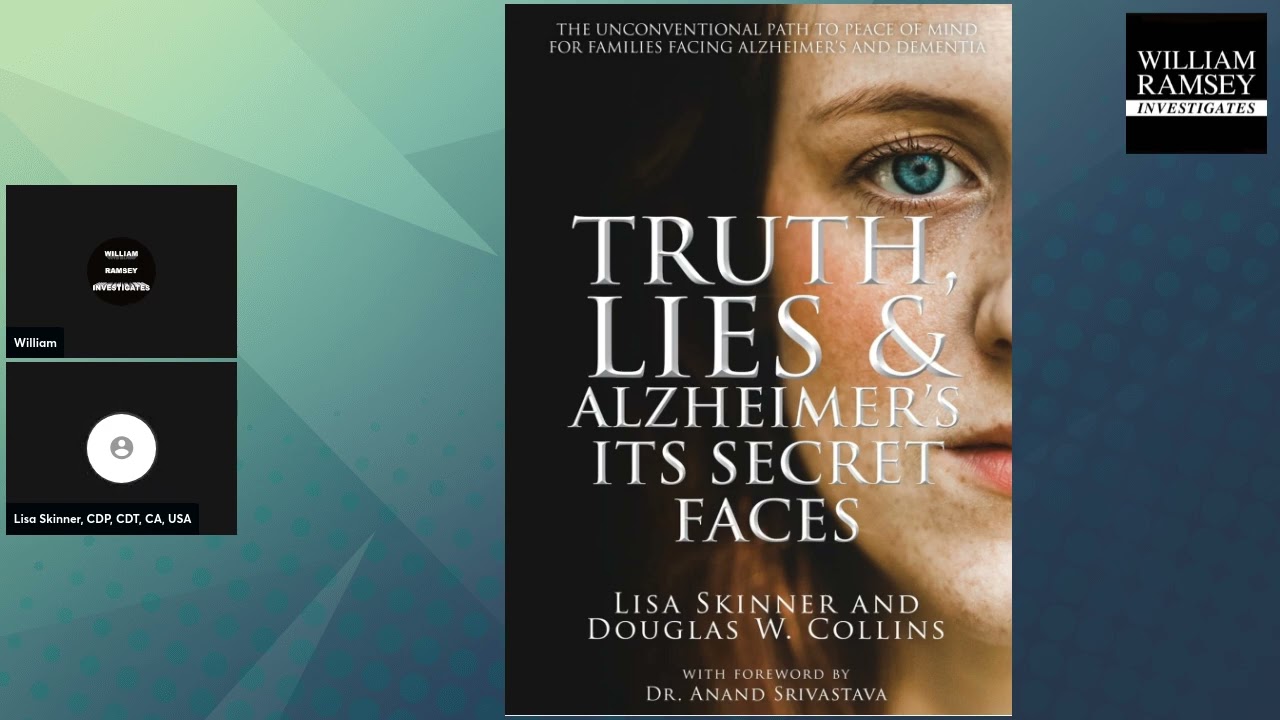
Okay, we are live. Hi, this is William Ramsey. Welcome to William Ramsey Investigates. On today's show, I have a very special guest. Her name is Lisa Skinner, S-K-I-N-N-E-R. And if you're watching this on Rockfin, Rumble, or X, you will see a cover to her book. The book title is Truth, Lies, and Alzheimer's: Its Secret Faces, and she's written this with Douglas W. Collins. She is a behavior specialist in the field of Alzheimer's disease and related dementias. She's had a 25-year career as a community counselor, private advisor, and regional director of senior care facilities. She's helped thousands of families and caregivers, and she had a number one bestselling book titled Not All Who Wander Need Be Lost. And this is her latest book, and she keeps working with people in this field. And she's been on many national and regional media broadcasts such as CBS, iHeartMedia, Fox, ABC, USA Today. And I will pull up her website, which I'll put in the show notes. Her website where she can be contacted is mindingdementiasummit.com. And you can find more information about what she does, her podcast too, as well. Is something that you can check out. So again, we're going to talk about this book, full title, Truth, Lies, and Alzheimer's: Its Secret Faces with Lisa Skinner. So Lisa, welcome to the show.
Hi, William. Thanks for having me. I really appreciate you asking me to come on today to talk about this heartbreaking disease that so many of us are thrust into.
Yeah, yeah, it's becoming more common. A lot of challenges as people age, they had faced these challenges. Maybe when we're younger, you don't see it up front. Some of the people's parents, or unfortunately their friends, have some of these, uh, either memory or dementia or Alzheimer's. Maybe you can talk about your background, how you got started in this a quarter century ago, and then we can just go from there.
My first experience actually dates back 50 years. Oh, wow. Yeah, with my personal experience, my first personal experience was with my grandmother. This was my introduction to Alzheimer's disease as a teenager, and it was significant in my life. It's played a very significant role in the path I've chosen. And you want me to tell you what happened real quick?
I do. Tell you, tell the whole story. Take your time.
It's a really interesting story.
Okay.
So my grandmother lived, I want to say, a mile from my family home. And I had a very close relationship with her. Saw her all the time. I grew up with her. And quite frankly, I adored her. She was a very special, special lady and a great cook. I just looked forward to any meals that she invited us over to. So I just got my driver's license and I was just so excited to show off to my grandma that I could drive over to her house all by myself now. So I went over there She answered the door. We went into the living room as usual for a quick, uh, catch-up. And no sooner did we sit down and she started telling me about these birds that were living in her mattress and that they would come out at night and peck at her face. And my jaw kind of opened up. Like, am I really hearing what I think I'm hearing? But then she started telling me about all these rats that were running around her house and invading her. And she pointed to the floor, she said, "Do you see them? Do you see them? They're running all over." And then finally she said, "And then there are these men that keep breaking into my home. They're stealing my jewelry. They're eating my food. They're just taking over, and I just know that they will eventually do away with me and just take over my life. And I don't know what to do about it. I'm so scared all the time. I can't sleep at night because these birds are pecking at my face. And my— by this time, my jaw is down to the floor, and it's the most far-fetched stories I have ever heard in my life. But I grew up in the generation where you do not contradict your elders. You always show the utmost respect. So I really didn't know how to respond to these stories I'm listening to coming. I mean, I didn't even know that there was anything wrong with my grandmother because my mother never told me. She never said a thing.
Right.
So what I did, out of respect for my grandmother, not that I understood anything about brain diseases or neurodegenerative conditions, but completely out of respect for my grandmother, I empathized with her and I said, oh, Grandma, this must be terrible for you. I said, I want to help you. I want to see if we can maybe get rid of the rats or get rid of the birds or, you know, just do whatever we need to do to help you feel safe again and you can start sleeping again. I said, let's start by going into your bedroom and I want you to show me where these birds are getting in and out of your mattress. So maybe we can call somebody that can take it away or do something about it. So we went into her bedroom. I threw the covers off her bed. I'm looking everywhere for signs of birds, holes, whatever. I couldn't find anything. And I said to her, 'Grandma, help me here. I'm not seeing anywhere where they're actually getting in and out of your mattress. Can you show me a hole or where you think that— how they're accessing your mattress?' And of course, she just kind of stared at her mattress, and then she turns to me and looks me straight in the face and she says, "Oh, Lisa, they're there. They're just very, very clever." And of course, later on, when I chose this as my profession, I learned that people living with dementia, one of the brain diseases that causes dementia, they become very masterful at explaining their stories to you. And that's exactly what she did. It was brilliant. And I stayed a little while longer, and then I went home, and I kind of chewed my mother out, and I said, why didn't you tell me that there was something wrong with Grandma? I said, this is how I had to find out. I didn't know what to say. I didn't know what to do. And she said yes, your grandmother has been diagnosed with senile dementia which is synonymous today with Alzheimer's disease. And Lisa, we're not going to talk about this anymore. And that was the mindset back then 50 years ago. People did not want to talk about Alzheimer's disease or senile dementia or whatever you want to call it. It was taboo. It carried back then stigmas that have followed us through today. But people kept it a secret in their families because they didn't want anybody to know that a crazy person was part of their family, which of course now we know it— this is not mental illness, this is actual brain disease that's damaging our brains and these are the behaviors we're seeing as a result. So as a teenager, my first experience was to witness my grandmother having a false belief or a delusion. That was— those were the birds in the mattress. She was having hallucinations with the rat. She was actually thought she was seeing rats running all over her floor. And then paranoia and suspiciousness, which is another very common behavior or response we see to the damage being done to the brain, and that was believing there were men trying to do away with her and they were stealing her things. And these are all actually very common things we see in people who are about entering their mid-stage of Alzheimer's disease or a related dementia. And when I say dementia, What I'm referring to is we— there are about 200 brain diseases that as of today have been identified to attack different parts of our brain. And then the result of that changing brain or the damage being done results in these behaviors like I just described. That I witnessed with my grandmother, and we put those all into a classification or a bucket that we refer to as dementia. So dementia is not a specific disease. It's a— it's a broad term. It's an umbrella term that we use to refer to the symptoms, the signs, and the behaviors that result from the brain, the damage being caused by the brain disease.
Right, right. So that's the phenomenon is dementia, not the cause, right?
That's exactly right. But the reason why there are hundreds and hundreds of these signs, symptoms, and behaviors, but there are overlapping similarities to what we see, even if it's being caused by a different brain disease. So some of the more common ones are Alzheimer's is the most common. We're starting to hear a lot more about Lewy body disease.
Yes, I know somebody. Yeah. Famous person in your neck of the woods up in Northern California was, uh, what the comedian had Lewy body, right?
Oh yeah. Robin Williams.
Robin Williams. Yeah.
Yeah. And then there's frontotemporal. There's vascular dementia, which we see the same similar signs, behaviors. But that's actually not a brain disease. That is caused by having a stroke or mini strokes. But the symptoms are very similar. The behaviors are very similar because the damage is being done, has been done to the brain by bleeding, the brain bleed. So that's that distinction, which a lot of people are unclear about. So I think it's kind of an important thing to clarify.
Yeah, I agree.
And then after my grandmother, I have since had 7 more family members follow in her footsteps. So to answer your first question that you asked me, this had a huge influence on me choosing to help other families that are going through this, because one of the things that I came to find out was a lot of people don't relate Alzheimer's disease with anything more than memory loss and confusion. And it is so much more complex than that. And I already gave you guys some examples of the behaviors I saw in my grandmother that are very common to having a brain disease.
And you mentioned stages too. I think that's an important thing to understand too, because people see this slide in, you saw this hallucinations with your grandmother and these kind of stories. But sometimes you get the little trace, like something's off with your loved one. They're seeing something. They may respond to sounds differently. They may fly off the handle more. They may become agitated easier. Would you agree that those are kind of the beginning, some of the beginning signs of dementia, like the onset?
They can be, but I'm glad you brought this up because this is a really important thing to raise awareness to. I've had so many people over the 30 years that I've been doing this professionally confide in me that they're worried that they might be developing Alzheimer's disease because they've misplaced their keys, or there's— once in a while they forget a person's name, it just flies out of their head. And I think we can all relate to this. It happens to me. I— last week I walked into my kitchen, I couldn't remember what the heck I went in there for. I turned around, walked out, and I go, oh yeah, now I remember. That is actually considered a part of the normal aging process. It happens to all of us. When it really becomes something more concerning and, you know, possibly time to get a professional medical assessment is when things like that start to occur more frequently and more severely, or some of the things that you mentioned, William, those start to occur. But most people are not even diagnosed with Alzheimer's disease till they're already well into their mid-stage because That is when these signs, symptoms, and behaviors become so blatantly obvious to family members and other people that we realize, you know, maybe there was something starting, but we really didn't— we just missed it or we didn't pick up on it because it was so subtle. And that's what makes living with these diseases even more difficult because it prevents us from doing earlier interventions than we might do if we were able to catch it earlier on.
Right, right. I mean, so, and there are interventions. Can you talk about some of those interventions?
Yes, we, there have actually been a myriad of studies done over the last 30, 40 years that actually have identified risk factors factors that can minimize an individual's risk of developing Alzheimer's disease, and there are 4 of them that we call non-modifiable. And then the rest of them, which is a huge list, those we call modifiable because you can make lifestyle changes, you can control them, you can treat them. So as far as the 4 non-modifiable ones. If any of these 4 that I'm going to reveal apply to any individual, those all are already stacked against you, if that makes sense. So the number 1 risk factor for developing Alzheimer's disease is our age, and we can't change that. We're all aging, and Alzheimer's disease the common type, typically starts to show up at the age of 65, with the exception of early onset Alzheimer's, which is a rarer type of Alzheimer's that will show up before the age of 65, but it's a rare type. Okay, so age is number one. Gender is number two, or gender is one of them. So if you're a female, Studies have shown, we know that more females, more women develop Alzheimer's disease than men. So if you're a 65-year-old woman, then you're at a little higher risk than a 55-year-old male, let's say.
What's the percentage-wise? Is it 60/40 women to men?
That sounds about right. And the reason why— there's a couple theories. Number one, women live longer than men. And the second theory is when women are going through the change of life stage and producing— or before change of life, we produce hormones that men don't even have. And there's a theory that there's a correlation between the estrogen that we have that they don't have could be a contributing factor to a higher risk of developing Alzheimer's disease. I don't think that that is based on defensible scientific fact, but they're thinking it has something to do with it. And then genetics plays a role. So there is an Alzheimer's gene that can be passed down by either our mothers, our fathers, or by both parents. It's called the APOE4 gene, and any child of somebody whose parent carries that gene, it can be passed down to that child. If they carry one allele of this APOE4 gene, then it came from one parent. If they have both of them, if they have two APOE4 genes, then it was passed down from the mom and the dad, and that increases your risk even more of developing Alzheimer's disease later in life. Now, I just want to reassure everybody, If you found out that you carry both genes, does that mean you're going to develop Alzheimer's disease? And I want to tell you, no, it does not. It means that you're at increased risk. So hopefully you can sleep tonight because it does not mean— it could skip you. Maybe you didn't inherit that gene. But all of these things that I'm talking about increase a person's risk does not mean that they will get it.
Gotcha.
And I mentioned a few minutes ago, I have 8 family members who have developed one of the 200 known brain diseases that cause dementia. 5 of those are blood relatives, and the other 3 were through marriage, like my mother-in-law was one of them. But 5 of them were on or in my mother's family. She didn't have it. But I, I do go through life knowing that I am at increased risk because obviously it runs in my family. So I have to pay attention to that. Is there anything I can do about it? Yes. Is there any way I can prevent it? Absolutely no. There is no known prevention. And then the fourth modifiable risk is ethnicity, and we do know now that certain ethnic backgrounds have a tendency to be at a higher risk of developing Alzheimer's disease than others, and we can't change our ethnicity. So I'm just going to, for sake of time, I'm just going to go through the four non-modifiable because those are the ones that Any of those 4 that I'm talking about apply to any individual, will increase your risk of developing Alzheimer's disease. But then, and I'm, I'm not going to go through these in detail, but I'm just going to mention them. There are quite a few risk factors that play into increasing your risk even more because they're gonna be added on to the non-modifiable ones. And the number one modifiable risk factor is cardiovascular disease. So anybody out there living with heart disease, high blood pressure, it does increase their risk, but we refer to it as a modifiable risk factor because it can be treated. Your doctor could, you know, treat that condition, that medical condition. There are a whole bunch of medical conditions that fall into increasing a person's risk. Diabetes is really huge, sleep apnea, hearing loss, but all of those can be controlled and managed under a doctor's care. So that's what makes the difference between modifiable and non-modifiable. And then the other really important ones to be aware of that studies have shown direct correlations to a person's risk of developing Alzheimer's disease falls under lifestyle choices. So the foods we eat, I think that there's absolute truth in that old adage, "You are what you eat," and we have found through these studies that the worst foods that we can eat are ultra-processed foods. They cause inflammation in our bodies, they can— they also cause inflammation in our brains, and there is a direct correlation between inflammation and a risk of developing Alzheimer's disease. So that's a lifestyle choice. It's recommended that you know, to minimize your risk as far as dietary choices goes, to maybe follow more of a keto or a Mediterranean-style diet with more leafy green vegetables and complex carbohydrates versus simple carbohydrates, because we know they spike the glucose levels in our bodies. So again, that's controllable if we choose to make those adaptations in our lifestyle. The other thing that we're seeing a direct correlation to a risk of developing Alzheimer's disease is getting regular exercise. And it doesn't have to be the old no pain, no gain type of really regular rigorous exercise. You can walk for 20 or 30 minutes, 4 or 5 days a week, and that will suffice in lowering your risk of developing Alzheimer's disease. Because just as we need to exercise our muscles, we need to exercise our— the cells in our brains and keep those neurons firing and keep our blood circulating. Those have all been found to be contributors to risk of developing Alzheimer's disease. And then the other thing that is recommended is that we continue throughout our life to stimulate our brains by learning. And the number one thing that has been pointed to that can really help minimize our chances of developing Alzheimer's disease is to learn a foreign language. You really have to work that brain to translate a language from one to the other. That's a great one, or learning a musical instrument. But anything that kind of requires critical thinking skills is kind of what they're talking about.
Gotcha. So lifelong learning will help you out. That's one of the positive choices. You can inculcate into your life to prevent kind of brain, brain decay, I guess, is the way to put it.
Yes.
And the food you eat. So these are good choices: exercise, eat well, keep learning. Those are kind of things that, uh, that keep you healthy. So that's a good concern, and your loved ones too, right? So those are good things to, uh, to take on in your life. And then, so what are the questions? What would— like, people always ask, what's the steps people take for people who are moving from kind of the early onset to middle stage Alzheimer's? Like, there's a lot of things— caregiving and oversight, and people wander around, there's sundowning, there's repetition, there's all kinds of pretty intense things that happen when people really go to the next stage, right?
Yeah, and these things that you mentioned all start showing up about mid-stage. Before that, they're pretty subtle. There's another in-between or interim stage that we call mild cognitive impairment, but the difference between that and normal aging process is really the frequency and the severity of the memory loss or the cognitive impairment, as we say. So if you're noticing it happening more frequently or more severely, that could be a telltale sign that a brain disease is developing in a person's brain. But not everybody who has mild cognitive impairment advances to dementia. It just depends on what the underlying causes. So let me just explain that real quickly. If it is a brain disease, one of these 200 brain diseases like Alzheimer's that actually is developing in a person's brain, that will for sure become dementia and progress all the way to the end of life. There's no going back. We have no cure, we have no treatment. We have prevent, or, you know, we have the things we just talked about that can help reduce risk. But it's— these are diseases that don't discriminate against anybody. They're either going to pick on you or they're not. And we don't know if we're one or the other until it happens. And that's part of the sadness of these diseases. It can show up in anybody at any time. So mid-stage is when we really start to notice that there's something really suspicious here. The other thing that happens with mild cognitive impairment, if it's not being caused by Alzheimer's disease or one of the others, It could be we're seeing this similar symptoms because the person is living with a thyroid condition. That can be treated with antibiotics. So if somebody does test positive for a urinary tract infection and they're treated with antibiotics, those symptoms and signs will go away. They're reversible, but only if it's not due to brain disease. And there's a couple others that are pretty common that mimic dementia symptoms besides urinary tract infections. It's Lyme disease is one that's huge. Kris Kristofferson, for those who you remember, of, of you who remember, I idolized the man when I was a teenager. He was diagnosed with Alzheimer's disease. And treated for it for 3 years. And then they decided to test him for Lyme disease, and it turns out that he had Lyme disease. They were treating him for the wrong thing. And then they start treating him for Lyme disease. But it is easy to misdiagnose because there's no conclusive or definitive diagnosis for Alzheimer's disease. They just— process of elimination. They eliminated everything else they thought it could be. So they finally narrowed it down to— he has Alzheimer's disease. Nobody thought to test him for Lyme disease until 3 years later, and it turned out to be positive. So that is another thing that can be— it can be reversed. And alcohol dementia is another one. So my point here is, depending on what the root cause of the symptoms that we're seeing are, there are a few conditions that, um, it will not progress into dementia, can be treated and either stopped in its tracks and you won't get any worse, or actually reverse the symptoms when once you get rid of the underlying cause—thyroids, Lyme disease, you know, the ones that I mentioned. Right.
And what's the effect, like somebody who gets sick, the effect on families is it's not just, it's pretty much everybody in that person's circle, right? I mean— Oh yes.
Yeah.
I mean, the psychological toll, not just for the person ailing from the disease, but people around them too.
Well, that's a really good point because I have heard so many stories from people who have neighbors that are living by themselves next door with dementia, and they're constantly coming over to their house and they need this and they want that and they're lonely, and it's just constant knock, knock, knock on the window, knock, knock, knock on the door. So it can affect anybody in that sphere.
Police, you can put the locals, the neighbors, the family. It's really something else because there's wandering. Like, this really happens, like these kind of, uh, silver warnings or whatever. Like, I'm seeing them all the time. People wander out of their house. Some people have to have like special locks on their doors to keep people from wandering out, right?
Yes, and this is really where, to the point where people who do have a brain disease that's causing dementia, it can come out of nowhere. Go walking out of the house and then all of a sudden, just on the flip of a switch, they don't remember their name, they don't remember where they live, they don't remember who they are. My grandmother, that's one of the things she did. She was living alone when I went to visit her. We had to change that at some point, but one day she got in her car to drive to the grocery store, something that she did on a routine basis, and she got on the Sir Francis Drake Boulevard, which was two lanes each way, and she stops her car in the middle of Sir Francis Drake and then gets out of her car and starts wandering around because evidently she was looking for the grocery store entrance and she thought that she had parked her car in the grocery store parking lot. But she was— yeah. And somebody, thank goodness, noticed that, gosh, there's this elderly woman just wandering around on Sir Francis Drake and she's put herself in complete harm's way So he helped her. And that can happen just in a split second. When she got in her car, she knew exactly where she was going and what she needed. And then just instantaneously, her short-term memory just short-circuited on her. And this happens every day.
Right. Happens all the time. These are like the new challenges. And what, what are your recommendations for people who are at extreme, kind of at the end of, uh, I mean, there are certain symptoms like they just, they don't get out of bed, like they almost are shut-ins, right? Like from when they go from moderate to extreme.
The severe, yeah, the severe stage, they're needing 24-hour-a-day, 7-day-a-week care. They need help with every one of their activities of daily living. A lot of them have kind of fallen into almost a comatose state, but I do want to emphasize that they're still there and they are still aware of their surroundings to some degree. So don't take that for granted because a lot of people think that they're gone and they're not. I mean, as far as understanding, hearing you, Being aware of music, those things are still reaching them. There is a living, breathing, feeling human being still in there to the absolute very end. But a lot of these things that we can keep— help keep them safe can be implemented into their homes, your homes, private homes, without having to have them go into a more institutionalized environment like a care home, a memory care neighborhood. But I think the, the main thing to understand here is there are a lot of products out there and things that we can do to help keep them safer if they want to stay home, if you make a decision to keep them at home, but you really have to make sure that their needs are taken care of. They really, I mean, send caregivers into their home and implement certain safety protocols that will help keep keep them from opening the front door and walking down the street and then not— and getting lost because they don't remember their name or how to get back to their house, that type of thing.
Right. It's, uh, and it's, it's kind of a slow process. It usually doesn't advance very fast. Would you agree with that?
Well, I do agree with that because that's what, um, science has shown us to date, um, that Alzheimer's disease and some of these other brain diseases can literally be developing inside our brains for 10 or 20 years before we even start to see the most subtle, um, signs. A long, long time. Some of them, it develops quicker than that. But when we start seeing symptoms, it's realistic to believe that they could have been developing it for decades before we actually start seeing the symptoms. So it is slow developing in some people and faster in other people.
Are there any modern tests or anything that can show that kind of early development taking place for people? MRIs or some kind of cognitive test or whatever?
We don't have anything conclusive or definitive to actually pinpoint that diagnosis, but there are a lot of tools out there like an MRI that can show atrophying in the brain. In other words, the brain shrinking. That is a sign of brain disease developing. The brain actually starts shrinking. So if you look at a, a photo of a healthy brain and one of a brain that has Alzheimer's disease, the size of the brain, the difference is just shocking. That can be seen. There's a PET scan that can show things like that. There's a new blood test that has just been approved recently, like in the last couple of months, that can now show if there's evidence or signs of something developing, but again, not conclusive or definitive. So there are helpful aids now, but nothing that— the only thing that we know of right now that can conclusively tell if somebody lived with Alzheimer's disease is after they've already passed and they can do an autopsy of the brain. Other than that, it's it's still, okay, well, I'm seeing signs of shrinkage on this MRI or in this PET scan, so I suspect that what we're seeing here is Alzheimer's disease, but it could be something else.
Right, that's the most important is get a proper diagnosis, right? Just like Chris, Christofferson's situation is make sure you're properly diagnosed because you may have some other disease too.
I mean, yeah, I think that they're probably going to have to start routinely testing people for Lyme disease now because it does mimic the many of the symptoms and the signs and the behaviors that we see with other diseases that cause dementia symptomology.
Right. Lisa Skinner Skinner Skinner, we are at the 40-minute mark. Is there anything else you'd like to add or anything I missed before we wrap it up?
One thing, and I tell this to everybody, nobody wants to be blindsided by an Alzheimer's diagnosis. It's devastating on families, caregivers, and the people who are diagnosed. My suggestion is to be more proactive, be more prepared if it happens to you. And we're being told that the number of people who will develop Alzheimer's disease, just in the next 25 years, is expected to triple worldwide. So the chances of it touching your family are high, or they're there. Be prepared. Understand the disease before anything else and know what it does to the brains of the people. And then I teach skills, techniques, to know how to effectively communicate with people who are living with these diseases. And I would like to invite everybody out there who is going through this now that I do offer a podcast. I've been doing it for 2 and a half years. It's a highly rated podcast globally, and it's a resource for everybody. I talk about every aspect under the sun about living with Alzheimer's disease and related dementia. And that's a free resource for everybody.
And that's Truth, Lies, and Alzheimer's, right? So people can find that anywhere.
Same title as my book. It just doesn't have its secret faces, but that is my podcast, Truth, Lies, and Alzheimer's.
And then your website is mindingdementiasummit.com, right? So correct. Also most more information there. In some of your other interviews. And is that the best way to contact you as well as through that?
Uh, I have a Facebook group that you can message me. That's called Lisa Skinner Author on Facebook. Okay. Or you can hit contact on my website.
Website. Okay. Yeah. That's good. So there's places to contact you. Yes. And the book can be found on Amazon. So let's get that back up. Let's get the title. Full title again is Truth, Lies, and Alzheimer's: Its Secret Faces. The author is Lisa Skinner, S-K-I-N-N-E-R. Ner, and I'll put links to our Facebook group, our website, and our podcast in the show notes so people can check that out. And thanks so much for your time and your wealth of information. I really appreciate it.
Thanks again for having me.
I appreciate that. Great. Stay there, stay there.
More from Lisa



Fidget Apron for Elderly, Sensory Aprons, Products for Elderly Demo with Lisa Skinner

Skil-Care Sensory Gel Pad for Light Box, Mini Fidgets, Set of Five Pieces for use with Dementia






