Lenore Hall, Lois Letchford & Lisa McCarty "When Learning is Trauma."
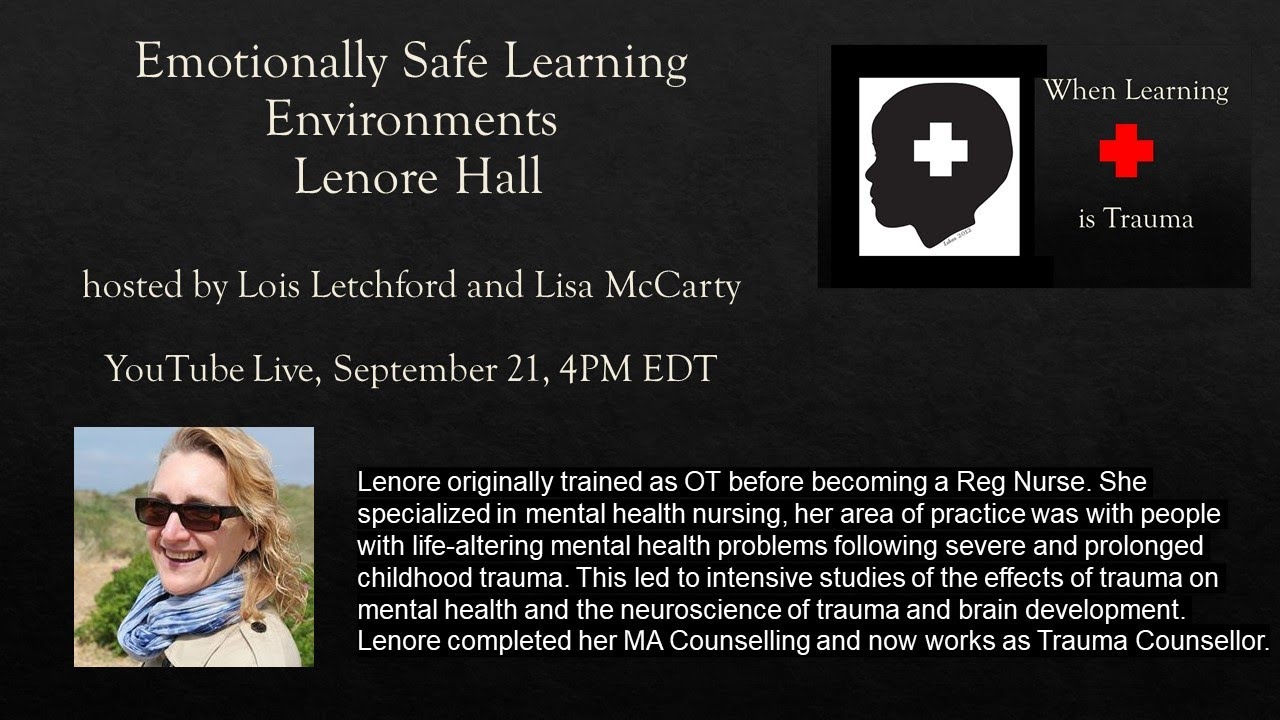
In this live YouTube panel titled “When Learning Is Trauma,” host Lois Letchford brings together trauma‑informed counsellor Lenore Hall and dyslexia advocate RN Lisa McCarty to explore how chronic stress and trauma interfere with learning, especially for children with language‑based learning differences. The conversation begins with Lois sharing her son Nicholas’s early school failures and the emotional fallout that went unnoticed. Lenore introduces Dan Siegel’s hand model of the brain, describing the survival (automatic) brain, the emotional (social) brain, and the executive (learning) brain, and explains how activation of the survival system shuts down the learning brain. The panel defines trauma broadly – not only major events but also repeated, overwhelming stress – and discusses how defensive patterns, isolation, and a lack of language to describe distress become entrenched in children and their families. They emphasize the need for safety, connection, and parasympathetic activation (deep breathing, laughter, fun) to bring the learning brain online. A recurring theme is “the problem is not the problem,” urging parents and educators to look beyond surface behaviours to underlying neuro‑biological stress. Practical strategies are offered: start with a child’s strengths, create fun, curiosity‑driven activities, teach emotional vocabulary, use breathing and humor, and build supportive adult “cheerleaders.” The discussion also covers advocacy – researching dyslexia, joining community groups, and collective action to change school practices. The episode concludes with calls to connect via social media, purchase Lois’s book, and tune in to the next episode featuring author Don Wynne.
Chapters
All right, remember, copy and paste this to your— this, the link that I'll pull up for you.
Wait, I don't—
you've got to do that for me.
Okay, fine.
And you're live.
We're live, so we can just wait while we copy and paste it into YouTube and Twitter so that people know what to do.
That's better. Right.
What's the temperature there, Lenore? Uh, I don't know what to do.
It's warm in a portal. It's only about 20 degrees, I guess.
So, which is really pleasant at 6 o'clock in the morning.
Yeah, it's just me. We're getting 30 degrees today. We're good.
No, don't say— don't do anything.
How are we doing?
Cutting one paste. You're live. Yeah, we're just waiting for it just to put it up on YouTube, on Twitter, and Facebook so that we all know, so that other people can join in and Do what they have to do. We've got— I'm having problems getting the right thumbnail up too because it keeps changing. So where are you, Lenore? We've got a blank chair. Lenore, we're missing you. We can hear you, but we're missing you. Lenore is in Brisbane, Australia. It's 6 AM, so it's very early for her. But the sun, you can see the sun is bright. Well, you can't see it. It's nice and hot as we face the equinox. Click on yourself. I need to click on myself. As we face the equinox, we get cold, they get hot. So I'll just wait for Lenore, but in the meantime, This is our series, When Learning Is Trauma, and before I begin, I'd like to acknowledge my son Isaac and his friend Chris for all their input and making sure this series goes out effectively. So, and it's really good to have such excellent technical support to do something like this. I'm Lois Letchford. I'm the author of the book Reversed: A Memoir and a Literacy Problem Solver. Lisa, thank you for joining us again. Tell me a little bit about you and why—
Yes, I'm, I'm Lisa McCarty. I am an RN, and I have 2 dyslexic sons and a dyslexic husband. So I've learned a lot over the years with this, and I'm just thrilled to be doing this series with you because I think it's so important. I'm a dyslexia advocate, and I'm also a member of the Decoding Dyslexia Pennsylvania And I work closely with other dyslexia groups as well, so I'm, I'm in it to win it.
I'm loving it.
And Lenore, welcome, welcome from Brisbane. This Lenore is our second international guest.
Thank you, thank you for having me. I'm related to Lois. Am I allowed to say that?
Yes, you can say that.
We're sisters. And I have seen the struggles that Lois has been through with the schooling and the issues with working with the system. And I'm also a registered nurse, and I happen to work in trauma, with trauma, in psychiatric care for people who've been very traumatized throughout their life. And I've seen the effects of, like, very, what you call, huge traumas on individual lives. But then what we fail to take into account are all the small traumas that also affect us. And so I've taken that further and I've done a Master's of Counselling. And my specialty is looking at trauma and how it affects us. And it really is much more than, than just a, like, seeing an accident and having PTSD. Trauma is, is, it involves us all actually, because we are all traumatized to a degree. None of us have perfect parents. None of us have that ability to, to really process trauma well as a child, and we need help to do that. And so many of us come into adulthood with issues of trauma that we don't even realize we have. And so that, that affects many just everyday people who go through experiences like not fitting in in school, getting bullied, who tell their parents or don't tell their parents, and who don't even realize. that it's affecting their nervous system and their brain. And the parents don't know how to help very often because they're often traumatized themselves and going through their own issues seeing their child suffer. So that's, that's just a little, a little in, into, I think, what we're going to talk about today.
Perfect.
And, um, yeah, because you, you just, to me, you just said some things that were, were critical. Let me tell you how this series came about, if you don't know. And it's that my son Nicholas failed first grade way back in 1994. And we know— I knew he wet his pants, I knew he bit his fingernails, and I knew he stared into space. I wasn't really aware of the teachers screaming and shouting at him every day. That took a long time to come out. And A couple of years ago, you know, well, now this boy is confident, he's appeared to overcome these challenges, confident, competent, and articulate. And I said, and I thought, this will be fine, I can ask him now about what happened in first grade. And my son shut down. He cried and his tongue went round in his mouth. I took a video of it and I deleted it. Oh, my goodness. because I didn't want anyone to see it. And it was on talking to Lenore that we realized the implications of it and what had actually happened during that first year. And Lisa lives with it more on a daily basis.
I'm in the thick of it right now. And it's scary. And, you know, we do what we can, but it's hard for these kids, I think. You know, a lot of adults that I talk to, they have had to learn to live with this. And the lucky ones find out what the nature of the problem was, and they're able to sometimes, um, you know, get a little peace with it. But other people don't, and that scares me. And I actually work as an RN in an inpatient drug and alcohol facility. And, you know, I also have— so I'm speaking with adults that have been through some problems with with school. But I also have my, my sons who, in talking to their friends, it's, it's serious and it's dangerous. And it, and it's, and it's, as a parent, it's traumatizing too, I would even add. You know, it's hard for parents to watch this and the things that we hear the kids saying. And so I'm just so excited that Lenore's with us to give us some information about what happens to the brain, you know. And there's, there's our, um, Lois has our poster up there, which is, is terrific. So yeah, I'm, I'm right in it.
That's a really great place to start, Lois. Should we start now with your poster?
Yes, I've posted this on a number of occasions, but Lenore, would you talk us through this? I'll walk it through.
I'll walk you through. Now, might I add, you know, I'm no great expert expert on the basic neurology, neurobiology, because, um, but this stuff is just becoming so, uh, well known, especially in the therapy and counseling and psychology circles. So if anyone is interested, like, I just give you a good source, and that is Dan Siegel. He's the originator of what we call the hand model of the brain, but, and it looks at these basic areas. The survival brain, the emotional brain, and the executive brain. Now, if we start with the survival brain, that is our automatic brain, and that just connects— that connects to the heart, breathing, and digestion. It's all— and it's very important in our, um, the fight-flight reaction when we get— when we experience danger. that part of the brain alerts and we go into fight-flight mode. So everyone, I'm sure, has heard of the fight-flight-freeze reaction that originates in our survival state. That's, that's not under our automatic— that's not under our control. So that happens automatically. Then we have the emotional brain, and we call it the social-emotional brain. In the limbic system, which is the next one. And if you do the beautiful Dan Siegel hand model, the automatic brain is, is in the, in the palm. The emotional brain is in the thumb, which is just over your palm. That part of the brain is to do with connecting to people. It's very involved in our attachment when we are children.
Yes.
how we connect to others. Our memories are all stored there. And that's also connected to the fight underneath part of the brain. So right sits right over the fight flight. So very involved in that. And the final part of the brain, this executive or smart brain, which is our top fingers, which just curl over the top. That's our learning brain. Now this very— this is a very important piece into piece of information to remember for anybody. And I'm This is very simplified, so please, if I sound like I'm talking to children, it's just so everybody can get it, but it's very good information to know. When our— so with our learning brain, it's very important we are in a relaxed state to be able to have our learning brain functioning. So when we're in any state of stress or distress, which is activating our survival brain, our cortex literally goes offline. We flip our lids, as Dan Siegel says. So the learning brain does not function. We can't think clearly when we're under stress. And it's only through— and it's actually the actions of the activity of the emotional social brain And as we start speaking, as we can start connecting, because our speech is on our smart brain, executive brain. So when we can start activating the social brain and our speaking brain, that we can start to calm that survival system and get our learning online again. Now that's very important basic information to understand. Is that, is that clear, Lisa?
Yeah, I like the explanation. It is very clear, and it makes sense when I think back on some of the comments that I've heard the kids say, or just in talking to my husband and other people who struggle with this, because it's definitely harder for them when they're feeling that anxious. And now I can see why.
Exactly, because that part of the brain is basically offline, your learning brain doesn't work. When we, when we have our stress levels up high, and often with children going through even more so with repeated stress, then you learn to be in that state of constant trying to function in that state because you develop defensive patterns, which, which are all about protecting yourself. So defensive patterns of of approaching people within our social brain, then you, you, it's more about protecting yourself than approaching people. It feels, people feel more, situations feel more dangerous. So you're protecting yourself and you're not open to learning and trying out new things and asking questions. Does that make sense?
Yes.
Yeah. Lenore, you said, you said You know, that the children, something goes wrong and they don't tell their parents, or that, you know, the parents aren't aware. Can you tell us more about that, please? Well, I think it's—
there's probably many reasons, but it's, to me, I think it's very much about that protective, trying to— those patterns of protection rather than and defensive patterns where they're trying to protect themselves rather than— and like feeling like they're not good enough and it's something's wrong with them. They'd start developing an identity around, around this. So it's, it's my fault and I should be able to like figure this out. Nobody can help me. Those sorts of— that sort of thinking is all connected to this. So there's probably many reasons, Lois. I don't, I don't know. Sometimes it's like you said with Nicholas, there are no words. They don't even know how to put it into words what's happening, especially when you're a younger child, right? That's, um, and that was Nicholas's experience.
Yeah.
Would you say that how it was for you?
Well, you've said a few things then, you know, that That it's defensive, that it's my fault. And the children don't have the language to say, I'm hurting even. I can't do it. And then, you know, in our other talks, you've talked about children failing in school. Then the parents get the call, your child's not doing well. What's the family reaction?
Well, it sets off— as Lisa talked about, it sets off a chain reaction. in the family because parents go into stress as well. I mean, the parent— as you, Lizzie, you said, your parent— you as a parent, it's trauma for you.
Yes.
Everyone is affected when their child is hurting to, you know, to the extent, you know, that that reaction of your stress response is up. What do I do?
What—
how do we approach this? And often we go in guns blazing as well, you know, because it's like, I, you know, it's hard to To just keep open and feel like this is an easy thing to do because you don't know what to do either.
It's scary.
It's scary and you're stressed. It's scary and stressed. And what stress does to the brain is that whole process we talked about. Your executive, your learning brain, your— yeah, your ability to hear and be open is also not not doing so well. So the most important thing for a parent is to know, first of all, okay, just keep calm, keep, you know, knowing how to calm yourself. And that might not be an easy thing if you're not familiar, if you haven't dealt with this thing before, you know, if life's just been okay before.
And Lenore, I, you know, I've noticed with kids who have learning problems or other problems at school, it's not just learning problems, it can be social-emotional things, things going on with groups of kids, whatever it is, when they start to get that, um, when that fight or flight is happening even before they get into the building and they're coming up with, my stomach hurts, I'm sick, I can't go to school, and then they get into truant behaviors and things like that. And then of course they're also looked at as behavioral problems at that point. Um, but, and can you talk a little bit about what you see with when, when that stress is happening? Like when it's almost as though You expect it to be bad. You expect to be, you know, to have your learning environment not go well. It's that expectation of, you know, trauma or being scared or being in that fight or flight. Do you see then kids shut down? I mean, I've seen this in my own family, but I can imagine it happens to many more where you go from trauma to just shut down.
Yeah.
That is exactly right, because it's those levels of stress in the body where you have that heightened response first of all, but then when you're absolutely at that point where you can't take anymore, you shut down because that's the only way to survive in that environment. That is absolutely— that's described so beautifully by other, other authors how that happens, and, and then you disconnect. And, you know, you can— and that can go so far as you can disconnect from your, from your body and from the environment. You go often into the daydream, or you disconnect into other forms of behavior that give you something, you know, like bad behavior you describe. But the— it's very much connected to those repeated states of trauma and stress, I might add.
Mm-hmm.
Produce those patterns of defence, those defensive patterns where you, like you talk about, your expectations are this is not going to go well. Your whole view of the world is affected because you have these repeated situations. Why would you expect any different? There's no one there to help me, you know. This is what I get.
Yeah.
And so you, instead of the patterns of approach, which is what, when you feel safe, when we feel safe and connected to another human being, this is our basic attachment, um, learning that tells us we need safety as the very basis of all, um, social connecting. We need to feel safe and connected to another human being. then we can be open to approach. Then we're open, then we're curious, and we're looking for, hey, this is a great world. And, you know, and then we look around and look— the little kids look for mummy. Yeah, mummy's there, I'm good. And off they go again. So that beautiful picture of, you know, what good attachment looks like. But attachment never stops. We're always looking for those safe connections to thrive. You know, that's part of us as people. We need healthy connections We need that safety all through our lives. It doesn't stop when we're little kids. And when we feel safe, when we feel like we're not going to be attacked, like we are— we've got something to offer, yay! You know, we're just excited to go out there and explore. And that's what our kids lack, right?
Lenore, we've been talking a lot about this offline. But we talked about why you and I and Lisa think the word fun should be a scientific word.
Yeah, that's great. That's great. Well, let's— I'll put it into the neurobiology again really quickly. Because let's just look at the 2 systems that are activated. Okay, so that survival brain is connected, connected to the sympathetic nervous system, the fight-flight, which reduces— sorry, releases adrenaline and cortisol in the body. So that puts the whole— we all know that sense of the heart rate's going, our stress is high, we can't— we're just shallow breathing, that state of just gotta act.
Panic.
Fight-flight. It says it all very well. Our state of the emotional brain in the middle Is connected to the parasympathetic. Very simply, it's a little bit more complex than this, but the basic function is with the parasympathetic nervous system that works like the brake on the sympathetic. So that's the system we need to get to to reduce our stress. One of the best ways to do that is just deep breaths. Couple of deep breaths. Laughing is another way. Laughter, singing, just any way to connect to that parasympathetic nervous system gets— reduces the stress on the sympathetic. So laughing and fun is a surefire way. If you can laugh, you're right, you, you get used to— you know, you can't be stressed and laugh at the same time. time. It's just beautiful how the body works. But we need to tap into knowing how it works and finding the ways that tap into that and the strategies that help our kids, right?
That makes sense. Yes. Yes. I mean, that's what I did with Nicholas.
Yes.
You know, and I asked him when he's 28, what do you remember from this time? Well, he remembers the serious stuff. But, you know, I wrote a really silly poem for him that was, you know, a really silly poem. And I'm thinking I'm getting one thing out of it. He wrote the ingredients for the witch's spell. 25 years after that, his face lit up. That was so funny.
Wow.
I don't remember the details. But I just— they remember the feeling. That was so funny.
And right on that point again, yeah, it's okay. But in our social brain, where we've all seen it now, that's also connected to our memories and our emotions. So when you have high states of emotion connected to a memory, like the fun things or the traumatic things, either, either high states, those are the things we remember most.
Yeah.
So all our stressful events where we have really high emotions, we remember those. You remember the things where there was danger and where you, where you were really scared from your childhood.
Yeah.
Right? But you also remember really well the things that were really fun, that really warmed your heart, were really great, you were really connected and safe.
Yeah.
But also with learning, the importance of having, having that level of curiosity and interest and fun involved in learning, it's going to help our kids to remember. So if our kids are bored out of their brains with learning, they're not going to remember it. Because that is literally encrypted into our neurobiology, right? We need to be engaged and curious and having some interest in it to be able to learn. I don't know if teachers get that when they have teacher training, but I'm sure they do.
Well, actually, I don't think they do, and particularly With reading, we've got so much focus on you've got to learn these letters and sounds and you've got to do the phonemic awareness. They forget about the emotional engagements that are absolutely critical for a child to be connected to the text or the poem or whatever they are using. And they're just giving read it, answer the questions, read it, answer the question, and forgetting everything else. And it really Tell me what happens to the brain then.
Can you imagine, like, the stress, what we talked about? Now there's different— like, trauma is not— trauma is not those big things that happen, and repeated trauma is not that, just all the big negative events. Trauma is, is anything that's stressful, that feels overwhelming, right? That's my definition that I go from, where we feel overwhelmed, where we don't feel we have the resources To do this. Our stress levels are up there.
Yeah.
So you've got repeated tests happening in schools, repeated questions with children who don't grasp the basics. How traumatic, how stressful is that?
Yeah.
And it's that repeated stress then that's forming their worldview and their identity. And, and like Lisa said, the issues have just become so compounded. Because we, we just don't realize how, how bad it is for these poor kids. Yeah. Yeah.
Lenore, you know, when, when we have talked too, you have said what happens to our memories, you know, when these memories are being laid down, what happens in the brain? How do we get rid of them? How do we deal with Oh, okay, these traumatic memories. Yes.
Yes, yes, that's a great question because we— you can. It's, it's not that you can't, like they're stuck there forever. Trauma can— trauma needs to be processed, otherwise they do get stuck in the brain. And like Lois described right in the beginning with Nick, there was no words Right? But trauma, these memories get stuck in that part of the brain, the social brain, where we— where the memories are connected to the limbic system, the amygdala. And I mean, there's a whole— the neurobiology will go through those processes, but I can't even start to go through it here. It's very, very complex. But it's so important to get— to be able to get that That learning your, your cortex online to gently just encourage the words, or tell me what happened, like whatever words they can get out. Because once you start connecting the words, our language is in the cortical part of the brain. So you are starting to connect to your cortical part of your brain and You're starting to get the brain to be more coordinated and connected because while you don't have language, those memories are stuck there.
That's fascinating.
Yeah.
And I think it also goes beyond school and into my area, your area, where you're dealing with people who have language-based problems. They have difficulty expressing these things. And how are they supposed to work through this with folks if they can't really get that out? And I think, you know, when Lois is talking about her son unable to process that, um, you know, it's, it's a problem. Because if you're a counselor and you're dealing with somebody who's been through some of these things and also is dealing with a learning problem, say like dyslexia, Yeah. you have to understand the nature of their difficulty and somehow or other, you know, help them through this. But I think sometimes these people also get labeled as sort of, um, you know, unwilling to work through their counseling session or whatever. If the person that on the other end, the counselor, doesn't understand that, it can be hard.
Absolutely right, because we—
you—
it's so vital what you said that, because that's something I needed To have get through here, that you're getting into the area of their ment. It's a mental health issue. Then it's affecting their mental health in a way that like and then you get all lovely labels on it. But we know these kids are not doing well, and they're using other ways to feel good. As you said before, either like getting into drugs and alcohol, or you know they these. bad behaviors, or, or they're stuck, you know, in very difficult— like, or they're isolated, which brings its own pain. Because isolation— look, I might add, I've written in a blog, I was shocked when I read it in a book— the pain of isolation equals the pain of injury, like physical injury.
Yeah.
We feel physical pain when we're isolated from people, or when we isolate ourselves. And what do people do? You need to— they medicate themselves for pain, right? It's a whole area of mental health we're getting into, as I'm sure so many families experience.
Yeah.
And I find myself getting frustrated when people will say, well, other things cause these things. And that's true. Other things certainly do cause anxiety, depression, substance use problems and suicidal ideation, all that. That's true. A lot of other things do cause those, those problems. But this is an area that needs attention, and we all should be caring about this. So I like to say, I understand that other things can cause all of these things, but I'm dealing with, you know, that has learning problems, and I'm surrounded by it. And so this is where I do put that focus. So that people can understand how serious this is. Yeah.
And I think as people, we, we like to have simple solutions, right? We like this simple cause and effect when it is never, ever, ever like that. We are complex people. We have complex brains. It is never just this equals that. So when we take— we have to take the whole picture. We have to look at the dynamics of what's happening in that child's life and the complexity of how this is all— what the meaning that child is making of that. And because we're meaning-making people as well. So the child is forming beliefs about themselves. all the time in those early developmental years are fundamental. Fundamental learning is occurring as we send our children to school and in our homes, right? So how we— and when we're parents, often parents, we don't know what to do. You know, I've been there. I've parented 2 children.
Yeah.
And you keep trying, you keep doing the same thing over and over because that's all you know. And keep getting the same result because you don't know to do anything different. And we all do it, you know, it's not, it's not we're bad parents, but it's just that we, we don't know how to help our children. And it's painful, it's a really painful place to be.
Lenore, you talked about, you know, the little saying that you have, the problem is not the problem.
Yes.
And that, I think, is what— is that what you're talking about now?
Absolutely. That was exactly on my mind because we see a problem in front of us. The teachers see a problem in front of them, like the behaviour problems, or this child is not paying attention, or, you know, I've got a class full of kids and I've got to get through this class with all these tests and test results and all this. So they're focusing on their problem. The problem often, like the problem they're seeing in the children, is not the problem, as we know as parents, the problem is not the problem. It's the deeper issues that, certainly with dyslexia, there's a whole issue of that you're not addressing that level. So definitely the problem is a great way to remind yourself that this is not the real issue. And dig a little bit deeper. So if you're trying to deal with it, it's about digging a little bit deeper because every person is different, every child is different. So with one child, you might have to— like with Nicholas, he said he had no words for that experience, but you could start connecting with him on the fun things. So you, you connect, you get— start to connect where you can. Build connection where you can, which starts connecting other areas of the brain. So it's like you've got to start, always start from a place of safety. What can your child cope with? And build connection where you can, and then start going deeper and deeper to where the real issues are. Does that make sense?
So really, I'm just listening to the birds in the background, which is Brisbane, Australia at 6 AM. Yeah, the crows are really talkative. But also, Lenore, what you're saying then is when children are struggling, the first thing should not be deal with the letters and sounds. We have to find other ways to connect with the child before you even start dealing with the things that they are struggling with.
Oh, that is— that absolutely makes total sense from a neurobiological sense, in a neurobiological way, because you're trying to push the very thing they're really, really stressed about, right? So you have to go back to where they feel safe.
Yeah.
So what's something they can feel in control of? What do they get? What, what is their level of mastery? Yeah, for a teacher's term, I guess.
You just said it. What do they get? So you've got to start with their strengths.
Yes, absolutely. Because they feel safe in that.
Yeah.
And I'm sure that's totally, you know, you saw it with Nicholas, right?
Oh, yes. Yes.
Yeah.
You know, and recently Dr. Tim Rozynski wrote a post and gave all of the positives on poetry and the power of poetry. And I wrote and added, you've got to add the emotional connection.
Oh, beautiful. I love it.
You know, and when we're providing, you can do this. Before we start doing the things they struggle with, we're giving them a foundation of confidence and of strength building.
Exactly, because they feel safe with the— with that, within that environment, they feel connected. And then the learning brain is fully, fully connected online, and you've got the brain doing all what it's supposed to do, you know, working like As it's supposed to. It's, you know, I think it's really vital to remember whatever you can do to bring that brain, the cortical brain, the learning brain online. That's what's vital. That safety, safe connections, and that emotional, I'm okay, I can do this. Yeah, that is vital.
I can do this. And I want to do this. Oh, you know, it's the one to the other, isn't it?
I have a little 2-year-old grandchild, and he's— that's what he says.
I can—
I do it, I do it. That's his favorite thing when he's doing a puzzle. It's so exciting. I do it, I do it. And so he's excited to do the next one and something that's a bit harder. You know, it's just It's beautiful to see, isn't it?
Well, that's, that's what I got from Nicholas when we had that time, you know, the time in Oxford, was that, you know, I tapped into his curiosity and his strengths. And he said, he said recently, you know, I started to love learning there. In fact, he wrote that in the beginning of his PhD thesis, you know, this is where the place where I learned that I could learn.
Yes.
And I never want to stop learning. That's what he says now.
Yes. Oh, that is just beautiful. Lisa, is that your experience? Have you had any positives with your children in their learning?
Well, yeah, I have.
And actually, um, Kieran's been working with Lois, and the first time he worked with her, I almost fell over when I asked him how it went because I had had to go to work. And he said it was actually fun, and I almost hit the floor. I thought, I've never heard him, you know, say that about the thing that's most difficult for him. So, so that was really exciting. But Lois and I have had some conversations about this, and, you know, and we, we really think that a connection has to be made in order for them to feel like it's, uh, or, or have wins, get some wins as I call it. We actually have a question. Um, do you see that from, from Dina?
Yes.
It says, how did you cope with Um, or how did you train or help yourself associating learning with trauma? So how did you come to connect the dots there? I think that's—
Yeah, but I remember Lois telling me that story of Nicholas where he had no words. Remember?
Yes.
So that, that— can you just say that question, say that experience? I think this is a vital piece of information. Because people are not seeing that it's traumatic and the stress of what our children are going through. So I think it's really important that this is what we're trying— this is exactly what we're trying to get across in this message, right?
Yeah.
Well, the question is, how do you train yourself out of association with learning with trauma?
So how do you Sorry, sorry.
Yeah, no, no, no.
I think I said it wrong.
Yeah. Okay.
So once it's there, once you— how do you say every time I go into this situation, really you're in a panic mode?
Oh, exactly. Great question. Oh, dear people. Oh, you're all darlings. Yeah. So remembering these 2 states within our body. Recognizing that our survival brain is connected to the fight-flight, and our social safety is connected to this parasympathetic system. So when we, when we recognize that we're in that state of heightened alert, we're in that state of stress.
Yes.
That's when we— it's so vital to take some deep breaths. Say to yourself, I'm stressed, I'm scared.
Use language.
Put words on it, because that starts to help connect your learning brain to bring your stress down. Take some deep breaths. Give yourself some gentle words. It's okay, you're okay, you're gonna be okay, we're gonna find a way, you know, somehow to get through this. Like, I hope you've got some connecting somewhere, like, or we've got to find some help in this.
Yeah.
Just some words of encouragement. But the deep breaths, I can't stress enough how vital our intentional deep breaths Are to reduce our stress levels going into that situation. And gentle words to ourselves, or finding a safe person who can help you through it. Absolutely vital.
That's key.
Safe connections to help us work with this. Lois, you're crying about—
Oh well, she's saying this. Xena has written, how do you cope with being brought down while learning how you learn? You know, and that's that you need help. Would you answer that, Lenore?
You need help. You need safe people to help you because you don't have the resources yourself. That's why you're struggling. You don't have the resources. And trauma, as I said right in the beginning, is when our system— when we are overwhelmed by our experiences, by what's happening around us. When our internal resources are overwhelmed, that's traumatic. That's a traumatic environment for us. Our stress levels are up, and when you continually go into that stressful environment, it's actually damaging our brain.
Yeah, yeah.
And we need help.
Yeah, yeah, we need help. And when you do have the learning, you want it to be You know, it's not delivered in a way that is engaging. So it's got to be more of a fun. So how can we take that learning and turn it into something that will make you laugh? Or can we turn it into a song so that the brain is able to take in this information?
Yeah.
I mean, I think that's what I— that's how I operate when I'm dealing with the most damaged children, because if it's not fun, Forget it.
Yes, exactly. And Lois, that you've, you've gotten to that place by pure instinct and seeing what works. But the neuroscience totally backs everything up that you've done.
Yeah.
And the connect— like, you had that safe connection with Nicholas.
Yes.
So then you could build on that. But it is vital, like, to— for parents to understand this is not the child's Yeah. It's not— and often, you know, it is— we're in a difficult school system where they've got all their checklists and whatever else they've got to get through. But those techniques that you employ, I look—
get it out there.
You're doing a fantastic job just getting it out there and making that known because you know they work.
Yes.
There's another—
There's another comment from Xena. That was powerful. Do you think that it is true for both children and young adults?
Yes.
I'm not sure what that is. That's a pronoun, but I—
Trauma. Trauma. Yes. Like, we all can— we all need those safe connections. And we all can be traumatized throughout life. You know, just because we get to adulthood doesn't mean to say, you know, we've got all the answers to everything, if that's what she's referring to. But it's about learning these techniques.
Yeah.
Or from managing our own stress as parents, first of all, in helping our children.
Yeah.
We have to learn to just Bring our own stress levels down because we're teaching our children how to do that as well as we do it. Our children model what we do. So if we're getting more and more stressed, our children are learning that as well.
Yeah.
So look, it's— yeah, it's really important.
And that also probably also started to answer— Christopher had a question Do we have any advice? And this goes to the 3 of us. Do we have any advice for coping with academic trauma? I would say, you know, getting that cheerleader who understands it is key. Getting that, you know, I'm a dyslexia advocate. This is why I do what I do, because I want to have somebody in their corner that understands it. That's my advice. Find somebody that understands how these kids are feeling. how they learn best, and help advocate for them, and then teach them to advocate for themselves. That's where we are with my youngest son, and I have to tell him, you have to understand this. And I say, here's your opportunity to learn how you learn.
Yes.
And we are his cheerleaders in helping that, but we also understand this. And that's not so for some of the kids, but you have to find that key person or people, teacher, parent, somebody that can help. That's my advice.
Absolutely. That's that whole feeling of I'm not alone in the world.
Yes.
Because when you, when you feel alone, it's, it's damaging. Like, it's, it's giving— it's pain. It's— you feel that pain in our nervous system. It's an injury. And in isolation and loneliness is Again, going into that arena of mental health, that habitual isolation, and I'm alone with this and disconnected from people because, you know, everybody else seems to be getting it, but I can't.
Yes.
It's damaging the nervous system when this is their continual experience. So yes, safe people, getting them connected to safe people, but teaching skills of getting their stress levels down, managing stress, right? Recognizing when you're feeling stressed, teaching your kids this so that they start to recognize it in themselves. I can feel like, what, what does stress feel like in your body? And I've written this in a blog, you know, your heart's racing, you're, you're all that. So the kids start to see that as normal if this is happening all the time, but teaching them that, you know, we can actually work, we can take some deep breaths, start to, you know, whether you just have to hum or sing or something.
Yeah.
Think of something positive or something just to help you get those stress levels down.
Get—
hold something in your hand that's an object of connection and And something that's meaningful, because— and then you can feel that you're holding something, it moves something in your brain. So all these— there's little strategies, there's just get help to— so that the child can start building some strategies to help managing their stress, and they're not feeling like they're powerless. Yeah, yeah, it's really important.
That's really huge, you know, that the feeling that you're not powerless. I mean, you know, what we've talked about a lot, because I think we've said, you know, when children are failing, they don't have the words.
Yeah.
So we have to, you know, give them the words and say it's okay to feel bad. And then when the school calls us up and says the child's not doing, we are the ones who have to stop and say, let's take a breath and let's examine this. Before we start condemning the child and looking at what else we have to do. What else? What other comments do you have, Lenore? Time's running out.
Well, I just loved what Lisa said before, advocate, because if your child doesn't have the words, then as a parent you can see your child's distressed. And rather than— then it's the problem is not the problem. So dig a little deeper and you have to find the words to advocate on behalf of your child and to be that, give them, to speak those words like, and to empower them, right? That's what Lisa said before. I hear there's a whole network of this happening, which is powerful because collectively we can do it, right? We need to think a collective, in a collective way. We have greater abilities as people. And we need to build connections as people, not divide. You know, we don't do well when it's us and them, where we're dividing each other, where it's like, even with teachers, we don't do well when it's like, you know, going with all guns blazing. We do much better if we go in and say, hey, we've got a collective problem here, we need to try to find ways to deal with it. Does that make sense?
Yes, that's perfect, Lenore. Our time is running out.
Yeah.
So we all have to take a breath. Where have I gone? I've lost something. I've lost everything.
Thank you.
I'm back again with the help of Isaac. Lenore, thank you for your insights. And I've taken away the problem is not the problem. Stop blaming the child. When a child's in fight and flight, they're not— nothing's going in and they have no control.
Yeah.
When a child is feeling physically isolated, we're back into fight and flight and it's physical pain. They're the things we have to change. Start with safety, start with connections. But ultimately, for children who we want to They have to be laughing, emotionally engaged, be curious, and turning that— the word fun into a science word.
Yeah.
Absolutely. I love it.
I love it.
Lisa, is there anything else you want to say?
I think you just hit all of it. You had all those points that Lenora brought up, and I think you covered it all.
It's absolutely great to connect on that. You know, that power of connection is powerful. You know, when we are connecting and agreeing what— with these, you know, it warms your heart. And just take that away. We need those warm heart connections.
I do have one thing to add.
Yes.
Yeah, that—
and I, and I say this all the time, um, to research Research yourselves. Do your own research into some of these things.
Yeah.
Because if you're waiting for schools to uncover some of this, if you're waiting for other people to understand it, it might not happen quick enough. And so if you know that there's a problem, you research these areas so that you can understand them a little better. Because I think part of what happens with parents, as we've mentioned, is we're scared. We're scared and it makes everything worse. So if we have the knowledge base, we can help to educate other people on what some of these kids and even people who are in college, whatever, a lot of people are undiagnosed with certain things. And if you do your own research, we can— you can help uncover what's needed.
We have one more question, and it's from, again, from Xena. If the parents aren't supportive, how can a person become their own cheerleader?
Research.
Research.
Yes, information is power. It really is. Yeah, infinite. But also connect, connect to yourself. Like, when you notice you, you're most stressed, learn to get your stress levels down yourself. Be your own friend in that.
That's beautiful.
So that's really important. Connect to yourself and then connect to supportive people to help you research.
And other groups. There's a lot of groups that are available on Facebook and online, and you can be your own support system and bounce ideas off of each other. I think there's a lot of information out there that can really help people. And there are things if you're a struggling reader, for example, there's a lot of great YouTubes. This is one of them, right? A lot of great YouTube, Lois. She's got a lot of great ideas and information that if you can't read well, or if that's stressful for you, there's— this is the digital age. There's so much information out there. You just have to, you have to put your mind to it and dig for it. And it's doable.
It's doable. Well, thank you, Lisa. Lisa, where can we connect with you?
Well, I'm on Facebook. And again, I mentioned I'm also with Decoding Dyslexia of Pennsylvania. I'm on LinkedIn. LinkedIn, sort of, but I don't really check that. One of these days I'll get into that, I suppose. Mostly Facebook.
And Lenore, you can connect to Lenore through me. Ask me a question from my website. Sorry?
Facebook.
Lenore's on Facebook. Great to hear. Now where's my conclusion? Connect with me because I'm the author and I'm doing all this social promotion. It's all part of me. Please hit the like and subscribe button because that helps our, uh, the YouTube data and the YouTube algorithm.
Action.
I didn't hear that.
Action.
And my channel, it helps promote everything that we do. Find me on my website, loislatchford.com, and I'm on Facebook on loislatchford.com, on Twitter and LinkedIn as well. Twitter is @LetchfordLois. So great, Lenore, thank you for getting up early. I did that.
You're welcome.
Oh, you can buy my book on Amazon as well. Amazon is the easiest place. The comment that comes out every time is that every educator should read my book because it's— it, you know, Nicholas had an extraordinary story and I talked about it on my YouTube video yesterday that It came out today. So thank you, Lisa, and thank you, Lenore. And next week we are talking to Don Wynne, author, dyslexic, and his topic is When Learning to Read Is Not Enough for a Dyslexic. And he had really quite a traumatic experience going through school. I just said that. And we look forward to having you all there. And again, thanks, Lenore, and thank you, Lisa. Thank you.
Yes, thank you, Lenore.
I've got to go and do some teaching now. Okay, bye-bye.
Bye.
Bye. Thanks, Lenore. Okay, thank you. End stream. Yes, end. Click here.
More from Lois


Overcoming Adversity: A Dyslexic Learner's Journey to Success | When Learning is Trauma #shorts

Redefining Success, Beyond Grades in Education | When Learning is Trauma #shorts

Turning Awareness into Action for Dyslexic Learners | When Learning is Trauma #shorts

Why Dyslexia Goes Unnoticed: A Systemic Issue | When Learning is Trauma #shorts

The Long-Term Impact of Unrecognized Dyslexia | When Learning is Trauma #shorts

The Heartbreaking Reality of School for Some Kids When Learning is Trauma #shorts



