Lois Letchford, Dyslexic conversations with Martin Bloomfield.
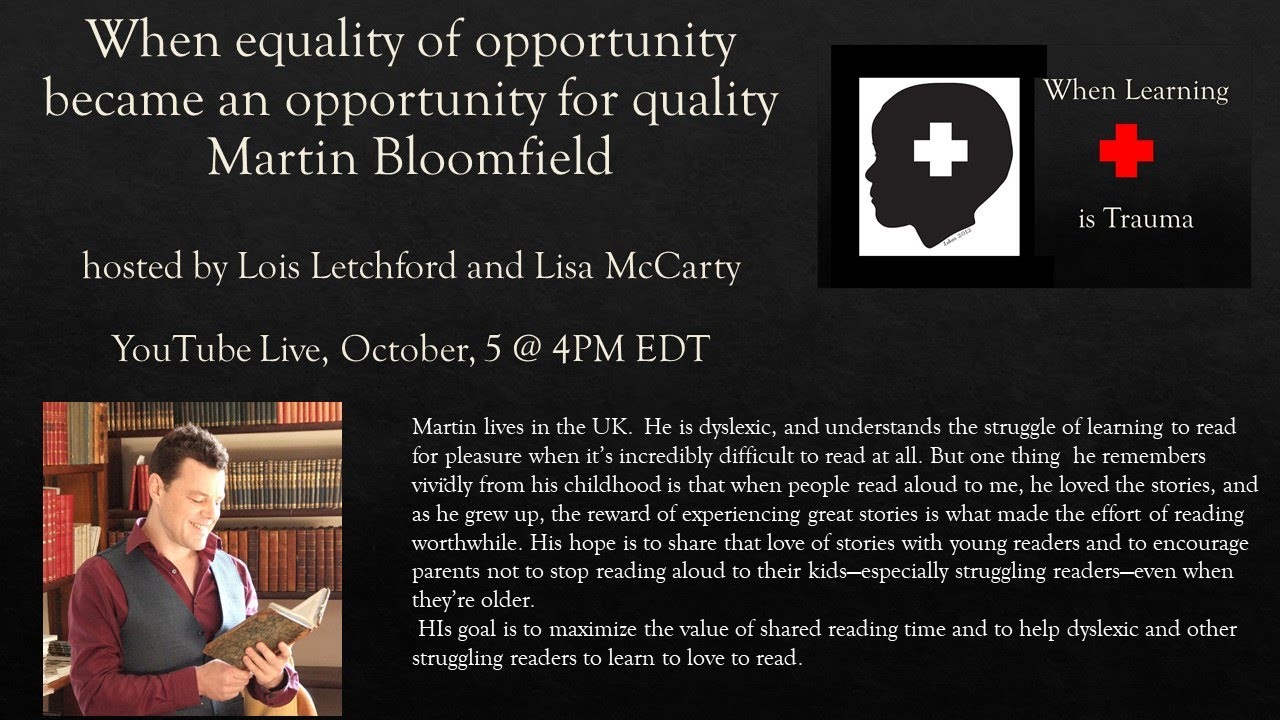
In this hour‑long streamed conversation, Martin Bloomfield shares his lived experience of dyslexia and the trauma of a punitive, exam‑focused school system. He describes how early mis‑diagnosis, relentless labeling as "not trying" and physical punishments (including caning) eroded his self‑esteem, leading to chronic anxiety, nausea, and suicidal risk. The dialogue expands to critique the broader education model: its over‑reliance on linear, output‑based assessment, the suppression of curiosity and creativity, and the systemic abuse of neurodivergent children. Martin argues for a shift toward "input" assessment—valuing effort, originality, and interdisciplinary thinking—while warning that the current "science of reading" focus on phonological processing is too narrow. Lois connects these ideas to her own family, especially her son Nicholas, and discusses equity, privilege, and the need for systemic change. The conversation ends with Martin’s commitment to advocacy, upcoming ELT award nomination, and plans for future collaboration.
Chapters
Yep.
Do I want to start streaming as well or just recording and do it later?
Well, I mean, if you're going to be streaming at the time, which you are—
Yep.
I mean now, because no one's going to see it, or if they do it'll be kind of accidental, so we can do what we want and just make sure that we are streaming it.
Right, streaming, and then I have to go to— I have to go to Um, I have to go to, to my channel, and I have to go to my channel, and I have to go to go live, and then I come back here to you.
Yes.
Ah, now have we got— have I got everything going now? Is it working?
Now, if you can get to your channel, if you can show me where your channel is, then I can see whether you're streaming us.
Um, it's, uh, stream setup help. It's connecting streaming software to go live. I've lost— there's your Hangouts. There we are. Now I've got to go back here. There's you. Where's me? There's me.
There's you.
There's me. Ah, well, my son is not here.
Okay.
And so he's away getting his passport renewed in New York City today with my husband. So I'm, you know, I'm in charge. Nightmare.
It sounds very exotic, getting his passport renewed in New York City. That's the kind of thing that, that begins a film. That's the beginning of a film.
I've got you on 2 different places, so, you know, they tell me to do something, I don't know what it is. So I look at you here and then I know what I'm doing in one place. Now I can't see me.
I can see you full screen and I'm a thumbnail of myself.
That's all right. Well, that's fine. Oh, Martin! Martin, I've heard a bit of your story at times. Your story floors me. How have you coped? Ah, um, well, just a minute. Let's— can you tell the audience, if anyone is listening, we can refer them back to this. So you can give us a bit of your background now.
By refusing to accept what people told me. So if you like, I, I I was lucky. I came from a background where my brothers were academically capable. My brothers were academically effective. My older brother was a lot cleverer than me, although he had an accident about 20 years ago, and so he's now got some certain forms of brain damage. But my younger brother was academically always very, very bright, and my— be bright. And we lived in the shadow of York University, and so I was surrounded, I was in an environment where doing well at school was what you were supposed to do. That was the natural progress for somebody. You work hard, you do well at school. Now, I worked hard, I didn't do well at school. I worked really hard and I didn't do well at school. And, and that was very, very disheartening. But at the same time, coming from an environment where you were supposed to do well at school and you were supposed to then go on to university or something. Um, it meant that I— it wasn't in my nature to accept that that wasn't what was going to happen to me. And even though when I went to university, I did go to university, I was nearly 23. Um, I was something like 2 months off my 23rd birthday or something. So it took me a long time to get there. And in that process, it was dropping out, going back in, dropping out, going to sixth form college, then going to sort of night school technical college to take an extra A-level on top of the handful of really poor A-levels I'd achieved after retakes at school. And it was, it was, it was a very, very hard process being told by people that I wasn't trying, even though I knew I was trying. And what that does to you is it makes you want to stop trying.
Yeah.
If you try your hardest and people tell you you're not trying, you get marked down for it. You stop trying.
Yeah.
Um, you, you rebel. You, you become the class clown. You become unhelpful. You disengage from school. Um, you find school torture, quite frankly. It was, it was an awful, awful experience for me. Not only the teachers telling me that I wasn't very clever, because they told me that, Not only the teachers telling me that I wasn't trying, because they told me that, but the fact that— the fact that they would give us work at school, they would give us tasks, and everybody seemed to be able to do them, and to me I couldn't. And it wasn't— this is, this is the thing about dyslexia, it's what people need to realize about dyslexia, and it's something I know you talk quite a lot about, Lois. People define dyslexia quite incorrectly as a phonological processing deficit. Much of dyslexia— many dyslexic people do have a phonological processing deficit, that's true, but it's not the phonological processing deficit that means you read slowly effectively. It's the comprehension. It's looking at what you're being asked to do and not knowing what it means and not being able to do the tasks because you, you're just not on the same page. It's almost like they're talking a different language, but the language is so similar to your own language that you kind of get it and you think you understand it. And then when you produce something, it turns out they look at it and go, no, red mark, red mark, red mark, red ink all over the place. And, and that's what it's like. It's just, it's almost as though you're at school and you think you know what you're supposed to do But the proof that you don't know what you're supposed to do is when you hand it in and you get punished for it. What sort of system does that? What sort of system does that to a child? And, and I'm— yeah, I, I still get angry and depressed and, and, and nauseous, to be honest with you, when I look at my school days, because it's not that I can't It's not— it was never that I couldn't, it was that what they were saying to me and what I was hearing were different things. I was not comprehending what they wanted me to do in the way that they wanted me to do it.
I just got to write this down. You get angry, angry, depressed, and nauseated.
Nauseated, yeah, yeah. That sick feeling that I used to get having to go to school, that comes back to me. It's anchored within me, that sick feeling, that feeling of actually feeling unwell, having to go to school. That, that remains in you. And when I think of school days, I think of that.
And you're what, 6 and 7 and 8, or 6 to 15?
Yeah, it started at about 7.
Yeah.
I think when I was 5, and when I was 5, it didn't matter. The fact that I spelt my name wrong didn't matter. The fact that, you know, it's not really important. It starts to matter round about the age of 7 because cognitively you begin to change about the age of 7, and then you reach a certain type of reading maturity around about the age of 12 and 13. And this coincided, it's really interesting, It coincided with 2 changes of schools that I had. So I used to go to a local state primary school, and at 7 years old I was taken out of that environment and sent to a private school. And I wasn't certain at the time whether that was a good idea, but I did what my mum wanted me to do because you do.
You don't have a choice, do you?
Yeah, and my parents at that time had the resources for it. reasonable job. And they thought, yeah, we want one of our sons to go to a posh school. Between the ages of 7 and 13, I was at that school. That was the age for that school. And I thrived, not academically. Academically, I was the bottom of every class except one other kid who was worse than me. So me and one other kid, we were the bottom of every class. And actually, That was a school, that was a private school in the early 1980s, late 1970s, early 1980s, that would cane you for getting your Latin wrong. They would cane you for getting things wrong, and not immediately. There was a system of merits and minuses. You did good things, then at the end of the, at the end of the school year, you'd be presented with a prize at the school, whatever it was, school assembly or whatever, uh, school sort of open day. You did bad things or you achieved poorly in class And once you'd received 3— they're called the merits and minuses— once you'd received 3 minuses, that was enough for the cane. And I got the cane. Now, what's really interesting is I don't resent that, to be honest with you, because, um, it just seemed normal at the time. But what is, is that you would punish a child for not being academically worthy.
Yes.
What sort of standards are we setting? What statements are we making? And it doesn't have to be about physical punishment. It doesn't have to be about caning a child. Any punishment, any punishment for not achieving academic excellence is a moral crime.
Yes.
Quite frankly.
Yes.
If you're judging children against something that they haven't chosen.
Yes.
You're judging children against something that they have not chosen. A child would not necessarily choose to be good at maths or geography Yes, yes. A child isn't good at maths or geography, you punish him, you punish her. These days we don't cane, but what do we do? We make them stay late, we give them extra homework, we, we tell them off, we humiliate them in front of people, we, we hold them back a year. That happened to me a few times, being held back a year. That school, that private school I went to, did actually build me up as a human being, ironically. Ironically, I know it sounds strange saying this, but although there was a system of physical punishment for not achieving academically, it was a small school and they treated me with respect and like a human being. Even though I know it sounds really, really almost like sort of dissonant when I say that, but they did. When I then went back to state school, my parents divorced, we had no money anymore, You know, the things that we'd become used to. Suddenly we didn't. We weren't. We weren't getting any Christmas presents. Instead of nice Christmas presents, nothing at all. You know, I then went to state school at that point. Again, I was punished physically often, although not officially physically. But yeah, they would smack you. They would. You know, I would get punished for not achieving academically in that school because there was no attempt at. building me up or loving me as a human being. The teachers had no time for me. My school friends— they weren't friends— my school sort of peers, they would bully.
Yes.
And they would laugh and they would jeer. And so suddenly, from being somebody who was not achieving academically but was still valued, I went into this new environment where I wasn't achieving academically and I was devalued. I was despised as a young boy. As a 13-year-old boy, when you're becoming pubescent as well, when you're suddenly— you've been taken out of an environment full of friends and you're put into a new environment where you don't know anyone, suddenly hate you because you're new, and, oh, Martin can't perform academically, so this is a reason we can beat him up.
Yeah.
And it's the most traumatic thing, the most traumatic experience a boy can go through. And, and not only can you not do what they ask you to do, not only can you not do what they tell you to do, you don't understand why you can't do it.
Yeah, I'm taking notes.
Oh, please do. Yeah, and you don't understand, you don't understand why you can't do it. You don't understand what to understand. That's one of the things, it's this sort of meta reasoning. You don't understand why you don't understand. Because I can hear what the teacher's saying, I can see the same dates that he's putting up about the Battle of Waterloo or whatever it is, but when it comes to writing that essay, how come I'm only getting 20% and everyone else is getting 60s and 70s?
Yeah.
Um, when it comes to doing the, the exam at the end of the year, how come I'm only getting 20, 25% and everyone else is getting a reasonable number. In Britain recently, we had O-level and A-level GCSE and A-level results coming out, um, and people were— how on earth can any child get a, get a, a U? That's unclassified. It must be the school's fault. I don't know whose fault it is, but if I didn't get a D, I got an E. If I didn't get an E, I got an F. If I didn't get an F, I got a U. These days, children are expected to get a star, a double star, a triple star. I don't even know what that means.
Yeah.
You know, the most, the most I could ever expect from school was a C. If I got a C, my God, I felt happy with myself. That's a C. That's effectively— it's adequate. That's the most I could expect. And what that does is that teaches my young self, that teaches that young child That at best, at absolute best, it is a triumph if you can be adequate. That, that, that, that, that— and that says something quite, quite damning. It's an indictment of a school system where they teach children that the best they can hope for is just below average.
Yeah.
That's a horrible thing.
You know what amazes me?
And how did I get through it? Yeah, I don't know, to be honest with you. I got through it because that environment that I came from gave me this idea that I had to get through it. That's what we do, you get through it, you don't drop out. Even though I did drop out and then went back in again, you know. And yet I also knew, this is the strange thing, I also knew deep down inside myself that when teachers told me I wasn't clever— and they did— when teachers told me I wasn't clever, when school friends, friends, when school peers told me I wasn't clever, they were, they were missing something. And so I would, in, in my own head, I'd make this, this distinction between what it is to be clever and what it is to be intelligent. And cleverness is clearly something academic. It's the ability to remember what the teacher tells you and regurgitate it.
Yeah.
In the way that the teacher wants you to regurgitate, and that's cleverness. But intelligence is the ability to think for yourself. And I kept telling myself that, and it's that constant sort of reappraisal I was being told by others that got me through. It was this refusal to accept A refusal to accept that I was what they told me I was, and a refusal to accept that the, the proof of what they told me I was— because my school grades appeared to be the proof of them telling me I wasn't clever. Yeah, yeah, yeah, yeah. And I think something happened as well. I, I could look back I was quite self-aware. I could look back and realize that the older I got at school— and this went into like, actually it really became very obvious because I went to sixth form college, and sixth form college was different. Um, it wasn't the same environment as school. So you take your O-levels, GCSEs now.
Yeah.
At school, and then instead of taking your A-levels at the same school. You'd go on to sixth form college, but because I'd failed all my GCSE O-levels, I went on to sixth form college to retake them. And the environment was different, the teachers did look at you differently, the people who went to college didn't have to go on to sixth form college, so either they wanted to or they came from families that wanted them to. And it wasn't so aggressive, it was a little bit kinder.
Yeah, yeah.
And something I realized there was that, um, I retook my O-levels and I got GCSEs and I got 3 of grade C, and that was enough to allow me to do some A-levels. Not as many as other people were allowed to take, but 2 A-levels because most people were taking 3. And, and, um, oh, and, and General Studies, so it made me feel like I was taking 3 A-levels. Even though everyone else was then taking 4. When I was doing that, it became really obvious that what they wanted out of us was different. It had changed. So at school it was— and I'm making this into a cartoon of the truth, I'm, I'm sort of turning it into a hyperbole of the truth— but at school they threw information at you and you had to then throw the same information back at them. That was effectively what school was. You know, it was, it was, it was a game of tennis. They would hit you, hit the ball at you, and if you could hit the ball back at them, then you were academic. That was what school was. Sixth Form College was different. A-levels were slightly different. There was an element of interpretation, and as soon as we were allowed to interpret, I started to come into my own. And that was a really interesting moment that Suddenly at sixth form college, I was clever. I was clever in class, in English and in economics, which is what I took, and then general studies. In English and economics, I was clever, and, and, and, and I was interpreting, and I was making, making connections that other people weren't. I was at the top of the class. What then happened is they made us take exams, and I failed all my exams again because there's a difference between being able to do something and being able to do an exam. And my entire life— so I, you know, after then dropping out of school and, and, and then eventually going back and taking another A-level at night school and being top of the class in that A-level and then scraping the mark from an exam, I went to university. where I won the— for 2 years on the, on, on the trot, I won the award for best student. And yet when it came to the exams, my, my, my continuous assessment, my project work, my dissertation, they were getting really good marks. Put me in an exam hall and I was dropping 3 mark bands.
Yeah.
So from firsts, I was going down to thirds. in university.
Yeah.
And, and in the exams, and, and it, it, it was, it was amazing to see the difference in what I could do and what they were demanding that I did.
Yeah.
And if you like, the, um, the exam system— I see the exam system as the hangover from school. So that exam, that testing exam system, is a perfect fit for school when you're young, because you feel like it's the same kind of torture that I couldn't do. But as you go up through the education system, as you're doing a doctorate— like your son did a doctorate, I'm doing my doctorate— you don't have to sit an exam. You can do what you want. You can, you can analyze, you can think, and you're not constrained by the exam system. And, and, and if you like, I think this mindfulness, you have to be mindful of what it is. That's holding you back. And it— to me, it was clear from my, my personal point of view that that which was holding me back was my ability to do classic, um, how do I put it, linear schoolwork.
Yeah, yeah.
Where the schoolwork is what you might call linear, I couldn't do it, and I still couldn't do it. If you asked me to do it now, I would fail.
Yeah.
Where schoolwork is allowed to be nonlinear, where you're allowed to think, to interpret, to join dots from, you know, if you're doing a history, if you're doing history, you're allowed to, in fact you're encouraged to go into science or into theology or into maths or geography because that can be relevant. And if you do that, if you do it well, then that's the mark of doing well. At school, you're not allowed to do that. And, and, and school is a straitjacket for the mind. That's what school is.
Wow, that's a good one. That's, that's just, you know, Martin, I think what What kills me about your story is that your story could so easily have been my son's story.
Yeah, yeah, yeah.
You know? And you're living what he could have lived. And I think what, in the back of my mind, how as a mother I would have been, well, Nicholas, you're doing the best. You're doing your absolute best. And And, you know, you're not as smart as you think you are. And look where he ended up when he had that level of privilege.
Yes.
And I had to really shift my belief and my training and my view of him. And that, you know, we had 6 months in Oxford. There were 4 months where I worked with him. Those 4 months changed his life. If we'd stayed in school—
Yeah.
It's like it would have been your story all again.
Yeah, yeah, absolutely. And I know people who are undergoing exactly what I underwent. I'm talking to the mother of a young 10-year-old and he is being kept inside during breaks and during lunchtime to complete the work that he's not doing correctly the rest of the time. He's being— it's cruelty. You don't take your child away from his friends at break and lunchtime.
Yes.
So if what you're doing is you're making him sit through that very thing that is psychologically and emotionally traumatizing him, you don't put more of that onto him.
Yeah.
Because that's not gonna help.
Yeah.
It's a little bit like saying, um, oh, you don't like the hot acid? Well, here's some more hot acid.
Yes.
It doesn't help anybody.
It's just— And keep drinking it and keep drinking it and keep drinking it until you're sick.
Yeah, yeah. And if you don't— yeah, if you, if you don't drink it properly, then it's your fault.
It's cruel.
It misunderstands the nature of what learning is. It misunderstands the nature of what a human being is. It misunderstands the nature of what school is supposed to be. We've known ever since the days of Montessori, John Dewey, we've known how education can be. We've known, and no one does it because they're scared. Governments, educational authorities throughout the world know that, well, we fail, let's say, 20% of the kids.
Yes.
So we fail 15% of dyslexic kids, we fail Couple— we failed the percentage of autistic kids, percentage of however many autistic kids there are these days, you know, we failed the couple of percent of kids with this, but overall we get 80% of the kids through. So it's okay to fail those kids, they're collateral damage in, in, in this. No child is collateral damage. No child is collateral damage. I was that collateral damage. Nick would have been collateral damage.
Oh, kills me, kills me. Yeah, because I don't— you know, I see you come kind of come out of it. I don't think he would have. I think he would have committed suicide.
Uh, yeah, yeah, yeah, yeah, yeah. The statistics— I mean, I know that I don't want to turn it into a dry statistic thing, but the statistics on dyslexia and attempted suicide are shocking. They have to be.
They have to be.
You are something like twice as likely to attempt suicide if you're dyslexic. You've got an 85% raised chance of self-harm, a 50% raised chance of suicide, that kind of thing. It's, it's, I mean, it really is absolutely shocking and it's not surprising.
Yeah, yeah, because your self-worth, you're worthless, you've got no value, you can't do what's been asked of you, what's wrong with you? Yeah, so there's got to be something wrong with me.
Yeah, think about it as an adult. If you're an adult— I was talking to a, a very, very wise man many years ago. He'd undergone the most awful, awful situation. He'd been hit by a tram, um, many, many years ago, and he'd lost so many of his faculties. He gained many of them back I mean, he'd worked and worked and worked, and, and, and this loss of his faculties and the regaining of his faculties, it gave him a view on life. And he was working from middle to upper management. I think he was already in upper management in a very, very large German company. He was, he was very, very big in what he did. And he was sent on a training camp for, for go-getters at that company. And something they told him, and it was really interesting, is that In business, in work, there are only ever really 2 things you worry about. One of them is being appreciated, the other of them is being competent. These are really the 2 things we, we worry about in business. Everything else, you know, things like are you going to lose your job, you can't worry about that because you don't know, you know. But the thing, things that, you know, are you appreciated and are you competent, and are you appreciated for being— Well, that goes for school as well. And at school, if you're not competent, you're not appreciated. And, and, and, and if we think about it, we're in business now, we are grown up, and yet what happens to you if you find yourself in an environment where you're not appreciated, or when you, when you feel your competence is maybe in question? It hits you hard. Well, we're grown-ups, we're adults, we've got coping strategies to deal with that. These are children, they don't have those coping strategies. And so when competence and their levels of appreciation are questioned, when they're undermined, they don't have the cognitive and the emotional strategies to deal with it. And what, what do they do? Well, they, they introvert, or they become angry, or, or whatever. And each of those responses is something you get punished for. If you're introvert, you're sullen. If you get angry, you're a bully. And so where a child isn't able to cope, they're punished for not being able to cope.
Yes.
And yet, what are they unable to cope with? They're unable to cope with that very thing that is effectively torturing them. So if a child's got dyslexia and it's unrecognized, even if it is recognized, or if a child has some other form of neurodiversity, cannot get on at school, then they're underappreciated, they're— and they're undercompetent. Both of those things make them feel bad.
Yeah.
If they don't have the coping strategies, then they'll introvert or they'll extrovert, they'll become angry or they become sad. Each of these responses is a punishable offense at school. They can't win.
So Martin, you know, so yeah, I'm so— I, you know, I— you amaze me at all that you have achieved. And, and, you know, the graphics that you put up on, on LinkedIn to me are phenomenal.
And what they do is they show the kind of thinker I am.
Yes.
Thank you. I'm really pleased. I'm really grateful you say that. Um, but of course you'd never have been allowed to do anything like that at school. school, would you?
Yeah.
And this is, this is the thing, you know, you wouldn't, you wouldn't be allowed to express yourself in any other way than, now answer these questions and answer them in the way that I tell you to answer them. And there's a right way, there's a wrong way, by the way. If you don't answer them in the way I want you to answer them, that's wrong. Oh, by the way, if it's wrong, I'm going to somehow penalize you, I'm going to punish you. I mean, you know, it's, it's, it's, it's like Yeah, you know, those graphics— I was gonna say those graphics are the manifestation, the proof of, of, of how I think. I think visually, I see connections between things, and I can simplify a message and, and make it, make it sort of— and apply the message to particular areas. You're not allowed to do that at school. They whack you around the earlobe if you do that at school.
Nicholas is a 2nd grade teacher. Fantastic lady, but she had a special book for him to do. And one afternoon, I can't remember what it was, but he had to do it, and he did it all, every little bit persistent. Da da da da da da da.
She gets to the end and says, "It's all wrong." What they need to do at school, and it's something which I bang on about, I made a video about this on the YouTube channel, is they need to stop solely marking for output and they need to start marking for input. What is input? Input is the amount of time you spend on something, it's the effort you put in, it's the, the new and original way in which you do it. That's what input is. And if people are allowed to realize that originality or trying something new is, is a competence that people are crying out for in the workforce, Yeah. Rather than doing everything the way that you're supposed to do, you know, rather than if you don't get the right answers, you know, you're gonna, you're gonna be marked down, you're gonna be somehow punished because there is a— there's always some form of punishment for not getting the right answer.
Yes.
You know, if output is all that people mark for, they don't mark for input, they don't mark for effort, they don't mark for intelligence of thought, they don't mark for a unique way of presenting the, the, the findings, even if those findings are wrong. See, the rightness and wrongness often is quite irrelevant. It doesn't matter whether the Battle of Waterloo was in June or July. Who gives a damn? You know, it doesn't matter. What does matter? Go print that. That's intelligence. That's what's important. And, and, and, and how that applies to other things, how that applies to cotton farming in India, I don't know. You know, that's what's interesting, and that's what helps children develop their thoughts rather than school, which hammers that— hammers out originality. It, it makes you frightened of getting things wrong. And if you're frightened of getting things wrong, you're frightened to experiment, you're frightened to be yourself, you're frightened to try anything new. And so school is that very institution that makes people scared of creativity. Yeah, it makes it—
particularly if you're failing.
Particularly if you're failing. There's proof of this, um, throughout the '90s, um, or the '80s and '90s. Um, a test was done, and this test measured, um, genius levels and creativity. Um, you can actually measure how, uh, what, what a creative genius is. There are certain standards, things like the, the, the, um, the Torrance Test of Creative Thinking, you know, this, this sort of thing. You can measure creativity. And they, the scientists, the, the, the— I can send you the research, I can send you the, the results as well if you want. Very, very interesting. I'll look for it. Children. They measured— they took thousands of children and they measured how many of these children were creative geniuses. And these children, by the way, were preschool. They were 5 years old. The number of preschoolers, 5-year-olds, who were creative geniuses— 98%.
Ah, yeah, okay. Yeah.
They then measured them again, the same kids, 5 years later at the age of 10.
Yes.
30% were creative geniuses.
Yes.
They then measured them again at the age of 15.
Yes.
12% were creative geniuses. They, they gave up because it was too frightening. They were a bit depressed, so they gave up measuring. Somebody else then measured, um, adults, 20-year-olds, uh, you know, or not 20 years, but adults, for their levels of creative genius. Um, And it was 2%. Yeah, 2% of adults were creative geniuses. What had happened from 98% who are creative geniuses and 2% who are not? We went to 2% who are creative geniuses, 98% who are not. What had happened in between? Education had happened in between. Education had happened in between. And, and this is what education does— it makes you terrified of getting it wrong. Now, by the way, that little thing that I've just said was inspired— I'm going to be honest— it was inspired after watching a video by a guy called Ken Robinson. If you ever see Ken Robinson online, yes, online, you'll see videos, check him out. He's an absolute genius. I know, I love what he's— yeah, I love what he said.
I know.
Um, that particular story about the creative genius, um, was inspired by— and then I went and researched it and found that the research is all there, and I'll send you the research and I'll send you the, the links and the sources. But it came from something called, um, Changing the Paradigm, I think it was called. And it's like a cartoon video. Yeah, it's so important, so important. But yeah, it speaks to everyone who's been chewed up by the system.
I've read 2 books on curiosity recently. One is Why by Mario Levio and Ian Leslie's Curious. Mario Levio talks about— now let me get this, we're talking about curiosity— he said curiosity is unruly. And that's why we don't like it in school, because school is about control.
Yeah, yeah.
And the other thing about— from, from Laveau, he said that curiosity propagates growth.
Yeah.
And it picks up other things. And that's what I tapped into for Nicholas. That's what made the difference.
And yet What do they teach him at school, or what does the rest of the world teach him? Curiosity kills the cat!
Yeah, yeah, yeah. You're not allowed to be curious!
Stop being curious! Curiosity bad! What sort of world are we living in where curiosity kills the cat? It finds a cure for the cat! If the cat's ill, be curious, find the cure! Curiosity lets the cat die slowly, quite frankly. So lack of curiosity lets the cat die slowly. Only curiosity, only curiosity will cure the cat. There is nothing else in the world except blind fortune that would cure that cat. You need to be curious. Something else as well which is really important— how many times at school— and, and this is really interesting— How many times do you remember at school that they told you to stop asking why?
Yeah, yeah, yeah.
Why would they do that? Why would anybody tell you to stop asking why? Why is one of the most important questions in the world. I work with teachers, I work with business people, I work with social organizations. They have all been— they all talk to me about this because we have really good conversations about this. They're frightened of the word why.
Yeah.
Because they've been told that it's not— use it anymore.
Yeah.
This is what, this is what growing up does. It stops you being curious. Why is such a good question because not only does it, does it, does it feed my curiosity, it forces the other person to consider what they've just said. And that's why you're not allowed to ask it because the school teachers aren't there to consider what they've just said, they're there to throw information at you so you can hit it back at them. You know, you don't ask Martina Navratilova why you do it, why is she doing it, she just does it.
Just do it, just do it like her.
Yeah, yeah. And then I'm not having a go at teachers, I'm really not having a go at teachers. I know it sounds like I am, but what I'm doing is I'm attacking an educational system that forces teachers to behave in particular particular ways towards those children who are in their charge.
Yes.
And no matter how nice they are and how kind they are, as long as— it's like the Black Lives Matter movement in a way, Black Lives Matter movement. No matter how nice you are and how kind you are, so long as you propagate those structures, so long as you perpetuate those structures, you are upholding the structures that crush the kids.
Yes.
And, and, and And yet there are teachers, lots and lots and lots of teachers who are really lovely people, yeah, who are really good at their job. But as long as their job crushes children, it doesn't matter that they're good at them because those children will be crushed. Yeah, those kids who are neurodiverse do not fit into the system. So if you're good at the system, great, I'm really pleased for you. Yes, system's still going to hurt the kids.
You know, Martin, I don't know what you think about this science of reading business. Because the honest answer is it worries me because I think it's going to leave as many children behind as we've left behind before.
It's a little bit like, we know that a lot of dyslexia is linked with phonological processing, not all of it but a lot of it. We therefore know that if you can teach phonological processing, it stands to reason that you're helping people with dyslexia. Therefore, it appears that, um, it appears that if we get people to teach phonological processing, then we've done our job. But we haven't, because simply, simply, it's, it's a little bit like saying, um, um, that elephant in oil and on fire, throw a blanket over its tusk.
Yeah.
It doesn't deal with the whole problem. It focuses on one thing which alone, on its own, that phonological processing— if you can mend the phonological processing, yes, it will have some beneficial effects. But the reason that people focus on phonological processing is that's what people think dyslexia is because of the structure of the word dyslexia, dyslexis, ability to read. And therefore solve the phonological processing and reading, which is a mechanical thing Which is not. But, you know, if you think reading is a mechanical process of, of words coming off the page, jumping through your eyeballs, and then going into that part of the brain, and then being translated into sound in that part of the brain, then, okay, if you can get that right, then, then that's reading. Of course it's not reading. Of course it's not reading. It, it reminds me of this. It reminds me of this, that the kind of attitude that people have reminds me very much when I was a child and I was 10 years old I had to write an essay for biology, and I remember one of the few things I remember, and I wrote about— excuse me if this is an inappropriate subject matter— I wrote about— it was human reproduction, and I said about how the man's penis enters the woman's vagina and sperm comes out of the penis and fertilizes the egg and a baby appears. That's sex. And I thought I understood sex. Of course I didn't understand sex. I understood that one part of the biological process of sex. It's the same with reading.
If you—
if it's like if I'd been a 10-year-old writing about reading, I would have said it's when sense data, which is a faulty concept anyway, when sense data hit the eyes and it's processed into sound in the brain, and that's reading. It's not. That is part of the mechanics of reading. And, and, and if all you're doing is you're twiddling with part of the mechanics, or even the whole of the mechanics of reading, you're not looking at reading at all. Why is that? Um, very interesting story. My old philosophy, um, tutor, a guy called Oswald Hanfling— anybody who's ever heard of philosophy would have heard of Oswald Hanfling, I get, or, you know, at a particular time. He and I were sitting in a room together before a seminar started, and I'm going to imitate him. And he said to me, um, I was listening to the radio last night. I went, oh yeah? And he said, I was listening to the radio and the, the radio presenter said that scientists have discovered what makes us laugh. And he paused and said, and that made me laugh. It's that kind of— this pure scientism of This is what reading is, this is what makes you laugh, this is what sets it. There's so much more involved. So, and if you, if you miniaturize the context, then you're not understanding what reading is. It involves comprehension, it involves all sorts of extra-contextual activities, it involves joy. Reading involves joy, you know. And, and, and, and if you can, if you can show me where joy happens between the words coming off a page and into my eyes and getting processed into sound in my brain, then you'll win the Nobel Prize because it's not there. That's not where joy happens. Reading involves joy, it involves wanting to read, it involves this feeling, it involves curiosity, it involves all sorts of things. And it also means that not everybody wants to read and not everybody is as good at reading at different stages, and that's okay. That's okay, because quite frankly, no one reads a damn thing these days anyway. They're all on TikTok.
Try writing, try writing 1,000 words.
Yeah, they're all doing Zoom meetings, they're all having things, you know, audiobooks and TV, and what's wrong with that? What's wrong with that?
Yeah.
It's almost like, you know, reading is useful, reading is really good, we need it, of course we do, but if someone can't read, it doesn't matter. It doesn't matter. There are all sorts of other things that can happen in the world that mean that they are useful communicators and that they can get the information they need visually, auditorily, through conversations, all sorts of things. You don't have to sit and read pages and pages and pages of books. You don't.
And, and, and we don't need to kill the joy of learning.
Absolutely, absolutely, absolutely. Yeah. And those, those people who have miniaturized learning, who have shrunk learning to phonolo— reading, sorry— those people who have shrunk reading to phonological processing have, have lost any aspect of joy, and they've lost any aspect of comprehension, and they've lost every aspect of auditory processing, which is very important. Auditory processing— phonological processing and auditory processing are not the same thing at all. If they've lost— they've lost any aspect of what they call convergence, which is where your eyes are focusing and where your mind's focusing when you're reading. Your mind— your eyes tend to stop, I think, 3 or 4 times per second for a fraction of a second as you're scanning. People with dyslexia, their eyes don't do that. Um, they do it differently, and we know that because we've seen the evidence for it. So they've lost any aspect of convergence, any aspect of comprehension, any aspect of auditory processing, any aspect of context, any aspect of joy. I mean, God Almighty, you know, it's almost like it's incomprehensible to me why these people have got the ear of education, because it seems to go against everything that education wants. What is education? It's building somebody. The Germans have a great word for it: Bildung. Bildung. So this, this idea that it's not just educating the mind, this is a whole person, um, that, that you, you grow and, and become skilled and become able. It's not that you just know things. It's not that your, the bucket in your brain is filled with units of knowledge. There's more to it than that.
Education in this country has come down to a standardized test.
Yeah. Yeah.
You know, which I think is— forget it, it's a waste of time.
In Britain, since the mid-'90s, in universities certainly, but also in schools, the better grades the students get, the better ranking the educational institution gets. The educational institution wants a higher ranking, and so suddenly education has been upended. Suddenly the students are there to provide a higher ranking For the school, rather than the school is there to educate the students. As soon as you commoditize education like that, as soon as you start ranking education, then you use the students, and let's be honest, young children, as a means to an end.
Yeah, yeah. Martin, you know, I wanted this from you. I wanted to get your background. Again, because it, you know, no child should have to go through what you went through.
Yeah, you know, quite honestly, yes.
My brother, my brother had an accident when he was 4. You know, anyway, he had an accident. He was in hospital for 12 weeks. So this would have been 1955. And I knew he had some sort of head injury and he had migraines and he would lie on his bed with his fists in his eyes because we couldn't get rid of the pain. He went to school and he got the cane for not getting his spelling right. I sat in the back of the class and watched, horrified. You know, what have we learnt in these last 50 years, 70 years?
And by the way, that story you've told tells another story as well. You were there in that class while your brother was caned. I bet you loved your brother, I bet you respected your brother, and to see that happening to your brother would have had a horrible effect on you. When we punish a child, we're not just punishing the child, we're destroying bonds and relationships and destroying trust all around.
I, you know, and my sister says— my sister's going to talk on our thing— On our seminar series because she's now a psychiatric nurse, and she said exactly the same thing, that everyone is traumatized by that experience, watching it and seeing it happen, you know. And my brother has a head injury, I'm thinking.
Yeah, yeah, yeah. And he's been, he's been punished for having a head injury.
Yeah, yeah, yeah. And then you can't keep the letters in sequence. I mean, what, what are we— anyway.
Yeah, no, I mean, it is, it is, it is. And I, you know, when we put it like this, when we articulate it, when we bring it out into the open, what we're doing is we are showing systemic child abuse. That's what this is. It's not simply that, you know, some teachers are bad. There is systemic child abuse going on. And we have to look at it in that way because if we don't, we enable it.
I think the caning has gone, but the punishments, the removal of playtime, the addition of homework, and you haven't finished this has not gone.
Yep, absolutely. Yeah, yeah, the social punishment, the stigma, the The, the knowledge that the child is not respected by the teacher, you know. Yeah, the punishment comes in so many different ways— detentions and, and, uh, yeah, you know, do it again, you know. And, you know, telling the parents at the parent-teacher's meeting that the boy's naughty or the girl is, is bad or, or whatever. This is punishment.
Yeah.
Yeah, and the fact that we say, oh, they don't cane anymore, it's kind of irrelevant because if these children don't know about caning, then it's not like they're going to go, well, at least I'm not being caned, because they don't know about it. Yeah, so if you're like, if you grow up in a, in an environment where those are the punishments, yeah, punishments meted out to you, you know you're being punished.
Yeah, yeah, yeah. Oh, Martin, well, when we talk next time Yes. You know what, I, you know, I love your topic about equity. If I'd find the name here, I'd have it, but I don't have it right on my head. But come up with 3 things that I would like people to walk away from the semin— from your session with. What 3 things can we focus on that people can say, yes, I can do this? And your topic is going to be, Martin, 1, 2, 3, 4, when equity of opportunity become an opportunity for quality?
Yeah, equality of opportunity. Yeah, does— when equality of opportunity becomes an opportunity for quality. Yeah.
Do you want me to change that?
Yeah, could you? Yeah, because it was a deliberate play on words because quality and equality sound quite similar.
When equality of opportunity?
When equality of opportunity becomes an opportunity for quality. I'll just write it down in the— That's what I've got.
When equality of opportunity become an opportunity for quality. I've read it incorrectly.
I'm going to punish you for reading that incorrectly. Stay behind over lunch, don't talk to your friends, and do it again.
Oh, Martin, we have got so much work to do.
Yeah, yeah, yeah.
So much work still to do.
Yeah, yeah, we do.
Yes. So, well, thank you for this whole hour that you have spent with me.
It's a pleasure to—
I am going to encourage people to listen—
To have somebody say to me, Martin, you've got an hour, rant. That's the best thing in the world.
When I get back to England, I'm going to make a special trip to York. I've got to meet you, you know. And say, Nicholas, this is— you, as Nick, knows he's privileged. Nicholas knows he's been privileged.
So, I mean, privilege comes in all forms. I mean, I'm privileged in that I had that background where it was accepted that university and academic success was okay, and that was a form of privilege. Yes, because I know people who don't come from that background and who end up dropping out of school But they are, and, and, and, and fine, I'm not going to say that their jobs are worthless, I don't mean that, but, but they might be unhappy in their jobs, they might, they might feel deep down inside that, that they want something else, but they're not able to get that other thing, and that's, that's the tragedy of it.
Yes, that is the tragedy, isn't it? And you know that you can do a whole lot more, but you're limited to Yeah, although I'll tell you what the real tragedy is, and this is—
I remember while I was unemployed, one of those times I was unemployed, because I've been unemployed at least as much as I've been working. It makes no difference that people congratulate me for being articulate or whatever. I have been long-term unemployed because I don't fit into the system.
Yeah.
And on one occasion when I was on the bus, top deck of the bus, being driven to the unemployment offices to sign on and have to justify my existence once more to the people who thought of me as worthless for not being— and for not having yet found a job, because I couldn't find a job. On one of those occasions, I remember the bus stopped, um, at some traffic lights outside a school, a primary school. And on the top deck of the bus, I looked down and I saw children playing happily outside the primary school, and I just— I nearly cried for them. I just thought, oh God, the things you're gonna have to go through. And that's the tragedy, the fact that these happy— and I mean it— these happy, innocent children are gonna have their spirit— it's by a system that does not care. And that is— it's grotesque. It really is grotesque.
Yeah.
And as I say, it doesn't matter that there are many, many teachers who want to do their best. The system will not allow those children to flourish.
Yeah.
And until the system allows the children to flourish, it doesn't matter how nice the teachers are, because they will crush the kids, guaranteed.
Martin, we need to breathe and we need to laugh.
Yes, we certainly do. Yes.
Well, you know, you have, you have done incredibly well, just incredibly well. And every time I see your graphics, I just think phenomenal. I wish I could do that. But you know, we've both been through a system that tries to put us down. And we're neither there yet.
Yeah, but we will, we will change it, we will change it, we will change it. I am determined, and I'm not just saying that, I'm not just one of these people who puts the word warrior on my Twitter page and shouts about it. I'm actually trying to change it. I am involved in projects that hopefully will make a difference.
Yes, yes, yes. Yes.
And I am passionate about it.
Well, we have to be because we've lived it.
Yeah, yeah. I don't want anybody else to go through this.
Yes.
I really don't.
Yes. And that'll— I'm going to write up— I'm going to put this up. This will be something that people can access. And then I'm going to write something beside it and possibly put a blog post on it because your story is so important.
Thank you.
Yeah.
Your story. If it speaks to people, then, then, then that's the, the measure of the story.
Yeah, so thank you, and we will talk to you again on October 5th.
Yes, yes, just after I get back from, uh, from the awards ceremony. Wish me luck! Uh, innovation in ELT, I'm up for, uh, uh, innovating English language teaching by focusing on dyslexia. I don't think I'm gonna win, but I'm up there.
But you're there, you're there.
I'm gonna really enjoy it. I'm really looking forward to it.
That is fantastic. Now I've got to remember to do things. I've got to remember to stop streaming here and stop streaming there. Thank you, Martin. I look forward to talking to you again.
Thank you, Lois. Really love— always love talking to you. Always.
Okay, bye. Stop streaming.
Stop.
More from Lois


Overcoming Adversity: A Dyslexic Learner's Journey to Success | When Learning is Trauma #shorts

Redefining Success, Beyond Grades in Education | When Learning is Trauma #shorts

Turning Awareness into Action for Dyslexic Learners | When Learning is Trauma #shorts

Why Dyslexia Goes Unnoticed: A Systemic Issue | When Learning is Trauma #shorts

The Long-Term Impact of Unrecognized Dyslexia | When Learning is Trauma #shorts

The Heartbreaking Reality of School for Some Kids When Learning is Trauma #shorts



