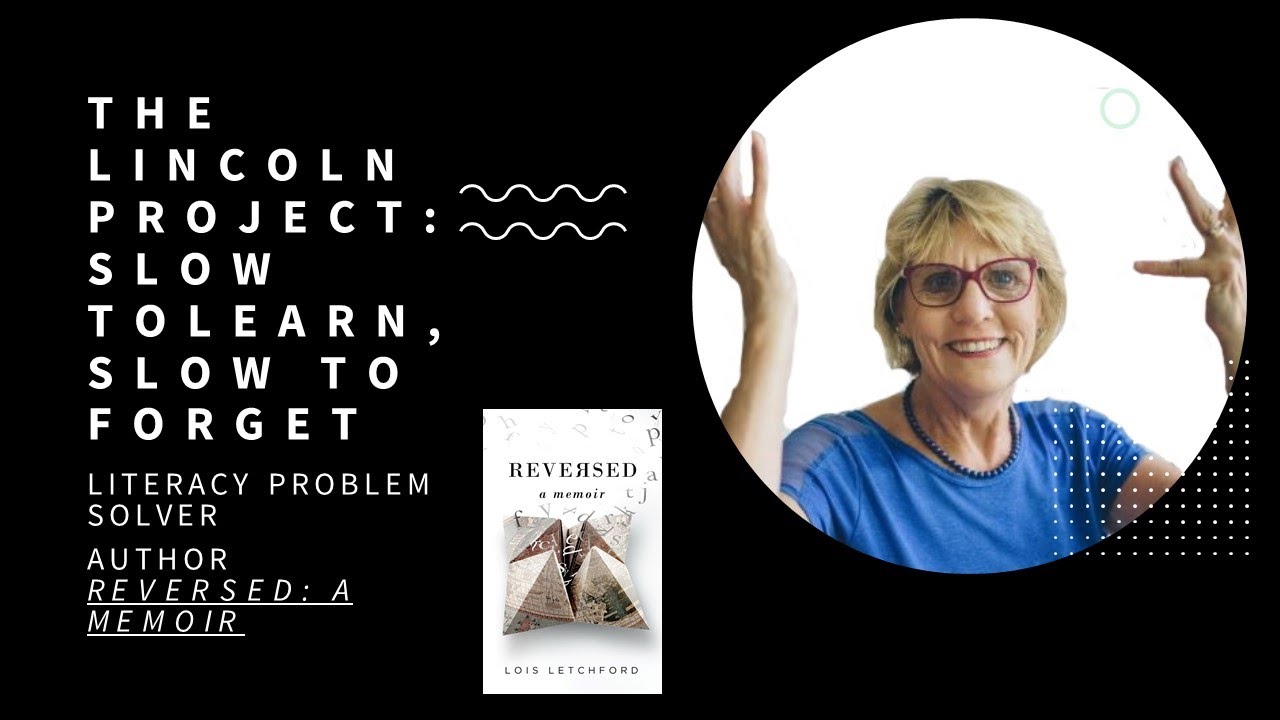
In this talk, Lois Letchford introduces herself as a "literacy problem solver" and author of Reverse a Memoir. She recounts her personal evolution from a mother of a child with severe language and cognitive challenges to a certified reading specialist. Her son Nicholas, once assessed with low IQ and limited language skills, eventually earned a PhD, a transformation that sparked Lois’s deep curiosity about why reading interventions succeed or fail. She describes how this lived experience shaped her approach to reviewing the scientific literature on reading, emphasizing that research is never neutral and must be examined through the lens of real‑world classroom outcomes. Lois stresses the importance of connecting academic findings to the everyday struggles of children who “sit in the classroom every day and fail,” positioning herself as an advocate for those learners. The talk frames her journey under the banner of the Lincoln Project, titled “Slow to Learn, Slower to Forget,” highlighting both her initial learning curve and her commitment to remembering and applying effective reading practices.
Chapters
Hello, Lois Letchford, literacy problem solver and author of the book Reverse a Memoir. Talking this week about learning and particularly my journey from a parent to a reading specialist and my son's journey from low IQ to PhD. And it comes under the title of the Lincoln Project, So Slow to Learn but Slow to Forget, because I would say I am slow to learn, but I also am slow to forget. Once I had taught my son in England and I saw this change, I saw this boy who was happy, I saw him absorbed in what we were doing, and I saw him asking questions I could not answer and curious. It transformed the way I approached reading. It also made me curious. About the science of reading. We went back to Australia, we went back to our home, and Nicholas went back to school. And over the years, I went back and became a reading specialist. I did my studies to become a reading specialist. And what I did was started to search the literature for what makes reading work. I had to become curious. And because Nicholas was so low and his journey was really quite different, it really had me approaching the literature from a different point of view. And no literature is neutral. It's worth thinking about that. Because I came with my background of not now just a teacher or a parent, but I came with a son. Mm-hmm. Who was so low with his language base. So every time I'm reading the academic literature and looking for the science of reading, I am thinking, what happened with Nicholas? What went wrong? What worked? What didn't work? Why did it work? So all the time I had these questions in my mind as I was reading through the literature. And that's where you come up with the science of reading. The science of reading, as I said first up, is a soundbite. Every academic paper has hundreds of hours of research and data collection and writing behind it. Hundreds of hours. So when you're reading a 20-page paper, think of every person who has been involved in that paper and the collection of data. And then you sit there and read it. From your point of view, from the students you have taught. How does this connect? How does it disconnect? Where does it connect? Where is the disconnect? And that's what I do when I'm doing reading of academic literature. Where is it coming? What else has to be done? So this is Lois Letchford. I started as a mother. I became a reading specialist and my son who was so low, Achieved a PhD. Follow our journey. Find out why I am so passionate about teaching those children who sit in the classroom every day and fail. Thank you.