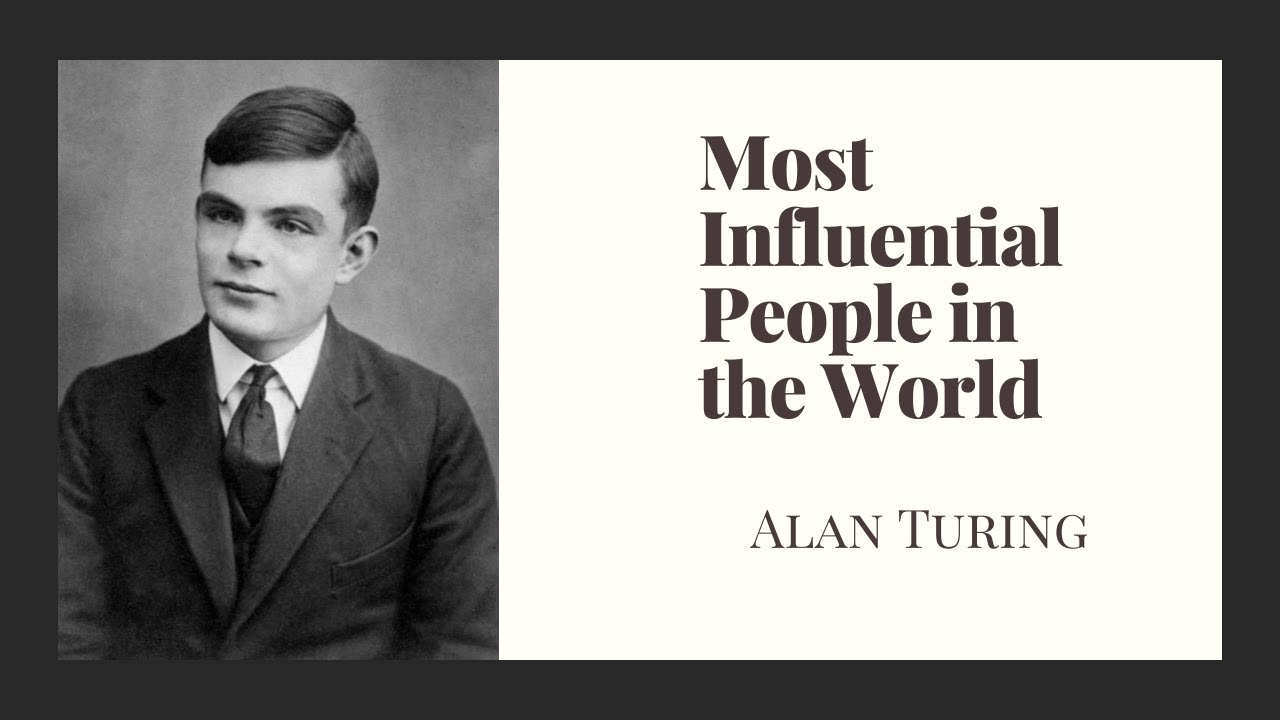
In this 10‑minute YouTube monologue, Lois Letchford reads from her book Eureka! About Scientists Who Changed the World and presents a concise biography of Alan Turing. She outlines his birth (1912) and death (1954), early childhood in England while his father worked in India, schooling at Sherborne where he excelled in maths, and his first love, Christopher Morcom, whose death spurred Turing to win a Cambridge scholarship. Letchford explains Turing’s 1936 paper on computable numbers, the invention of the abstract “Turing machine,” and the parallel work of Alonzo Church. She then moves to his wartime role at Bletchley Park, describing the Enigma cipher, the daily‑changing settings, and Turing’s invention of the Bombe that broke Enigma in 1943. After the war she notes his pioneering work on electronic computers at the National Physical Laboratory and Manchester, and his 1950 “Computing Machinery and Intelligence” paper that introduced the Turing test. The narrative concludes with the tragic persecution of Turing for being gay, his suicide at 41, and a call to watch The Imitation Game and share the video. The tone is educational, conversational, and reverent, with a sympathetic sentiment toward Turing’s achievements and personal hardships.
Chapters
Hello, I am Lois Letchford. I'm the author of the book Reverse to Memoir and a literacy problem solver, and I'm reading from the book Eureka! About Scientists Who Changed the World. And today I wanted to read the story of Alan Turing. You may know the movie Imitation Game. And that was based on the life of Alan Turing. And he was born in 1912 and he died in 1954. It's, as I say, quite a sad story. And they say he's an English mathematician who cracked the Enigma machine and laid the groundwork for our understanding of artificial intelligence, AI. And it goes on. A man who saved lives of millions of Allied personnel during World War II. Alan Turing committed suicide when he was just 41. The reason? He had been persecuted by UK law because he was gay. Alan Mathison Turing was one of the most brilliant mathematicians of the 20th century, born in London. A distant cousin of his mother's was the physicist George Johnston Stoney. He introduced the term electron in 1891. His father Julius had been a member of the Civil Service of India, and the pattern of Alan's childhood was that his parents, particularly his father, spent almost all of his time in India while Alan and his elder brother John remained in England, farmed out to family friends. At the age of 13, Alan was sent to Sherborne School in Dorset. He did poorly at most of his classroom subjects but excelled at maths and science. About 18 months after his arrival, he came down with the mumps, which meant he was confined to the school sanatorium for a few weeks. The illness shaped his future. Left to his own devices, He devoured science books, not least Einstein's work on relativity for the lay reader. Also at Sherborne, Alan had his first love affair with a boy a year older than him, Christopher Morcom. The 2 planned to share rooms at Cambridge University's Trinity College, but while Christopher passed the entrance exam to Trinity, in 1929. Alan failed it. And then in 1930, while Alan was trying to work out what to do, Christopher died from the complications of tuberculosis. Turing responded to his bereavement by passing the scholarship exam for Cambridge King's College, where he was tutored by the mathematician Max Newman, who would later, like Turing, do groundbreaking work during World War II in cracking German codes. It was during this time that Turing published his first important paper on computable numbers with the application to a problem— I can't even pronounce it. In 1900, the German mathematician had presented the mathematical world with a set of 23 fundamental philosophical problems that had yet to be solved. In 1928, with most of these having been tackled, Hilbert restated 3 of them: to prove that math was itself complete in itself, consistent, and obedient to the rule of truth or falsehood of mathematical statements could be decided through maths. Kurt Gödel soon showed that A and B were in fact false, and in so doing he produced famous incompleteness theorem, but remained open. To tackle the third problem, Turing envisaged a sort of Infinite computer that could be programmed using a set of fairly simple rules to make decisions about simple mathematical operations. Through analysis of how such a computer would behave and the logical problems it would face, he was able to show too that C was false. The imaginary computer he dreamed up have ever since been called The Turing machines. At about the same time Turing was working on this problem, so was a prominent US mathematician, Alfonso Church, who arrived at the same conclusion through an entirely different line of reasoning. Having read Turing's paper, Church invited him to study. Turing spent a couple of years at Princeton before returning to the UK and to Cambridge in 1938. His interest had turned to codes and decryption when the war broke out in September 1939, and he moved to the UK's government decryption centre at Bletchley Park. This is where he built his team trying to crack the coded message the Nazis were sending via a device called the Enigma machine. The version of this being used by the German military was regarded as virtually uncrackable, and that its periodicity, about 1 trillion— it changed its settings every 24 hours, so they had 24 hours to crack the code, and that became an impossible machine. Nevertheless, using a device that Turing invented called a Bombe, Because it ticked ominously, just like a bomb. His team was able to crack it in early 1943, and the Allies were effectively listening in on Axis military communications. After the war, Turing did pioneering work on electronic computers at the National Physical Laboratory in London. Then in 1948, under his old friend and tutor Max It was while at Manchester he produced another groundbreaking paper, Computer Machinery and Intelligence. He— here he put forward the idea that if you're having a conversation, written or otherwise, and you can't in any way tell if it's a machine or a human being you're dealing with, If it's in fact a machine, to all intents and purposes, that machine is intelligent. This is one of those conclusions that initially seem to affront reason, but more than you think, it reveals itself to be making a very profound statement, not just about the machine or artificial intelligence, but about our own intelligence. The idea of the Turing test, as it is now called, has not only been influential in AI studies but also entered popular connections. And that's all I want to tell you about Alan Turing. Watch the movie Imitation Game, it's brilliant. Hit like if you like these videos and share and learn about people who changed our world. In ways that we could never have imagined. Thank you.