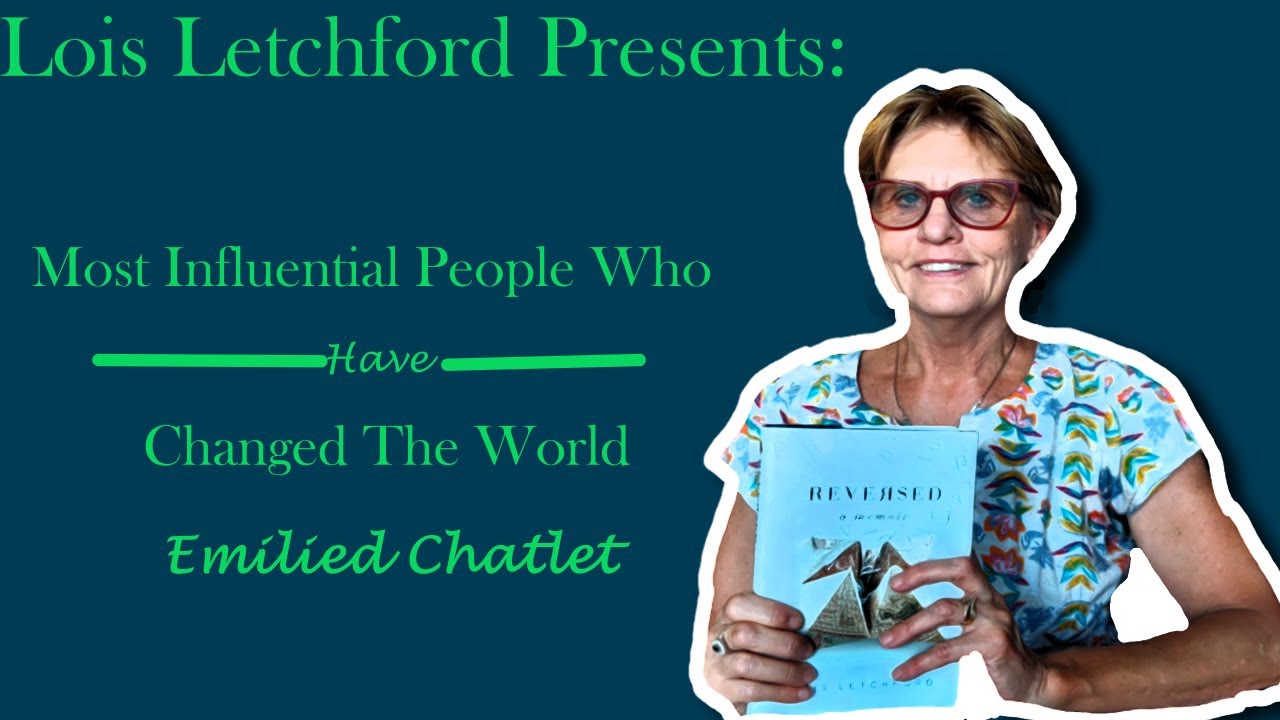
Lois Letchford traces the life of Émilie du Châtelet, an 18th-century French physicist whose work was forgotten for two centuries. She translated Newton's Principia Mathematica into French and wrote Institutions de Physique, introducing ideas about kinetic energy and conservation of energy. She died in 1749, shortly after giving birth to her fourth child.
Chapters
Hello, I'm Lois Letchford, author of the book Reversed: A Memoir, co-founder of Teaching Students with Dyslexia, reading about people who changed the world. Today I'm reading about a rare woman, Émile du Châtelet, born in 1706 and died in 1749. And this one shows the challenges women had and women face in doing scientific research. And it begins with, ignored for over 2 centuries, the brilliant scholar who defied her era's sexism and brought Newton's Principia to the French. For over 2 centuries, Émilie was treated as the merest footnote in the history of science. She translated Isaac Newton's mighty Principia Mathematica In 1687 into French. It's only relatively recently that they've come to appreciate that, as far as science was concerned, she was, as it were, the most important member of the partnership. De Chateau was born as Gabrielle. Um, it seems her father was eager to see his daughter excel in all areas of life because he brought in tutors for her in various, in various of the sciences and did not neglect her sporting and artistic talents. She grew up to be tall, beautiful, free-spirited, and a free-thinking woman. At 18, she gets married off. has children. In her mid-20s, with the support of her husband, she resumed her studies. And so that's what we need to know. She spent years in UK and she attended Isaac Newton's funeral. By the time he— they returned to France, they were convinced that Newton's work lay true science as opposed to some of the ideal championed by the French intelligentsia. In particular, there was a debate over what kept the planets moving in their courses around the sun. Newton explained this via his theory of universal gravitation. So that's what we're on about, and that's what she did. She had already written, uh, an essay And in 1737, for a scientific competition. And 1740, she produced her first book, the Institution of Physics Lessons in Physics, a summary of the latest ideas in the science with contributions of her own. She originally intended as an aid in teaching her teenage son, but soon realized It had wider applications. So. In the essay, they rebutted points of physics one by one, explaining in effect that a woman couldn't be expected to understand science. It's what happens, isn't it? Ah. We don't know who first had the idea of translating the Principalia, but it must have been obvious to both the husband and the wife that she was the one doing the job. She spent some years on the task, and in the later stages was working at breakneck speed, often 17 hours a day. What made matters even more difficult for her was that she was now pregnant with her 4th child. The reason she was working in such a frenzy was that she was uneasy about this pregnancy and was fretted that it might not survive. Her translation was an impressive feat. And more staggering was it was 300 pages of her commentary explaining Newton's ideas in a more digestible form, plus an appendix. In her commentary, she proposed the idea of the conservation of energy, exploring the notion that moving objects had energy, kinetic energy. She also garnered complimentary essays for some of the best scientists of the time, including the Swiss scientist Daniel Bernoulli. Then came tragedy. She managed to beat her deadline, gave birth to her daughter, but within a week she had died, and within less than 2 years the child had died also. Oddly enough, despite having been so influential in getting started on On this achievement. They didn't see it come to print. So there's worth to look out— work to look out for the year, and, you know, work to look out for and study and look up these people, share their achievements, because sometimes things get lost in history. But they were always prepared to challenge the thinking of the day. So hit like, hit subscribe, and share it with others. Thank you. Thank you.