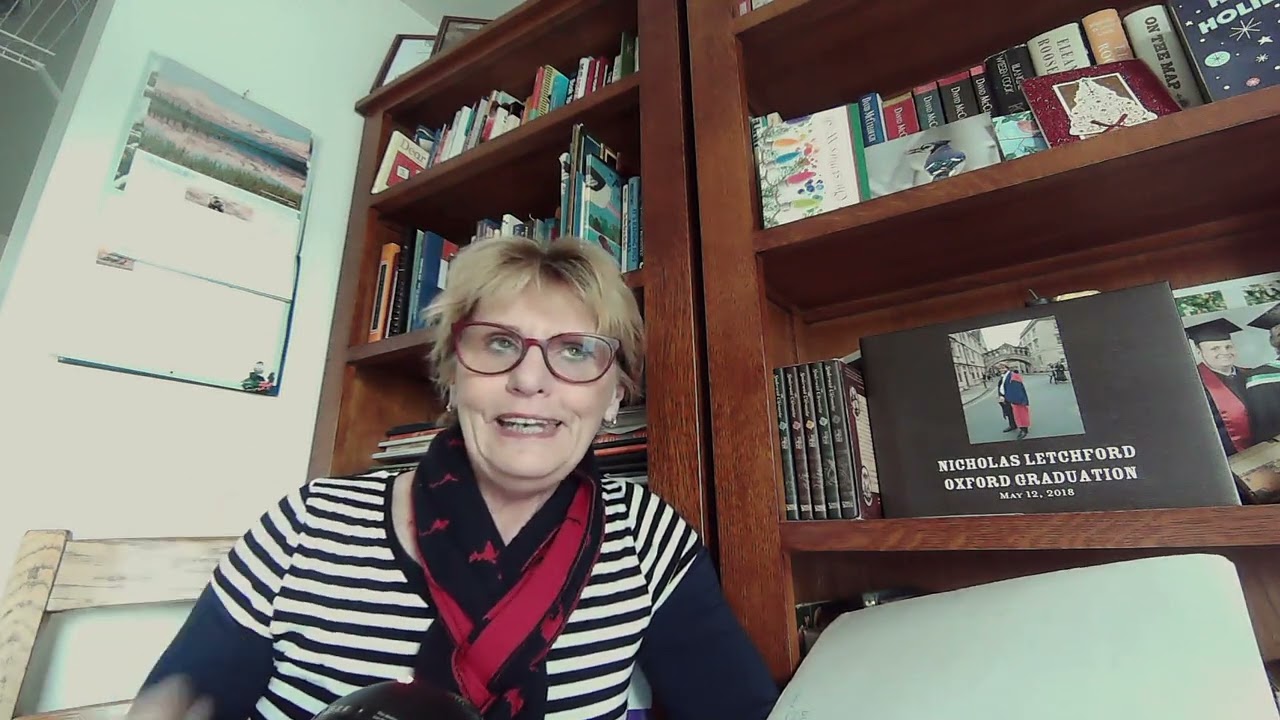
In this video, author and literacy advocate Lois Letchford recounts a recent three‑week trip to Egypt with her son Nicholas, who works remotely for the World Health Organization’s Eastern Mediterranean Regional Office. She connects the journey to Nicholas’s early struggles with literacy, describing how in 1995 she taught him using a poem titled “Hieroglyphics” that framed reading and writing within the context of ancient Egyptian symbols. Lois explains that this contextual, content‑based approach—using oral language, picture‑talk, and thematic content—served as a “nest” that supported the development of phonemic awareness and decoding skills. She uses the metaphor of birds building nests to illustrate how foundational literacy experiences must provide a supportive environment for growth. The narrative also touches on the logistical challenges of traveling during the Omicron wave, Nicholas’s current work as a mathematical modeler for COVID‑19 at the WHO, and an invitation for viewers to follow along with photos and further stories.
Chapters
Hello, I'm Lois Letchford, literacy problem solver and author of the book Reversed: A Memoir. Talking today about Egypt. I have actually just spent 3 weeks in Egypt. Why am I talking about a travel blog? Well, it still relates to literacy. My son Nicholas, picture of him up here, now works for For the WHO as a contractor, he still lives in Oxford. He works remotely for the Eastern Mediterranean Regional Office. He had meetings in Egypt, and he had a workshop in Aswan. And he asked my husband and I to join him, which we willingly did until halfway through November, when suddenly Omicron becomes rampant throughout the world. And we thought, "Uh oh, maybe we shouldn't go." checked the insurance details and it said fear of flying because of COVID or travelling because of COVID is not an excuse. So we went, we went and visited Nicholas in Egypt and it became almost a pilgrimage. As you know, Nicholas struggled with literacy and I taught him in 1995 in Oxford and it was a life-changing experience. For him and for me. And that's what I want to talk about, because in 1995 I wrote poems for Nicholas, and one of the poems I wrote was called Hieroglyphics, and it simply says, I've just been born too late, you know, by a few thousand years or so, when reading and writing was not so important and hieroglyphics were all the go. I have this little problem, for reading's hard for me. Hieroglyphics is what I like and should be used by people like me. And so Nicholas, right from that early age, had an interest in hieroglyphics, and what intrigued him was the thinking in pictures. And even at that time, he started to write a few sentences. In pictures, in hieroglyphics, just as they did ancient, those many years ago. And that set us on a path or had a conjoining path with other learning, but it was the content that was so critical at the time, the content of learning about Egypt. And you have to ask, Why? Whenever I look at literacy instruction and I see phonemic awareness and I see the decoding and all of that is involved in literacy, I see that and I see it being taught in isolation. When I taught Nicholas with his enormous deficit in language, we were teaching it in context. And this little poem, the poem allows us to Listen, to ask questions, and then to explore more of the world of hieroglyphics. And it takes you into the world of mummies, which Nicholas also loved. And this was one of the books that we picked up, and it was a brilliant book because it's all pop-out and it shows how things were done, and it gives you an idea of what's going on and these bits flip out and there's a lot of talking around pictures and the foundation of literacy is always the oral language. So one little poem, one little poem of I've Just Been Born Too Late brought us to a whole new world. To me it's It's like building a nest for birds. Birds build a nest so they can lay eggs. You don't lay an egg just in a tree because it needs— an egg needs conditions to help it grow. And that's what the nest is. And each bird lays its own, creates its own nest and lays its egg. And what I did with Nicholas was built the nest that allowed his egg to flourish. And it's the foundations of literacy, the decoding and the phonemic awareness, and all of those things are like the egg, but they need a bed. And that's what I did in Oxford in 1995, is we built The bed, we built the nest to allow him to flourish and to grow. It's an interesting analogy. I hope you like it because there's so much more to this story about Egypt and following our son as he became a mathematical modeler for coronavirus in the World Health Organization. Thank you. Hit like, hit subscribe, and I'll have lots of pictures to show you.