Reversed a Memoir - The Story Behind the Book Part 2: Oxford
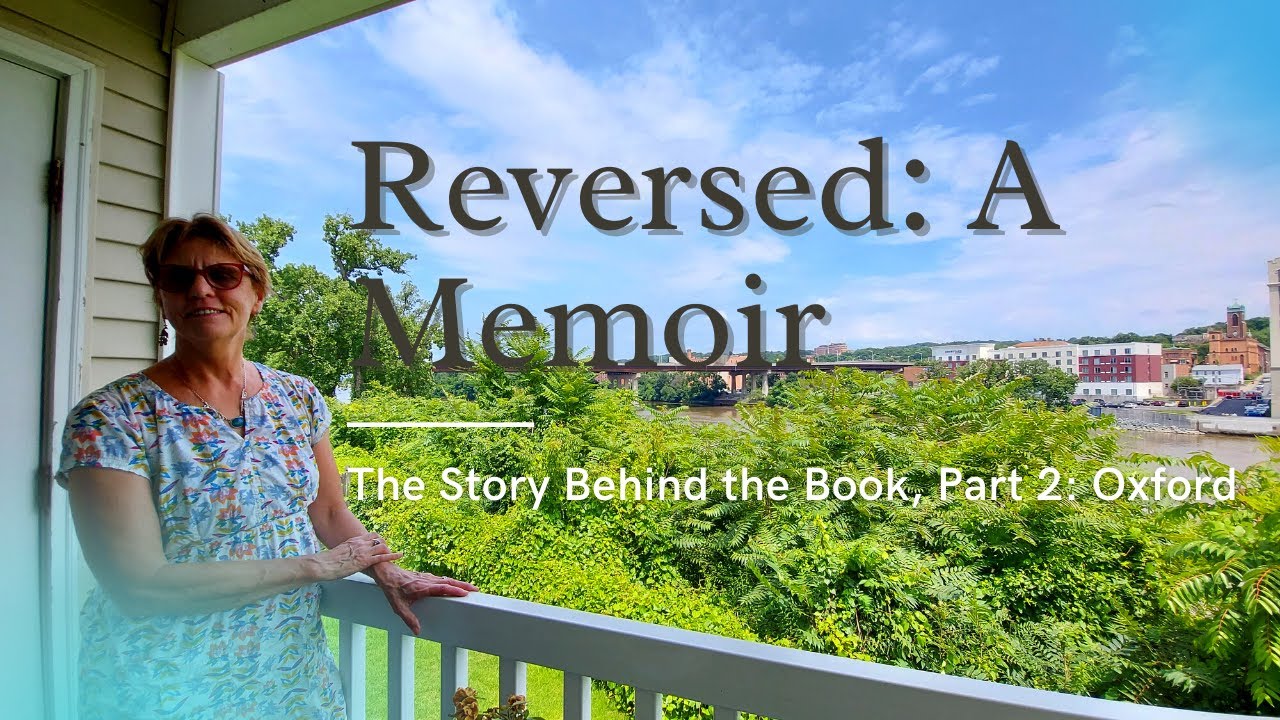
This content was created by Lois Letchford. This content was uploaded by Lois Letchford. This is a YouTube video titled "Reversed a Memoir - The Story Behind the Book Part 2: Oxford" (posted 2021-11-14) featuring Lois Letchford speaking in a first-person monologue about Part 2 of her memoir. She recounts a 1995 stay in Oxford, UK, describing her efforts to teach her son Nicholas to read: the failure of a commercial program, the breakthrough using short rhyming poems and multisensory/visual supports (maps, 3D pictures), focus on decoding (short vowels, consonant digraphs like ch/sh/th, and consonant blends), the practical strategies she used, emotional challenges, and the learning outcomes and long-term reflections. The piece is promotional of her book and literacy message.
Chapters
Hello, I'm Lois Letchford. I'm the author of the book Reverse to Memoir and a literacy problem solver, and sharing with you part 2 of my journey in this story, why it was written in 6 parts. Part 2. My husband is a professor, and in the second half of 1995, he has We were on study leave in a place called Oxford, England. Oxford, UK. In fact, my husband completed his PhD in Oxford and he was returning to his supervisor. Our eldest son was born there and now we were returning with our family for these 6 short months. When we arrived, the school holidays begin, or the school vacation, summer vacation begins for 6 weeks. I try and work with Nicholas occasionally when his brothers are home, and it was just a no-go. He just couldn't— didn't cooperate. So instead of now having 6 months, we're actually down to 4 months because the 6 weeks plus an odd week here and there getting the boys settled, it was just gone. Down to 4 months to teach Nicholas to read. And I had been prepared. I'd taken a series of books that someone had recommended to me that would be useful. Called Success for All, and they were a disaster. In fact, they made me cry. It makes me cry now. So what do you do? I can only go forward. But thankfully my mother-in-law was with me and she heard me getting frustrated. She heard me saying things that I should not have said to my son. And she said, Lois, put away what is not working and make learning fun. Now, her words were so important to me because I was in a deep hole. These books were supposed to work. The title said it— Success for All— and Nicholas couldn't do it. And when you're in a hole like that, it's really challenging. It was challenging for me to get out of it, and I didn't know what to do. And her words allowed me to stop, and they gave me permission to evaluate and think again. Throw away what's not working, she said, and make So now I'm in a position of what else can I do? There's no internet in 1995. Access to the libraries, as we were visitors, to even borrow books was complicated. It wasn't simple because you need an electricity bill and this and that and the other to show you are a resident there. I was very lucky. So that's not simple, although you can go to the library and use it. Taking books out is not easy. So I'm stuck in a new country with very few resources that I have access to. I know very few people there. We have old friends, but that's it, and they're much older than us and their children didn't have these sort of struggles. So where do you turn in a time like that? And there was no one I could actually turn to. So I'm left on my resources to say, do something. And I then started to think, what can he do? Well, I knew Nicholas could see patterns and rhyme words. They were his 2 strengths that he had. And here's me, I thought, what can I do with that? I can write a little rhyme. And for some reason the words bug and mug and lug and tug came to mind. I don't know why those, not cat and hat and rat and bat, because there's many more of them, but mug and bug. And we say in Australia, we say, what a mug. Fairly common saying. Not so much anywhere else in the world, but for Australians it's a common saying. So I wrote the simplest poem about a mug of a bug lugging his rug along the kitchen floor, and doesn't he know the rug will tuck the good things out the door? What struck me then, the moment I had that poem ready for Nicholas and put on the table, our lessons transformed. I did not ask Nicholas to read anything. I knew he couldn't read it, so I changed. I read the poems to him, and that— the writing and the reading too— transformed the atmosphere in the classroom before we got to anything else. Nicholas was no longer stressed about doing We had fun together. We had fun over this poem. And I still remember being at the end of our time of working together with this poem. We must have worked for an hour at least. I was exhausted from making sure Nicholas understood everything, that he got the rhyming words, that he found rhyming words. Did we create more rhyming words? But that he had fun, and then he went With his mother, my mother-in-law, with his grandmother to create the picture of a bug. He absolutely loved that bug and we, it was a 3D picture so there's wings, nothing moved but it's a picture and then you put stickers on for the dots and it was memorable. He had so much enjoyment From that one poem. It caused me to then, oh, if this worked, let's do another one that worked, and another, and another, another poem. And then one of the poems was about Will Bill Jill Hill. So we had a windmill on a hill, and the girl and the boy are picking flowers, and the flowers were now picking flowers on the windmill, by the windmill on the hill. And the flowers are on the windowsill. And so you've got a window and a sill. We then had to create a window, and we just had some clear plastic, and that was our window for the house. And Nicholas, in this day and age as an adult, remembers that creation. I didn't realise at the time that I was teaching for his Because he remembers these poems as adults. But I'm staying back in 1995, what it was like. He just enjoyed it. And then as every poem made an impact, the poetry started to expand. Because if it's working, it's working. And I had a pen and paper with me no matter what I was doing. And as I was going Going on the bus, I'd have rhyming words going in my head and writing them out and crossing them out and starting again and practicing until I got a rhyme that I thought was acceptable and fun. So I'm engaged in it as much as he is. And then the double O comes up, as in cook, look, and book, and I just thought we'd have some fun with this one. And I You know, cook, look, and book. You might be cooking using a book, but I thought of Captain James Cook, the last of the great explorers. That poem, Captain Cook had a notion, there's a gap in the map of the great big ocean. He took a look without the help of any book, hoping to find a quiet little nook. Took us on an unexpected exploration. Because as we're doing this and discussing Captain Cook, you know, in the book I say we went to a library. Well, I had to, you know, juggle some things that fitted in with our story and narrative very quickly. In reality, we went to the British Science Centre, the science centre in London. And we were given a tour. And we spent all day there. We started at the top of this place looking at all the old planes, and my husband loves all this stuff. And the very ending, we saw these globes of the world printed from 1550 onwards. That's my memory. There's a whole series of them. And as we're looking at this, I picked Nicholas up and said, look, Nicholas, there's a gap in the map. There's no Australia. And now, originally I just had words. Now we had a picture to go with these words and that was transformative. Because remember, at this time I am just a parent. I'm a mother who's trying to help my son and I'm going to do anything to help him learn and be— at least learn to read. And With finding that map, I realised the importance of needing the visuals to do everything. And that was transformative because when Nicholas said to me, can I see Captain Cook's original maps? That was his first question. I go, this is not the question of a child with a low IQ. And he had to ask me twice before I said, yes, I'm sure they'll be here somewhere. I don't know where they'll be, but we can try the British Museum. And I called the British Museum and they said yes, they were there, but we had to make an appointment to see them. And since Nicholas was under 10, we couldn't see the originals, but we can see photocopies of the originals. And that was, that was great, you know. So that was Brilliant for him, we could see these maps that Captain Cook actually drew. The journey that that took us on, the excitement, you know, there's in my mind and my feeling at the time, I remember there was this double-edged sword. Yes, Nicholas is asking these fantastic questions, but the decoding is at a level, at learning at a Snail's level. A total snail's pace. So I'm conflicted in what I'm seeing. But as we were in Oxford and this journey of mapping started to take off, my husband becomes part of it as well. And as we travel, we're looking for maps. We're looking at maps, and there were many map shops in Oxford at the time. And you can see them. We're looking at projections. And I bought a book, The Changing Map of the World, to give me more understanding of how our maps came about today and what steps had to be taken to get the map that we have today. And when you're coming with no knowledge, all of this was so exciting to me. But I couldn't just give Nicholas— read anything to Nicholas. When I did find a library, the Abingdon Library, the books were old, and if I read a paragraph to Nicholas, I lost him. I just lost him. He just would turn away. And that was really discouraging. But then what it made me do was get that information and turn that information into a poem. Now I had Nicholas back. The poems are rhyming, they're short, and as we walk to school to pick up his brothers, we're reciting them. And we would laugh and giggle because we could never remember the third line. And then so you're digging into your memory for, oh, what was this line? What was this poem about? So I wrote about Cook, I wrote about Columbus, I wrote about Ptolemy. And Nicholas loved planes, so we started to follow the journey of how planes were built, starting with the Wright brothers. Who came before them? What was their knowledge? Who came after them? And we found amazing information, all of which I put to Nicholas in the form of a poem. And then we would illustrate them or find pictures of something, because we had to have pictures. We couldn't go to the internet. Again. That was the exploration and the teaching of— really, Nicholas learned that he loved learning. A love of learning, just that, was unbelievable. And that to me was totally unexpected. And he just loved it and he just absorbed everything that I gave him and he could give it back to me in his own words. That was phenomenal that I could see that and really life-changing. Definitely life-changing. Because I'm seeing the power of poetry, me as a parent, I'm seeing the power of poetry. I'm seeing a change in Nicholas. I'm seeing that content while we teach decoding And you notice there are 2 pictures here. This is one from 2018, and these are our photographs from 1995. They're not particularly clear, but you can see it's the same bridge. And in the corner here is my mother-in-law and father-in-law and our family. And my mother-in-law had died on May 11th, 2018. And 18, the night before Nicholas graduated. But we're back in Oxford in 1995, finishing off the story. One person spoke to me from Isaac's kindergarten class, and she saw Nicholas standing with me, and she said, tell me about him. And I said, well, he's got a problem with reading, so we're not sending him to school. And she just said, I've got some books for you. Her books changed my life. I had originally bought Alpha to Omega, the book, the guide for teaching reading, linguistic approach, fantastic book. And the book this lady gave me was Hear It, See It, Day It, which was a fellow author of Bev Hornsby, showed the importance of teaching the consonant digraphs. Ch, sh, and th with short vowel only and the consonant blends. I have, you know, about 16 weeks left, 4 months. We spend 2 months learning ch, sh, th with short vowel only. We spend another 2 months learning consonant blends Short vowel only. It, to me, it gives an idea of the depth of Nicholas's struggles with hearing and understanding words, but also it gives an idea of what was required to be done to teach a child like him. I can't push him to learn any faster than he does. While we're learning about Captain Cook, I'm seeing his eye Ideas exploding. I'm seeing millimetre-pace learning as we deal with decoding, but he's learning it. He can recall it every day, and every day, although he's slow with it, it gets 1 second faster. I had multi-sensory approaches. We touched the words. I had word puzzles, so we're joining You know, the front of a word and the end, like rash. Rrrr ash, I put together, and b ash, so that then he would have to find one to the other. And he could do it. Over time he got better and better and better. He was never brilliant at it, but he could do it. He could read the word in isolation, then we'd put them in context, we'd make sentences and I'd again write poems with some of these words so that he was seeing it and hearing it in isolation and in context. Seeing the level of structure that was needed to deal with Nicholas was important for me. These sounds, the consonant blend sounds and the consonant digraphs, are really quite challenging for children to hear like this. The CH and the SH. They muddle them. So I had to really work on one sound first before we implemented the second. One sound and get it really solid in his brain and give it an action. Shh, shh, shh for the SH and ch, ch, ch was the train sound. So every time you're hearing it, you're doing something and distinguishing. Between those 2 sounds and never ever muddling them up. So there's a level of difficulty that he has that most children don't have that had to be addressed in a quiet room, in a quiet place with me and him. When my in-laws left to go back to Australia, I had Nicholas to myself 3 days a week. His younger brother was in school 3 days a week. I struggled to teach him on the other 2 days because there was too much noise, too much distraction. Any distraction was too much for Nicholas. So there's a level of support that he needed that often was not available in the classroom. So I was thrilled I had this opportunity to work with him, and as I said, it was transformative. For me and for him. And I have— I'm now talking, it's now 2021. We've had a lifetime since 1995. But as we left England in 1995, I had 2 feelings. I was over the moon that my son had learned so much in the content line. I was over the moon that he had mastered all of the short vowel sounds, that he had mastered the The consonant digraphs and the consonant blends and that he could read them. And we had just started on long vowel sounds. That part of all of our learning was unbelievable. I was concerned, enormously concerned about really the limited progress that he had made. I had wanted much, much more. I wanted him to be reading books and doing everything else. And he couldn't pick up a book and read it at this point in time. That was obvious to me, that he was still struggling at that level. But his learning and why we are learning were all now in place. And so that was— that's how the journey started. Working content was critical. Teaching of decoding was critical. But what else does he have to do? I felt I hadn't done enough. And a friend reminded me, she said, Lois, even in your book, you, you downplayed your panic and your fear. Because our friends were in Leeds and we visited them and I was often, you know, how's he going to get there? And I remember I said to her, Nicholas is so slow with learning. these things. And Nicholas overheard me and he wet his pants. Immediately he knew what I was talking about and he took it to heart and knew again he was failing. How I wish he had never heard that, how I wish I'd never shared it. But when your child is 7 years old, you don't know the future. You don't know what they can do or they can't do. All you can do is provide the best set of resources at the time, and that's what I did. With my limited knowledge, I provided him with a reason why we learn. I provided him with the foundations of sound-symbol correspondence. One letter, one sound. Two letters, one sound. Vowels. Can he consistently do it? I did that. And unknowingly, I taught me about the power of teaching the most vulnerable students. And I've read, I've done so much since then, so I get caught between what it was like then and what it's like now, the 20-something years plus. And it's taken me a long time to see the full implications of what we did during that year of 1992. So read the book, write a review, share it, hit like here on the YouTube channel, hit subscribe, because all of these things make a difference to getting our message out quite simply that we must teach children to read. This is a shorter one, but it's part 2 of Oxford UK. Thank you very much.
More from Lois


Overcoming Adversity: A Dyslexic Learner's Journey to Success | When Learning is Trauma #shorts

Redefining Success, Beyond Grades in Education | When Learning is Trauma #shorts

Turning Awareness into Action for Dyslexic Learners | When Learning is Trauma #shorts

Why Dyslexia Goes Unnoticed: A Systemic Issue | When Learning is Trauma #shorts

The Long-Term Impact of Unrecognized Dyslexia | When Learning is Trauma #shorts

The Heartbreaking Reality of School for Some Kids When Learning is Trauma #shorts



