When Learning is Trauma: Dr. Mary Helen Immordino Yang, Lois Letchford, & Lisa McCarty
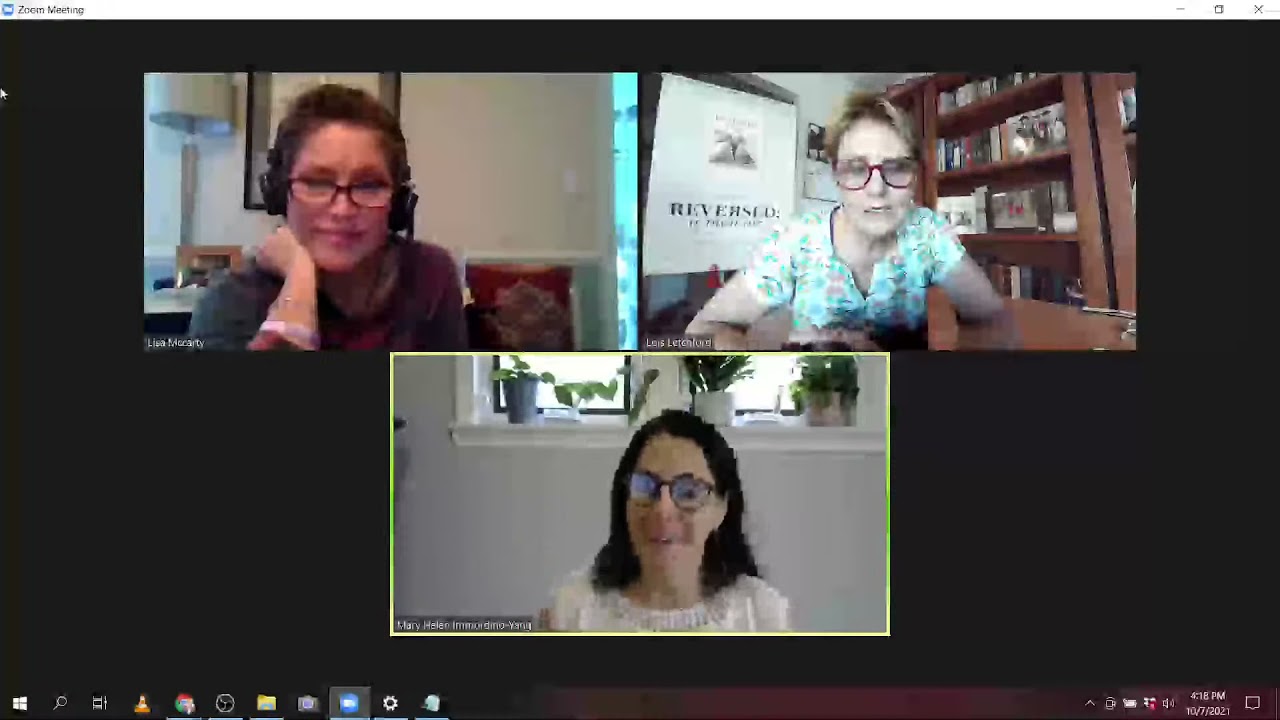
Dr. Mary Helen Immordino-Yang, a neuroscientist, explains why traditional outcome-focused schooling fails marginalized youth. Learning is fundamentally emotional and social engagement, not instruction. She argues teachers should facilitate self-actualization, curricula should be interdisciplinary, and the brain is plastic, shaped by cultural experience.
Chapters
Ah, we're live. Thank you and welcome to When Learning Is Trauma. I'm Lois Letchford, author of the book Reversed Memoir. Lisa is my co-host and she's a mental health nurse. And this, this morning— this afternoon, I am absolutely delighted to welcome Dr. Mary Helen Imwarden-Ouyang from California in the CANDLE research. I like that. Tell us about your work, please.
Yeah, thanks for having me. So I mean, I study the ways that young people make meaning out of their experiences and the ways that learning and self-development and sort of intellectual growth and social and emotional growth are really connected to each other in the mind and in the brain, and the ways that deep understanding and personal development can be supported in our schooling opportunities for youth, especially for youth from underprivileged circumstances, but really for all youth. And I study that in the brain, I study youth brain development, I talk to kids and understand the ways in which they experience things, try to learn from them about what it feels like to be them and how they make sense out of things, and then the ways that those dispositions for making sense, for experiencing, for engaging with curiosity, with complexness, with compassion, with, you know, sort of ethical deliberations and self-relevant deliberations, the ways that those processes that young people naturally engage in the world actually appear to causally grow their brains over time and in turn to support well-being and success and purpose in life and flourishing as young adults.
That's a lot.
Yeah, I should have said too, I also study teachers and how teachers can learn to support these processes and how really effective teachers, you know, especially in low socioeconomic status contexts and working with kids who are marginalized or who feel marginalized from their communities or from their schools, how teachers who are really effective in those environments at promoting youth engagement and self-development and self-actualization and deep understanding and belonging and culture in the school, how those teachers do it, you know, trying to kind of lift up the social and emotional and cognitive work that goes into effective teaching. Especially I focus on secondary teaching.
Yeah.
You know, teachers who work with adolescents, because I think that age group, you know, really we need major innovations in the way that we train and support teachers who work with adolescents. You know, many of them do amazing work, but it's not systematically supported, or— and they don't have opportunities to learn to do that kind of work in their training too often.
Yeah.
You know, if you know chemistry and you know how to manage a classroom, you're a chemistry teacher. But really, you need to know a whole lot about supporting young people's growth and development as chemists, right, and as people who do chemistry. And so trying to really shift the way we think about teacher professional development Also, and also the way that we think about supporting and honouring and training our secondary teachers.
And that, I mean, you're even talking about normal, within the normal range of students in a way, because we add the complexity of I've failed through school all the way.
So— Yeah, I mean, many of these Many of these youth in these schools do experience failure for various reasons throughout the system. So that's a major and pervasive problem. The dropout rates and the anxiety and the depression and, you know, sort of disconnectedness from school is a major problem in these schools. You know, actually across across demographic lines. It looks different in different kind of demographic settings, but no one's really thriving in mainstream education right now at the secondary level. And I think we need to really think about what kinds of experiences we want to design for our kids and what kinds of supports our teachers need to be able to engage, you know, kids in those experiences in a really genuine way and how we might re-envision the future of education around the developmental needs of the young people in the system first.
Yes, I think you said something really important there. I don't know how the school systems are in California, but I'm going to assume they're the same as they are in Pennsylvania, and it's very standardized. My 16-year-old just today found some TikTok thing that said how disappointing schools were, that, you know, kids want to learn, they're curious learners, and then they go to school and then we standardize everything, and a lot of the kids really don't fit into that mold. So I think it's important how you said it's like a system that needs to change, but how do we do that? That's one of the reasons we're doing all this work. But I'm fascinated to hear how you got interested in all this, if you don't mind sharing a little of your story.
I have a 16-year-old also who's in public high school and doing all kinds of things. Yeah, so how did I get into this? Well, I mean, I was not a kid who really enjoyed school as a child. I was, you know, a very thoughtful, socially engaged kid in my own way, looking back on it. I was running a farm, I was teaching horseback riding lessons to all the local kids, like on my little free pony that I had and took care of all myself, you know what I mean? I had lots of privileges, like to be able to have a pony like that and stuff. We lived in the middle of the woods in Connecticut, and we built the barn ourselves and did all that kind of thing. Power to my amazing parents. I only now really appreciate what they did. They were from Yonkers, New York, which is a very inner suburb— inner city neighborhood of New York City, and Detroit, Michigan, which again is not a— You know, we're really from a— from low SES neighborhoods, and yet, you know, in urban centers, and they decided to like let their kids have a farm and build barns and have ponies and stuff. So, I mean, we did all kinds of things when I was a kid, but when I went to school, I just remember feeling like I couldn't quite figure out the system, and I really couldn't be myself there. I really just felt very stifled. I couldn't have said it like that, but it really just became— increasingly oppressive. Like, you know, the feeling of relief on Friday afternoon and the feeling of dread on Sunday night throughout my elementary school and middle school years is kind of hard to express. And, you know, so I never really thought that I would go into teaching or anything like that. But I was actually— it's a long story— but I was super interested in carpentry and people, and I was really kind of an anthropologist, but I didn't know that. psychologist, human development anthropologist. So I went around the world as a young adult, just really spending time living in different places and mainly around boat-building communities. I was very interested in how people build traditional boats in Kenya, in Russia, in Ireland, and France, right, and in the US. And so, you know, I was really engaged with all of that. And then I, you know, you asked for the personal story, like this is how things happen. I also was very interested in developmental psychology. When I was an undergraduate in university, I double majored in French literature and— I didn't double major, what am I saying? I majored in French literature and I decided not to double major so that I would be able to study abroad, but I was very interested in psychology and considered doing a major in it, but then I thought, and I think rightly, this is a good decision, I can go back and study psychology anytime. I can't go live in Kenya anytime and do a 6-month or 8-month project there. I ended up going and and get credit for it. So I went back to psychology, kind of at night school and stuff like that, because I was very interested in the ways that children learn language, that culture shapes development, how people interact with one another, how we come to know things the way we know them. But I didn't really know how to bring this all together into some kind of field of study or something that I could really do with my life, so I was sort of had these 2 parallel tracks going, one with woodworking and stuff and boat building and learning how to do these traditional trades and try to learn from the people who were engaged in these trades on the one hand, and on the other hand, really interested in children and how they learn and how they interact and how those interactions shape the way we think and feel about the world and make sense out of the world. And I ended up— I was working as a carpenter apprentice And about a year into it, I ended up cutting my hand on a window at a job site where I was, you know, installing these really nice custom cabinets we had made. But anyway, there was a rotten window and it slipped and cut my hand and I had surgery on it and I had to not work for some months. And I thought, what am I going to do for myself? I was 23 years old and like, oh gosh, you know, my workers' comp is going to run out. Like, I need to figure out what I want to do with myself. And this is a nice opportunity actually to do something different. So I went back to my undergraduate experience and thought I had been very fascinated with all kinds of science. All through my undergrad, I did— like, I was constantly doing a year of every science, basically. I did a year of physics and a year of astronomy and a year of biology and physical anthropology and all these different sciences just because I was always just naturally extremely curious and interested in how to understand the, you know, kind of the natural world. It really fascinates me, humans being, you know, part of the natural world, I think. And so I went back and got all that and took it to the Board of Education in Massachusetts and basically said, you know, why don't you let me teach science for a couple of years and I'll work toward my teaching certification. There were schools in Boston suburbs that were, you know, there was one in particular that I kept seeing advertising for a science teacher that they just didn't have enough staff for these big schools. You can't do that. Yeah, that were, you know, being recredited and struggling and, you know, were really places that were trying to do good things but just didn't have the resources. And so I got them this big junior-senior high school which was a junior-senior high school, which means, you know, kids from about age 12 all the way up to 18, right, in one school instead of 2 schools, because the school for the younger grades had been closed down because there wasn't enough funding to maintain it.
Yeah.
So they put everybody together in one building, and all of a sudden they needed teachers and all this stuff. And I basically went to them and said, like, you know, let me, let me help teaching some of your advanced-level classes in biology and physics and things like that. So after a couple weeks, they finally thought they were desperate enough, they met with me. And I went, and when I got there that day, they said, you know, we have a 7th grade teacher— that's a teacher who teaches 13-year-olds, right— who's teaching mixed integrated science, right, who wants to move back up to teaching these advanced classes in high school. Would you be able to do full-time with 13-year-olds? And I was like, sure. They're like, are you sure you know what to do? I'm like, oh, I'll follow them around. I'll figure it out. So I got my provisional certification from the state basically by showing them all the science I had done. And I did really well with it in undergraduate. I got some of my undergraduate professors who were from a major university to like help me, give me curriculum materials and stuff. And then it turned out that on top of all that, I mean, these fortuitous opportunities are always really the thing, right? On top of all that, the school was about to lose its accreditation because Massachusetts had just shifted its state standards from sort of life science in 7th grade, you know, physical science in 8th grade, earth science in 9th grade, something like that, to they now wanted an integrated interdisciplinary science curriculum all the way across, all the way through the span of 6th, 7th to 12th grade. And the teachers who'd been teaching in these programs really were experts in one area and not across. But of course, here I came with like a year of university-level study, which, you know, gives you a pretty good basis. Yes.
Yes.
You know, for 7th grade level of thinking about something, right, across all these different sciences. So I got myself in charge of rewriting a curriculum for the whole district around this integrated interdisciplinary approach to science across the levels, and I worked with teachers from the higher grades and I did the lower grades and we all coordinated together and it was It was really fascinating to try to figure out how would we build a curriculum that really helps kids think like scientists and not divide their knowledge into biological things and physical things and Earth-related systems things and chemistry things, but actually build a curriculum where topics followed on each other in a natural progression where you were really kind of investigating the world in a systematic way. And it was really fun. And then the other thing that happened that I just never had imagined before this happened, is that when I got actually into the classroom and was working with these kids, it turned out that this school was among the most diverse schools, maybe the most diverse school in the eastern half of the United States at that time. It had like 81 languages spoken among 1,100 kids. There were refugees coming from all over the world basically landing in this district. Yeah. There were kids from Haiti, kids from Malaysia, kids from Rwanda, that was during the Rwandan genocide conflict, just after it. There were kids from Sarajevo and Kosovo, right? There were just kids coming from very, very different places, all kind of converging as immigrants into this school district. And I had all those kids together in my science classes, and it just became this absolutely amazing, fascinating experience to be thinking and working with those kids and trying to help them understand the science while also watching them struggle to try to grab at what they were experiencing in this new American context, including the context of my class and the tools and the questions and the curiosities that we were kind of putting out in that class to try to use that information to make a story out of what had happened to them, to try to understand the world. What's going on? What is genocide? Why do I look different than you, right? Why did I just move here and all of a sudden I'm freezing all the time and my skin looks so different from you? And like, I don't understand, like, where am I? Like, what is going on? And all of these kids were kind of, you know, grappling with these issues, identity issues, issues of narrative and story and positionality, at the same time as they were grappling with these complex scientific issues that I had just been learning about at university, which I was sharing with them. And it became this incredibly interesting couple of years for me, and from there I decided, you know, I think I found my—
Your niche.
my life's work. I really want to bring developmental psychology and education as a kind of applied problem space together to understand the ways that kids' social and emotional selves kind of show up to the learning process and what that would mean for the way that we would design schooling opportunities for young people and the ways that we would support adults in orchestrating those opportunities for young people. So So I went back to graduate school at Harvard to study that just for a master's level, and then as soon as I got in at the master's level, I was like, okay, I can't do this this fast. I gotta keep going. And so my professors were like, what are you doing? You should stay. Well, all right. So I kept on working and ended up getting further and further into this and trying to understand social and emotional and complex cognitive development and the way that they really go together. And, you know, realized also that as I was doing this work, you know, everything that we were seeing in the education realm, right, the behaviors we're seeing, the outputs we're seeing, the explanations kids are giving us, the things we're witnessing and observing, you know, I thought we're building theories about this, but it would be very useful to kind of constrain these theories in accordance with what we know about how culture and sociality and affect function in the brain and the body and how they're interrelated in shaping these, you know, kind of dispositions of mind and these developmental trajectories that kids are on. So I went to try to learn about the brain and neuroscience and social and affective neuroscience in particular, cultural neuroscience, and there really was very little known, very little known at that time.
Right.
You know, very, very basic things like we, you know, put a snake in your face and like we see your amygdala light up. I was like, you know, I'm hoping we could get some something a little more complex than that for thinking about these issues. That's a useful place to start, but— and so I went after I had this amazing opportunity to— really life-changing opportunity to become a postdoc with Antonio and Hannah DiMaggio, who were then moving to University of Southern California, and I was the first postdoc who came with them. They were really making a shift in their illustrious career. They had really been doing a lot of work around the biological basis for emotion and really, you know, you might even say launched the modern study of— the modern scientific and neuroscientific study of emotion. And they were very interested to begin to start thinking about what this means in a social space, what it means for culture, what it means for human creativity. In education. And so I went to train with them. I spent 2 and a half years intensively studying affective and social neuroscience and basically inventing with them new methods to begin to start to study these things. And now I bring these different worlds together. So the kind of social and affective brain science, cultural and anthropological perspectives, and human development and psychological perspectives. together in an education space to try to understand the kind of entirety, like in a whole dynamic system, how young people are growing themselves and how adults can facilitate and support those processes most effectively.
Yeah. I come from the literacy background. And when we do literacy, particularly for children who struggle, we do it for many, we say, this is what you're going to learn. We ignore culture. We ignore the child and we sit there with the book. And if they get it, it's fine. If they don't, well, we go and repeat that same process. And you talk a lot about culture and cultural background. Can you tell us more about cultural background and emotion?
Yeah, I mean, I think the thing to understand that, you know, that not just my science by any means, but like a whole field of science are now starting to really discover and explain is that, you know, the way the human brain develops, we don't have the genes to tell our brains fully how to develop and make a human, or even how to make a human body, right? Our— the legacy of our evolution is that we've kind of, you know, outsourced our development onto the— onto our cultural learning, onto the interactions we have, onto the opportunities we have to think together with other people.
Mm-hmm.
And this is like quite literally true. You know, when you look at— I've written about this in a brief for educators that I wrote with, co-authored with my student, Christina Klundrak, who was then Crone, and Linda Darling-Hammond, who's an educational policymaker, which is available from the Aspen Institute for free. If you just Google Aspen Institute, Immordino-Yang, brain, you'll pull this brief up. You can read the evidence. But, you know, What is becoming very clear is that we don't have an increasingly specified genome that says, here's how to do calculus, here's how to do reading, here's how to do— these things are highly unnatural to our brains. And yet they're hugely important and useful cultural tools for thinking, for expressing information, for analyzing problems. My daughter is texting me to say, hi, Mama.
Hi.
Sorry, I'm going to take a drink. She's in university. This is her first year away at university. Anyway, and where was I? So, you know, we don't have these incredibly specified genomes. What we have is a kind of relaxing, we think, of the genetic specification for our cognitive abilities. And what that means is that we're incredibly plastic and Mm-hmm. You put a human infant in social relationships, in a cultural world, and they naturally engage with the adults and the children around them, and with the world and the artifacts around them. And as they do that, they watch each other, they imitate, they learn from each other, and they build themselves into the human that is adapted to that setting. And so when you think about schooling in that, as a major societal effort, you know, to intervene in that developmental process, to shape that developmental process in service of certain kinds of skills which we culturally value, then it becomes really clear that the ways that young people build themselves are not by us giving them knowledge, it's by us orchestrating a context in which kids are invited to engage productively with these cultural ways of knowing and thinking in order to build them for themselves internally, to construct themselves as a thinker in this time and place.
Wow.
And so when we think about it that way, it really shifts the focus of our educational enterprise and makes it much more developmental and less about the learning outcomes, so to speak. The learning outcomes are really important, but you can't focus on them as what you're aiming for. You know, it's like a physician who focuses on, you know, lowering their patient's fever, right? Okay, yeah, you got to get the fever under control, but that doesn't tell you why they're sick, right? Or how to make them healthy and help them live so they don't get sick again, right?
Yes.
The process-oriented approach to developing young people will produce the learning outcomes at the end, or the, you young people with the propensities and dispositions to be able to go learn for themselves whatever they don't know yet that they need. But in the meantime, it's really a major shift in the way we think about the process of schooling, the goals and aims of schooling, and the ways in which we hold the adults in the system accountable for what happens to kids and what they experience in these settings.
We have a lot of work to do based on all of that.
We really do. I know it's totally the opposite. I want to crawl under a rock sometimes and just—
I'm glad you're doing this work because it's hugely important. I think too, like the word, the buzzword epigenetics now is getting a lot of attention and it isn't just—
Well, yeah, it's these epigenetic processes that are actually teaching the brain how to grow itself. It's kind of like the brain has potential and then it's waiting.
You need to—
it doesn't know how to grow until it sort of sees, well, what am I going to be doing?
Right.
I don't want to program myself to do that.
Right.
You know?
And it's not just encoded in that gene code.
It's definitely not.
It's coming from all these other areas. And I don't think we're real good at that right now in our current education system. Again, not to put every, you know, the education system down, but it really is a one-size-fits-all. And it is disappointing.
How about one-size-fits-nobody?
Yes, or that.
Maybe it's like that. You know, it's like the one-size hat. You know, you're like, well, you know, maybe if you had, Right, an adjustable hat, then I could wear a one-size hat, but you know, I mean, it's— yeah, I don't know.
Yeah, it is a shame.
Yeah, the aim of our current education system was, you know, it really was set up in a time and place that's very different than what young people need now to be able to be productive members of society, you know, and not everybody was meant to be able to do school 150 years ago. It was fine if you were dyslexic, well, this just isn't for you, go out and be a farmer or a tradesperson or something else. And that was a completely okay choice. But right now, that's not. You're really left out of the global conversation and the world's economy. You're really deprived of opportunities to agentically steer your own future if you don't do this thing that we've designed called school, which really needs— we really need to rethink seriously what that experience is like.
And I work with a lot of people who have enormous amounts of anxiety and depression And a disproportionate number of these folks did struggle in school. And a lot of people will say to me that school didn't mean anything to me. There was nothing there for me. And that's— how do you reach somebody who's not fitting in that? And I don't think it's an easy thing to do. I loved how one of your papers, and you were describing, we used to think that learning and emotion— like learning is basically more important than emotion. And I think you said emotion was like the child in a china shop just banging around and messing and stuff up, but where now we think it's really the glass shelves that learning is sitting on, that it is the base. I thought that was brilliant. I'm sorry, maybe—
Thanks. I'm glad you like it. That's a 2007 paper. That was the first time I wrote it as a postdoc with Demasio. That's me trying to get my head around why the heck am I doing this work.
Well, it spoke to me because it makes sense. And I think there's a lot of research now in just trying to figure out new brain cell development and there's BDNF and all this stuff and how you can grow new cells in the hippocampus, which is mostly known for memory and learning, and it's closely related to the amygdala, which is mostly associated with emotion, and how does that all tie in with our executive functioning. And there's no brain area that works in isolation to itself.
Right.
So you're not just learning these— like, they want the kids to learn the facts and the figures and, and some things.
But why? Like, what are you going to use those for? You can find them on Google. You know, I'm not saying you don't need to learn them, but you need to figure out what are we using these for? You know, what are the dispositions of mind that we want our young people to bring to problem solving, and how do these tools enable them to develop those dispositions? Because the things that we're having kids memorize now, right, are going to— they're going to be irrelevant later. Of course they are. The point is not what do you know, it's how do you think, right?
I love them.
What kind of thinker are you? And not even what kind of learner, because what kind of learner to me gets really trite. It's about like, how do I tackle what somebody else gave me and then recall it, you know, long-term? It's more than that. It's like, what dispositions of mind do you bring to the world as a thinker? What kind of scholarly identity? What kind of engagement with complex ideas and issues? How do you notice things, right, and try to parse and make sense of them? And that's what we really need to develop in our young people if we want to have a society that's flourishing over time, that's innovative, that's sustainable, that's socially just, right? These kinds of societies don't— they rely deeply on the dispositions of mind and heart of the people in them. And, you know, it's kind of like I sometimes talk about it as like if we wanted to get a bunch of kids to to win a soccer tournament, right, or a football tournament, like whatever you call it where you are in the world. You know, it's like, you know, we felt like, okay, well, they need strong leg muscles and they need, you know, they need all these things. So you get a bunch of like weightlifting equipment and you have them all do their reps until they're strong, and then you send them out on the field and like they lose the game, right? It's like we do that with kids. We build up all these muscles, but we never let them play the game. They never actually become citizens. They never engage in community-oriented kinds of culture-building activities, they never learn to engage with complex social and topical and disciplinary issues, I mean disciplinary, I mean like mathematical, historical, scientific, political, literature-oriented arts, how do they learn to engage with complex issues and what sort of capacities do they bring to that process? Somebody can't— you can't give somebody those, right? You can't memorize all the rules of the soccer game and then strengthen your leg muscles on a machine and then go out there and win the tournament.
And play.
You have to actually learn by doing and learn by engaging and by making mistakes and by moving through it in your own time and way. And we really don't have a tolerance for that in our education systems too often.
And particularly, you know, that's a brilliant example with literacy because that's exactly what we're doing and saying we've only got a little—
Yeah, yeah, yeah. And let me just be clear, it's not that a weightlifting machine isn't useful. If your left leg is consistently too weak for your right leg and you're great, then doing the weights on it might help you, but in the service of some other aim. You're kind of— and that's like the reading instruction, like, I'm going to help you with your phonological decoding because you Dyslexia, right? Let's pull you out and work on that, but then get back in and engage. We're not going to interfere with your ability to engage with complex, developmentally appropriate content and thinking just because you can't phonologically decode, right? Any more than we're going to keep you from playing the soccer game until your left leg's stronger. Get out there and play, but yet we're also going to build on some extra supports for you, right? We really need to think much more dynamically about letting kids move in and out of these context like that and actually make schools the real thing. You know, the quote that always kills me is it's like school is preparation for life, right? People say like, well, in the real world this won't happen. You know, the thing is, it's like when you're 15, school is your real world, right? Yes. Why are we always preparing kids for something that they've never been at yet, right? It's like believing when you play the game of soccer, there's going to be another team on the field. Well, why don't you just get out there and play and you'll find that out really We've got some questions.
The first one is, what do you think teachers can learn from hearing about a student's traumatic experience with learning, both in school and at home?
Well, you know, I think one of the questions I ask teachers when I'm working with teachers around, you know, these issues is, you know, stop and ask yourself, I tell them, like, you don't have to tell me, stop and ask yourself, Go down your roster, you know, for every kid in that room, can you describe something that that kid does better than you or knows better than you do?
Right?
You know, that's just kind of a sort of a starting point. Like, engage with kids as competent humans who bring things to the mix, right?
Mm-hmm.
You know, that's the first thing. And then if some of that is knowing something about a child's past or their traumas, right, that's up to the child to share that. You know, what we really want to do is support all young people in, you know, feeling safe and supported and belonging and that they are enough, right, that they are a good and valid and, you know, like, you know, full-person member of this school community, and that what they bring to the school community we value, and that we're supporting you in exploring your own potential, and we're supporting and, you know, caring for you, and, you know, kind of steering you and providing you opportunities and feedback that would, we hope, be helpful as you grow yourself through these opportunities. And like when we think about the teacher's role that way, it first of all takes a lot of pressure off teachers to have to manage every kid. Like, it's not your problem, it's the kid's life.
Yeah.
Right?
But your job as the teacher is to know every kid very well, is to be engaging with that child as a human who's growing themselves, and to try to facilitate in a beneficial direction that growth, right? To make it possible for— and make those resources available to that child. And that might mean That the kid needs special kinds of supports to be able to access print, be able to access visual things if they're blind, or whatever it is. Those are extreme examples, right? But so it, you know, it's really this notion of kind of engaging with each child as a human and facilitating them to grow themselves.
Wow.
And to feel well enough to really be courageous and engage complex ideas that push themselves. And that's what a teacher's role is. And to be able to do that, you really, really have to love the children you're working with. You really have to know them well. And you really, really have to understand what complex, high-level thinking looks like in the domain in which you're engaging them. And then you engage with them like junior colleagues. You know, my colleague David Perkins at Harvard Grad School of Education talks about the junior version, right, of—
Yes.
of science, of history and stuff. And, you know, that's really like what it is. You're really engaging them as a historian, but, you know, but at a level that a 6th grader can get their head around and manage.
Yeah.
Rather than telling them about the history or the science that somebody else already did, you know, which tells you something and is useful to know, but does not teach you how to be a scientist or sets you up to be a scientist.
Perfect. I wanna go on and on and on, but I'm really aware of your time and our time.
Yeah, I'm sorry.
And I thank you. It's all this work taking back a lot of time. That's all I'm saying.
One last question. What do you think parents can learn from this? I think you've answered that. Many students repress their feelings, thus affecting their learning experience and their wellbeing. Have you got a comment on that? And then we'll let you go.
I mean, as a parent, I mean, I'm a parent too, right? I have 2 children who are now pretty big, right? But, you know, I mean, I think again your role as a parent and your role as a teacher are really kind of shadows of each other. I think of teachers as kind of specialized parents.
Yes.
And I know a lot of teachers get offended by that, but I do. They're, you know, they're— you're a chemistry parent. Your job is to parent these children into feeling and thinking like chemists or like literature, you know, writers or like journalists or like artists or whatever it is, you know, historians, physicists, okay, it is a kind of developmental exercise. It's not just about imparting nuggets of knowledge that you then ingest and recall, right? So that's the first thing, and I think in parenting your job is really to kind of obviously wrap around and be the shepherd of that child as they engage with the world on their own terms and move through They're building themselves in developmental directions, right? And your job is to help them manage the aspects of that process that they're not yet developmentally able to manage on their own, and then to step back when they can. And that's a very dynamic support, right? You know, sometimes kids can do things that other days they can't do, you know what I mean? Like, you know, if your pet cat just died, right, then like you're not the same as you were yesterday when your cat was alive, and you might need So skills are dynamic. They're not fixed. They're not— they don't move up like a ladder. They move more like a, you know, like an upward trend over time, but they dynamically cycle. And we're all like that because we're all humans. And then I think as a parent, just really, the trick is to be deeply engaged with your child, to know your child, and continually relearn who your child is as they develop over time. Without micromanaging the pieces that aren't yours to own, right? Without controlling them. You can't control people, and you shouldn't want to, because when you control people, what you're doing is ceding the developmental opportunity for them to learn to manage themselves in a particular context in favor of just achieving the outcome, which is you're quiet, you're behaving how I want, or whatever it is. Right now, but without them actually learning, you know, developing within themselves the capacities to engage in that kind of regulation, that kind of thinking, that kind of behavior. So as a parent, your job is really to kind of, you know, keep your child safe, keep your child moving in directions that will facilitate advantageous opportunities for them to grow themselves in directions that you think are good for them, and that will And that, you know, they're telling you they are suitable to, right? And co-creating those with your child while sort of managing the pieces that the child isn't big enough to really understand yet or to have any kind of leverage with yet or to be able to hold together for themselves. That's what parenting is.
Yeah. You know, this whole session with you, I'm privileged that you even talked to us.
Yeah, it was my pleasure. It was fun.
But, you know, learning and trauma should never go together. And just thank you for being with us. We'll let you go and then finish it off.
Thank you for joining us. Thanks so much for the work that you do. Yeah.
Thank you. Bye. And Dr. Mary Helen's work is available if you Google her name. She's on— she's done TEDx talks watched by millions. You know, if you put it into Google, there are the links in the description. Find out about all that she does because her work is phenomenal and has incredible Incredible implications. And you can go, so we'll finish off. There's a few more things to say. Bye-bye.
Thank you.
Oh, I'll tell her. You can find Mary Hennell by Googling her name, and she's on the— her website is in the show notes. And, phew, that was great. I knew she has incredible knowledge on the power of emotions and learning. And when we're in traumatic states, we don't learn.
That's—
so please hit the like, hit the subscribe button, hit the bell for notifications, share the channel with your friends and family so it can grow. Well, we're talking about dyslexia, hearing stories about it. You can find me on Twitter and Facebook, LinkedIn, Instagram. Lisa, and I'll come back and do the rest. Lisa, where can we find you?
Well, mostly Facebook. I guess, uh, Instagram when I get on it, and YouTube.
Social media is a challenge. And I am the author of the book Reversed: A Memoir. Uh, you find my book on Amazon. Read it, write a review please, I love it. I have a reading writing program and demonstrations on my website. And I have to thank Chris and Isaac for all their technical support because without them this show would not go on. Next week we are talking to Darren Clark from the UK. Darren Clark failed his way through school with incredible implications and he was diagnosed with dyslexia at the age of 36. He now works with British Dyslexia Association as an advocate for teaching children to read and teaching dyslexic children to read. And I hope today we got across the message, the importance of engaging children emotionally as well as teaching them to do everything else that we need to do. Lisa, have you got any final thoughts? It was a lot.
I was really glad to have her come on here. It really gave us a lot to think about. A lot of things we already know, but this is just one of the questions I wanted to ask, but I knew I wouldn't have time because she had to go, was how is she going to fix all of this?
We can ask her that. We can ask her that, you know, because her work is research-based. You know, she does brain scans, she does all sorts of things, and that too is available on the internet, free downloads. I, I came across her work through typing in emotions and learning.
Yeah, yeah, and it is very much, um, related, interrelated.
Yes.
You can't have one without the other. So there's so many different things to this. That was, that was great to have her.
Oh, incredibly privileged. So anyway, so thank you. So we're back on Monday next week talking to Darren. Thank you again. Hit like, hit subscribe, and share it. Thanks, Lisa.
See you, Lois. See you, everyone.
Bye.
I did say that.
Not done.
No, I did say that.
Excuse me.
More from Lois


Overcoming Adversity: A Dyslexic Learner's Journey to Success | When Learning is Trauma #shorts

Redefining Success, Beyond Grades in Education | When Learning is Trauma #shorts

Turning Awareness into Action for Dyslexic Learners | When Learning is Trauma #shorts

Why Dyslexia Goes Unnoticed: A Systemic Issue | When Learning is Trauma #shorts

The Long-Term Impact of Unrecognized Dyslexia | When Learning is Trauma #shorts

The Heartbreaking Reality of School for Some Kids When Learning is Trauma #shorts



